- 456 pages
- English
- ePUB (mobile friendly)
- Available on iOS & Android
eBook - ePub
About this book
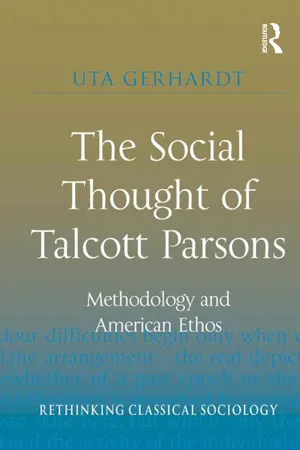
The Social Thought of Talcott Parsons offers an insightful new reading of the work of Talcott Parsons, keeping in view at once the important influences of Max Weber on his sociology and the central place occupied by methodology - which enables us to better understand the relationship between American and European social theory. Revealing American democracy and its nemesis, National Socialism in Germany as the basis of his theory of society, this book explores the debates in which Parsons was engaged throughout his life, with the Frankfurt School, C. Wright Mills and the young radicals among the "disobedient" student generation, as well as economism and utilitarianism in social theory; the opponents that Parsons confronted in the interests of humanism. In addition to revisiting Parsons' extensive oeuvre, Uta Gerhardt takes up themes in current research and theory - including social inequality, civic culture, and globalization - offering a fascinating demonstration of what the conceptual approaches of Parsons can accomplish today. Revealing methodology and the American ethos to be the cornerstones of Parsons' social thought, this book will appeal not only to those with interests in classical sociology - and who wish to fully understand what this 'classic' has to offer - but also to those who wish to make sociology answer to the problems of the society of the present.
Information
Themes
Chapter 1
Positioning the Parsons Project
In volume IV of Theoretical Logic in Sociology, The Modern Reconstruction of Classical Thought: Talcott Parsons, published in 1983 and influential until today, Jeffrey Alexander honored Parsons as a classic whose work he respected, but could not help rejecting his accomplishments.1
Alexander charged Parsons with a two-fold methodological error: mistaking formalized social theory for empirical reality,2 and also embracing neopositivism through the systems approach with its four-cell action schemas,3 was methodologically erroneous.
Also, supposedly a two-fold presuppositional error needed mention. In his early work Parsons apparently endorsed idealism as he shunned from a multidimensional model that would have been viable empirically,4 and in his late oeuvre allegedly perceived the social (societal) community unduly harmonious when empirical evidence showed how highly ambivalent cultural structures are.5
More than 25 years later, Alexander still targets Parsons for presumed idealism.6 In 2002, in his presentation at the Russell Sage Foundation Conference commemorating the centenary of Parsons’s birth, Alexander specifies for the societal community “The Promise and Disappointment of Parsons’s Concept,”7 considering “the dialectics of modernity.”8 Parsons should have exposed the contradictory rather than consensual forces, Alexander charges:
To reconstruct a more satisfactory theory of the societal community, one would have to look closely at how processes of anti-universalism, which have often led to destruction rather than progress, were (and are) built into the processes and definitions of modernity itself. … If the endemic and dangerous persistence of particularism and exclusion is theorized, then one must dispense with the utopian idea that value consensus will produce social integration, much less justice.
To disagree with Alexander as he lectures Parsons for utopianism, means to raise doubts in defense of Parsons. Alexander seems to adopt the criticism voiced since the 1950s. However, Parsons’s merits have been rediscovered gradually since the 1980s.
The new beginnings took a decade. It became obvious from authentic sources that Parsons had conceptualized the economy as he analyzed society,9 had focused on modernity,10 and had analyzed National Socialism.11 No longer could Alvin Gouldner’s 1970 strictures hold sway, which had made the Harvard department responsible for The Coming Crisis of Western Sociology.12 No longer was the urge felt as in the 1970s, to “de-Parsonize Weber,”13 but rather the need arose to reestablish the Weberian Parsons.14
Vigorous debate in the last two decades has yielded criticism15 but also praise, the latter sometimes fraught with pedagogic effort.16
Nevertheless, things have improved considerably over the last decade. The 2005 special issue of the Journal of Classical Sociology has no unduly critical overtones,17 and the American Journal of Economics and Sociology of 2006 stages a comeback for Parsons the economist, acknowledging that he emphasized the social aspects of the economy.18 At any rate, no longer is he judged an ardent supporter of the capitalist nation-state,19 neither is he said to have chosen his intellectual predecessors on the grounds that he wished to promote his career at Harvard.20
In 2007, Craig Calhoun, President of the Social Science Research Council since 1999, on behalf of the American Sociological Association, edited an authoritative history entitled Sociology in America.21 This book has not taken notice of Parsons as the icon of American social thought, however. Some authors in this collection see him even following in the footsteps of Herbert Spencer, the theorist whose work he declared “dead” in The Structure of Social Action,22 merely because, on the occasion of the re-edition of Spencers The Study of Sociology in 1961,23 Parsons wrote an introduction to that book. The charge is that he returned to Spencer in the 1960s with no apparent apprehension.24
Others in Sociology in America claim that Parsons returned to positivism in the 1950s.25 Calhoun criticizes such endeavor: “Parsons’ functionalist theory would by the 1960s provide one of the dominant images of a disciplinary mainstream (in all senses of the term disciplinary),”26 when he endorses the criticism of C. Wright Mills who, in The Sociological Imagination in 1959, had “satirized” Parsons’s functionalism as “grand theory” behind which allegedly lurked a “lack of critical attention to public problems.” Calhoun applauds Mills: “In a range of books through the 1950s he had pursued intellectual analyses that could also reach broad publics, with Power Elite most prominent.”27
My interpretation makes a fresh start. This chapter places Parsons in the middle of modern theory. My first theme is “The Quest for Methodology” that puts him into the historical perspective of the cultural sciences, for one, and looks at “The Politics of Theory” in defense of democracy. My second theme is that he entered into and was targeted by fierce controversy, sketched in the section “The Torment of Debate.” My third theme is the legacy of his approach, 30 years after his death, for sociology today, carrying the torch of Weber, in the section “The Imprint of Time.”
The Quest for Methodology
Spencerian Positivism and Its Enemy, German Philosophy
Unquestionably, Spencer did not invent positivism, neither did he coin the name sociology. Both, to be sure, were accomplishments of Auguste Comte, the self-taught apostle of social thought who proposed that society be planned under the maxime, savoir pour prévoir, prévoir pour règler. Obviously, the Comtean analysis lacked any semblance to what Max Weber was to call “value freedom:” Comte had no use for the distinction between Sociological Inquiry, on the one hand, and social engineering, on the other.
Spencer’s earliest treatise, entitled Social Statics: Or The Conditions Essential to Human Happiness Specified, and the First of Them Developed, first appeared in 1851.28 The book was a treatise in moral philosophy, intent on proving that the governing principle of social life was human nature expressed in faculties on which depended the advance of civilization. This principle, Spencer stated, underlay the “laws of social existence,”29 the most important of which was what he called “the law of equal freedom.” This law entailed that human happiness was greatest when and if individuals acted in conjunction with the conditions of society that were most congenial to the perfection of humankind. On that note, the principle of society was, he asserted, “the law of the perfect man—the law in obedience to which perfection consists.”30 Social statics, the structure that fitted progress best, guaranteed that everybody be free to “exercise his faculties”31 to the full. Otherwise, one would be punished through, notably, falling into poverty or suffering from physical or mental deficiencies. Therefore, the more imperfect men were being allowed to exist, Spencer opined, the more the continuous improvement of civilization was being threatened. As to individuals, inferior social status or any other stigmatized condition was punishment in Spencer’s eyes, due to the person’s failure to use his faculties to the full:
Now if God wills man’s happiness, and man’s happiness can be obtained only by the exercise of his faculties, then God wills that man should exercise his faculties; that is, it is man’s duty to exercise his faculties; for duty means fulfilment of the Divine will. That it is man’s duty to exercise his faculties is further proved by the fact, that what we call punishment attaches to the neglect of that exercise.
Progress, in particular, came through the law of equal freedom. This was evident because the most prosperous societies were also the most advanced culturally, Spencer maintained. The dynamics of evolution meant perfection, that is, those nearer perfection were also the more civilized races or classes. They had every right to defend their prerogatives against those less civilized or privileged. From this understanding of history as guarantor of progress, Spencer condemned the poorlaws as well as general education. These modern institutions presumably posed undue constraints upon the most successful (who were also the most civilized) in societies where the government made the rich pay for the welfare of the less affluent. The modern welfare state was seen to hinder rather than facilitate progress toward the perfection and the utmost happiness of humankind, respectively.32
This was the philosophical doctrine for which Spencer claimed objectivity as moral thought. He maintained that he looked at the facts and could thereby arrive at substantiated insights. What, then, were these facts? They lay, he suggested, in evolution as it entailed progress toward the best possible purpose of history, the perfection of mankind. However, if mankind did not learn the lessons of history, he warned, suffering would continue to take its toll in the world. He explained that the primordial heritage had to be honored by mankind. This meant that the present unsatisfactory state of facts would not change unless the most cultivated enjoyed the fullest liberty, and the less cultivated or less able would die early and, if possible, childless:
[T]he manifold evils which have filled the world for these thousands of years— the murders, enslavings, and robberies—the tyrannies of rulers, the oppressions of class, the persecutions of sect and party, the multiform embodiments of selfishness in unjust laws, barbarous customs, dishonest dealings, exclusive manners, and the like—are simply instances of the disastrous working of this original and once needful constitution, now that mankind have grown into conditions for which it is not fitted – are nothing but symptoms of the suffering attendant upon the adaptation of humanity to its new circumstances.33
The justification for these assumptions, for Spencer, lay in historical determinism:
Derived, therefore, as it is, directly from the Divine will, and underlying as it does the right organization of society, the law of equal freedom is of higher authority than all other laws. The creative purpose demands that everything shall be subordinated to it. Institutions and social forms m...
Table of contents
- Cover Page
- Half Title Page
- Title Page
- Copyright Page
- Table of Contents
- Dedication
- Preface
- Part I Themes
- 1 Positioning the Parsons Project
- Part II Tenets
- Part III Dialogs
- Part IV Positions
- Epilogue
- Bibliography
- Name Index
- Subject Index
Trusted by 375,005 students
Access to over 1.5 million titles for a fair monthly price.
Study more efficiently using our study tools.
Frequently asked questions
Yes, you can cancel anytime from the Subscription tab in your account settings on the Perlego website. Your subscription will stay active until the end of your current billing period. Learn how to cancel your subscription
No, books cannot be downloaded as external files, such as PDFs, for use outside of Perlego. However, you can download books within the Perlego app for offline reading on mobile or tablet. Learn how to download books offline
Perlego offers two plans: Essential and Complete
- Essential is ideal for learners and professionals who enjoy exploring a wide range of subjects. Access the Essential Library with 800,000+ trusted titles and best-sellers across business, personal growth, and the humanities. Includes unlimited reading time and Standard Read Aloud voice.
- Complete: Perfect for advanced learners and researchers needing full, unrestricted access. Unlock 1.5M+ books across hundreds of subjects, including academic and specialized titles. The Complete Plan also includes advanced features like Premium Read Aloud and Research Assistant.
We are an online textbook subscription service, where you can get access to an entire online library for less than the price of a single book per month. With over 1.5 million books across 990+ topics, we’ve got you covered! Learn about our mission
Look out for the read-aloud symbol on your next book to see if you can listen to it. The read-aloud tool reads text aloud for you, highlighting the text as it is being read. You can pause it, speed it up and slow it down. Learn more about Read Aloud
Yes! You can use the Perlego app on both iOS and Android devices to read anytime, anywhere — even offline. Perfect for commutes or when you’re on the go.
Please note we cannot support devices running on iOS 13 and Android 7 or earlier. Learn more about using the app
Please note we cannot support devices running on iOS 13 and Android 7 or earlier. Learn more about using the app
Yes, you can access The Social Thought of Talcott Parsons by Uta Gerhardt in PDF and/or ePUB format, as well as other popular books in Social Sciences & Sociology. We have over 1.5 million books available in our catalogue for you to explore.