Yoshida addresses the common misconceptions of single, never-married women and aims to uncover the major social and cultural factors contributing to this phenomenon in Japan. Based on interviews with married and never-married women aged 25-46, she argues that the increasing rate of female singlehood is largely due to structural barriers and a culture that has failed to keep up with economic changes.
Here is an academic book that is also reader-friendly to the general audience, it presents evidence from the interview transcripts in rich detail as well as insightful analysis. Important sociological concepts and theories are also briefly explained to guide student readers in making connections. Thus, this book not only serves to enlighten readers on current issues in Japan – it also provides sociological perspectives on contemporary gender inequality.
I was learning new things at the job I got after graduating from college, and the job was getting kind of interesting. … I had a boyfriend from college but it didn’t lead to marriage. … There were many other single women around, so I didn’t feel much pressure [to marry]. I was kind of relaxed, not thinking much, and then found myself getting here [i.e., remaining single].
(Tsuneko,1 43 years old, never married, marketing consultant)
On June 18, 2014, Tokyo Assemblywoman Ayaka Shiomura, from a minority party, was making a speech at an Assembly meeting. She was requesting more governmental support for women in the areas of childrearing and infertility when she was interrupted by heckling. Multiple men of the leading conservative Liberal Democratic Party shouted: “You should get married soon!”; “Can’t you bear children?” Loud laughter followed. Assemblywoman Shiomura, a former TV personality and bikini model, was never married and had no children, and was just a few weeks shy of turning 36. Barely collecting herself, she completed the speech with tears and a shaking voice.2 Publicly humiliating women for their single status, as observed in this incident, is hardly uncommon in Japan.3 Shiomura later complained in one interview to the press that her hecklers were “insensitive to women who want to but cannot marry.”4 Indeed, politicians and the general public have been oblivious to the notion that women might in fact be unable to marry. Instead, never-married women have been objects of criticism and ridicule, particularly since the late 1980s when the number of unmarried women began to surge.
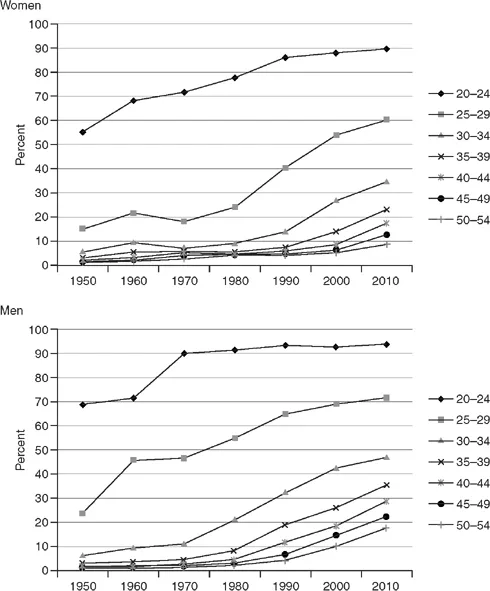
As in all developed nations, as well as many rapidly developing countries,5 the number of never-married singles has increased dramatically in Japan. As Figure 1.1 shows, for women, the first significant rise was observed among those aged 25–29 between 1980 and 1990, when Japan’s economy was booming at an unprecedented rate. In the early 1990s, the Japanese economy entered a severe recession, and still the never-married population continued to grow. The most recent statistics from 2010 show that 60.3, 34.5, 23.1, 17.4, 12.6, and 8.7 percent of women in age groups 25–29, 30–34, 35–39, 40–44, 45–49, and 50–54, respectively, had never been married – record highs for each age group. (Note that the corresponding figures were higher for men: 71.8, 47.3, 35.6, 28.6, 22.5, and 17.8 percent.6) Unlike unmarried people in many Western countries, most of these never-married singles in Japan were not cohabiting with partners.7 Instead, the majority lived with their parents, and some lived on their own.8 Also, whereas a growing number of unmarried women in the West have children outside wedlock, unwed motherhood is extremely rare in Japan.9 These figures reveal Japan as one of the least-partnered nations in the world.
Figure 1.1 Percentages of never-married women and men by year: Japan, 1950–2010.
Sources: For figures in 1950, 1960, 1970, and 1980, Ministry of Internal Affairs and Communications, Statistics Bureau (2015b); for figures in 1990, 2000, and 2010, Ministry of Internal Affairs and Communications (2011).
This phenomenon of increased singlehood (mikonka) has received political, social, scholarly, and media attention in Japan largely because of its direct association with Japan’s “population problem (jinkō mondai).” Japan’s birth rates declined sharply and have lingered far below replacement level (which is an average of 2.1 children per woman)10 at the same time as the single population grew.11 The total fertility rate12 for 2014 was 1.42 (meaning that the birth rate of 2014 estimated an average of 1.42 children would be born per woman). Simultaneously, as in other nations, average life expectancies increased. Japan’s birth rate has been one of the lowest in the world, whereas its average life expectancy has been one of the longest.13 Together with a low level of acceptance of immigrants,14 Japan has become the most aged country – meaning that the proportion of the population that is elderly is larger than is the case for any other country.15 To illustrate, in 2013, one out of four (25 percent) residents in Japan was aged 65 and above. This rate is projected to increase to one out of three (33.4 percent) by 2035.16 By comparison, in the U.S. the proportion of the population aged 65 and above was about one in eight (13 percent) in 2010, and is projected to grow to be one out of five (20 percent) by 2030, after which the growth rate of the elderly population should slow down.17
The Japanese government came to consider the changing demographic structure as a “social problem” and has implemented various social programs and policies to help married women balance work and family, with the intended goal of increasing birth rates.18 These programs and policies, however, have had little effect because the single population continued to rise and never-married women rarely had children.19 Women who do not marry have therefore been seen as the major obstacle to solving Japan’s population problem, and this partly (or perhaps largely) explains why never-married women have faced harsh treatment by the public and government officials.20
Women’s single status in Japan has often been assumed to be the result of personal choices and preferences. This assumption was made not only by many politicians but also by the popular media and some prominent social scientists. Coining the later popularized term, “parasite singles,” Japanese sociologist Masahiro Yamada contended that many individuals chose or preferred to stay single and live with parents because they wanted to maintain luxurious, materialistic, carefree lives instead of marrying and taking on parenting and other family-related responsibilities.21 On the other hand, some feminist scholars interpreted increased singlehood to be an outcome of women’s resistance against (patriarchal) marriage or traditional gender roles/ideology.22 Since the late 1980s, the popular media has coined stigmatizing labels for never-married women and propagated them.23 These include: “Christmas cake,” popularly used in the 1980s and meant to belittle unmarried women past age 25 as leftovers – like Christmas cake, which is no longer sought out after December 25; “parasite singles,” Yamada’s term suggesting singles were selfish, materialistic, dependent, and irresponsible; and “loser dogs (make inu),” taken from a book title by a never-married female author Junko Sakai and directly defining single women as “losers.”24 It is also very common for the mass media to frame women nowadays as unquestionably “choosing careers over marriage.”25
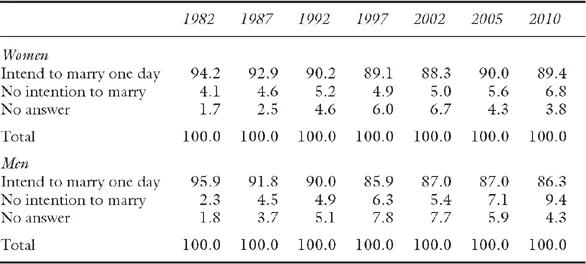
This assumption that women chose or preferred to stay unmarried, however, is not grounded in empirical evidence.26 As shown in Table 1.1, national surveys of single women (and men) have consistently shown that the great majority of single women in Japan – more women than men – wished to marry one day, and this statistic holds throughout the time of increasing single population.27 Empirical studies have also shown that most Japanese, married or unmarried, take (heterosexual) marriage for granted as the “normal” life path to take;28 this was the case even for and among gay men.29 Never-married women are also significantly less happy and healthy than their married counterparts,30 and struggle more economically compared to never-married men and married people.31 Why, then, are so many more women in Japan unmarried today than in the past? This book aims to employ a sociological perspective to identify the true causes of increased singlehood among women in Japan.
Increased singlehood: a global yet undertheorized phenomenon
As mentioned above, the number of never-married singles increased in all developed, and many newly developing, nations. Despite its ubiquity across the globe, never-married singlehood has been relatively understudied in the West, and undertheorized in sociology. Existing sociological theories tend to lump different types of unmarried statuses (e.g., cohabitation, unwed motherhood, divorce, postponement of marriage, and lifetime singlehood) together, and attempt to explain all (“not married”) as one phenomenon sharing the same cause(s). Whereas other forms of non-marriage – especially divorce, cohabitation, and unwed motherhood – have been studied extensively in sociology, never-married singlehood has received very little scholarly attention in the Western context.32
Table 1.1 Intention of marriage among single men and women aged 18–34: Japan, 1982–2010 (in percentages)
On the other hand, in the context of Japan, a fair amount of research has been conducted on never-married singlehood, and many of these studies indicate the inapplicability or inadequacy of current sociological theories of non-marriage/singlehood,33 themselves built on observations of (a limited number of) Western societies.34 Even so, Japanese studies have had little impact on theory-building, leaving existing theories limited in scope and explanatory power.
The most influential theories of singlehood come from the neo-economic perspective, which attributes the cause of singlehood to individuals’ rational choice making in changing economic contexts. The focal variable is either the economic independence gained by women (according to Gary Becker35) or deterioration in men’s economic prospects (according to Valerie Oppenheimer and her colleagues36). In these theories, individuals, especially women, are perceived to be calculating the cost and benefit of marriage (mostly in terms of its economy) and voluntarily choosing whether/when to marry, divorce, and so forth.
Other theories, the most prominent of which is the second demographic transition theory,37 point to a shift in culture as the cause of increased singlehood/non-marriage. This line of theories views societies as progressing towards greater individualism and secularization, or moving away from tradition. The argument is that this change in cultural context allows individuals to seek or choose non-traditional forms of romantic relationships other than marriage (i.e., the conventional form). In other words, according to these cultural theories, non-marriage/increased singlehood is an outcome of greater personal freedom.
Generally speaking, both camps of theories are, in my estimation, severely flawed because they see individuals as agents who make choices freely and shape their life courses with few social or cultural constraints. Though Oppenheimer et al. consider the constraining impact of men’s weak economic prospects, they continue to assume women’s ability to choose not to marry, and fail to address the impacts of other forms of social inequality, such as those based on gender, class, and race. This neglect of inequality is rather strange considering that a basic tenet of the sociological perspective is that social and cultural structures, embedded with power and inequality, shape individual lives and limit choices.38 Moreover, in the empirical world, people of disadvantaged statuses, such as the poor and highly educated black females in the U.S, are more likely to remain unmarried.39 It would seem that more intricate examinat...
Table of contents
Cover
Half Title
Title Page
Copyright Page
Dedication
Table of Contents
List of illustrations
Acknowledgements
1 Introduction: the drift into singlehood
2 Decline of marriage age norm: cohort effects and anomie
3 Limited chances of romance and problematic men: structural barriers and gender ideology
4 Cohort contrast in marriages that surrounded women: impacts of linked lives
5 Women’s ideas about gender roles: persistence of traditional gender ideology
6 Why aren’t Japanese women getting married? Conclusion and implications
Appendices: research method
Bibliography
Index
Trusted by 375,005 students
Access to over 1.5 million titles for a fair monthly price.
Study more efficiently using our study tools.
Frequently asked questions
Yes, you can cancel anytime from the Subscription tab in your account settings on the Perlego website. Your subscription will stay active until the end of your current billing period. Learn how to cancel your subscription
No, books cannot be downloaded as external files, such as PDFs, for use outside of Perlego. However, you can download books within the Perlego app for offline reading on mobile or tablet. Learn how to download books offline
Perlego offers two plans: Essential and Complete
Essential is ideal for learners and professionals who enjoy exploring a wide range of subjects. Access the Essential Library with 800,000+ trusted titles and best-sellers across business, personal growth, and the humanities. Includes unlimited reading time and Standard Read Aloud voice.
Complete: Perfect for advanced learners and researchers needing full, unrestricted access. Unlock 1.5M+ books across hundreds of subjects, including academic and specialized titles. The Complete Plan also includes advanced features like Premium Read Aloud and Research Assistant.
Both plans are available with monthly, semester, or annual billing cycles.
We are an online textbook subscription service, where you can get access to an entire online library for less than the price of a single book per month. With over 1.5 million books across 990+ topics, we’ve got you covered! Learn about our mission
Look out for the read-aloud symbol on your next book to see if you can listen to it. The read-aloud tool reads text aloud for you, highlighting the text as it is being read. You can pause it, speed it up and slow it down. Learn more about Read Aloud
Yes! You can use the Perlego app on both iOS and Android devices to read anytime, anywhere — even offline. Perfect for commutes or when you’re on the go. Please note we cannot support devices running on iOS 13 and Android 7 or earlier. Learn more about using the app
Yes, you can access Unmarried Women in Japan by Akiko Yoshida in PDF and/or ePUB format, as well as other popular books in Sozialwissenschaften & Kultur- & Sozialanthropologie. We have over 1.5 million books available in our catalogue for you to explore.