eBook - ePub
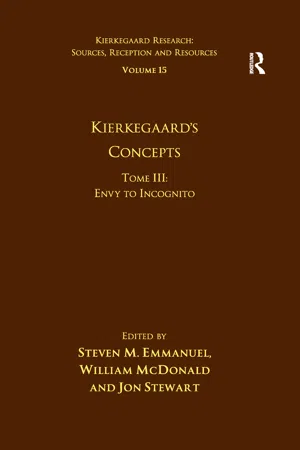
Volume 15, Tome III: Kierkegaard's Concepts
Envy to Incognito
- 256 pages
- English
- ePUB (mobile friendly)
- Available on iOS & Android
eBook - ePub
About this book
Kierkegaard's Concepts is a comprehensive, multi-volume survey of the key concepts and categories that inform Kierkegaard's writings. Each article is a substantial, original piece of scholarship, which discusses the etymology and lexical meaning of the relevant Danish term, traces the development of the concept over the course of the authorship, and explains how it functions in the wider context of Kierkegaard's thought. Concepts have been selected on the basis of their importance for Kierkegaard's contributions to philosophy, theology, the social sciences, literature and aesthetics, thereby making this volume an ideal reference work for students and scholars in a wide range of disciplines.
Information
Envy
Envy (Misundelse—noun; misunde—verb)
Derived from older Modern Danish (1500–1700s). The construction of the verb is the same as in the German misgönnen. It is constructed with the help of the negating prefix mis- from an older verb unde that originally meant “to be disposed” toward the other in this way or that, and later “to grant” a thing to a person. Thus, the verb literally means not to grant something to the other. Usually, however, both the verb and the noun also involve a desire to take away, to deprive the other of the desired thing.1 According to Molbech’s Danish lexicon, the verb misunde means “to be sorry, to be dissatisfied that it goes well with others; not to grant the other the good that he possesses.” The noun Misundelse refers to the disposition to envy (misunde) others.2
Envy is often discussed by Kierkegaard both in his published and unpublished works. It is repeatedly characterized as the counterpart of admiration (Beundring).3 According to Kierkegaard, there is “reflection’s envy” and “ethical envy,” the former being the precondition for the latter.4 The object of envy may be the freedom of the unmarried aesthete,5 the happiness of the married ethicist,6 the love of God that the Christian enjoys,7 or Christ himself.8 Envy takes the form of not granting the other the good things,9 of wanting to diminish the merits of the other,10 and of desiring altogether to destroy the other.11 In his journals and papers Kierkegaard also describes how he is being envied himself.
More thorough analyses of envy can be found in A Literary Review of Two Ages,12 in Christian Discourses,13 and in the journals and papers.14 It does not seem that Kierkegaard’s view of the phenomenon of envy itself and his understanding of the concept significantly change during his authorship. From his journals and notebooks one may see, however, that after the Corsair affair he comes to experience the reality of envy more thoroughly.
To understand the different aspects of Kierkegaard’s conception of envy, we shall begin with his (1) theological and metaphysical considerations, and then proceed to his analysis of envy as (2) a social and (3) psychological fact. Then we shall consider Kierkegaard’s (4) remedy for envy, (5) how he suffered from envy himself, and (6) how he still considered envy to be a good thing, as a means of ethical and religious upbringing.
I. Theological and Metaphysical Considerations
Kierkegaard occasionally considers the idea that envy is a phenomenon of life itself: that it has its basis in the world itself, or in the divine ground of existence. He writes about “life’s envy” (Livets Misundelse) of the prominent person, which indicates that he is just “a human being like everyone else.”15 He describes how the pagan is worried that “life’s envy” (Tilværelsens Misundelse) tomorrow might steal his good fortune.16
As Kierkegaard is aware himself,17 this is the pagan, ancient Greek idea of “divine envy”: the Greek gods were envious of human heroes and therefore brought them down sooner or later. In The Concept of Irony Kierkegaard notes how in Plato’s Timaeus the idea of envious gods was replaced with the idea of a benevolent demiurge “who did not know envy but wished to make the world like himself as much as possible.”18 Hence, the phenomenon of envy would no longer have its ground in divine metaphysical reality.
Considering this theological issue of envy, there is an interesting remark in the discourse “Every Good Gift and Every Perfect Gift Is from Above” from 1843. Kierkegaard writes about “the Father of lights, whose clarity no shadow changes, no shifting varies, no envy eclipses, no cloud snatches away from the believer’s eye.”19 The remark is probably equivocal on purpose: it is impossible to tell if there really is no shadow of envy in God, or if there is no shadow of envy only in the believer’s eye.
II. Envy as a Social Fact
As a social fact envy is analyzed above all in A Literary Review of Two Ages. In contrast to the enthusiasm typical of the passionate revolutionary age, envy is here claimed to be “the negatively unifying principle” in the modern passionless and reflective age.
Kierkegaard claims that the modern reflective age transforms existence into an equivocation in which the difference between morality and immorality is diluted.20 The modest implementation of the higher in one’s personal life is given up for an impersonal reflection. The inwardness of relationships between the low and the high (admirer–admired, citizen–king, son–father, adolescent–schoolmaster, woman–man) is enervated by critical reflection on the relationships.21
According to Kierkegaard, this tension of reflection establishes itself ultimately as the principle of modern society. In modern society “reflection’s envy” holds the will and energy of individuals in captivity and makes society into a vast penitentiary. This, in effect, corrupts the atmosphere of society and little by little reflection’s envy changes into “ethical envy.”22
What is worse, in modern society ethical envy takes the form of “characterless envy” (Charakteerløshedens Misundelse).23 In ancient Greece, for example, ethical envy was endowed with “character”: the envious admitted his own envy and the excellence of the excellent. Thus, envy still meant an indirect recognition, “a negative acknowledgement of excellence.”24 The modern reflective age, however, produces an equivocating envy that “no longer has the character to come to a self-awareness of its own significance.”25 Such a “characterless envy” does not recognize excell...
Table of contents
- Cover
- Half Title
- Title Page
- Copyright Page
- Contents
- List of Contributors
- List of Abbreviations
- Envy
- Epic
- Epigram
- Ethics
- Evil
- Exception/Universal
- Existence/Existential
- Experience
- Fairytale
- Faith
- Finitude/Infinity
- Forgiveness
- Freedom
- Genius
- God
- Good
- Governance/Providence
- Grace
- Gratitude
- Guilt
- Happiness
- Hero
- History
- Holy Spirit
- Hope
- Humility
- Humor
- Hypocrisy
- Identity/Difference
- Imagination
- Imitation
- Immanence/Transcendence
- Immediacy/Reflection
- Immortality
- Incognito
Trusted by 375,005 students
Access to over 1.5 million titles for a fair monthly price.
Study more efficiently using our study tools.
Frequently asked questions
Yes, you can cancel anytime from the Subscription tab in your account settings on the Perlego website. Your subscription will stay active until the end of your current billing period. Learn how to cancel your subscription
No, books cannot be downloaded as external files, such as PDFs, for use outside of Perlego. However, you can download books within the Perlego app for offline reading on mobile or tablet. Learn how to download books offline
Perlego offers two plans: Essential and Complete
- Essential is ideal for learners and professionals who enjoy exploring a wide range of subjects. Access the Essential Library with 800,000+ trusted titles and best-sellers across business, personal growth, and the humanities. Includes unlimited reading time and Standard Read Aloud voice.
- Complete: Perfect for advanced learners and researchers needing full, unrestricted access. Unlock 1.5M+ books across hundreds of subjects, including academic and specialized titles. The Complete Plan also includes advanced features like Premium Read Aloud and Research Assistant.
We are an online textbook subscription service, where you can get access to an entire online library for less than the price of a single book per month. With over 1.5 million books across 990+ topics, we’ve got you covered! Learn about our mission
Look out for the read-aloud symbol on your next book to see if you can listen to it. The read-aloud tool reads text aloud for you, highlighting the text as it is being read. You can pause it, speed it up and slow it down. Learn more about Read Aloud
Yes! You can use the Perlego app on both iOS and Android devices to read anytime, anywhere — even offline. Perfect for commutes or when you’re on the go.
Please note we cannot support devices running on iOS 13 and Android 7 or earlier. Learn more about using the app
Please note we cannot support devices running on iOS 13 and Android 7 or earlier. Learn more about using the app
Yes, you can access Volume 15, Tome III: Kierkegaard's Concepts by Steven M. Emmanuel,William McDonald in PDF and/or ePUB format, as well as other popular books in Philosophy & Epistemology in Philosophy. We have over 1.5 million books available in our catalogue for you to explore.