- 202 pages
- English
- ePUB (mobile friendly)
- Available on iOS & Android
eBook - ePub
About this book
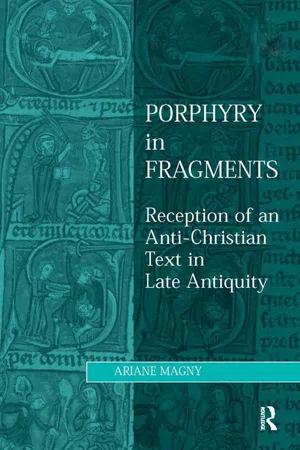
The Greek philosopher Porphyry of Tyre had a reputation as the fiercest critic of Christianity. It was well-deserved: he composed (at the end the 3rd century A.D.) fifteen discourses against the Christians, so offensive that Christian emperors ordered them to be burnt. We thus rely on the testimonies of three prominent Christian writers to know what Porphyry wrote. Scholars have long thought that we could rely on those testimonies to know Porphyry's ideas. Exploring early religious debates which still resonate today, Porphyry in Fragments argues instead that Porphyry's actual thoughts became mixed with the thoughts of the Christians who preserved his ideas, as well as those of other Christian opponents.
Information
Chapter 1
New Methods1
Porphyry’s Against the Christians, survives only in fragments, chiefly in Eusebius, Jerome and Augustine. A few were also found in the works of Diodorus of Tarsus, Epiphanius, Methodius, Nemesius, Pacatus, Severus of Gabala, Theodoret and Theophylactus. How can we collect the fragments and reconstruct Porphyry’s critique of Christianity?
Fragments in context
New methodological approaches allow for an expanded and more nuanced reading of the discourses against the Christians through the setting of the criteria required to study the treatise. First, there is the general problem of survival. As is too often the case with works from Antiquity, fragments are the only means for acquiring knowledge about lost writings.2 Indeed, as far as ancient Greek literature is concerned, ‘the ratio of surviving literature to lost literature is in the order of 1:40’.3 Many factors contribute to preservation or destruction of works, and they are not always related to the quality of these works,4 which were therefore not deliberately eliminated. According to G. Schepens, ‘There are difficulties the distribution of “books” in Antiquity … had to face before the invention of typography; the preference for easy-to-handle compilations over the often too voluminous (and more valuable) originals; … and, above all, the role of chance.’5 Furthermore, adds Schepens, most of the works from that period survived only partially in direct transmission. Textual distortions are thus very common, he argues, and are due to the mode of transmission from Antiquity to the Middle Ages.
In the case of Porphyry, there are specific problems. The complete version of Against the Christians is unknown. It was deliberately destroyed after the Great Persecution (303-11), various emperors having issued edicts condemning all of Porphyry’s infamous works to the flames.6 Some copies must have survived, but the principal sources for Porphyry’s treatise are Christian apologists who aimed at defending their dogmas against any future threat of persecution, in the case of Eusebius, or against ridicule in the case of Augustine – who writes, for instance, in his letter 102 to Deogratias, that stories such as Jonah in the belly of a whale were provoking laughter in pagan circles (102.30). These Christians quoted or paraphrased the philosopher when answering his ideas, which, in turn, creates a major problem for the fragment collectors. According to Schepens, ‘the methodological key-problem the student of (historical) fragments has to face is invariably a problem of context’.7 Historians must contextualize citations in the texts in which they were found in order to be able to understand their meaning fully; but, in so doing, they risk distorting Porphyry’s original meaning. Consequently, the risk with contextualizing is the distortion of the meaning of the discourses Against the Christians’ original version.8 Here, ‘Contextualization’ thus means reading the fragment as if it belonged to the context in which it was transmitted.
While establishing the required parts of a good, modern, historical fragment collection (taking as example the work of the late F. Jacoby), Schepens argues that the commentary should ‘consist of two moments’. These ‘aim at relocating the fragments in the lively political, intellectual and artistic process of intertextual exchange that once took place and to which the survival of these very fragments is testimony’. The first moment is ‘an act of deconstruction of the cover-text by which the fragment is set free from the potential biases of the text in which it survives. This operation aims at establishing the original meaning (if possible also the ‘wording’) of the fragments’.9 Schepens named as ‘cover-texts’ the works in which the fragments survive, for this wording creates, according to him, a distinction from the (con)text ‘of the later works in which the fragments survive’.10 As he put it, ‘The notion of cover-text conveys – … better than the phrases commonly used (sources of fragments or expressions like the citing or quoting later authors) … the consequential and multiple functions these texts perform in the process of transmitting a fragment.’11 He uses the word ‘cover’ to mean ‘to conceal, protect or enclose something’. He argues that the later authors perform just those three tasks when transmitting a text:
They, first of all, preserve (= protect from being lost) texts drawn from works that are no longer extant; very often, too, they more or less conceal the precursor text (form characteristics such as the original wording and style of the precursor text are no longer discernible; often also fragments seems to ‘hide’ in the cover-text, so that one can only guess where a paraphrase begins or where a quotation ends); and, last but not least, the cover-text encloses the precursor text: it is inserted or enveloped in a new con-text, which may impose interpretations that differ considerably from the original writer’s understanding of his text.12
The second moment that should be part of the commentary, according to Schepens, ‘is an attempt to reconstruct the lost context of the original work and try to re-insert the fragment in it’.13
Next, the work of A. Laks exposes the necessity to redefine the word ‘fragment’. He says that there is a distinction to make between a testimonium and a fragment. According to him, the pair fragment/testimony belongs to the primary critical apparatus of all ancient historians. Laks explains that a testimony is what can be found in the ancient literature about a lost text or its author, whereas a fragment is a part of that lost work. A fragment is thus a literal quotation, and a testimony is the doing of a reader, who gives us their secondary interpretation of the text. The difficulty lies in the fact that testimonies can be confused with fragments, or that one can hesitate between where a testimony and a fragment start and end, if present together. But Laks argues that scholars should go beyond the traditional separation of the two categories (commonly made under the letters A – fragments – and B – testimonies) in fragment collections, and understand that a testimony may also be a fragment, and therefore may be included in the A category. The only reason why a testimony should be excluded is when the selection is made according to what is literal; only the fragment is literal. But if the selection criterion is changed to ‘content’, then the testimony should not be excluded from the fragments. Laks says that the testimony of a work is actually a mere fragment.14 Laks applies his argument to doxographies (works that are collections of opinions), and therefore not to works such as Jerome’s, however he introduces the interesting notion that fragment collections should be more flexible in what they understand as being a fragment. As far as methodology is concerned, what an author says about a work before quoting or paraphrasing it should also be considered as part of the fragment.
In the context of a conference held in September 2009 on Porphyry’s Against the Christians, A. Laks was asked to discuss the problems related to a collection of the fragments of Against the Christians. Giving a fresh look at the topic, he exposed an error that has been missed by all the scholars who have been studying the treatise: Harnack never meant to publish a fragment collection, but a collection of (testimonium) fragments and references – ‘(Zeugnisse) Fragmente und Referate’.15 All of those who worked on the fragments since Harnack have, it seems, forgotten to translate part of the title of his work. As a result, our constant references to the fragments as, say, Fr. 1 or 44, are wrong, for Harnack did not attribute a number to ‘fragments’, but rather to ‘Fragmente und Referate’. Indeed, he himself abstained from using the word ‘fragment’, and refers to the passages from his collection as follows: ‘Nr’. (Nummer/number) 1, 5 or 28, and not ‘Fr’, 1, 5 or 28. Laks, therefore, does not only suggest a greater flexibility in our definition of ‘fragment’,16 but he also corrects almost a century of misinterpretation of Harnack’s work. This is why I have decided to use the abbreviation Nr. myself.
As I wish to demonstrate in this book, the traditional definition of the term ‘fragment’ is inappropriate as far as the remains of Against the Christians are concerned. Harnack had already observed this,17 and recent studies on the citation technique in Antiquity are ruining any hope in finding, among the Church Fathers’ corpus, some intact passages from the anti-Christian discourses, namely ‘fragments’.
Finally, one of the methodological issues raised by Schepens is the distinction between fragments that survive with or without title and/or book number.18 Assigning a title and book number is very important, because it allows an attempt to reconstruct the work, and because the fragments’ order necessarily affects their interpretation. The title and number of books (fifteen) of Against the Christians are provided by a reference in the Souda; it may also derive, as discussed earlier, from Eusebius of Caesarea.19 This mention may be associated with the title Against the Christians found in the Souda – should it, of course, be an actual title. After having found the title, the volumes must be reconstructed, which is difficult since fragments are related to books 1, 3, 4, 12, 13 and 14 only. Some fragments, therefore, allow for associating Porphyry’s ideas with a book number, and the ones that seem to correspond to the same ideas should thus be grouped under the right number.20 This is how Harnack chose his five headings, namely 1- Critique of the characters and reliability of the evangelists and apostles, as a basis for the critique of Christianity, 2- Critique of the Old Testament, 3- Critique of the deeds and words of Jesus, 4- The dogmatic element, and 5- The contemporary Church, rather than attempting a reconstruction as previous scholars did.21. Jerome identifies for us some of the content of book 1: ‘And the wholly unintelligent Bataneot and famous villain Porphyry objects, in the first book of his work against us, that Peter is blamed by Paul.’22 The first book may thus have been devoted to attacks on the apostles – or it may well have been an introductory survey of the incoherence of Christian teaching. Porphyry then gives examples of how the evangelists misquoted the Prophets. Eusebius, in the Ecclesiastical History (6.19.9), says that Porphyry criticized Origen’s use of the allegorical method of interpretation to decode Scripture in book 3 of Against the Christians. The book was thus most probably concerned with how the Bible should not be read as containing divine revelations aimed at the Christians, rather than the Jews.23 Jerome also identifies some of the content of book 14: ‘…The famous impious Porphyry, who vomited his rage against us in numerous volumes, argues against this passage in book 14 ...
Table of contents
- Cover
- Half Title
- Title Page
- Copyright Page
- Dedication
- Table of Contents
- Foreword
- Preface
- List of Abbreviations
- Note on the Texts
- Introduction
- 1 New Methods
- 2 Eusebius
- 3 Jerome
- 4 Augustine’s Letter
- 5 Augustine’s On the Harmony of the Gospels
- Conclusion
- Bibliography
- Index
Trusted by 375,005 students
Access to over 1.5 million titles for a fair monthly price.
Study more efficiently using our study tools.
Frequently asked questions
Yes, you can cancel anytime from the Subscription tab in your account settings on the Perlego website. Your subscription will stay active until the end of your current billing period. Learn how to cancel your subscription
No, books cannot be downloaded as external files, such as PDFs, for use outside of Perlego. However, you can download books within the Perlego app for offline reading on mobile or tablet. Learn how to download books offline
Perlego offers two plans: Essential and Complete
- Essential is ideal for learners and professionals who enjoy exploring a wide range of subjects. Access the Essential Library with 800,000+ trusted titles and best-sellers across business, personal growth, and the humanities. Includes unlimited reading time and Standard Read Aloud voice.
- Complete: Perfect for advanced learners and researchers needing full, unrestricted access. Unlock 1.5M+ books across hundreds of subjects, including academic and specialized titles. The Complete Plan also includes advanced features like Premium Read Aloud and Research Assistant.
We are an online textbook subscription service, where you can get access to an entire online library for less than the price of a single book per month. With over 1.5 million books across 990+ topics, we’ve got you covered! Learn about our mission
Look out for the read-aloud symbol on your next book to see if you can listen to it. The read-aloud tool reads text aloud for you, highlighting the text as it is being read. You can pause it, speed it up and slow it down. Learn more about Read Aloud
Yes! You can use the Perlego app on both iOS and Android devices to read anytime, anywhere — even offline. Perfect for commutes or when you’re on the go.
Please note we cannot support devices running on iOS 13 and Android 7 or earlier. Learn more about using the app
Please note we cannot support devices running on iOS 13 and Android 7 or earlier. Learn more about using the app
Yes, you can access Porphyry in Fragments by Ariane Magny in PDF and/or ePUB format, as well as other popular books in Theology & Religion & Christianity. We have over 1.5 million books available in our catalogue for you to explore.