- 238 pages
- English
- ePUB (mobile friendly)
- Available on iOS & Android
eBook - ePub
About this book
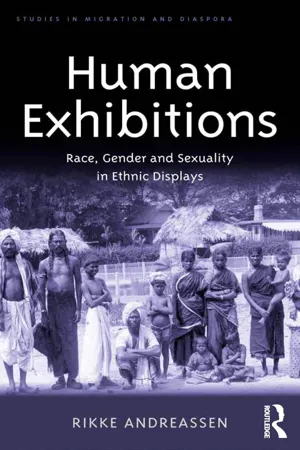
From the 1870s to the second decade of the twentieth century, more than fifty exhibitions of so-called exotic people took place in Denmark. Here large numbers of people of Asian and African origin were exhibited for the entertainment and 'education' of a mass audience. Several of these exhibitions took place in Copenhagen Zoo, where different 'villages', constructed in the middle of the zoo, hosted men, women and children, who sometimes stayed for months, performing their 'daily lives' for thousands of curious Danes. This book draws on unique archival material newly discovered in Copenhagen, including photographs, documentary evidence and newspaper articles, to offer new insights and perspectives on the exhibitions both in Copenhagen and in other European cities. Employing post-colonial and feminist approaches to the material, the author sheds fresh light on the staging of exhibitions, the daily life of the exhibitees, the wider connections between shows across Europe and the thinking of the time on matters of race, science, gender and sexuality. A window onto contemporary racial understandings, Human Exhibitions presents interviews with the descendants of displayed people, connecting the attitudes and science of the past with both our (continued) modern fascination with 'the exotic', and contemporary language and popular culture. As such, it will be of interest to scholars of sociology, anthropology and history working in the areas of gender and sexuality, race, whiteness and post-colonialism.
Information
Chapter 1
Humans on Display:
The Era of Human Exhibitions1
Theories and Terms
Today, the term ‘race’ is seldom used in Nordic countries, be it in public or academic discourses. ‘Race’ is associated with the prevailing biological racism of the nineteenth and early twentieth century, as is clearly expressed in the exhibitions of exotic people. The atrocities of Nazism and colonialism led the majority of Europeans to reject biological racism; as a result, the term ‘race’ disappeared in the Nordic countries. Thus, racial terminology and analytical categories like ‘racial visibility’ and ‘racial appearances’ are (almost) never used in contemporary public discourses, and only seldom used in academic discourses. ‘Race’ in the Nordic countries is viewed as a historical phenomenon we have left behind; instead, the term ‘ethnicity’ has been applied to the previous decades’ discourses and scholarly work.2 Recent Nordic scholarly debate has included some fierce criticism of some younger Nordic scholars’ re-implementation of the term ‘race’ as an analytical category.3
In this book I choose to use the term race. There are two reasons for insisting upon the use of race as an analytical category and for verbalising ‘race’ and ‘racial appearances’. Firstly, ‘race’ was the term used at the time of the human exhibitions, as race science and racial understandings of the time were based on certain perceptions of race and racial differences. More contemporary studies of race and Whiteness argue that race and racial differences tend to be attributed to ‘the others’ (that is, the non-White), whereas the White race and the White racialised body tend to be invisible.4 A key point in relation to the exhibitions is that race was not only assigned to ‘the others’ or ‘the coloured’; rather, the White race was a central concept at the time. Most Nordic race scientists at the time were more occupied with studying ‘the White race’ than other races. Therefore, I include ‘the White race’ in my race terminology and work analytically with ‘Whiteness’ in the book. The other reason for using ‘race’ in this book relates to the aim of illustrating the colonial heritage of the exhibition to present-day cultural production and racial thinking; this is covered in the final chapter of this book. In this context, I find it useful to label contemporary structures of discrimination and privilege in racialised terms, just as I find it expedient to apply a terminology of ‘race’ when describing the experiences of the exhibited people’s descendants in contemporary Denmark.
The term ‘race’ is not without complications. There is a danger of universalising when speaking about race; hence, one must be careful when describing others in racial terms. While some scholars argue against using ‘race’ because it evokes former colonial thinking,5 others argue against labelling visual bodily differences in terms of race, since such labelling might lead to understandings of race and racial differences as permanent entities, rather than constructs.6 Conversely, one could argue that visual bodily differences (e.g. hair texture and skin colour) both influence ordinary people’s lives and undeniably link historical power structures; by naming these differences, one is able to underscore racialised privileges and the lack thereof.7 As a whole, the Nordic countries have only recently begun to deal with and acknowledge their colonial pasts.8 Thus, this book is also an attempt to further acknowledge the past and its colonial heritage.
Social constructivism serves as a central theoretical foundation in this book, as exhibited bodies, written words and exposed photographs contribute to the creation of reality. The work of Michel Foucault has been central to my analyses; I have drawn particularly upon his ideas of the production of power and knowledge through society’s discursive practices.9 Building on the work of Foucault, other scholars, such as Chantal Mouffe and Ernesto Laclau, have also been sources of inspiration. These scholars have shown how different discourses compete to secure hegemony, how meaning is never static and how antagonisms between different discourses continuously seek to contribute meaning to a discourse.10 In the analysis to follow, I track how the discourse of race often changed from context to context, and how race was never a fixed category in the exhibitions. I am aware that my understanding and usage of ‘race’ is different from the usage in the late nineteenth and early twentieth centuries. Despite the attempts of exhibition organisers and race scientists to ‘freeze’ race and portray it as a fixed category ascribed with specific characteristics, my analysis clearly illustrates that race never existed as a natural biological category, but only as a socially constructed category. For instance, at the time of the exhibition, Finns were not considered a White race, but rather a coloured race seen to have no relation to the Nordic White race; in fact, it was believed that Finns were less intelligent, more ugly and more primitive than White Swedes, Danes and Norwegians.
Theoretically, my research has been inspired by post-colonial studies, including the work of Candra Talpade Mohanty, Franz Fanon, Edward Said and Homi Bhabha, as all four worked with colonisers’ representations of the ‘other’ in ways that are relevant to my analyses.11 Post-colonialism offers a perspective on the many power relations in play between different races, peoples and geographic parts of the world. Furthermore, post-colonialism offers a special perspective on the past that can be used to identify various identity constructions in relation to race, gender, sexuality and nationality in the human exhibitions, as well as the many identity and power constructions in the contemporary aftermath. As with social constructivism, a central tenet of post-colonialism is that written and spoken words contribute to reality. Thus, it becomes important for all agents to ‘gain a voice’. Post-colonialists, especially post-colonial feminists, have criticised Western scholars for describing other cultures and people in generalised, stereotypical ways, and for not giving a voice to these others.12 Describing others is not a neutral act. Certain conceptions of others are created through such descriptions. The act of describing holds an inherent power, as can be demonstrated in relation to the human exhibitions. Those who described or staged the exhibitions had the power to define the others, and those who were described and exhibited were rarely given the opportunity to influence these depictions of themselves. In other words, they had no voice in these narratives and depictions. This book strives to give a voice to the exhibited people and to incorporate their perspectives wherever possible.
At the time of the exhibitions, understandings and impressions of categories like race, gender and sexuality intersected, influenced and constructed each other.13 Thus, the exhibitions also provide a window for understanding the prevailing constructions of gender and sexuality – and how these categories intersected with race – at the time. Constructions of race have often been closely connected to constructions of nationality. For analyses of the exhibitions, I have found the combination of post-colonial feminism, feminism and nationalism useful. Theories of nationalism have often been conceptualised as gender neutral, but, in the case of the exhibitions, it has proven fruitful to combine nationalism with feminist theories of how women reproduce race and nations, as well as feminist analysis of interracial sexual encounters.14 In this context, I also drew upon other analyses of colonial sexual interracial encounters.15 I introduce the theory and theorists successively, as they are encountered in the book.
A Secret Archive
Major human exhibitions were held throughout Europe. While extensive research and writings exist on exhibitions in countries such as Germany, France and Great Britain, such research in Denmark has been very sparse.16 One reason for the limited Danish research is the lack of source material from these exhibitions. Scholars have mainly relied on newspaper accounts, and this has made it difficult to establish an in-depth understanding of the exhibitions. However, I discovered a previously forgotten archive in a basement under Copenhagen Zoo, which hosted many of the major human exhibitions. Buried in dust and cobwebs were stacks of boxes containing historical materials from the zoo. The boxes held troves of old letters, ledgers, contracts, photographs and more. The discovery of these materials in the ‘secret’ archive enabled me to write this book.17
Hidden away in the basement of the zoo was a gateway to the Danish exhibitions – and to surveying this realm of Danish history. In the zoo archive, I discovered old plans from the human exhibitions, descriptions of the ideas behind the exhibitions, contracts detailing the conditions offered to the exhibited people, detailed information regarding food and drink for the exhibited people, doctor’s bills pertaining to exhibited people’s illnesses, letters from schools requesting free admission to see ‘the savage people’ and much, much more. Discovering this archive was a fantastic experience and I am very grateful to Copenhagen Zoo for granting me access to the archive and for the great kindness shown to me while working on this project. I supplemented the information in the Copenhagen Zoo archive with extensive research in newspapers and magazines from the time. I found approximately 200 articles on the exhibitions, all of which were included in my overall analysis of these past events. In the late 1800s, journalists and commentators reviewed the human exhibitions in much the same ways as film and theatre are reviewed today; they also visited the exhibitions on the same terms as the general public, and wrote many reports of their experiences. In addition to these sources, I located a number of the original brochures and pamphlets published in connection with the individual exhibitions. Visitors typically received or could purchase a guide containing information about the exhibited people, including details of their lifestyles and customs and where they came from. A number of guides and posters from the exhibitions were found in the Royal Danish Library’s small publications collection (Småtrykssamlingen), which enabled me to include these materials in my research.
I spent almost three years studying the Danish human exhibitions and mapping this forgotten chapter of Danish history. During my studies, I constantly discovered new information, new exhibitions and new connections between the exhibited people and the Danish population. Working with the exhibits was an ongoing journey with an ever-growing scope of research. When beginning my study, I had the impression that there had been approximately 30 human exhibitions in Copenhagen from the 1880s to the 1910s; however, I ultimately found evidence of more than 50 exhibitions in Denmark, many of which were held in the provinces.
Please note that in this book, I use the term ‘exotic’ to refer to the exhibited people, as they and the exhibitions were considered exotic at the time – a key factor in attracting audiences. By ‘exotic’, I do not mean that the exhibited people, in themselves, were exotic, but that they were perceived as such at the time; thus, ‘exotic’ refers to the Europeans’ view of the exhibited and foreign people, rather than to the people, themselves.
Behold the Strange Foreigners
On a single summer Sunday in 1901, more than 18,000 people visited Copenhagen Zoo. The main attraction was not the zoo’s animals, but rather a convoy of Brown people that had just arrived from India: 30 Indians – men, women and children – on exhibition alongside exotic animals such as elephants, trained bears and snakes. A so-called ‘Indian village’ built in the middle of the zoo featured palm huts and hearths; the Indians lived there for three months, to the daily wonder of visiting Danes. The entertainment value of the Indians rested primarily in the fact that they appeared as themselves; they cooked, cared for their children, made handicrafts and tended to their animals. They also performed a spectacular entertainment show every day, which included magic tricks, acrobatics and elephant training. From the late 1800s to the early 1900s, Denmark hosted at least 50 such human exhibitions (or, as they were also called, ‘human caravans’), with the majority in the capital city, Copenhagen. Danes were invited to an ‘Indian Exhibition’, a ‘Negro Exhibition’, a ‘Bedouin Exhibition’, a ‘Chinese Exhibition’, and so on. Many of these exhibitions were held in popular amusement institutions such as the amusement park Tivoli, C...
Table of contents
- Cover Page
- Title Page
- Copyright Page
- Contents
- List of Photographs
- Acknowledgements
- Series Editor’s Preface
- 1 Humans on Display: The Era of Human Exhibitions
- 2 Race Science and Racial Hierarchies
- 3 Agency and the People Behind the Exhibitions
- 4 Gender, Sexuality and Romantic Relationships
- 5 The Forgotten History: The End of Human Exhibitions
- Bibliography
- Index
Trusted by 375,005 students
Access to over 1.5 million titles for a fair monthly price.
Study more efficiently using our study tools.
Frequently asked questions
Yes, you can cancel anytime from the Subscription tab in your account settings on the Perlego website. Your subscription will stay active until the end of your current billing period. Learn how to cancel your subscription
No, books cannot be downloaded as external files, such as PDFs, for use outside of Perlego. However, you can download books within the Perlego app for offline reading on mobile or tablet. Learn how to download books offline
We are an online textbook subscription service, where you can get access to an entire online library for less than the price of a single book per month. With over 1.5 million books across 990+ topics, we’ve got you covered! Learn about our mission
Look out for the read-aloud symbol on your next book to see if you can listen to it. The read-aloud tool reads text aloud for you, highlighting the text as it is being read. You can pause it, speed it up and slow it down. Learn more about Read Aloud
Yes! You can use the Perlego app on both iOS and Android devices to read anytime, anywhere — even offline. Perfect for commutes or when you’re on the go.
Please note we cannot support devices running on iOS 13 and Android 7 or earlier. Learn more about using the app
Please note we cannot support devices running on iOS 13 and Android 7 or earlier. Learn more about using the app
Yes, you can access Human Exhibitions by Rikke Andreassen in PDF and/or ePUB format, as well as other popular books in Social Sciences & Ethnic Studies. We have over 1.5 million books available in our catalogue for you to explore.