eBook - ePub
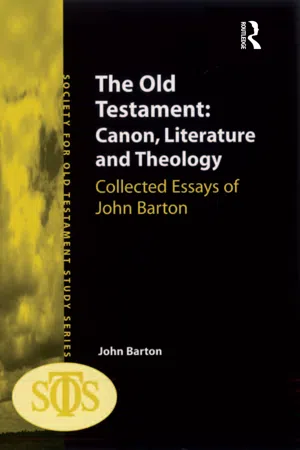
The Old Testament: Canon, Literature and Theology
Collected Essays of John Barton
- 308 pages
- English
- ePUB (mobile friendly)
- Available on iOS & Android
eBook - ePub
About this book
This collection of John Barton's work engages with current concern over the biblical canon, in both historical and theological aspects; with literary reading of the Bible and current literary theory as it bears on biblical studies; and with the theological reading and use of the biblical text. John Barton's distinctive writing reflects a commitment to a 'liberal' approach to the Bible, which places a high value on traditional biblical criticism and also seeks to show how evocative and full of insight the biblical texts are and how they can contribute to modern theological concerns. This invaluable selection of published writings by one of the leading authorities on biblical text and canon, also includes new essays and editorial introductions from the author.
Information
Chapter 1 ‘The Law and the Prophets'. Who are the Prophets?
DOI: 10.4324/9781315555041-3
This paper raises some questions, and makes a few tentative suggestions, about the understanding of prophecy in the post-exilic and intertestamental periods. No fresh evidence will be considered, but new ways of looking at familiar material will be suggested; the conclusions are intended as theses that might encourage further discussion of the issue they raise, rather than as the end of the matter.
The best way to introduce the lines of enquiry to be followed here is by explaining that they arise from trying to solve a problem I have caused for myself, by deciding to write a book on the Old Testament prophets in a rather new way. General books on prophecy are normally historical in plan, beginning with early prophecy and its roots, and with the phenomenon of prophetic experience in pre-exilic Israel and other ancient cultures. 1 For two reasons there might be merit in beginning at the other end: looking at the finished prophetic corpus first, and only then feeling one’s way back to earlier stages in the tradition. First, contemporary biblical studies are veering strongly towards an interest in the final form of the biblical text; and though I should want to see this as a matter of practising historical criticism in the last stages, just as it has traditionally been practised in the earlier ones, rather than as an abandonment of historical-critical method in favour of ‘canon-criticism’ or structural analysis, still a study beginning with what we have would at least make contact with what is going on elsewhere in biblical studies. But secondly, a case could be made for beginning with the finished text on the grounds that it is known, whereas a topic such as the psychology of the pre-classical prophets is very much an unknown, attainable only through very hypothetical reconstruction. And it is usually better to begin with what is known and work from there, even if it means reversing the historical order.
So at least I thought when planning a book on prophecy. Further reflection, however, immediately raised a problem, the problem which is the starting point for this paper, and made it clear that the finished prophetic corpus, and the context in which it was finished, is really hardly any more a known quantity than the life and times of Balaam’s ass. This is a problem faced by all writers on prophecy in the end, but I have turned it into a problem of prolegomena by insisting on beginning at the end. The problem is: what is to be done with apocalyptic? Usually it is taken as a given that apocalyptic is not prophecy in a straightforward sense; but no book on prophecy can ignore it because of at least superficial resemblances. The question as it presents itself to a student of the prophets is generally couched in the form ‘Is apocalyptic a true child of prophecy?’ – meaning, is it a natural development from the thought of the pre-exilic prophets, or does it distort and falsify many of their insights? Old Testament scholars will be familiar with the answers that have been given, ranging from a gradual transformation of prophecy into apocalyptic by imperceptible stages at one end of the scale, to an outright denial that the two movements have anything in common at the other. But if the question about the antecedents of apocalyptic is natural for a historical approach that takes the pre-exilic age as its starting point, a study that began with the canon might find it more natural to ask questions such as: Did apocalyptic writers regard themselves as prophets, and their books as prophecy? Did their contemporaries think of them as prophets? To resolve these questions we should need to know with some clarity what ‘prophet’ meant, not in the earliest times, nor in the era of classical prophecy, but in the age when what we call apocalyptic was flourishing. Despite some work on prophets in the early Christian community, 2 I do not believe much attention has been directed to this question. My attempt to begin from the known therefore proves naïve, but it helps to bring to light an important issue which is worth tackling in its own right.
1 What is a Prophetic Book?
A hopeful place to start might be by asking what is meant when the second division of the Hebrew Scriptures is called ‘the prophets’. There is no difficulty, I suppose, in understanding why Isaiah, Jeremiah, Ezekiel and the Twelve are so called; but as a designation for what we have learned to call the ‘Deuteronomistic History’ it is puzzling. We are accustomed to speaking of the ‘former’ and ‘latter’ prophets, but of course this distinction is quite a late arrival, and within the Hebrew tradition there seems to have been little awareness that there is any kind of natural break between Kings and the last four prophetic books until after the Christian era. The LXX clearly perceives the difference, and assigns the former and latter prophets to quite different parts of its canon. The lack of distinction in the Hebrew tradition can be seen most strikingly in a saying attributed to Johanan b. Zakkai, which is recorded in B. Baba Bathra 14b in justification of the Talmudic ordering of the prophetic books. The latter prophets are there listed in the order Jeremiah, Ezekiel, Isaiah, the Twelve; and the saying suggests this order is perfectly natural, because Kings ends in destruction, Jeremiah is entirely about destruction, Ezekiel begins with destruction but ends in consolation and Isaiah is all consolation. 3 The fact that this is not an entirely satisfactory reading of these books need not concern us; what it does show clearly is that all the prophetic books are being perceived as the same sort of thing, and that the former/latter distinction is not functional in reading them. (The saying has other points of interest which will concern us later.) We might say, then, that once there is a definite collection called ‘the prophets’, it seems to be perceived as one sort of thing, not two: our sense that two quite different sorts of literature have been lumped together under a heading appropriate to only one of them seems to find no echo in tradition.
Why did all these books, ‘histories’ as well as ‘prophecies’, come to be called ‘the prophets’? We may examine two theories sometimes put forward, and then go on to an explanation that somewhat undercuts them both.
(1) It could be said that Deuteronomistic History is indeed a ‘prophetic’ history, in the sense that (as von Rad showed 4 ) it works with an elaborate scheme of prediction and fulfilment, and the predictions are often uttered by ‘prophets’. 2 Kings 17 may be said to provide the rationale for the D history – it is the longest passage where the author speaks in propria persona – and it makes much of God’s warnings throughout the people’s history by the hand of ‘every prophet and every seer’ (v. 13). Might not this explanation be rather too modern, however? Classifying a collection of books by theme in this way is a typically modern concern – it is, indeed, just the sort of approach that has produced the term ‘Deuteronomistic History’. There are so many other possible themes, and so many other books that, on such a criterion, could equally well be called ‘prophets’ that the explanation, though of course possible, seems to me rather lame and forced.
(2) A second explanation, more commonly adduced, thinks in terms of an attribution of authorship. This is the natural way to take the title ‘Samuel’ – Samuel’s chronicle of his lifetime and a little beyond it. Baba Bathra ascribes Judges to Samuel too; and Kings it attributes to Jeremiah, apparently confirming the hypothesis. But the picture is spoiled by its comments on the other prophetic books: Joshua, it is said, wrote his own book (as well as the section in the Pentateuch about the death of Moses); and apart from Jeremiah, the books we regard as ‘prophetic’ are not said to have been written by what we call ‘prophets’ at all! Hezekiah and his company wrote Isaiah, and the men of the great synagogue wrote Ezekiel and the Twelve. ‘Wrote’ here seems admittedly to mean ‘copied out’ rather than ‘composed’ – or rather it seems to oscillate between the two in hopeless confusion; but at least there does not seem to be any desire to ascribe the books called ‘the prophets’ to authors who were prophets either in the sense that term bears in our usage, or in the sense it bears within the historical and prophetic books themselves.
I believe this begins to suggest a way forward. Might it be that ‘prophets’ as the title of the second division of the Scriptures is indeed an attribution of authorship, but we need to make some adjustments in our idea of what kind of person such a ‘prophet’ would have been thought to be? This possibility will gain in definition if we examine the famous passage in Josephus Contra Apionem I.8.41: ‘From the death of Moses until Artaxerxes … the prophets subsequent to Moses wrote the history of their own times in thirteen books … From Artaxerxes to our own time the complete history has been written, but has not been deemed worthy of equal credit with the earlier records, because of the failure of the exact succession of prophets.’ On the one hand, this supports the idea that the title ‘prophets’ is an attribution of authorship; but on the other, as is well known, it is nearly impossible to make Josephus’ thirteen books correspond to the prophetic division of the Hebrew canon, and it seems certain that he includes some of the Hagiographa as well. It tells us that all inspired books, worthy of complete credence, were written during the period in which – according to the theory that prophecy ceased with Malachi – there were prophets to write them; but it does not give us any specific explanation why just the books now in the second division of the Hebrew canon were called ‘the prophets’.
It may be, however, that Josephus is being read with the wrong expectations. It has been usual to take this passage as a witness to the closing of the Hebrew canon; to see Josephus’ apparent belief that prophetic inspiration ceased in the days of Ezra at the latest as a dogma derived from the fact that the prophetic section of the canon already ended where it does now. The theory of the demise of prophecy, that is to say, was produced ex post facto once the ‘council of Jamnia’ had fixed the limits of the canon. Now in support of the idea that Josephus is appealing to a closed canon it can be noted that his argument at this point is about the strictly limited number of books recognized as authoritative by the Jews, as opposed to the multitude of inconsistent writings used by others. But we then have to explain how Josephus comes to include in his closed prophetic canon books other than those we now have – for example fairly certainly Esther.
The older explanation of this was that the prophetic canon was indeed closed, but there was more than one version of what it contained. This used to be commonly held, 5 and it results in the so-called ‘Alexandrian canon’ hypothesis, where the LXX arrangement and selection of books is seen as an example of the kind of arrangement Josephus was taking as his datum. But this hypothesis has fallen on bad times, and most scholars would probably now follow Sundberg 6 in holding that there never was a widely accepted Jewish canon different from the present Hebrew Scriptures of Law and Prophets. Josephus’ arrangement is peculiar to him, and reflects his desire to assimilate as many books as possible to the model of ‘historiography’ – accurate history written by inspired prophets.
It seems to me that this may well be Josephus’ motivation, but that the issue has been somewhat clouded by the assumptions that he must have been working with some kind of canonical list arranged in a certain way, which he must be either following or deliberately varying, an assumption which is common to Sundberg and defenders of the ‘Alexandrian canon’ alike. To ask which canon Josephus knew and how it was arranged begs the prior question whether it makes sense to talk about ‘canonicity’ at all in this period, for books other than the Torah. If it is really true that the prophetic canon was fixed enough to have actually produced the theory that prophetic inspiration ceased with Malachi, then surely it was far too fixed for Josephus to have meddled with it for any purpose whatsoever. His freedom of manoeuvre suggests to me that it was not fixed in this way at all; and hence that the theory that prophetic inspiration ceased with Malachi is much more likely to have some other explanation. Furthermore, this would suggest that this theory was itself a genuine factor in leading to the eventual exclusion of some books from the ‘prophetic’ section when the canon was finally closed.
My suggestion, then, is that the term ‘prophecy’ or ‘prophetic book’ meant, for Josephus, not much more than ‘inspired’ or ‘authoritative’ book. For him, the distinction between (a) histories, (b) prophecies (in our sense), and (c) other kinds of literature, is insignificant compared with the only distinction that mattered to him, that is, the distinction between the Torah and everything else, between the words of Moses and the writings of those who came after him. It is often said that his ‘canon’ was tri-partite, even though the arrangement was different from ours, in that he recognizes (a) the Law, (b) the Prophets (though a different selection) and (c) ‘writings’. Thus he writes: ‘the prophets subsequent to Moses wrote the history of the events of their own times in thirteen books. The remaining four books contain hymns to God and precepts for the conduct of human life.’ This may indeed mean that the prophets wrote thirteen books, and someone else the other four books accepted by the Jews as authoritative; but it could equally well mean that thirteen of the books written by prophets are histories, and four hymnographic and sapiential. Even apart from this, it seems that Josephus’ understanding of Scripture allows only a basic twofold division. There is the Law, and there are the books of prophets, and no other books are authoritative in the same way. Books of prophets are books written by the properly authorized successors of Moses – not the Torah, but the next best thing. Because he is concerned, in Contra Apionem, with the modest compass and reasonableness of Jewish tradition, he stresses that these books are very few – no more than seventeen are to be found. But this does not imply that he is working with a canon which is closed in principle. It implies only that, if one had found a hitherto unknown book, one would have had to decide whether it passed the test: was it written by a true successor of Moses during the period before inspiration ceased? The Torah was a fixed entity, as all agree; but though there were criteria for deciding whether to treat any other books as authoritative, there was no fixed list below which a line had been drawn: in that sense, there was no prophetic canon. 7
This proposal in effect accepts Sundberg’s conclusions and takes them somewhat further. He argues that it is a mistake to think of the Hebrew and Greek canons as two separate lists with an independent history; rather, each represents a selection from a larger, uncanonized corpus of ‘holy books’ which Jews and Christians shared. The Law and the Prophets, according to him, were fixed, but the writings were open; Jews and Christians made a different selection from them. My suggestion is that the Law alone was fixed, and all other books formed an open corpus. (The Law, after all, is the only constant between the Hebrew and Greek canons.) In Josephus’ day, I believe, none of the decisions about where to draw lines among other books had yet been made. There was the Law, and there were inspired bo...
Table of contents
- Cover Page
- The Old Testament: Canon, Literature and Theology
- Society for Old Testament Study Monographs
- The Old Testament: Canon, Literature and Theology
- Copyright Page
- Dedication
- Table Of Contents
- List of Figures
- Acknowledgements
- Preface
- General Introduction
- I Canon
- Introduction
- 1 ‘The Law and the Prophets’. Who are the Prophets?
- 2 The Canonical Meaning of the Book of the Twelve
- 3 Canon and Old Testament Interpretation
- 4 Canonical Approaches Ancient and Modern
- 5 Unity and Diversity in the Biblical Canon
- 6 Marcion Revisited
- 7 Old Testament or Hebrew Bible?
- II Literature
- Introduction
- 8 Classifying Biblical Criticism
- 9 Reading the Bible as Literature: Two Questions for Biblical Critics
- 10 Historical Criticism and Literary Interpretation: Is there any Common Ground?
- 11 What is a Book? Modern Exegesis and the Literary Conventions of Ancient Israel
- 12 Should Old Testament Study be more Theological?
- 13 The Future of Old Testament Study
- 14 Wellhausen’s Prolegomena to the History of Israel: Influences and Effects
- 15 Intertextuality and the ‘Final Form ’ of the Text
- 16 The Final Form of the Text
- 17 Thinking about Reader-Response Criticism
- 18 On Biblical Commentaries
- III Theology
- Introduction
- 19 Gerhard von Rad on the World-View of Early Israel
- 20 Preparation in History for Christ
- 21 History and Rhetoric in the Prophets
- 22 The Messiah in Old Testament Theology
- 23 Covenant in Old Testament Theology
- 24 The Day of Yahweh in the Minor Prophets
- Index
Trusted by 375,005 students
Access to over 1.5 million titles for a fair monthly price.
Study more efficiently using our study tools.
Frequently asked questions
Yes, you can cancel anytime from the Subscription tab in your account settings on the Perlego website. Your subscription will stay active until the end of your current billing period. Learn how to cancel your subscription
No, books cannot be downloaded as external files, such as PDFs, for use outside of Perlego. However, you can download books within the Perlego app for offline reading on mobile or tablet. Learn how to download books offline
We are an online textbook subscription service, where you can get access to an entire online library for less than the price of a single book per month. With over 1.5 million books across 990+ topics, we’ve got you covered! Learn about our mission
Look out for the read-aloud symbol on your next book to see if you can listen to it. The read-aloud tool reads text aloud for you, highlighting the text as it is being read. You can pause it, speed it up and slow it down. Learn more about Read Aloud
Yes! You can use the Perlego app on both iOS and Android devices to read anytime, anywhere — even offline. Perfect for commutes or when you’re on the go.
Please note we cannot support devices running on iOS 13 and Android 7 or earlier. Learn more about using the app
Please note we cannot support devices running on iOS 13 and Android 7 or earlier. Learn more about using the app
Yes, you can access The Old Testament: Canon, Literature and Theology by John Barton in PDF and/or ePUB format, as well as other popular books in Theology & Religion & Religion. We have over 1.5 million books available in our catalogue for you to explore.