eBook - ePub
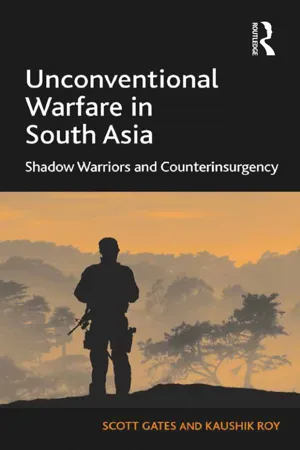
Unconventional Warfare in South Asia
Shadow Warriors and Counterinsurgency
- 218 pages
- English
- ePUB (mobile friendly)
- Available on iOS & Android
eBook - ePub
About this book
India is the world's tenth largest economy and possesses the world's fourth largest military. The subcontinent houses about one-fifth of the world's population and its inhabitants are divided into various tribes, clans and ethnic groups following four great religions: Buddhism, Christianity, Hinduism, and Islam. Framing the debate using case studies from across the region as well as China, Afghanistan and Burma and using a wealth of primary and secondary sources this incisive volume takes a closer look at the organization and doctrines of the 'shadow armies' and the government forces which fight the former. Arranged in a thematic manner, each chapter critically asks; Why stateless marginal groups rebel? How do states attempt to suppress them? What are the consequences in the aftermath of the conflict especially in relation to conflict resolution and peace building? Unconventional Warfare in South Asia is a welcomed addition to the growing field of interest on civil wars and insurgencies in South Asia. An indispensable read which will allow us to better understand whether South Asia is witnessing a 'New War' and whether the twenty-first century belongs to the insurgents.
Information
Chapter 1
Counter-Insurgency: Theories and Tools in South Asia
Counter-insurgency (COIN) theory is composed of roughly three parts: the nature of the rebellions, factors behind the origins of the rebellions, and the measures to be adopted for crushing such anti-state movements. As such, the term ‘theory’ is used as an equivalent of doctrine, which refers to a set of guidelines and often a composite body of ideas that influences the organization and deployment of the military assets. This chapter is divided into three sections. The first section discusses the New War theory regarding insurgencies and COIN in the contemporary world. The second section contextualizes COIN theories as propounded by the Indian security elite within the broader background of Western theories regarding COIN that emerged in the course of the twentieth century. This section also discusses the tools available to the Indian state for fighting the ‘shadow warriors’. And finally the third section shows the theory and instruments of COIN available to Pakistan.
COIN Theories in the Western World
In 1999, Mary Kaldor asserted that the end of Cold War and the beginning of globalization resulted in the genesis of New Wars. These new conflicts are a mixture of war and criminal activities characterized by large-scale abuse of human rights. In such wars, one finds a blurring of state and non-state distinctions. The autonomy of the state is eroded both from above and below and the net result is privatization of violence. Though these conflicts are local, they have transnational linkages. Non-governmental organizations (NGOs), international reporters and diaspora volunteers play an important role in such conflicts. Kaldor claims that the New Wars are different from traditional guerrilla struggles conducted by the Marxists. While the communist guerrillas tried to control territory, the objective of New War is to displace the civilian groups who are considered to be outsiders. In New War, the principal targets are the civilians; while in guerrilla struggles the principal victims of violence are security forces, nodes of communication, etc. The basic objective of New War is not state-building but to destroy the existing state structure. One of the basic factors behind the emergence of such wars is the rise of narrow and exclusive identity politics based on national, clan, religious and linguistic ethos. Political mobilizations for conducting such wars are accelerated due to the on-going revolution in information technologies. Such conflicts are financed through illegal trade in arms, drugs and other valuable commodities like oil and diamonds. And traditional humanitarian interventions will fail to stop such wars which will continue in the twenty-first century. The spectacle wars launched by the USA with high technology precision weapons to destroy the ‘rogue’ regimes (Afghanistan, Iraq, etc.), accelerate state collapse and further fuel the criminalized New War (Kaldor 2005a: 1–12; Kaldor 2005b: 210–22).
Herfried Munkler supports the New War theory of Kaldor. In Munkler’s paradigm, New War is characterized by three trends: the privatization of war, asymmetricalization, and demilitarization of war. Demilitarization of war means that the irregulars’ targets are civilians and the non-military infrastructure. Munkler contends that each of these trends was present in the history of warfare. But the simultaneous presence of these three trends is an original development and hence constitutes the nature of New War. Munkler points to a distinction between guerrilla war and New War. While the guerrillas use civilians for cover and logistical backbone, in New War, the civilian population is the prime target of the irregulars. Guerrillas depend on the support of the people. In contrast, those engaged in terrorism in the conduct New War use the civil infrastructure. The characteristics of such wars are de-territorialized and non-state forms of violence. Non-state agents such as affluent émigré communities and large companies finance these wars (Munkler 2007: 67–82).
A retired British General Rupert Smith also stresses the paradigm shift of war. Instead of New War, he uses the term ‘war amongst people’. The paradigm of industrial war, which emerged during the American Civil War and reached its logical culmination during the two World Wars, was eventually replaced by the new paradigm of war amongst people. Smith, influenced by the French post-modernist political philosopher Michel Foucault claims that power is a relationship and not a possession. In order to exert power, a country has to use its strength. Since the insurgents/terrorists move among the people, it is extremely difficult for the conventional armies of the West to use their strength. Insurgents organized in small cells and the members of each cell are often unaware of the members of another cell. The functions of a cell are to: direct military actions, collect and hold resources, and conduct political actions. The results of the activities of such cells are sub-strategic conflicts, which in turn challenge the strict bipolar peace-war distinction. Information – and not firepower – is the new tool required for fighting amongst the people. Further, media plays an important role in the new paradigm of warfare initiated by the non-state agents. While in the industrial war, the objectives are measured in territorial and material terms, in fighting amongst the people, the objective is to capture the will of the people. This can be done by collecting information about the local societies undergoing troubles and about the insurgents. After getting such information, the security force should strive to separate the insurgents from the people and attempt to change the attitude of the people till the rule of law is established. To achieve this, the security forces have to gain legitimacy in the eyes of the people. So, the moral component of the operation is vital. In order to gain information superiority as well as to influence the mind of the people, the commander of the government force must establish a positive relationship with the journalists (Smith 2006: 17, 329, 381, 393; Smith 2007: 28–43).
A more recent theory in the field is the concept of Fourth Generation Warfare (4GW), which is actually a derivative of the New War concept. In 2006, retired American Colonel Thomas X. Hammes wrote that warfare evolves from generation to generation (Hammes 2006: xi). This view contradicts the argument put forward by one school that a series of Revolution in Military Affairs (RMAs) had occurred in Western history and that at present, we are witnessing a RMA based on information technology (Goldman and Mahnken 2004; Knox and Murray 2003). Hammes writes that modern warfare is divided into several generations. First Generation Warfare (1799–1815), represented by mass military manpower, reached its epitome under Napoleon Bonaparte. Second Generation Warfare, characterized by firepower, reached its culmination in the trenches during the Great War (1914–18). The Nazis introduced Third Generation Warfare (1939–42) with their use of panzers for conducting large-scale manoeuvres. Now, we are in midst of a 4GW. The evolution of each generation of warfare requires an earlier evolution in the political, economic, social, and technical spheres. Hammes is influenced by Toffler’s wave theory, which states that the entire society was transformed before the transformation of warfare occurred with each wave. 4GW is characterized by manpower-intensive low-technology conflicts around the world (Hammes 2006: xii, 12, 16–31). To quote Hammes: ‘It is an evolved form of insurgency. Still rooted in the fundamental precept that superior political will, when properly employed, can defeat greater economic and military power, 4GW makes use of society’s networks to carry on its fight’ (Hammes 2006: 2). 4GW have been evolving around the world over the past seven decades. Two examples are Vietnam and Chechnya. Hammes warns that as the world still conceptually grapples with the 4GW, the 5GW (an individual or a small group causing devastating damages by sudden terrorist strikes, especially using biological weapons) is just round the corner (Hammes 2006: 3, 290–91).
In 2007, the 4GW theory received a shot in the arm from Frans Osinga, a retired colonel of Netherlands. Osinga writes that 4GW is distinctly non-conventional and non-military in character. The 4GW opponents wage war in the political and moral arena rather than in the military dimension (Osinga 2007: 179). To quote him, ‘It will be characterized by: very small independent groups or cells acting on mission-type orders; a decreased dependence on logistics support; emphasis on manoeuvre; and psychological goals rather than physical ones’ (Osinga 2007: 174). Non-state groups like the Hamas and Al-Qaeda represent agile cellular organizations. They are networked through ideology, shared ideas, experience, trust, goals and doctrine that thrive in uncertainty and foster innovation, creativity and initiative. Such a setup enables rapid and varied actions in a non-linear fashion. Osinga continues that in order to counter 4GW, close attention should be paid to the culture of the local societies in which this form of warfare is occurring. Following the American air-power theorist of manoeuvre warfare, John Boyd, Osinga claims that the COIN forces must observe, learn, and adapt to the local changing circumstances. Overall, 4GW points to the rise of non-trinitarian warfare and irrelevance of the Clausewitzian Trinitarian paradigm (army, people and the government forming the three sides of an equilateral triangle) that mostly focuses on conventional warfare between the nation states. In order to destroy the 4GW enemy, the COIN force must isolate the insurgents from three essential vectors (physical, mental and moral), while improving their own connectivity across the same vectors. The 4GW model derives from Martin Van Creveld’s argument put forward in 1991 in the book On Future War, that interstate war has become obsolete due to the decline of the nation states. The works of Christopher Coker and the British historian John Keegan who argue that warfare is not merely instrumental, as the West conceives, but also cultural for many societies, are the basic building blocks of 4GW theory (Osinga 2007: 174, 177, 179–81, 184).
Hugh Smith equates low intensity conflicts (LIC) and terrorism with anti-modern war. He says that after 1945, anti-modern warfare has killed more people than conventional war and this is the trend for the future. Besides kidnappings and extortion, these New Wars will be fought in cyberspace. The increasing reliance of states on information superhighways will generate cyber-terrorism. Computer hackers would be the new warriors. Somewhat in tune with Kaldor and Rupert Smith, Hugh Smith writes that anti-modern war is less of an instrument of policy wielded by the government on behalf of the people than a violent activity that engages all the elements of the society including those who are unarmed. Violence is more endemic than instrumental. In Hugh Smith’s paradigm, anti-modern war appears to be irrational because the insurgents participate in insurgencies for mindless violence rather than any rational calculation (Smith 2005: 251–71).
Similarly, Coker writes that the non-West’s understanding of warfare and warriors is psychologically and emotionally distinct from the Western concept of warfare. The Americans with their rigid instrumental or utilitarian attitude of warfare will never be able to grasp the objectives of 9/11. For the West, war is the means to an end but for the non-West, war is an end in itself. Hence, the Clausewitzian principle that war is a form of political intercourse is not applicable to the wars waged by non-Western societies. He continues that in instrumentalizing war, the West no longer understands the expressive elements inherent in the warfare waged by non-Western elements. Violence for the latter is not only instrumental but also constitutes the moral essence of the warrior. In the non-Western military cultures, for a true warrior, violence is existential. War is as much a means of realizing one’s humanity as achieving their political objectives. Through violence, a warrior comes to know himself and he creates his self. For the Asian insurgents, violence is cathartic, an existential experience by which they liberate themselves from their squalid circumstances and achieve their humanity. For Coker, the concepts of revenge and honour, rather than the Western concept of rationality, shape warfare outside the West. The West also possesses honour codes but has instrumentalized them. This is not the case in the Islamic societies. The Arab and Pushtun ideas of honour are an important component of the militant Islam that is fuelling the current insurgencies. Coker hints at 5GW warfare when he asserts that the citizens of the developed countries are now more interested in private security. And the military institutions of the state are failing to provide that. To counter the new terrorists, the mass conscript military must act more like a police force and must transform itself into small self-sufficient composite brigades filled with thinking middle-class citizens (Coker 2002; Coker 2007: 83–103).
Coker seems to have influenced Robert M. Cassidy, a battalion commander of the US Army. Cassidy, in his monograph which came out in 2006, writes that the present global insurgency is an evolving insurgency (the same term is used by Hammes, the proponent of 4GW) of a new kind. It has some similarities with twentieth-century revolutionary guerrilla war but also lot of differences from it. This evolving hybrid form of insurgency remains the strategy of the weak and embraces the hit-and-run tactics associated with guerrillas (Cassidy 2006: vii) Cassidy warns his American audience:
Potential adversaries are from Asia and the East, from cultures that have generally espoused an Eastern tradition of war. The Eastern way of war stems from the philosophies of Sun Tzu and Mao Tse-Tung, and is distinguishable from the Western way by its reliance on indirectness, perfidy, attrition, and protraction. In other words, the Eastern way of war is inherently more irregular, unorthodox, and asymmetric than our traditional conception of war. (Cassidy 2006: 3)
Cassidy continues that besides culture, which encourages attritional evasive warfare, the material and technological weakness of the Islamic world will encourage it to wage asymmetric warfare through ideas. While the twentieth century revolutionary guerrilla warfare was driven by the secular Marxist ideology, this new form of global insurgency is driven by a radical variant of Islam. The objective of the Islamic form of global insurgency is to overthrow the Westphalian system of states and establish an ideal Islamic Caliphate (Cassidy 2006: 6, 10–13).
Before moving on, we need to take stock of the theories regarding the paradigm shift of warfare discussed above. Most of the theorists who argue for a paradigm shift in warfare pay lip service to the history of warfare and state formation. Unlike Hugh Smith and Coker, several scholars search for rational reasons behind the genesis of insurgencies and reject the bipolar division of the world into Western and non-Western categories. Coker’s division of the world into Western mentality and non-Western mentality shaping warfare reminds one of Herodotus’ division of the world into Orient versus the Occident. Coker has to produce empirical evidence to prove his claim that the non-Western people fight for irrational atavistic reasons. Every insurgent group, be it Al-Qaeda or a Naga outfit in North-East India, has political objectives. So Clausewitz is not merely dead but alive and kicking. It is simplistic for Cassidy to argue that Marxist guerrilla warfare has been replaced by Islamic guerrilla warfare. Take for example South Asia. While in Kashmir, Islamic guerrilla warfare is going on; in Nepal and Jharkhand, the Maoist insurgencies constitute the principal threat. And in North-East India, the tribal feelings since the eighteenth century remain the principal driver of insurgencies.
In a compelling counter-argument to the New War thesis, Stathis Kalyvas shows that New Wars are first hardly new – that the qualities that distinguish supposed New Wars were evident in civil wars fought in the 19th and early 20th Centuries (Kalyvas 2001). Moreover, some New Wars exhibit the ideological purity that supposedly characterizes ‘old wars’ (Kalyvas 2005: 92).
The opportunity costs of joining a rebel movement cannot be dismissed out of hand. A highly educated relatively wealthy potential recruit must give up much more than a poorly educated poor peasant (Collier and Hoeffler 2002: 14–15). But this does not necessarily mean that material incentives are the main factor inducing young men to join an insurgency. Some insurgent groups are able to recruit without providing any economic remuneration (for instance, Maoists in Nepal and in Central India) and several insurgent groups which depend heavily on a supply of tangible incentives to attract and retain personnel within their ranks. The role of non-pecuniary rewards is especially significant for recruiting and maintaining the allegiance of rebel soldiers (Gates 2002). This is not to say that material incentives play no role. In the case of a cash crunch (limiting the ability to purchase weapons and supplies), a rebel group may then be forced to turn to loot and plunder. In the case of South Asia, one such example is the Khalistani insurgents of the late 1980s. Some groups may not rely on non-pecuniary rewards, by promising economic rewards and political power in the future when the rebels would capture the state apparatus. In present Pakistan, tribal and clan linkages and the hope for a better future sustains the rank and personnel of the Baluchi insurgents.
Elisabeth Jean Wood’s case study of the civil war in El Salvador in the 1980s features several motives for fighting. ‘While material grievances, principally inadequate access to land, played a role, I show that emotional and moral motives were essential to the emergence and consolidation of insurgent collective action.… Insurgent campesinos in interviews repeatedly stressed the importance of motives such as “that we not be seen as slaves”’1 (Wood 2006: 2). Wood continues that the campesinos (landless day labourer, permanent wage employee or farmer working on a small holding) who participated in land occupations and marches and provided logistical support to the guerrillas ran enormous amount of risk. Moreover, participation was voluntary. About 75,000 civilians in a population of five million died during the civil war. Wood does not find any evidence of E.P. Thompson’s ‘moral economy’. She claims that moral commitments and emotional engagements were the principal reason behind insurgent collective action during the civil war. The insurgents believed that they are creating a new social order in accordance with God’s will and they are also making history (Wood 2006). In a different context, Islamic insurgents in Kashmir are also in many cases motivated by non-tangible incentives: that they are...
Table of contents
- Cover Page
- Title Page
- Copyright Page
- Contents
- List of Maps and Tables
- Preface
- List of Abbreviations
- Glossary
- Introduction
- 1 Counter-Insurgency: Theories and Tools in South Asia
- 2 Tribes, State-Building and Guerrillas in North-East India
- 3 Communist Insurgencies: Maoists in Nepal and India
- 4 Jihadis in Kashmir
- 5 Insurgencies and Counter-Insurgencies in Pakistan
- 6 Insurgency and Counter-Insurgency in Afghanistan: From the Soviets to the Americans
- 7 Insurgency and Counter-Insurgency in Punjab
- 8 Insurgency and Counter-Insurgency in Sri Lanka: 1983–2009
- Conclusion
- Index
Trusted by 375,005 students
Access to over 1.5 million titles for a fair monthly price.
Study more efficiently using our study tools.
Frequently asked questions
Yes, you can cancel anytime from the Subscription tab in your account settings on the Perlego website. Your subscription will stay active until the end of your current billing period. Learn how to cancel your subscription
No, books cannot be downloaded as external files, such as PDFs, for use outside of Perlego. However, you can download books within the Perlego app for offline reading on mobile or tablet. Learn how to download books offline
We are an online textbook subscription service, where you can get access to an entire online library for less than the price of a single book per month. With over 1.5 million books across 990+ topics, we’ve got you covered! Learn about our mission
Look out for the read-aloud symbol on your next book to see if you can listen to it. The read-aloud tool reads text aloud for you, highlighting the text as it is being read. You can pause it, speed it up and slow it down. Learn more about Read Aloud
Yes! You can use the Perlego app on both iOS and Android devices to read anytime, anywhere — even offline. Perfect for commutes or when you’re on the go.
Please note we cannot support devices running on iOS 13 and Android 7 or earlier. Learn more about using the app
Please note we cannot support devices running on iOS 13 and Android 7 or earlier. Learn more about using the app
Yes, you can access Unconventional Warfare in South Asia by Scott Gates,Kaushik Roy in PDF and/or ePUB format, as well as other popular books in Politics & International Relations & Peace & Global Development. We have over 1.5 million books available in our catalogue for you to explore.