- 246 pages
- English
- ePUB (mobile friendly)
- Available on iOS & Android
eBook - ePub
About this book
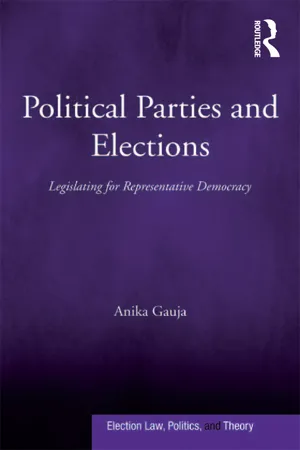
Political Parties and Elections presents a comparative analysis of the ways in which advanced industrial democracies seek to regulate the activities of political parties in electoral contests. Actual political practice suggests that parties are crucial actors in democratic elections, yet the nature and extent to which parties are regulated, or even recognized, as participants in the electoral process varies greatly among nations. Author Anika Gauja analyzes the electoral laws of five key common law democracies with similar parliamentary and representative traditions, similar levels of economic and political development, yet with significantly different electoral provisions: the United States, the United Kingdom, Canada, Australia, and New Zealand. Using the relationship between law and politics as a lens, the book focuses specifically on the ways in which these jurisdictions seek to regulate the behavior of their political parties as the product of a broader normative vision of how representative democracy ought to function. In its subject matter, comparative scope, and interdisciplinary theoretical framework, this book examines not only electoral law but also ancillary legislation such as funding regulations, associations and corporations law, and constitutional provisions. It also analyzes the case law that guides the interpretation of this legislation. Political Parties and Elections represents an innovative body of research, comparing for the first time the electoral-legal regimes of a significant number of common law nations.
Chapter 1
Public Law, Political Parties and Representative Democracy: A Framework for Comparative Analysis
In this chapter, I argue the need for a comparative assessment of the way in which the law seeks to regulate the activities of political parties as actors in elections – an assessment that acknowledges the inherent relationship between politics and the law. My central contention is that any differences between legal regimes and the way in which they have changed over time can best be understood as the product of lawmakers’ normative conceptions of representative democracy and the place of parties within it. The chapter will also briefly examine the symbiotic nature of the relationship between politics and the law, who are the key lawmakers in the regulation of political parties, and introduce the crucial debate on the public–private distinction in public law and how this has been applied to the legal regulation of political actors. Finally, I outline the book’s research design and method, the selection of states for analysis, and provide a brief chapter outline.
Introduction: Political Parties and Representative Democracy
Political scientists have long recognized the importance of political parties in the functioning of modern representative democracy. For example, Giovanni Sartori (1968: 471) has claimed that ‘citizens in Western democracies are represented through and by parties. This is inevitable’, while Schattschneider (1942: 1) argued that ‘modern democracy is unthinkable save in terms of political parties’ (see also Kelsen 1929; Ware 1987; Rosenblum 2000; Pildes 2004: 101). Actual political practice suggests that political parties are crucial actors in democratic elections: in established democracies, it is typically the political parties that nominate candidates for public office, run highly visible and organized election campaigns, and whose names (alongside their nominated candidates) appear on the ballot paper. As voters, we are much more likely to identify with, and express a general preference for a political party than endorse the policies of an individual candidate. This general conception of the importance of parties is reiterated in public opinion – an analysis of survey data from 13 states revealed that three-quarters of respondents thought that political parties were necessary for democracy (Dalton and Weldon 2005: 933). Although the definition and exact function of political parties is a topic of constant contestation in political science scholarship, a common theme underlying all accounts of parties in modern liberal democratic systems (and one that distinguishes them from other political actors such as pressure or interest groups) is that they exist for the purpose of contesting elections for public office.1
While the significance of parties is often taken for granted in politics and society, there exists considerable variation between legal systems as to the nature and extent to which parties are regulated, or even formally recognized, as participants in electoral and democratic institutions and processes. In common law liberal democracies such as the United Kingdom, Australia, Canada and New Zealand, only recently has the law acknowledged political parties as anything more than mere ‘voluntary associations’, akin to social and sporting clubs. In these democracies, many electoral law provisions continue to be characterized in terms of individual candidates rather than battles between national political party organizations. This categorization of political parties has had important consequences for voters, for example, in the area of campaign financing where expenditure by political parties has for the most part of the twentieth century been unregulated and hence issues regarding transparency and fairness in the electoral contest have arisen. It has also had important ramifications for members of political parties by historically restricting their legal rights and opportunities to seek redress for any wrongs committed by a party against them. This absence of any substantial legal regulation of the financial and internal affairs of political parties has been portrayed by many commentators as a ‘double standard’ between the importance of political parties in modern systems of representative democracy and their status at law, and has been followed by calls for increased legal regulation.2
However, this laissez-faire treatment of political parties is not something that is common to all nations. Political parties in the United States are some of the most comprehensively regulated parties in the world, despite constitutional freedom of speech and association provisions that could conceivably be used as a shield to protect political parties and their members from interference by the state. The impact of First Amendment rights upon attempts to regulate the activities of political parties is a constant source of tension in American jurisprudence. Amongst European democracies, the legal position of parties in Germany is so strongly articulated in the country’s Basic Law that they are regarded as ‘institutions of constitutional law’ (Müller and Sieberer 2006: 439). Parties also feature prominently in the constitutions of Portugal, Spain and many newly established democracies following the collapse of the Soviet Union. What these diverse experiences suggest is that political parties are viewed and regulated differently across nations according to historical experiences, political philosophies, social attitudes towards the normative role that political parties should play in representative democracies and how elections as processes are actually defined.
A difficulty with much of the existing literature on the legal status of political parties is a tendency to treat the political importance of parties and the fact that they have not been subject to a great deal of regulation in many liberal democracies as a curious paradox, without providing any sustained historical, political and legal analysis as to why this has occurred. Adequately explaining the current climate of legal regulation and predicting future developments not only requires a legal and political analysis of the body of case law and precedent relating to both the legal and political status of parties, but also a broader examination of the legislative and constitutional design of representative democracy in the various nations under consideration, and an appreciation of the political and historical context within which major reforms have occurred.
Political parties are particularly fascinating to explore as subjects of legal regulation not only because of their importance in the functioning of representative democracy as we currently know it, but their unique characteristics and dynamic nature. Parties are constantly evolving in their organizational forms, they are multi-levelled and multi-layered institutions with several centres of power and by their very nature as aggregators of citizen opinion they embody significant disagreements between and within members, supporters and party activists. However, the fact that political parties are not autonomous or unified actors poses a significant challenge for their legal regulation.
Given these interesting variations, a comparative analysis of the ways in which advanced industrial democracies seek to regulate (or refrain from regulating) the activities of political parties in electoral contests is timely. Furthermore, it is appropriate to adopt a theoretical perspective to rationalize and analyse these divergent legal regimes that acknowledges that the regulation of political parties through the public law is inherently connected to lawmakers’ own normative visions of representative democracy and the place of parties within it. As lawmakers within the legislative arena are typically also party members, these normative visions might also embody a particular regard for partisan interests. There is an intimate relationship between politics, normative political theory and election law that reflects the diversity of electoral law provisions across the globe. Although this relationship between law and politics is readily acknowledged by constitutional law scholars, it needs to be more explicitly and systematically addressed in electoral law studies.
Political Parties and Elections analyses the electoral laws of five common law democracies with similar legislative and representative traditions, similar levels of economic and political development, yet with significantly different electoral provisions: the United States, the United Kingdom, Canada, Australia and New Zealand. The book specifically focuses on the ways in which these jurisdictions seek to regulate the behaviour of their political parties as the product of a broader normative vision of how representative democracy ought to function. Such visions are more often than not obscured or unacknowledged and identifying them requires a careful analysis of both legislative provisions and case law, informed by historical and contemporary political debates. Although the primary aspect of this study is elections, the way in which political parties contest government is regulated through more than simply a discrete body of electoral law. In this respect, I also examine the impact of ancillary legislation such as funding regulations, associations and corporations law, administrative law and constitutional provisions. The analysis incorporates both legislative sources and developments in case law – the latter source is most often missing from works published on parties in the political science tradition. It is an original synthesis of secondary material, new legal and empirical political research and critical commentary.
Existing Literature on the Legal Regulation of Political Parties
Compared to the burgeoning generalist literature on political parties, electoral and party systems, very few books have been written to date on election law in the democracies under consideration, let alone specifically on the role and regulation of political parties as electoral actors.3 This is perhaps a consequence of the fact that the topic sits at the intersection of two interrelated, yet conceptually distinct disciplines (political science and law), that until recently have tended to talk past, rather than to, one another. Few manuscripts published in the legal tradition adequately acknowledge the importance of politics (and particularly parties) in shaping the contours of representative democracy. As Bogdanor (2004: 718) argues:
It is perhaps because the law was so late in recognising political parties that constitutional lawyers and other writers on the constitution have taken insufficient notice of the fact that parties are so central to our constitutional arrangements and, more particularly, that these arrangements vary with the configuration of the party system.
Similarly, many politics books dealing with parties and democracy pay little attention to the substantial body of public law that regulates and shapes the activities of these organizations. This is surprising given that party politics essentially reflects society and is played out within a set of rules, which, although changeable, inherently influence parties’ conduct (Jupp 1968: 36). All party systems are characterized by a particular set of social, political, cultural, economic and legal circumstances. Although the first four of these influences have been analysed at great length by the political science community, the various legal frameworks governing the operation of political parties have received far less attention, particularly from a comparative perspective (van Biezen 2008a). This is a significant omission, as the potential for the law to influence the activities of political parties is considerable. Legal regulations are the most direct form of state intervention in party politics, requiring parties to fulfil conditions that relate to the content and form of their organizations (Müller 1993), in addition to indirectly influencing parties’ priorities through the design of electoral systems.4 In bringing together these two perspectives, I hope this book to be of use to both lawyers and those interested in studying politics.
Nevertheless, as the trend towards increased regulation is becoming more apparent, comparative party scholars have devoted more attention to the topic of legal regulation in recent years (see, for example, van Biezen 2008a; Karvonen 2007; Gauja 2008; Janda 2005; Casas-Zamora 2005; Johns 1999). Of particular concern is the potential impact that legal regulation may have on parties as organizations, and the character of the broader democratic system within which they operate. In this respect, discussion of the legal framework has centred upon the design of electoral systems, and hence the impact of the law on political parties tends to be evaluated predominantly to the extent that party activities intersect with the proper functioning of a competitive electoral system (see, for example, Rae 1967). The main areas of existing inquiry include the regulation of political campaigns (including party finance, broadcasting and advertising), the conduct of elections and disputed returns, the registration of parties and electoral administration. Excluding some more recent scholarship in the US (see, for example, Kang 2005; Magarian 2003; Garrett 2002; Persily and Cain 2000), there has been comparatively less analysis of the impact of the law on parties in their capacity as participatory organizations.
Studies of the legal regulation of political parties have been more numerous in the democracies of Western Europe. Many earlier writings centred on the experience of Germany, which provides explicit regulation for its political parties, but academic attentions are becoming increasingly comparative in scope, now focusing on other nation states of Europe (see, for example, van Biezen 2008a, 2008b; Müller and Sieberer 2006). American legal scholarship has also paid increasing attention in the last decade to what Issacharoff (2000: 596) refers to as ‘the structural and institutional mechanisms necessary for participation in democratic politics’, of which party law forms a crucial element (see, for example, Epperson 1986; Persily and Cain 2000; Magarian 2003). Apart from several recent volumes that focus on campaign financing (Ewing and Issacharoff 2006; Ewing 2007), party regulation is remains relatively under-studied in the United Kingdom, Australia, Canada and New Zealand.5
The Relationship Between Politics and the Law
The research and analysis presented here is underpinned by the fundamental assumption that politics and the law are intertwined. Employing a legal-procedural perspective in evaluating comparative regulatory frameworks, I argue that the laws that regulate how elections are conducted are just as worthy of analysis as the outcomes that they produce (which is the predominant focus of the political science discipline).6 As Geddis (2007a: 1) argues, ‘on most occasions when the electoral process comes under scrutiny, the institutions and practices underpinning it are treated as given’. From a procedural perspective, how laws are made, who makes them and the purpose they are meant to serve are questions just as relevant as their specific content and their political consequences. In examining these questions, important policy issues and conflicts come to the fore, and the different norms and conceptions of politics that various actors might hold will inevitably lead to competing assessments and different prescriptions about the appropriate status and legal regulation of political parties (van Biezen 2008a: 14).
For a complete comparative picture, it is necessary not only to evaluate the current laws that regulate the behaviour of political parties as electoral actors, but also analyse the deeper policy and political issues that lie behind the decisions to adopt different legal regimes that are not always made explicit. The book demonstrates how debates over the rules, laws and regulations that are adopted and applied to political parties reflect historical developments, deeper notions of the nature and form of representative democracy, and how this might differ not only between political actors, but between jurisdictions and nation states.
I take a new institutionalist approach to law and the role of the courts in investigating the ways in which courts are political institutions and how they are connected to the larger framework of government and representative democracy. The underlying assumption of this approach is that law, political processes and institutions are symbiotic. Laws reflect prevailing political and socioeconomic forces, but they are also constitutive of these elements as they can ‘privilege certain groups or ideas above others, can influence the strategies of actors in the political and socio-economic systems, and can also shape the attitudes and goals of actors in the political process’ (Hausegger, Hennigar and Riddell 2009: 23). When we apply this thinking to the legal regulation of political parties, an element of circularity appears in the relationship between law and democracy, in which parties are both the governors and the governed. Legal and electoral systems rely heavily on their ‘democratic genesis’ for legitimacy (that is, a system of lawmaking involving political parties; yet democracy only exists in an institutional and procedural form as it has been created by laws framed by political parties (see Geddis 2003: 53; Issacharoff, Karlan and Pildes 1998: 1–3).
Politics Shapes Lawmaking
The practice of politics inherently shapes the law, whether this occurs through the process of contestation and debate that occurs in the legislative chamber by elected representatives, or in the practice of interpretation and the application of laws and constitutions that is undertaken by the judiciary.
One interesting yet potentially problematic aspect of the legal regulation of parties is that the design of electoral systems and the legislation governing their conduct is initiated, debated and implemented by the parties themselves. Hence, there is opportunity for governing parties to reinforce pre-existing patterns of dominance, or to privilege their own positions in the design of particular legal regimes. In recent years, studies of party organization (and in particular the cartel party thesis, discussed below) have been concerned with this possibility, and it has also been noted by legal scholars (Feasby 2007; Geddis 2007a: 20; Carothers 2006: 194; Pildes 2004). As Carothers (2006: 194) argues, we need to be circumspect of both the underlying rationale and the potential consequences of electoral legislation: ‘even when changes in party law are the cooperative project of all of the main political parties in a country, both those in government and the opposition, some part of the underlying motivation may not be democracy strengthening, no matter how the project is billed’. In other cases, legislation that is enacted may reflect or favour, more blatantly, the interests of the governing party, or privilege the interests of those parties currently represented in the legislature. Examples include party registration provisions, ballot access laws and the provision of public funding and subsidies to parties. Whether or not judicial review and constitutional oversight provides sufficient protection in this instance (assuming that courts are willing to flex their muscles in the wake of parliamentary sovereignty) is a topic that is open to debate, and one which I explore further in Chapters 4, 5 and 6.
However, des...
Table of contents
- Cover Page
- Title Page
- Copyright Page
- Contents
- List of Tables
- Acknowledgements
- 1 Public Law, Political Parties and Representative Democracy: A Framework for Comparative Analysis
- 2 Political Parties and Constitutions
- 3 The Gradual Legal Recognition of Political Parties
- 4 Requirements for Party Registration and Internal Organization
- 5 Regulating Party Candidate Selection Contests
- 6 Parties and the Conduct of Elections
- 7 The Public Funding of Election Campaigns and Political Parties
- 8 The Private Funding of Election Campaigns: Regulating Political Donations and Expenditures
- 9 Parties in Parliament: The Independence of the Legislature
- 10 Conclusion
- Bibliography
- Index
Trusted by 375,005 students
Access to over 1.5 million titles for a fair monthly price.
Study more efficiently using our study tools.
Frequently asked questions
Yes, you can cancel anytime from the Subscription tab in your account settings on the Perlego website. Your subscription will stay active until the end of your current billing period. Learn how to cancel your subscription
No, books cannot be downloaded as external files, such as PDFs, for use outside of Perlego. However, you can download books within the Perlego app for offline reading on mobile or tablet. Learn how to download books offline
Perlego offers two plans: Essential and Complete
- Essential is ideal for learners and professionals who enjoy exploring a wide range of subjects. Access the Essential Library with 800,000+ trusted titles and best-sellers across business, personal growth, and the humanities. Includes unlimited reading time and Standard Read Aloud voice.
- Complete: Perfect for advanced learners and researchers needing full, unrestricted access. Unlock 1.5M+ books across hundreds of subjects, including academic and specialized titles. The Complete Plan also includes advanced features like Premium Read Aloud and Research Assistant.
We are an online textbook subscription service, where you can get access to an entire online library for less than the price of a single book per month. With over 1.5 million books across 990+ topics, we’ve got you covered! Learn about our mission
Look out for the read-aloud symbol on your next book to see if you can listen to it. The read-aloud tool reads text aloud for you, highlighting the text as it is being read. You can pause it, speed it up and slow it down. Learn more about Read Aloud
Yes! You can use the Perlego app on both iOS and Android devices to read anytime, anywhere — even offline. Perfect for commutes or when you’re on the go.
Please note we cannot support devices running on iOS 13 and Android 7 or earlier. Learn more about using the app
Please note we cannot support devices running on iOS 13 and Android 7 or earlier. Learn more about using the app
Yes, you can access Political Parties and Elections by Anika Gauja in PDF and/or ePUB format, as well as other popular books in Law & Law Theory & Practice. We have over 1.5 million books available in our catalogue for you to explore.