eBook - ePub
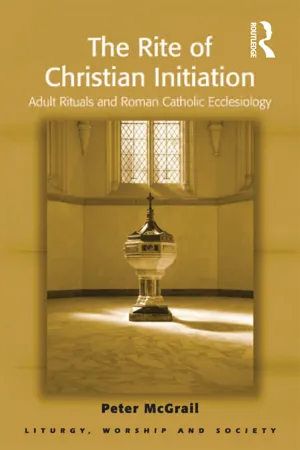
The Rite of Christian Initiation
Adult Rituals and Roman Catholic Ecclesiology
- 230 pages
- English
- ePUB (mobile friendly)
- Available on iOS & Android
eBook - ePub
About this book
In the wake of recent papal legislation, the various liturgies of the Roman Rite may today be celebrated in either their post-Tridentine or post-Vatican II forms. Whilst much discussion of this new situation focuses on purely liturgical issues, this book breaks new ground by arguing that the coexistence of the two forms raises questions of a profoundly ecclesiological character. Peter McGrail explores the relationship between ritual form, ecclesial self- understanding and constructs of the world that are at play as adults become members of the Church. Analysing the rites by which adults were taken into the Church for three and a half centuries, this book goes on to explore attempts to find a new ritual expression for the journey to Christian Initiation, set against the divergent and even conflicting ecclesiologies which were at play before and during the Council.
Information
Chapter 1
The Perfect Society and the Mystical Body: Catholic Ecclesiology from Trent to Pope Pius XII
Benedict XVI devoted his General Audience address of 23 February 2011 to considering the impact upon the Church of the life and work of the cardinal, polemicist and saint Robert Bellarmine (1542–1621). Bellarmine’s magnum opus, the ‘Debates on the Controversies of the Christian Faith against the Heretics of this Time’1 (henceforth Disputationes), was for Benedict ‘a reference point, still valid, for Catholic ecclesiology on questions concerning Revelation, the nature of the Church, the sacraments and theological anthropology’.2 The second and third points are significant for this study, for not only was Bellarmine a contemporary of the 1614 OBA, but the Disputationes was also one of the dominant influences on ecclesiological thought during the course of the later history of that rite. In terms of the subsequent discourses of initiation two ecclesiological motifs that thread through the chapters of this book stand out from his work. The first, which casts light upon Ottaviani’s concerns about the Introduction to Sacrosanctum Concilium, is with regard to the visibility of the Church. This motif relates, in the first instance, to the question of where can the limits of the Church be set – relevant here because it defines who does and who does not require initiation and what manner of ritual is to be performed with them. Flowing from that arises the question of exactly what kind of visible society the Church is – and how it relates to other human institutions. As we shall see in this chapter, the nineteenth- and early twentieth-century formal response to that question was expressed in terms of the Church as ‘Perfect Society’ – a concept that sits comfortably with the ritual of the OBA. The second Bellarminian motif, the concept of the Church as the Mystical Body of Christ, similarly raises an echo in later theological developments. After a complex history of development across the nineteenth and twentieth centuries this was to become one of the two dominant ecclesiological images of the RCIA. The exploration of that history, and of these two ecclesial models, forms the necessary prelude to the next chapter’s consideration of the OBA, and indeed to the whole book. They will recur across its length – informing the theological analysis of the rites, and the discussion of the various mindsets and preoccupations that in a post Summorum Pontificum Church inform the choice between using the Ordinary or the Extraordinary forms of adult initiation.
In this chapter, therefore, I trace the outlines of ecclesiology in the period of the OBA’s ascendancy. I take Bellarmine as a starting point because he offers a clear point of departure for exploring the issues at stake. Then, after considering the pioneering exploration of the Church as Mystical Body by the German theologian Johann Adam Möhler (1796–1838), I discuss the attempt to bring that model alongside the concept of Church as Perfect Society as expressed in the first draft schema on the Church prepared for the First Vatican Council (1869–70). I then move into the twentieth century, continuing to explore the progress of the theme of the Church as Mystical Body.
Robert Bellarmine
The Disputationes grew out of Bellarmine’s lectures in polemics delivered between 1576 and 1589 at the Gregorian University in Rome. Thus, in approaching a definition of the Church he opened polemically by considering a range of approaches to defining the membership of the Church, which he synthesised from Protestant theology. A common motif he identified was an understanding that the true Church is an invisible, spiritual reality that cannot be directly mapped onto the Church on earth. So, engaging with the writings of Johann Brenz (1499–1570) and the Apology of the Augsburg Confessions of Philipp Melanchthon (1497–1560), he wrote:
These men imagine that there are two Churches. The first is the congregation of the Saints who truly believe in God and obey Him. It is not visible, except to the eyes of faith. This they hold to be the true Church, to which, they say, belong the privileges spoken of in the Scriptures. The other Church is external, but still bears the name of Church. They consider this to be the congregation of those who are united by doctrine and in the use of the sacraments. Good folk and wicked alike are to be found in it.3
Bellarmine responded to this construct of others’ views by insisting that there can only be one Church, and that this must (a) be visible and (b) constitute a mixed community of both the good and sinners. His fundamental definition of the Church, therefore, was framed in structural terms:
There is one Church, not two, and this one true Church is the assembly of men joined by the profession of the same Christian faith and by the communion of the same sacraments, under the regime of legitimate pastors and especially of the Roman Pontiff, the one Vicar of Christ in the world.4
Bellarmine’s articulation of the concrete nature of this assembly is not hedged about by concerns about the presence of sinners within it or the ultimate eternal destiny of some of its members. At the level of fundamental reality, the Church is just as visible as any other institutional sub-sets of humanity, such as the Roman people, the Kingdom of France and the Republic of Venice.5 This definition, Bellarmine thought, provided three basic criteria that could serve as an easy rule of thumb for determining exactly who is and is not a member of the true Church: profession of the true faith; sacramental communion; and submission to papal authority. The non-baptised (including catechumens who were preparing for baptism), heretics, apostates, the excommunicated and schismatics all fell outside the Church – everyone else, even the most public sinner, was deemed to be a member. As a result, Bellarmine effectively identified the Christian Church with the Catholic Church as visibly manifested and institutionally constituted.
The Church was understood by Bellarmine also to constitute a theological reality:
a living body, in which there is a soul and a body. The soul comprises the internal gifts of the Holy Spirit, that is Faith, Hope, Charity, etc. The body comprises the external profession of faith and sharing in the sacraments.6
Bellarmine subsequently elaborated this theology of the Church as Body by distinguishing between the ‘formal’ and ‘material’ parts of the Church. The latter comprises individual men and women who are members of the Church. This ‘material’ part of the Church, he wrote, is in a constant process of flux and of transformation in Christ, but not all members of the Church will be saved. On the other hand, those elements that together constitute the ‘form’ of the Church (‘Apostles, Prophets, Pastors, Doctors, etc.’)7 are constant, and therefore one can speak of the Mystical Body per se as being destined for salvation.
Benedict XVI’s positive assessment of Bellarmine’s theological contribution contrasts sharply with the view of Yves Congar (1904–95). In an extremely negative evaluation of the Counter-Reformation Catholic polemical ecclesiological genre, of which the ecclesiological portions of the Disputationes were an early and highly influential example, Congar wrote that such treatises on the Church were:
principally, sometimes almost exclusively, a defence and affirmation of the reality of the Church as machinery of hierarchical mediation, of the powers and primacy of the Roman see, in a word a ‘hierarchology’. On the other hand, the two terms between which that mediation comes, the Holy Spirit on the one side, the faithful people or the religious subject on the other, were as it were kept out of ecclesiological consideration.8
The charge that the study of the Church had been reduced to a study of the hierarchy is a challenging one; Congar was careful in speaking of the ‘fortunes’ of Bellarmine’s text, deflecting attention, perhaps, away from the author himself.9 However, the key features he attributes to his ‘hierarchology’ can certainly be found in Bellarmine, and not least in the insistence upon the ‘visibility of the Church and her members’.10 In a rather sweeping summary of the entire Protestant–Catholic ecclesiological polemic, Congar wrote:
whilst Protestants were reducing the Church to an inward Christianity, to salvation, and by so doing were dissolving ecclesiology, Catholic apologists were looking at her above all as the machinery of the means of grace, as the hierarchical mediation of the means to salvation.11
The Church as Perfect Society
The Bellarminian appeal to the external and especially to the hierarchical aspects of the Church was to find nineteenth- and early twentieth-century expression in the concept of the Church as ‘Perfect Society’. This concept should not be confused with any sense of the Church as ...
Table of contents
- Cover Page
- Title Page
- Copyright Page
- Dedication
- Contents
- Acknowledgements
- List of Abbreviations
- Introduction
- 1 The Perfect Society and the Mystical Body: Catholic Ecclesiology from Trent to Pope Pius XII
- 2 The Extraordinary Form 1: The 1614 Ordo Baptismi Adultorum
- 3 Sacrament of Christ and People of God: Ecclesiology at the Eve of Vatican II
- 4 The Extraordinary Form 2: The Christian Initiation of Adults from 1948 to Vatican II
- 5 The Ecclesiologies Of Vatican II: The Church Ad Intra
- 6 The Ordinary Form: The Rite Of Christian Initiation Of Adults
- 7 Christian Initiation And The Church Ad Extra
- 8 Hermeneutics of Continuity and Discontinuity
- Conclusion
- Bibliography
- Index
Trusted by 375,005 students
Access to over 1.5 million titles for a fair monthly price.
Study more efficiently using our study tools.
Frequently asked questions
Yes, you can cancel anytime from the Subscription tab in your account settings on the Perlego website. Your subscription will stay active until the end of your current billing period. Learn how to cancel your subscription
No, books cannot be downloaded as external files, such as PDFs, for use outside of Perlego. However, you can download books within the Perlego app for offline reading on mobile or tablet. Learn how to download books offline
Perlego offers two plans: Essential and Complete
- Essential is ideal for learners and professionals who enjoy exploring a wide range of subjects. Access the Essential Library with 800,000+ trusted titles and best-sellers across business, personal growth, and the humanities. Includes unlimited reading time and Standard Read Aloud voice.
- Complete: Perfect for advanced learners and researchers needing full, unrestricted access. Unlock 1.5M+ books across hundreds of subjects, including academic and specialized titles. The Complete Plan also includes advanced features like Premium Read Aloud and Research Assistant.
We are an online textbook subscription service, where you can get access to an entire online library for less than the price of a single book per month. With over 1.5 million books across 990+ topics, we’ve got you covered! Learn about our mission
Look out for the read-aloud symbol on your next book to see if you can listen to it. The read-aloud tool reads text aloud for you, highlighting the text as it is being read. You can pause it, speed it up and slow it down. Learn more about Read Aloud
Yes! You can use the Perlego app on both iOS and Android devices to read anytime, anywhere — even offline. Perfect for commutes or when you’re on the go.
Please note we cannot support devices running on iOS 13 and Android 7 or earlier. Learn more about using the app
Please note we cannot support devices running on iOS 13 and Android 7 or earlier. Learn more about using the app
Yes, you can access The Rite of Christian Initiation by Peter McGrail in PDF and/or ePUB format, as well as other popular books in Theology & Religion & Religion. We have over 1.5 million books available in our catalogue for you to explore.