eBook - ePub
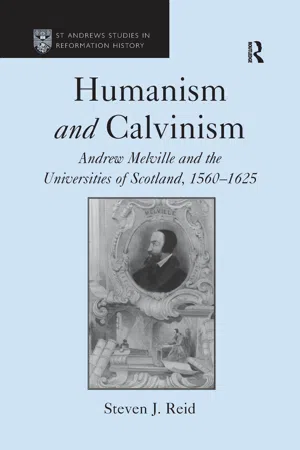
Humanism and Calvinism
Andrew Melville and the Universities of Scotland, 1560–1625
- 350 pages
- English
- ePUB (mobile friendly)
- Available on iOS & Android
eBook - ePub
About this book
Across early-modern Europe the confessional struggles of the Reformation touched virtually every aspect of civic life; and nowhere was this more apparent than in the universities, the seedbed of political and ecclesiastical society. Focussing on events in Scotland, this book reveals how established universities found themselves at the centre of a struggle by competing forces trying to promote their own political, religious or educational beliefs, and under competition from new institutions. It surveys the transformation of Scotland's medieval and Catholic university system into a greatly-expanded Protestant one in the decades following the Scottish Reformation of 1560. Simultaneously the study assesses the contribution of the continentally-educated religious reformer Andrew Melville to this process in the context of broader European social and cultural developments - including growing lay interest in education (as a result of renaissance humanism), and the involvement of royal and civic government as well as the new Protestant Kirk in university expansion and reform. Through systematic use of largely neglected manuscript sources, the book offers fresh perspectives on both Andrew Melville and the development of Scottish higher education post-1560. As well as providing a detailed picture of events in Scotland, it contributes to our growing understanding of the role played by higher education in shaping society across Europe.
Information
CHAPTER 1 Between Reformation and Reform: The Scottish Universities, 1560–1574
The intellectual forces of humanism and Protestantism had a very limited impact on the Scottish universities prior to 1560, and the two decades following the reformation were precarious and unsettling times for what were at heart three very medieval and Catholic institutions. Cut off at a stroke from the papal authority that had created them, they not only had to re-orient their teaching and curriculum towards the new Protestant status quo, but had to find a new identity for themselves.
They had only partial success in achieving this. Aberdeen remained largely Catholic and Glasgow almost ceased to exist. St Andrews managed some measure of reform, and what was achieved was down largely to the work of university staff, with occasional help (and sometimes interference) from the civil government and minimal involvement from the General Assembly, the governing body of the new Protestant Kirk.
At all three, however, the overriding impression is one of paralysis followed by stasis. All the universities were unwilling or unable to shed overnight the legacy of their medieval and scholastic past, and the vast majority of their pre-reformation academic framework (particularly at St Andrews) was retained wholesale or modified with the minimum of effort. Looking collectively at the picture of Scottish higher education in the immediate aftermath of the reformation, it is clear that the process of university reform only gained real momentum with the arrival of Andrew Melville in Glasgow in 1574. However, one trend that does emerge in this turbulent period, and which would dominate events at the universities for the following half century, was the involvement of both national and civic government in the earliest attempts at Protestant reform. An attempt to revitalise Glasgow under the aegis of the town council in 1573, though abortive, would be a prescient model for similar attempts by town councils in Edinburgh and Aberdeen to provide their citizens with a Protestant ‘arts college’, where they could ensure their children received a decent and ‘godly’ education; and the limited progress and development at Aberdeen and St Andrews, despite a range of competing social, political and religious tensions within both universities, owed much to the interference of the royal government in their affairs.
The Scottish Universities, c. 1410–1560
By 1560 there were three universities in Scotland, and all three owed their existence to the Catholic Church. Each founded by bishops, they were all members of the elite class of institution known as studium generale, authorised by papal bull to teach arts and the higher faculties of theology, law and medicine, to examine students for masters or doctoral degrees, and for their chancellor (ex officio the bishop or archbishop of the diocese) to confer the licentia ubique docendi, the universally recognised qualification allowing a graduate to teach at any other university in Europe. The University of Glasgow was established by a papal bull of Nicholas V on 7 January 1451, and although its founder, Bishop William Turnbull, had placed an especial focus at its outset on the teaching of canon and civil law, within a year of its foundation the university also included a range of masters and students in theology and arts.1 In 1495 papal approval was given to Bishop William Elphinstone to erect a university possessing the full range of faculties in the ‘physical remoteness’ of Aberdeen. The foundation charter of King’s College (as the collegiate foundation at the core of the university was known), drawn up on 17 September 1505 and supported by a broad range of endowments and annexed parishes, provided for 36 staff and students. These included a principal and sub-principal who would teach theology and philosophy respectively, dedicated teachers in canon law, civil law, medicine and grammar, 18 bursars in theology and arts, and 12 priests and choirboys.2 The oldest Scottish university, St Andrews, began life when a small group of graduates, mostly from Paris and without a fixed residence in the city, started teaching in early 1410. By February 1412, this peripatetic group had grown to such an extent that Bishop Henry Wardlaw was willing to grant them legal privileges and exemption from taxation in a charter of incorporation, and the university was formally ratified by Pope Benedict XIII in a series of six papal bulls in August 1413.3
By 1560 St Andrews had, unlike Glasgow and Aberdeen, developed from a single pedagogy into a federation of three distinct colleges (each almost as large as the foundations elsewhere) administered as a single university. The first of these, a centre for theology and arts dedicated to the Holy Saviour, or St Salvator, was founded by Bishop James Kennedy in 1450. Kennedy’s foundation was an attempt to provide fresh impetus to studies in the university on a new site away from the original foundation in the south quarter of the medieval city, where squabbles over precedence and privileges, inherent resistance to change on the part of the masters, and inadequate endowment made the idea of reforming it unpalatable. The corporate structure of St Salvator’s – symbolically mirroring Christ and the twelve apostles – comprised three masters in holy orders who were to be a master, licentiate and bachelor in theology respectively, four masters of arts studying towards their theology degrees, and six poor scholars who would serve as choristers in the ornately gothic collegiate church that Kennedy created as part of his foundation.4
On 20 August 1512 Archbishop Alexander Stewart and the prior of the Augustinians in St Andrews, James Hepburn, erected the hospital and church of St Leonard, with funds from a number of lands belonging to the priory, into a further university college, to be known officially as the ‘College of Poor Clerks of the Church of St Andrews’. Better known as the College of St Leonard, it comprised a principal and theologian, four chaplains (two of whom were regents in arts), and 26 poor students in arts and theology, and was founded with the express aim of better educating novices of the local Augustinian order.5 However, by the early 1520s the works of the ‘heretik Luthere and his discipillis’, outlawed in Scotland by Act of Parliament on 17 July 1525, were circulating and being widely debated at the college.6 John Knox noted that St Leonard’s was central to the early dissemination of Protestant doctrine in the city and that several of the staff and students, along with a number of the ‘novices’ of the abbey, were persecuted as heretics by Archbishop James Beaton in the 1520 and 1530s.7 The most famous of these was Patrick Hamilton, who had come back to St Andrews after a brief spell at Philip of Hesse’s newly-established university at Marburg in 1527 espousing a number of Lutheran beliefs, and was burnt outside the gates of St Salvator’s College on 29 February 1528.8 However, Hamilton’s fellow student Henry Forrest, tried and executed by Beaton in October 1533, had also studied at St Leonard’s, entering the college in 1526.9
The final college established at St Andrews before 1560 was the ‘College of St Mary of the Assumption’ or St Mary’s. Established in rather piecemeal fashion between 1525 and 1555, the first stage in its foundation took place under Archbishop James Beaton between 1525 and 1538 and was sited on the remains of the original university buildings.10 Founded for the ‘instruction of our lieges in the Catholic faith, the opposing of heresy … [and the] instruction of able men in culture, science and policy within our realm’, Beaton aimed to counter the heresy he saw within Scotland with a college that would act as a vehicle for Catholic reform.11 The plans for his foundation were heavily influenced by his nephew, the Parisian-trained humanist Archibald Hay, who argued in his Oratio Pro Collegii Erectione (1538) and in his Panegyricus (1540) to Beaton’s nephew and successor Cardinal David Beaton that the college should incorporate the humanist subjects of poetry, rhetoric and history into the curriculum at the college, as well as the works of Cicero and Plato alongside those of Aristotle.12 Most importantly, Hay argued that the college should follow the example of a growing range of foundations on the Continent, including the University of Alcala founded around 1500 and the College des Lecteurs Royaux founded by Francis I in Paris in 1530, which placed a central emphasis on training students in classical Latin and in the original source languages of the Bible – Hebrew, Aramaic, Chaldaic and Greek – so that Christian humanists could better engage with the source text of their faith.13
The plans for St Mary’s stalled following the murder of Cardinal Beaton at the hands of Protestant reformers in 1546, but the college was re-founded by Archbishop John Hamilton between February 1554 and February 1555 on a much larger scale with a complement of 36 staff and students.14 Hamilton’s re-foundation of St Mary’s was part of a wider series of initiatives for Catholic reform that he implemented in Scotland between 1549 and 1559, including a series of reforming provincial councils enforcing new standards in clerical behaviour and education in line with the decrees of the Council of Trent, and the publication of a vernacular catechism in August 1552 that tried to appeal to both Catholics and moderate evangelicals in tone and content.15 Hamilton’s re-foundation proposed three theologians and three philosophy professors with a canon lawyer at its core, alongside a grammarian, rhetorician and several ancillary staff, and although it made no mention of the ‘trilingual’ foundation proposed by Hay, it did closely follow the plan for a school of divinity at Bonn laid down by another proponent of Catholic church reform, the Archbishop of Cologne Hermann von Wied.16 With the different strands of his reform programme, Hamilton aimed to produce qualified, literate preachers who could strengthen the Scottish Catholic Church while appealing to as broad a base of moderate reformers as possible. Unfortunately, St Mary’s was still in largely embryonic state when the reformation gained momentum in Scotland and overtook all of Hamilton’s attempts at reform, including the teaching programme at the college.
Beyond the programme of Catholic reform envisaged at St Mary’s and the evidence of evangelical fervour at St Leonard’s, the penetration of humanism and Protestantism into the pre-reformation Scottish universities was limited. The core arts courses at both St Andrews as laid down in the minutes of the Faculty of Arts on 12 May 1419 and in the statutes drawn up for Glasgow on 28 July 1452 are almost identical in every respect and based on that of Paris, where Aristotle, in Latin translation and supported by a range of medieval scholastic commentators, formed the basis o...
Table of contents
- Cover Page
- Title Page
- Copyright Page
- Table of Contents
- Acknowledgements
- List of Tables
- List of Figures
- Abbreviations and Conventions
- Introduction
- 1 Between Reformation and Reform: The Scottish Universities, 1560–1574
- 2 Humanism and Calvinism: Melville’s Education, 1545–74
- 3 The First Foray into Reform: Melville and the ‘Ancient’ Universities, 1574–84
- 4 Reform and Reaction at St Andrews, 1579–88
- 5 The Rise and Fall of ‘Melvillian’ St Andrews, 1588–97
- 6 The Rise of ‘the Moderates’ in St Andrews, 1597–1606
- 7 ‘Godly’ Humanism, Civic Control: Scotland’s Protestant Arts Colleges, 1582–c.1606
- 8 The Scottish Universities Post-Melville, c. 1606–25
- Conclusion
- Appendix Student Matriculations and Graduations, 1559–1625
- Bibliography
- Index
Trusted by 375,005 students
Access to over 1.5 million titles for a fair monthly price.
Study more efficiently using our study tools.
Frequently asked questions
Yes, you can cancel anytime from the Subscription tab in your account settings on the Perlego website. Your subscription will stay active until the end of your current billing period. Learn how to cancel your subscription
No, books cannot be downloaded as external files, such as PDFs, for use outside of Perlego. However, you can download books within the Perlego app for offline reading on mobile or tablet. Learn how to download books offline
Perlego offers two plans: Essential and Complete
- Essential is ideal for learners and professionals who enjoy exploring a wide range of subjects. Access the Essential Library with 800,000+ trusted titles and best-sellers across business, personal growth, and the humanities. Includes unlimited reading time and Standard Read Aloud voice.
- Complete: Perfect for advanced learners and researchers needing full, unrestricted access. Unlock 1.5M+ books across hundreds of subjects, including academic and specialized titles. The Complete Plan also includes advanced features like Premium Read Aloud and Research Assistant.
We are an online textbook subscription service, where you can get access to an entire online library for less than the price of a single book per month. With over 1.5 million books across 990+ topics, we’ve got you covered! Learn about our mission
Look out for the read-aloud symbol on your next book to see if you can listen to it. The read-aloud tool reads text aloud for you, highlighting the text as it is being read. You can pause it, speed it up and slow it down. Learn more about Read Aloud
Yes! You can use the Perlego app on both iOS and Android devices to read anytime, anywhere — even offline. Perfect for commutes or when you’re on the go.
Please note we cannot support devices running on iOS 13 and Android 7 or earlier. Learn more about using the app
Please note we cannot support devices running on iOS 13 and Android 7 or earlier. Learn more about using the app
Yes, you can access Humanism and Calvinism by Steven J. Reid in PDF and/or ePUB format, as well as other popular books in Theology & Religion & World History. We have over 1.5 million books available in our catalogue for you to explore.