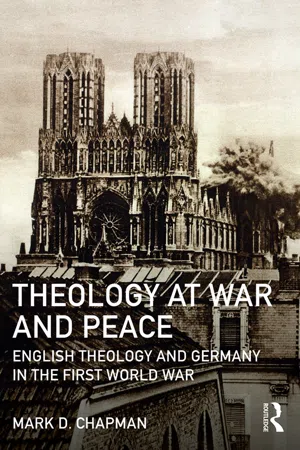
This book is the first detailed discussion of the impact of the First World War on English theology. Assessing the close relationships between English and German theologians before the First World War, Chapman then explores developments throughout the war. A series of case studies make use of a large amount of unpublished material, showing how some theologians sought to maintain relationships with their German colleagues, while others, especially from a more Anglo-Catholic perspective, used the war as an opportunity to distance themselves from the liberal theology which was beginning to dominate the universities before the war. The increasing animosity between Britain and Germany meant that relations were never healed. English theology became increasingly insular, dividing between a more home-grown variety of liberalism and an ascendant Anglo-Catholicism. Consequently, this book offers useful insights into the development of theology in the twentieth century and will be of keen interest to scholars and students of the history of theology.
eBook - ePub
Theology at War and Peace
English theology and Germany in the First World War
- 174 pages
- English
- ePUB (mobile friendly)
- Available on iOS & Android
eBook - ePub
About this book
Information
1Theological responses in England to the South African War, 1899–1902
The second Anglo-Boer War of 1899–1902 – often referred to as the South African War – is perhaps the most difficult of all the British imperial conflicts to understand. While there were comparatively few casualties among the combatants on either the British or Boer side,1 it has nevertheless been regarded as South Africa’s ‘Great War’.2 The historical importance of the war and its legacy continue to be highly contested and have been the subject of much discussion, at both an academic and popular level.3 On the one hand, there are tales of heroism and of a dogged determination by the Boer commandos against their mighty foe;4 on the other hand, there are recent studies of the effects of the war on the African population.5 Since the war played such a key role in the formation of the identities which have shaped the course of South Africa through the twentieth century, interpretations have always been highly charged. For instance, from the very beginning of the war, the popular rhetoric of chivalry and of the ‘gentlemanly’6 war rubbed up against the far more ambiguous reality of cruelty, disease and hardship exacerbated by the scorched earth policy of Lord Herbert Kitchener (1850–1916) and Lord Frederick Roberts (1832–1914). Similarly, the enforced internment of displaced people, mainly women and children, in ‘concentration camps’ was the subject of much discussion in the British press during the war itself, where the rightness of British colonial policy was questioned.7 Because of this profound effect on the civilian population, both black and Boer, it is possible to see the South African War as the first ‘total war’ in modern history.8
In Britain too, the war had a powerful effect: in some ways it marked the high point of imperialism. The popular response at home was often characterised by extreme jingoism, which could lead to great public displays of fervour (as with the festivities which followed the relief of Mafeking in May 1900). Rallies of the war’s opponents, the so-called ‘pro-Boers’, were sometimes broken up by populist gangs. At the same time, the war revealed important aspects of a changing understanding of the nature of imperialism: indeed, it might be seen as initiating a new phase in British colonial history. Crucially, the war was regarded by some – most famously the economist J. A. Hobson (1858–1940) – as the beginning of the end of imperialism, or at least as revealing it in its true economic colours. Far from simply carrying the higher values of British civilisation to the outside world, imperialism began to be reconceived as the merciless exploitation of resources which paid little attention to the welfare of the native peoples.9 Such approaches to imperialism, however, remained the exception: most domestic British responses to the War were far more supportive.
This chapter addresses the rhetoric of imperialism as it was displayed by a number of preachers and theologians of the Church of England during the Boer War.10 While there have been some studies of the effects of the South African War on the churches both in England and South Africa,11 there have been no extensive discussions of the response among theologians and preachers in the Church of England. My interest is not primarily in the rightness or wrongness of imperial policy; neither is it in the effectiveness or the morality of the conduct of the war (something, which, especially in its later stages, provoked hostile reaction from many churchmen and women).12 Instead my focus is far more limited: my chief interest is in the characterisation of the British Empire as a Christian – and consequently universal – ideal. This provides a background to the perceptions of the Christian Empire in the Great War only a decade and a half later.
The complexities of race
A factor which made the Boer War more complex than earlier colonial wars was that it was perceived to be a ‘white man’s war’ fought by one group of Christian Europeans against another. The rhetoric which spoke of the British mission to civilize and Christianize the ‘childlike’ heathen was thus rendered far more questionable: there were no longer the clear-cut certainties such as those displayed by General Kitchener’s defeat of Abdullah al-Taaisha at the Battle of Omdurman in the Sudan in 1898. The issues of race were well expressed by one of the leading Anglican opponents of British policy, Henry Scott Holland (1847–1918), Canon of St Paul’s, and later Regius Professor of Divinity at Oxford:
Why is it that the war in South Africa offers no real standard of what constitutes true imperialism? Because no normal development of the Empire ought to include the conquest of a white race … The Empire, as a moral ideal, has never contemplated so harsh a possibility as that of having to break a white nationality, and then to rule it by compulsion.13
Another Anglican opponent of the war, Canon Edward Lee Hicks (1843–1919),14 Canon of Manchester Cathedral and afterwards Bishop of Lincoln, who had presided over the Manchester Transvaal Peace Committee from its foundation in November 1899, preached in early 1900 against what he called ‘this needless, fratricidal war. … [The Boers] are fighting for their independence. Their love of liberty is a passion; they have religious zeal for freedom which recalls the heroism of the Maccabean Jews’.15 In August he preached in the Cathedral: ‘Prejudice and passion have prevailed instead of calm and collected reason. Few have examined the official records, the actual facts. Statements of the wildest sort, pleas wholly groundless, have taken hold of the popular mind’.16
The Gladstonian Dean of Durham, G. W. Kitchin (1827–1912), who was the most senior anti-war churchman, became president of Gateshead and District Branch of the South Africa Conciliation Committee, an act which led to his resignation as chaplain to the Durham Corporation.17 He was well-known for his denunciation of the ‘gin-palace spirit of Jingoism’.18 Preaching in his cathedral on loving one’s enemies,19 he noted that the
prejudice and angry ignorance have persuaded us that the enemy was but a horde of savages, who would run away at once. The whole temper of our times is so utterly anti-Christian that it appals me when, from the quietude of this home, I look out upon it all, and note the intolerance with which men hate opinions opposed to the momentary enthusiasm.20
Looking for a more Christian principle to stand between ‘the natives and the aggression of Europeans’, he upheld the virtues of a gentleman’s war based on ‘the Christian precept of love and brotherhood’,21 especially when what he regarded as the imperial British Goliath was pitted against the Boer David.
The ambiguities of race, however, also shaped the rhetoric of those actively supporting the war. Preaching at Westminster, the patristics scholar and Canon of Westminster and Rector of St Margaret’s (and Dean from 1902), J. Armitage Robinson (1858–1933),22 for instance, was explicit about the need to plant the virtues of equality in all those of the ‘Anglo-Saxon’ race in South Africa. Britain, he believed, was fighting for a higher set of ideals against the exclusivist national ideals of the Boers. The arduous task now facing Britain was
the assertion of equality between all men of European descent in the regions of South Africa for which we have any responsibility. It is a struggle to maintain the British ideal – the open door of civic liberty – against a lower ideal, the prevalence of which, our experience has taught us, must be a curse to humanity. …
The task has proved far heavier than any of us had imagined. We are facing a people not only armed with the most modern weapons behind almost inaccessible entrenchments: but, what is more, a people fighting for an ideal – lower than our ideal indeed, an ideal of exclusiveness and of racial domination, – but yet an ideal, and one closely resembling that of ancient Israel, and only wrong by comparison with a higher ideal; and so maintaining a cause upon which they (no less sincerely than we on our part) can invoke the blessing of God.23
To maintain the higher ideal placed a particular responsibility upon Britain which involved ‘costly obligations’ and ‘personal sacrifices’,24 which would lead to a ‘renewed consciousness of strength and of mission’. In short God:
has indeed pushed us forward to the forefront of his purpose....
Table of contents
- Cover
- Half Title
- Title Page
- Copyright Page
- Table of contents
- Acknowledgements
- Introduction
- 1 Theological responses in England to the South African War, 1899–1902
- 2 Theology, nationalism, and the First World War: Christian ethics and the constraints of politics
- 3 Missionaries, modernism, and German theology: Anglican reactions to the outbreak of war in 1914
- 4 The Church of England, Serbia, and the Serbian Orthodox Church in the First World War
- 5 Anglo-German theological relations in the First World War
- 6 The Sanday, Sherrington, and Troeltsch Affair: Theological relations between England and Germany after the First World War
- 7 The ‘sad story’ of Ernst Troeltsch’s proposed British Lectures of 1923
- Bibliography
- Index
Trusted by 375,005 students
Access to over 1.5 million titles for a fair monthly price.
Study more efficiently using our study tools.
Frequently asked questions
Yes, you can cancel anytime from the Subscription tab in your account settings on the Perlego website. Your subscription will stay active until the end of your current billing period. Learn how to cancel your subscription
No, books cannot be downloaded as external files, such as PDFs, for use outside of Perlego. However, you can download books within the Perlego app for offline reading on mobile or tablet. Learn how to download books offline
Perlego offers two plans: Essential and Complete
- Essential is ideal for learners and professionals who enjoy exploring a wide range of subjects. Access the Essential Library with 800,000+ trusted titles and best-sellers across business, personal growth, and the humanities. Includes unlimited reading time and Standard Read Aloud voice.
- Complete: Perfect for advanced learners and researchers needing full, unrestricted access. Unlock 1.5M+ books across hundreds of subjects, including academic and specialized titles. The Complete Plan also includes advanced features like Premium Read Aloud and Research Assistant.
We are an online textbook subscription service, where you can get access to an entire online library for less than the price of a single book per month. With over 1.5 million books across 990+ topics, we’ve got you covered! Learn about our mission
Look out for the read-aloud symbol on your next book to see if you can listen to it. The read-aloud tool reads text aloud for you, highlighting the text as it is being read. You can pause it, speed it up and slow it down. Learn more about Read Aloud
Yes! You can use the Perlego app on both iOS and Android devices to read anytime, anywhere — even offline. Perfect for commutes or when you’re on the go.
Please note we cannot support devices running on iOS 13 and Android 7 or earlier. Learn more about using the app
Please note we cannot support devices running on iOS 13 and Android 7 or earlier. Learn more about using the app
Yes, you can access Theology at War and Peace by Mark D. Chapman in PDF and/or ePUB format, as well as other popular books in Theology & Religion & Religion. We have over 1.5 million books available in our catalogue for you to explore.