eBook - ePub
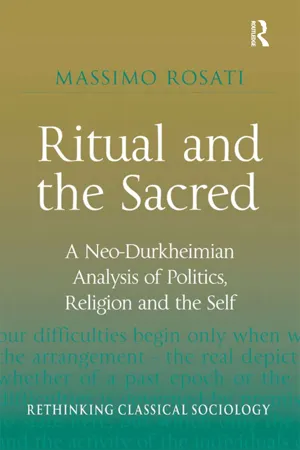
Ritual and the Sacred
A Neo-Durkheimian Analysis of Politics, Religion and the Self
- 180 pages
- English
- ePUB (mobile friendly)
- Available on iOS & Android
eBook - ePub
About this book
Ritual and the Sacred discusses some of the most important issues of modern socio-political life through the lens of a neo-Durkheimian perspective. Building on the main lesson of Durkheim's Elementary Forms of Religious Life, this book articulates values and practices common to non-Western and religious traditions that have the capacity to shape our modern way of living. Central to this volume is the question of modernity and scepticism with regard to mainstream Western wisdom; Rosati focuses on the notion of societal self-reassessment and self-revision, illustrating a willingness to learn from 'primitive' societies. This reassessment necessitates us to rethink the central roles played by ritual and the sacred as building blocks of social and individual life, both of which remain salient features within the modern world. This title will be of key interest to sociologists of religion, philosophy politics and social theorists.
Information
Chapter 1
Frame Analysis: The Lesson of The Elementary Forms of Religious Life
1.0 The ‘tragic competition’ and the winner
If we look at the history of sociology from our privileged position of heirs, our heroes, above all the classics, look like ‘tragic’ figures. There is no need to talk about the tragic and mythical-before-he-became-a-myth life of Karl Marx, or about the tragic-Nietzschean life and sensibility of Max Weber, who was capable as none other of describing the nightmares of modernity; there is no need to talk about Georg Simmel, who explicitly, once again in a Nietzschean manner, wrote about the ‘tragedy of life’. They all had serious biographical troubles, more or less as everyone of us, and they all managed to reflect and express their extraordinary sensibility in their works (and here lies the difference between them and most of us). However, it would seem that to have a sensibility consistent with the widespread postmodernist Zeitgeist, one necessarily has to be a Nietzschean. David Émile Durkheim, not being a Nietzschean, appears a naïve figure, a deaf and blind positivist, a rationalist (as if this were an insult), a modernist, and so on. However, it is my suggestion that David Émile Durkheim can aspire if not to being the winner, at least to taking part in this strange competition for being acclaimed the most troubled, tragic and unlucky man!
In other words, I maintain in this chapter that toward the end of his life, Durkheim was becoming more and more doubtful about modernity and its self-comprehension, and that his sociology of religion, basically The Elementary Forms of Religious Life, has an important lesson to teach us. Roughly speaking, the lesson is the following: if modern societies want to survive and deal with their contingency, they must be open to self-reassessment and self-revision, as it is, at least in principle, in the DNA of modernity; they must be ready to learn something significant from ‘primitive’ societies, something that implies skepticism about answers given by mainstream modernity, and in a sense stammered out by Durkheim’s previous works too – the cult of the individual, loyalty towards democratic political values –, understood for sure as the best available to us, but insufficient for avoiding new forms of pathology. Durkheim’s sensibility was much more complex than is usually understood; he was not unaware of the ‘tragedy of life’, or of the dimensions of suffering in social life. This is, among other things, what makes Durkheim’s sociology – above all his sociology of religion – precious for us. He was capable of offering a reading of modernity sensitive towards strains and pathologies, and at the same time he saw in some elemental components of religion a possible way of facing these strains and pathologies. He was neither a naïve optimist, nor a desperate thinker; this is what makes it important to learn the lesson of The Elementary Forms of Religious Life, recovering the Durkheimian program, and looking at ritual and the sacred as elemental and necessary building blocks of individual and social life. In my understanding, this opening with Durkheim is a crucial premise, given that I will build my own skeptical reading of modernity on Durkheim’s 1912 masterpiece.
1.2 A ‘look from far-away’ on modernity
Durkheim’s central issue, before and after The division of labour in society, was based on the following question: “What explains the fact that, while becoming more autonomous, the individual becomes more closely dependent on society? How can he simultaneously be more personally developed and more seriously dependent?” (Durkheim 1902b, xliii-xliv). Durkheim sought different solutions to this question, which remained a constant over the years, in his various works. First, in The division of labour in society, he provided an answer which was against the limits of ‘hypermodernism’: individual freedom and social solidarity can coexist in modern societies through the division of labour that binds autonomous individuals thanks to a mechanism of functional interdependence on strong moral values. If the stress laid by Durkheim on the moral aspect of the division of labour distinguished his answer from Spencer’s and the utilitarians’, it was not sufficient to make a clear-cut difference. It emerges, in the same book, how Durkheim’s own anti-utilitarian assumptions urged him to seek pre-contractual grounds on which to base the merely contractual relations, thus establishing a balance which would otherwise be impossible to reach on purely utilitarian grounds. This basis was identified, with a degree of doubtfulness, in the content of the collective conscience of modernity, that is, in the cult of the individual, progressively replacing the religious contents of collective conscience of pre-modern societies.
At a later stage, through a series of intermediate passages that I do not intend to reconstruct here, Durkheim resolved the question in the wake of mainstream modernity, with an answer noticeably reviewed and corrected, influenced by Kant and not too dangerously mechanical. In this phase, clarified in his essay on Individualism and the intellectuals, the freedom of the individual, its universal character rather than what identifies it as individual, becomes unquestionably ‘the only system of beliefs which can ensure the moral unity of the country’ (Durkheim 1898c, 10). It is a secular religion as in Kant, of which ‘man is, at the same time, both believer and God’ (1898c, 8), that is an individualistic religion which is the exact opposite of the anarchy defended by utilitarians and feared by conservatives. Contrary to the hyper-modernist answer he provided before, Durkheim – following his encounter with ethnographic literature and after the ‘revelation’ he had had reading Robertson Smith, after realizing that it was possible to study religion through sociological lenses – clearly underlines the religious character of the cult of the individual. However, the contradiction and the challenge that motivated him not to stop his reflection here, but instead to explore it profoundly, is that this cult is more a set of beliefs (concerning the moral aspect of the individual as an end and not a means) than of collective practices. It is, therefore, a religion that ‘does not necessarily imply symbols and rites in the full sense’ (1898c, 10), a religion without ‘temples’ or ‘priests’. ‘Symbols’ and ‘rituals’, ‘temples and priests’ are still viewed by Durkheim as an ‘external apparatus’ ‘the superficial side of religion’. In the years that followed the writing of Individualism and the intellectuals, Durkheim would conclude instead, through a deeper study of primitive religions, that only such an apparatus and such collective practices can, at particular moments of effervescence, generate the feeling of a power superior to the individual, leading him beyond profane life and into the collective realm of the sacred. Rituals, symbols and practices in The Elementary Forms of Religious Life are no longer an ‘external apparatus’, ‘the superficial aspect of religion’, but its fundamental element, without which there cannot be any religion or any social life at all.
The cult of the individual was essentially a form of interiorized religion that Durkheim conceived in a way that would not antagonize Christian morality as the conservatives maintained it would. On the contrary, it was a more elaborate expression of such morality, perfectly consistent with modernity and the spiritualizing and interiorizing trajectory adopted by Christian morality from St. Paul to Kant; in other words, its more mature inheritance (see Durkheim 1898c). Durkheim therefore sought to answer the basic question animating his sociological reflection by drawing on the cultural resources of modernity itself (if not the only, arguably the most important ones).
However, as his system of thought gradually became more subtle, it acquired certain aspects that, from an exquisitely theoretical point of view, appear to rely more on Jewish tradition than on Christianity, and are undoubtedly distant from Protestant spiritualization and interiorization (see Strenski 2006; Nielsen 1987).
Generally, Durkheim’s refusal to link religion to a supernatural dimension, or to the idea of a divinity, choosing to refer it instead primarily to the life of a moral community, seems consistent with the importance the community has in Jewish tradition. Traditionally, according to Moore, a Jew – as opposed to a Protestant – cannot be a Jew ‘alone’ (Moore 1986, 295); it is the group that gives meaning to beliefs and ritual practices. Moreover, the emphasis on the ritual dimension and importance of practices and their priority over beliefs (1986, 296) is also quintessentially Jewish. The history of the Judaism in France during Durkheim’s time shows how the adaptation of Judaism to modernity involved a gradual process of disbelief in the truth of the revelation of mount Sinai concurrent with a defense, on the same basis, of the retention of ritual practices (see Eisen 1998). Durkheim’s notion of the sacred and of its main characteristics (contagiousness, duality and ambiguity, see Bloom 1995), also conformed perfectly to the Jewish concept of the quadosh, as did his analysis of the sacrificial (see Moore 1986, 296; Strenski 1997 and 1998). In conclusion, the emphasis given in The Elementary Forms of Religious Life to the relation between religion and action, and the significance reserved to moments of collective effervescence, is also Jewish (see Moore 1996).
My purpose is not to claim a generic ‘Jewish essence’ for the conception of religion as expressed in 1912, in the way that some commentators do (see Schoenfeld and Mestrovic 1989), nor to advance a ‘persistent influence’ (Cladis 2001, x) of the Jewish education Durkheim had received, proposed to act on his thought even at unconscious levels (Fields 1995, xix-xxxi; Lacroix 1981). My goal is not even to point out how The Elementary Forms of Religious Life affected the redefinition of modern Jewish conceptions, such as those outlined by Mordecai Kaplan (Kaplan 1981; see Fields 1995, n. 21). Both more generally and more specifically, my goal is to establish how Durkheim’s answer to modernity in The Elementary Forms of Religious Life is reminiscent of the Jewish answer (at least one answer) to modernity itself (see Moore 1986). How, in other words, there is a sort of elective affinity between the idea of religion expressed in Durkheim’s masterpiece, on the one hand, and Talmudic Judaism, on the other. On a broader scale, in the context of the present book, my intention is that of showing the theoretical consequences on our understanding of modernity of this elective affinity. A more detailed analysis of some parts of The Elementary Forms of Religious Life may help to clarify this point.
Usually, it goes without saying that, for Durkheim, the fundamental value of religion is to be found in practical virtues, in the power to elevate the individual, in the context of collective rituals, above the miseries of human life. This is also what preserves the future of religion. Religion no longer has a primarily cognitive function – even if it had one in the past (every religion has always been a cosmology too) it is today overpowered by science. Now its function is primarily practical: ‘The first article of any faith is belief in salvation by faith’ (Durkheim 1912a, 419). Whichever way the worshipper conceives of evil, he believes that faith will save him from it. Durkheim immediately clarifies that this salvation is not so much an issue of beliefs, but of communion of the believer with his God. Thus, given Durkheim’s idea that God is the symbolic, idealized representation of society itself, salvation is – beyond the self-deception the believer falls victim to – communion with other individuals, self-transcendence by way of sharing a community of faith. In Durkheim’s eyes, salvation is, like evil a social thing (see Rosati 2005 and 2008). It does not pertain to the individual soul, it is not a personal issue of good and bad intentions, of grace or of its secularized version. From Durkheim’s analysis of the ritual, we know that ‘generally there is no relationship between the feelings felt and the actions done by those who take part in the rite’ (Durkheim 1912a, 400). This is true not only for Arunta piacular rites (see 1912a, Chapter V, Book III), but also for the Jews and the Christians, that is for more complex religions:
If the Christian fasts and mortifies himself during the commemorative feasts of the Passion as does the Jew on the anniversary of Jerusalem’s fall, it is not to give way to sadness spontaneously felt. In those circumstances, the believer’s inward state is in disproportion to the harsh abstinences to which he submits himself. If he is sad, it is first and foremost because he forces and disciplines himself to be so; and he disciplines himself in order to affirm his faith (1912a, 403).
Here sincerity, intended as perfect correspondence between the inner states of the believer and ritual behavior, is not of the utmost importance. What is more important, for the sake of salvation, is being part of a community of doers. Salvation from evil is a collective drama, something that involves mutual responsibilities, something that implies a sense of shared destiny, a common past, common memories and plans for the future. In order to attain salvation it is not sufficient for the believer to feel remorse and to sincerely repent; what he needs most is to participate in a collective and public ritual. This, according to Durkheim, seems to require acceptance more than sincere adherence (see Rappaport 1999). If modernity and its Christian roots embrace the ideals of sincerity and interiority (see Seligman et al. 2008, and Chapters 3 and 5 below), Durkheim, by contrast, now seems to insist on the ritual and on its performative effects, contrary to his own assumptions as expressed in the essay on Individualism and the intellectuals. Religion no longer appears as something that can attain existence in the form of beliefs without the ritual ‘external apparatus’, but as something which necessitates a practical dimension for inner reasons. If the interiorized cult of the individual positioned Durkheim in the wake of Christian inheritance, the emphasis he subsequently gave to the external and public dimension of ritual seems to derive from other cultural resources, consistent with his Jewish education. If, for the anti-ritualism of modern sensitivity, home-made cakes and prayers are always best (Douglas 1997, 112; see also Douglas 1996), for the Durkheim of The Elementary Forms of Religious Life a purely individual religion, or one that is experienced in private, remains in the nature of a conceptual parasite on one hand, and self-contradictory, on the other.
What is suggested here is that The Elementary Forms of Religious Life must also be viewed as Durkheim’s bitter reflection on modernity. In fact, in the last years of his life, he felt an increasing sense of estrangement from modern life (Poggi 2000, 167), as if his conceptual paths and the development of modernity were taking different directions. We have clear autobiographical evidence of this feeling of isolation, particularly after the death of his son, André (see Durkheim 1998). What is in question here, however, are not only the biographical and psychological dimensions of this divergence, but also the theoretical one. We can try to imagine this man in his fifties bending over pictures of the Haida, reproduced in one of the ethnographic sources, or contemplating ‘scenes of the wildest excitement’ described by Howitt, Strehlow, Spencer and Gillen, or imagining the collective effervescence of the Arunta’s Intichiuma rite, and reflecting by contrast on the ‘peaceful monotony’ of modern ritual-less societies, on the ‘monotonous, slack, and humdrum’ character of modern profane life. If modern societies are ritual-less, as Durkheim writes, it is ‘because we are going through a period of transition and moral mediocrity. The great things of the past that excited our fathers no longer arouse the same zeal among us … meanwhile, no replacement for them has been yet created … In short, the former gods are growing old or dying, and others have not been born’ (Durkheim 1912a, 429). These statements are not to be read as an expression of a nostalgic or conservative mentality. They are directly associated with the scientific results Durkheim thought himself to have achieved in the course of his research. A ritual-less society is not a society lacking in something superficial and unnecessary, but a society whose future is in danger of obliteration.
In this respect, Durkheim’s analysis of sacrifice is another cardinal point that helps to grasp the message of The Elementary Forms of Religious Life. In discussing nature and role of the institution of sacrifice in Chapter II, Book III, Durkheim criticizes Robertson Smith, to whom he felt otherwise indebted (on Robertson Smith, see Beidelman 1974). According to the latter, sacrifice is an alimentary communion through which the worshipper communicates with the sacred principle that inhabits the sacrificial victim (see Smith 1894). Thus, it is not a mere act of tribute such as that of the servant to his king. Durkheim agrees with Robertson Smith on this points, but makes a substantially different point which recurs elsewhere in The Elementary Forms of Religious Life: that sacrifice also creates the divinity and therefore the sacred; consequently, the ritual of sacrifice is prior to the belief in the existence of a sacred principle. Without ritual the sacred would not exist. This ritual causality, which Durkheim perhaps borrowed from Mauss and Hubert, who were, in turn, influenced by Silvain Lévi’s study of the Vedas (see Strenski 1998 and 2006), is perfectly consistent with Durkheim’s more explicit criticism of Robertson Smith. Durkheim reacted to his inability to find a reason for the circle that links believers to their god, as in mutatis mutandis, individuals to society:
If, as i have tried to establish, the sacred principle is nothing other than society hypostatized and transfigured, it should be possible to interpret ritual life in secular and social terms. Like ritual life, social life in fact moves in a circle. On the one hand, the individual gets the best part of himself from society – all that gives him a distinctive character and a place among other beings, his intellectual and moral culture … On the other hand, however, society exists and lives only in and through individuals. Let the idea of society be extinguished in individual minds, let the beliefs, and aspirations of the collectivity be felt and shared by individuals no longer, and the society will die. Thus we can repeat about society what was previously said about the deity: it has reality only to the extent that it has a place in human consciousnesses, and that place is made for society by us. We now glimpse the profound reason why the gods can no more do without their faithful than the faithful can do without their gods. It is that society, of which the gods are only the symbolic expression, can no more do without individuals than individuals can do without society (Durkheim 1912a, 351).
This page is of crucial importance in the framework of the Durkheim’s book. Contrary to many vulgar interpretations of Durkheim’s thought, it shows that society is not a sort of Leviathan against the individual, but a fragile, contingent reality (see Poggi 2000, Chapter 5), dependent on individuals for its existence as they themselves depend on it, and in the same way as gods are in relation to the faithful (for a contemporary Jewish variation of this theme, see Heschel 1976). Durkheim was well aware of this contingency, finitude and fragility of collective life; from his pages emanate at times what Gianfranco Poggi called a real pathos. It is the fragility inherent in society that makes the ritual dimension necessary. As we have said, without rituals there is no sacredness, and without the symbolic dimension that represents it and constitutes it, there is no society. Ultimately, without society the individual is deprived of everything that makes him a human being. What is at stake in defending the ritual and public aspect of religion is the existence of society itself and of individuals and moral life with it.
Durkheim’s ideas were taking different directions from the development of modernity, as modernity tends to privatize, spiritualize and interiorize religion, thus threatening its very own foundations and conditions of being. The last time that modern society had come close to creating its own symbols and its own expression of the sacred, even if only artificially and in a brief period of time; the last time it had achieved a resumption of ritual life (which otherwise occurred only occasionally), and had led individuals on to a sacred space and time – a time that promises, for Durkheim, ‘less tense, more at ease, and freer’ life – was during the French Revolution. But the Durkheimian pathos, as Poggi affectively points out, never turns into an expression of regret for ‘Western decline’. Every society needs, from time to time, to re-create itself through collective assemblies and spaces devoted to public life. Hence Durkheim’s vibrant prophecy:
A day will come when our societies once again will know hours of creative effervescence during which new ide...
Table of contents
- Cover Page
- Title Page
- Copyright Page
- Contents
- List of Figures and Illustration
- Series Editor’s Preface
- Acknowledgments
- About the Author
- Introduction: Thorny Issues
- 1 Frame Analysis: The Lesson of The Elementary Forms of Religious Life
- 2 Modernity and the Rise of the Introspective Conscience
- 3 Society: Rituals and Traditions
- 4 Self-cultivation: The Individual as a Ceremonial Being
- 5 Politics: An Anthropological Gaze
- 6 Religions: New Routes to Pluralism
- Conclusion: Durkheim debut du siècle
- Bibliography
- Index
Trusted by 375,005 students
Access to over 1.5 million titles for a fair monthly price.
Study more efficiently using our study tools.
Frequently asked questions
Yes, you can cancel anytime from the Subscription tab in your account settings on the Perlego website. Your subscription will stay active until the end of your current billing period. Learn how to cancel your subscription
No, books cannot be downloaded as external files, such as PDFs, for use outside of Perlego. However, you can download books within the Perlego app for offline reading on mobile or tablet. Learn how to download books offline
Perlego offers two plans: Essential and Complete
- Essential is ideal for learners and professionals who enjoy exploring a wide range of subjects. Access the Essential Library with 800,000+ trusted titles and best-sellers across business, personal growth, and the humanities. Includes unlimited reading time and Standard Read Aloud voice.
- Complete: Perfect for advanced learners and researchers needing full, unrestricted access. Unlock 1.5M+ books across hundreds of subjects, including academic and specialized titles. The Complete Plan also includes advanced features like Premium Read Aloud and Research Assistant.
We are an online textbook subscription service, where you can get access to an entire online library for less than the price of a single book per month. With over 1.5 million books across 990+ topics, we’ve got you covered! Learn about our mission
Look out for the read-aloud symbol on your next book to see if you can listen to it. The read-aloud tool reads text aloud for you, highlighting the text as it is being read. You can pause it, speed it up and slow it down. Learn more about Read Aloud
Yes! You can use the Perlego app on both iOS and Android devices to read anytime, anywhere — even offline. Perfect for commutes or when you’re on the go.
Please note we cannot support devices running on iOS 13 and Android 7 or earlier. Learn more about using the app
Please note we cannot support devices running on iOS 13 and Android 7 or earlier. Learn more about using the app
Yes, you can access Ritual and the Sacred by Massimo Rosati in PDF and/or ePUB format, as well as other popular books in Social Sciences & Anthropology. We have over 1.5 million books available in our catalogue for you to explore.