- 190 pages
- English
- ePUB (mobile friendly)
- Available on iOS & Android
eBook - ePub
About this book
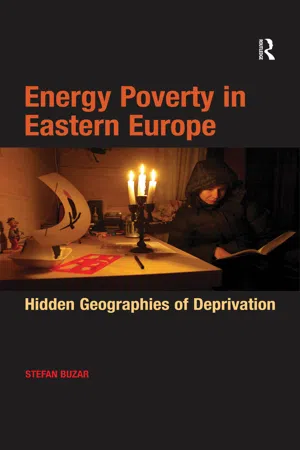
One of the consequences of the post-socialist transformation of Eastern and Central Europe and the Former Soviet Union is the emergence of energy poverty, a condition where households are living in inadequately heated homes. This book provides the first full-length examination of the causes, consequences and patterns of energy poverty in former Communist countries. Based on empirical evidence that spans different spatial contexts and scales and compares these with other parts of the world, the book links household-level deprivation with broader organizational and political dynamics. The book also analyzes the lived experiences of scarcity and marginalization with the aid of two in-depth country studies. Furthermore, it identifies the socio-demographic factors that distinguish energy-poor families from the rest of the population, while stressing the need for a comprehensive range of policy tools to address energy poverty. As the issue of energy supply from the former Soviet Union is likely to become one of the most important economic and political problems across the whole of Europe within the next couple of decades, the book argues that there is a direct link between the energy crises experienced by the region, and the social aspects of energy use in households.
Information
Chapter 1
Setting the Framework
While the challenge in most of the developing world is to expand infrastructure and service delivery, East European and Central Asian countries are struggling to prevent the existing energy systems from failing (World Bank, 2005)
Ukraine is at the verge of a second energy crisis (REGNUM News Agency, 14 February 2006)
The ex-Communist states of Eastern and Central Europe (ECE) and the former soviet union (FSU) encompass a population of more than 400 million people and an area that covers nearly 20 per cent of the world’s landmass. Since the early 1990s, they have been undergoing a process of deep systemic change, aimed at reforming the economic, political and social structures inherited from the Communist era. The new geopolitical situation has forced these countries ‘onto the economic geography agenda, not the least because the map of this part of the world has now been redrawn and there are many new states to be integrated into the world economy’ (Stenning and Bradshaw, 1999, p. 97).
However, the sheer extent of the post-socialist reform process has meant that social scientists and policy-makers have often neglected some of its finer aspects. The consequent accumulation of overlooked problems across inter-connected sectors of the economy has often led to severe social and political problems. One such situation exists at the boundary of the energy, housing and social welfare domains, where the slow pace of reforms has created major social and infrastructural difficulties. Winter after winter, the world’s media are replete with reports about energy-related humanitarian emergencies in post-Communist Eastern Europe and Asia. ‘Georgia‘s president has cut short a visit to the World Economic Forum in Switzerland and headed home to deal with a growing energy crisis’ stated the BBC news website on the 29th of January 2006, while just a week earlier it was reported that ‘schoolchildren are missing classes and boiler faults have left some households shivering as Arctic cold grips Russia’ (17 January 2006). It seems that every spell of unusually cold weather brings misery to countries in the region, as millions are left without heating and electricity, due to the energy utilities’ financial and technical problems (Lovei et al., 2000; Timofeev, 1998).
At the same time, post-socialist reform experts have been talking about a second type of energy crisis. Many countries in the region, especially those in ECE, have recently undertaken significant energy price increases, with the aim of removing the economic structure inherited from socialism. Before 1990, tariffs were set at below cost-recovery levels and there were extensive cross-subsidies from industry to the residential sector. The problem that has emerged in the post-socialist transition, however, is that most governments have been unable to develop the necessary social safety net to protect vulnerable households from energy price increases. This leaves many families with no option other than to cut back on their energy purchases. For example, a cross-country report in the Balkans has argued that power affordability is a problem ‘for many consumer groups’ in this region, including ‘pensioners, unemployed, low income households’. Moreover ‘many of the South East European countries have not yet developed adequate social safety mechanisms to protect energy poor consumers’ (EBRD, 2003).
The key premise of this book is that the two post-socialist energy crises are underpinned by a common predicament – the ‘hidden geography’ of energy poverty. By definition, a household is energy poor if it is living in an inadequately heated home, which can mean that either the average daytime indoor temperature of the dwelling is below the biologically-determined limit of 20°C necessary to maintain comfort and health (Boardman, 1991), or that the amount of warmth in the home is lower than the subjective minimum which allows an individual to perform his/her everyday life. There is a wide body of evidence to suggest that ECE and FSU countries are facing an escalating energy poverty problem, due to their specific social and physical conditions, such as: cold climates, temperature inversions, the removal of universal socialist-era energy price subsidies and falling real incomes post-1990 (Lampietti and Meyer, 2003). Although it has been shown that energy poverty in other countries, such as the UK, emerges through an interaction of low incomes, institutional strategies and housing conditions (Rudge and Fergus, 1999; Wicks and Hutton, 1986; Bradshaw and Harris 1983, Burghes, 1980), this theoretical connection has yet to be made in the post-socialist context.
Why energy poverty matters
Eradicating poverty is the greatest global challenge facing the world today and an indispensable requirement for sustainable development, particularly for developing countries … This would include actions at all levels to: … the access of the poor to reliable, affordable, economically viable, socially acceptable and environmentally sound energy services (World Summit for Sustainable Development, Johannesburg, 4 September 2002).
‘Poverty reduction’ and ‘improved energy services for the poor’ have become the buzzwords of global development discourses during the past two decades. The world’s key multilateral development institutions, including the United Nations’ Development Programme, the World Bank, UK Department for International Development – as well as influential international NGOs such as the Intermediate Technology Development Group, Friends of the Earth and Greenpeace – have placed a heavy emphasis on ‘sustainable energy for poverty reduction’. A wide range of financing instruments has been developed to support this goal, mostly by facilitating ‘technology transfer’ into developing countries (Buckley et al., 2001; World Bank, 1993).
However, although it has become commonplace to refer to ‘energy poverty’ in the context of developing countries in the South, the concept has yet to be related to the emergent socio-economic realities of the post-socialist states of the global North. Not a single academic or policy paper published to date has dealt explicitly with the problem of energy poverty in Eastern Europe. This is despite the growing number of studies of the social implications of energy reforms in post-socialist countries (see, for example Kovacevic, 2004; Velody et al., 2003; Lampietti and Meyer, 2003; Dodonov et al., 2001; Lovei et al., 2000), which have, through different analytical instruments, provided a wide range of views about the relationships between energy tariffs, affordability and post-Communist reforms. In the European context, the only academic contribution that provides an integrated perspective on the issue is Healy’s (2004) book on Housing, Fuel Poverty and Health: a Pan-European Analysis, which contains a cross-country overview of the problem. However, Healy sidesteps the Eastern European countries where energy poverty is a much bigger issue. It can be argued that the failure to conceptualize energy poverty as a distinct phenomenon, with specific contingencies and implications, has led to the theoretical marginalization of the housing, social policy and governance dimensions of energy reforms.
As will be discussed later in this book, the attitude of many policy-makers and experts in the ECE region is reminiscent of the situation in the united Kingdom during the early 1970s, when the notion of a distinct energy poverty problem was intercepted by a government minister with the statement: ‘People do not talk of ‘clothes poverty’ or ‘food poverty’ and I do not think that it is useful to talk of ‘energy poverty’ either’ (Boardman, 1991, p. 1). His view is now consigned to history, as it has been overruled by the immense body of evidence about the health problems faced by tens of thousands of British households living in poorly heated homes (ibid., and Wynn and Wynn, 1979; Bradshaw and Harris, 1983; Lewis, 1982; Isherwood and Hancock, 1979). Today, ‘fuel poverty’ is part of the mainstream of policy and academic discourses in the UK.
But will this be the case in the FSU and CEE? At the July 2006 G8 summit in St Petersburg, Russian Finance Minister Sergey Kudrin ‘noted the importance of fighting against energy poverty’, because ‘it is impossible to develop the economy, improve health care and develop education without having access to energy resources’ (RIA Novosti, 2006). Such statements, which were also embedded in the final declaration of the summit, echo President Putin’s earlier announcement that ‘Russia intends to come up with concrete initiatives and proposals on how to confront energy poverty, improving diversification and ensuring energy conservation security during the forthcoming G8 summit’ (Russia & CIS Business & Financial Daily, 2006). The judgement is still out as to whether and how this objective will be applied to the post-socialist context itself.
An integrated view of energy poverty in the ECE and FSU
One of the key underlying problems in the conceptualization of energy poverty in post-socialism is the lack of an integrated theoretical understanding of the interdependencies of social, energy and housing reforms. The restructuring process has turned the regions east of the Elbe and the Alps into a ‘playground of history’ (Przeworski, 1991, p. 21), where socio-economic processes unfold and differentiate at unprecedented speeds. These changes have brought about new trends in ‘the geographies of the region in the forms of metropolitan growth, the economic collapse of peripheral regions, the polarization of urban spaces as inequalities deepen, and the reworking of the territorial structure and democratic spaces of the state and civil society’ (Smith and Pickles, 1998, p. 5). In particular, ‘unemployment soared … income inequality has grown (in many countries it has exploded) and hardly any economic or social indicators have remained unaffected’ (Fajth, 1999: 417). This is contrary to the initial optimism about post-socialist reforms, which expected that the economic benefits of the transformation process would quickly ‘trickle down’ to the majority of the population.
The transformation process has also created new geographies of unevenness at the transnational scale: ‘while some countries have so far survived economic transition in reasonably good shape, for others the consequences of economic transition have been disastrous’ (Redmond and Hutton, 1999, p. 1). Such divisions have deepened even further with EU enlargement, resulting in several regional groupings of countries with different levels of development. he 10 states that have joined the EU are, to various degrees, well integrated within the sphere of Western capitalism, while others in the Balkans and especially the FSU are still struggling with the problems of post-Communist transition. The widening gap between the two groups of countries has led some experts to declare that ‘the similarities of systemic change have disappeared, and so has the research subject ‘transition’ (von Hirschhausen and Wälde, 2001: 107). However, ‘economic transformation cannot be separated from changes in social, political and cultural realms, and must be examined within its regional, national and international context’ (Stenning, 1997, p. 160). In this book, the post-socialist space is treated as a whole and the reform process is mainly described by the term ‘transformation’, because the more commonly used ‘transition’ implies a one-way movement towards a predefined state. The idea of ‘transition’ to a ‘market economy’ contradicts realities on the ground, which suggest a complex political and economic ‘transformation’ of the former socialist countries of ECE and FSU (Bradshaw and Stenning, 2000, p. 12; Pickvance, 1997; Smith, 1997).
The extensive social effects of the transition have been supplemented by the problematic situation in the energy sectors of nearly all ECE and FSU states. Despite being part of one of the most dynamic aspects of the economy, energy operations have presented a major reform challenge in the post-socialist period. Most former socialist countries pledged to adopt neoliberal energy legislation in the early 1990s (Wälde and von Hirschhausen 1998; Stern, 1994), requiring the vertical and horizontal unbundling of formerly state-owned integrated energy monopolies, the liberalization of energy markets and prices and the establishment of independent regulatory bodies. However, the high social and political costs of the energy reform process have delayed its implementation in the ‘advanced’ and the ‘lagging’ postsocialist states alike. Even leading reformers such as the Czech Republic have been reluctant to open up their energy markets in full or to privatize the national electricity monopoly (Kocenda and Cábelka, 1999). In some of the poorer post-Communist states, governments have been unable to compensate low income households with the adequate level of social protection. This has often resulted in bill recovery problems, as consumers have been unable or unwilling to pay for the electricity, gas or hot water provided by energy utilities (World Bank, 1999a).
There is also a deep disconnection between the literatures focussing on the spatial and institutional dimensions of post-socialist reforms, on the one hand, and the emergence of poverty in transformation, on the other. Although it is without doubt that the transformation process has exposed the post-socialist states to powerful globalizing tendencies, the nature of this relationship in the sphere of social exclusion remains unclear. For example, to what extent can we characterize post-socialist urban poverty as ‘a set of spaces of juxtaposed fragments and contrasts, where diverse relational webs might coalesce, interconnect or disconnect’ (Amin, 1999, p. 43)? Also, how is the post-socialist welfare state responding to the ‘global crisis of Fordism’ (Pierson, 1999, p. 423)? Unravelling the territorial and institutional background of domestic energy deprivation may help us find the answers to such questions. This means that the condition of energy poverty is thus significant in theoretical terms, because it encapsulates the broader interactions of economic, institutional and technical infrastructures.
At a more practical level, and perhaps most importantly of all, there is an urgent need for developing an analytical framework to interpret the growing body of evidence – both narrative and analytical – which suggests that millions of households in the region are living within a ‘hidden’ geography of domestic energy poverty. It is also necessary to determine how energy poverty relates to broader social exclusion patterns per se. This can provide local and national decision-makers with some of the badly needed expert knowledge for remedial action, if only by bringing the issue to the fore and stressing its innately path-dependent nature. Otherwise, the situation can only get worse if present trends of increasing residential prices, despite stagnant incomes, continue into the future. As evidenced by the experiences of other countries in Western Europe (see Healy, 2003), the economic and health costs of inaction can be prohibitively high.
Towards a geography of poverty
Adding to the analytical gaps in theoretical and policy understandings of energy poverty is the lack of a distinctively geographical conceptualization of poverty in the given context. A major part of post-socialist poverty research is produced and driven by welfare economists, and as such is disproportionately geared towards macroeconomic analyses. Nearly all the studies used by decision-makers in the region (the World Bank, IMF, EU, national governments) operate with a language of incomes, prices and poverty lines. More often than not, poverty is measured by dividing society into ‘poor’ and ‘non-poor’ individuals, or assuming a one-to-one relationship between income and welfare. The reliance on such blunt methodological tools is contradictory to the growing realization that ‘discussions about ‘advanced marginality’ in network societies … need to broaden their current scope of labour markets, techno-economic change, welfare restructuring … and housing and economic restructuring’ (Speak and Graham, 2000: 1991). A further problem is posed by the fact that very few studies extend beyond the domain of large scale economic and political interactions, into the lived experiences of poverty at the household level (for a further discussion see Cousins 2001, Burawoy and Verdery, 1999; Smith and Swain, 1998).
There is a growing awareness that poverty and social exclusion arise out of a combination of mutually-embedded and -networked conditions (Castells, 2002; Sibley, 2001; Blake, 2001; Graham, 2000). This implies that the dominant mode of poverty research will have to broaden and deepen its analytical horizons, if it is to foster more meaningful and effective practical solutions for social exclusion and marginalization. such a project could involve the use of economic geography in ‘foregrounding cultural and institutional variables previously thought out of bounds’ to the development of social and economic structures (Clark et al., 2000, p. 5). Although geography has seen a resurgence of poverty research in the period since Leyshon (1995) noted the absence of this term from the third edition of The Dictionary of Human Geography, many of the finer institutional and spatial aspects of social exclusion remain insufficiently explored within the discipline (see Mohan, 2000; Byrne, 1999). There is a need for a greater theoretical and practical role of human geography within poverty studies.
Aims, arguments, methods, scope …
In light of the above, the main purpose of this book is to contribute to an improved understanding of energy poverty in post-socialism. It aims to connect the literatures about the spatial and institutional dimensions of post-Communist economic reforms, on the one hand, and the emergence of poverty in transition, on the other. In this, it should foster an increasing awareness of the importance of organizational and social processes in constructing...
Table of contents
- Cover Page
- Energy Poverty in Eastern Europe
- Copyright Page
- Contents
- List of Figures
- List of Maps and Plates
- List of Tables
- Foreword
- Acknowledgements
- 1 Setting the Framework
- 2 Gaps in Theory and Policy: Tracing the Roots of Energy Poverty
- 3 Patterns of Domestic Energy Deprivation Across the Post-socialist space
- 4 The Institutional (Re)production of Inequality: Reconciling Energy, Welfare and Housing Reforms
- 5 Layers of Vulnerability: Towards a Socio-Demographic Profile of the Energy Poor
- 6 Everyday Experiences of Inadequate Warmth in the Home
- 7 Linking Conceptual Threads, Looking Towards the Future
- Bibliography
- Index
Trusted by 375,005 students
Access to over 1.5 million titles for a fair monthly price.
Study more efficiently using our study tools.
Frequently asked questions
Yes, you can cancel anytime from the Subscription tab in your account settings on the Perlego website. Your subscription will stay active until the end of your current billing period. Learn how to cancel your subscription
No, books cannot be downloaded as external files, such as PDFs, for use outside of Perlego. However, you can download books within the Perlego app for offline reading on mobile or tablet. Learn how to download books offline
Perlego offers two plans: Essential and Complete
- Essential is ideal for learners and professionals who enjoy exploring a wide range of subjects. Access the Essential Library with 800,000+ trusted titles and best-sellers across business, personal growth, and the humanities. Includes unlimited reading time and Standard Read Aloud voice.
- Complete: Perfect for advanced learners and researchers needing full, unrestricted access. Unlock 1.5M+ books across hundreds of subjects, including academic and specialized titles. The Complete Plan also includes advanced features like Premium Read Aloud and Research Assistant.
We are an online textbook subscription service, where you can get access to an entire online library for less than the price of a single book per month. With over 1.5 million books across 990+ topics, we’ve got you covered! Learn about our mission
Look out for the read-aloud symbol on your next book to see if you can listen to it. The read-aloud tool reads text aloud for you, highlighting the text as it is being read. You can pause it, speed it up and slow it down. Learn more about Read Aloud
Yes! You can use the Perlego app on both iOS and Android devices to read anytime, anywhere — even offline. Perfect for commutes or when you’re on the go.
Please note we cannot support devices running on iOS 13 and Android 7 or earlier. Learn more about using the app
Please note we cannot support devices running on iOS 13 and Android 7 or earlier. Learn more about using the app
Yes, you can access Energy Poverty in Eastern Europe by Stefan Buzar in PDF and/or ePUB format, as well as other popular books in Scienze biologiche & Scienze ambientali. We have over 1.5 million books available in our catalogue for you to explore.