- 200 pages
- English
- ePUB (mobile friendly)
- Available on iOS & Android
eBook - ePub
About this book
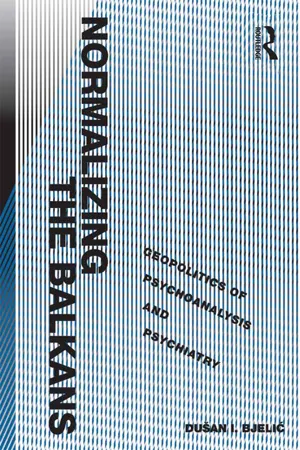
Normalizing the Balkans argues that, following the historical patterns of colonial psychoanalysis and psychiatry in British India and French Africa as well as Nazi psychoanalysis and psychiatry, the psychoanalysis and psychiatry of the Balkans during the 1990s deployed the language of psychic normality to represent the space of the Other as insane geography and to justify its military, or its symbolic, takeover. Freud's self-analysis, influenced by his journeys through the Balkans, was a harbinger of orientalism as articulated by Said. However, whereas Said intended Orientalism to be a critique of the historical construction of the Orient by, and in relation to, the West, for Freud it constituted a medical and psychic truth. Freud's self-orientalization became the structural foundation of psychoanalytic language, which had tragic consequences in the Balkans when a demonic conjunction developed between the ingrained self-orientalizing structure of psychoanalysis and the Balkans' own propensity for self-orientalization. In the 1990s, in the ex-Yugoslav cultural space, psychoanalytic language was used by the Serb psychiatrist-politicians Drs. Raškovic and Karadzic as conceptual justification for inter-ethnic violence. Kristeva's discourse on abject geography and Zizek's conceptualization of the Balkans as the Real have done violence to the region in an intellectual register on behalf of universal subjectivity. Following Gramsci's and Said's 'discourse-geography' Bjelic transmutes the psychoanalytic topos of the imaginary geography of the Balkans into the geopolitics inherent in psychoanalytic language itself, and takes to task the practices of normalization that underpin the Balkans' politics of madness.
Information
Table of contents
- Cover Page
- Dedication
- Title Page
- Copyright Page
- Contents
- Acknowledgments
- Introduction
- 1 Freud and the Balkans
- 2 Freud and the Language of Power
- 3 The Universal Subject and Colonial Geography
- 4 Kristeva’s Exile from Balkan Madness
- 5 Slavoj Žižek: Lacania and the Balkans’ Real
- 6 Immigrants as the New Balkans
- 7 Psychoanalysis, Psychiatry, and Insane Geographies
- 8 From “Family Myth” to “Family Resemblances”
- Bibliography
- Index
Trusted by 375,005 students
Access to over 1.5 million titles for a fair monthly price.
Study more efficiently using our study tools.
Frequently asked questions
Yes, you can cancel anytime from the Subscription tab in your account settings on the Perlego website. Your subscription will stay active until the end of your current billing period. Learn how to cancel your subscription
No, books cannot be downloaded as external files, such as PDFs, for use outside of Perlego. However, you can download books within the Perlego app for offline reading on mobile or tablet. Learn how to download books offline
Perlego offers two plans: Essential and Complete
- Essential is ideal for learners and professionals who enjoy exploring a wide range of subjects. Access the Essential Library with 800,000+ trusted titles and best-sellers across business, personal growth, and the humanities. Includes unlimited reading time and Standard Read Aloud voice.
- Complete: Perfect for advanced learners and researchers needing full, unrestricted access. Unlock 1.5M+ books across hundreds of subjects, including academic and specialized titles. The Complete Plan also includes advanced features like Premium Read Aloud and Research Assistant.
We are an online textbook subscription service, where you can get access to an entire online library for less than the price of a single book per month. With over 1.5 million books across 990+ topics, we’ve got you covered! Learn about our mission
Look out for the read-aloud symbol on your next book to see if you can listen to it. The read-aloud tool reads text aloud for you, highlighting the text as it is being read. You can pause it, speed it up and slow it down. Learn more about Read Aloud
Yes! You can use the Perlego app on both iOS and Android devices to read anytime, anywhere — even offline. Perfect for commutes or when you’re on the go.
Please note we cannot support devices running on iOS 13 and Android 7 or earlier. Learn more about using the app
Please note we cannot support devices running on iOS 13 and Android 7 or earlier. Learn more about using the app
Yes, you can access Normalizing the Balkans by Dušan I. Bjelic in PDF and/or ePUB format, as well as other popular books in Social Sciences & Ethnic Studies. We have over 1.5 million books available in our catalogue for you to explore.