eBook - ePub
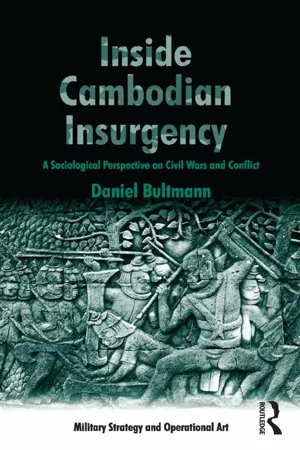
Inside Cambodian Insurgency
A Sociological Perspective on Civil Wars and Conflict
- 216 pages
- English
- ePUB (mobile friendly)
- Available on iOS & Android
eBook - ePub
About this book
There are many different types of power practice directed towards making soldiers obedient and disciplined inside the field of insurgency. While some commanders punish by inflicting physical pain, others use re-educative methods. While some prepare soldiers by using close-knit combat simulations, others send their subordinates immediately into battle. While these variations cannot fully be explained by the ideological set-up of different groups or by their political orientation, the basic assumption of the study is that they nevertheless do not emerge at random. This book puts forth that the type of power being utilised depends on the habitus of the respective commander and, as a result, becomes socially differentiated. Furthermore, power practices are shaped by the classificatory discourse of commanders (and their soldiers) on good soldierhood and leadership. The study found multiple 'habitus groups' inside the field of insurgency, each with a distinctive classificatory discourse and a corresponding power type at work. While commanders shaped the dominating power practices (such as military trainings, indoctrination, systems of rewards and punishments, etc.), low-ranking soldiers took active part in supporting or undermining power according to their own habitus formation. This book helps professionals in this area to understand better the types of power practice inside insurgencies. It is also a useful guide to students and academics interested in peace and conflict studies, sociology and Southeast Asia.
Information
Chapter 1
Greed and Grievances at War
Most observers of the Cambodian Civil War said that it was a mere proxy war caught in major Cold War competition, in which local agents were more or less pawns in the game (e.g., Reynell, 1989). Therefore, any need to delve deeper into its social and military structures and local politics was seen as a dispensable intellectual exercise. Analysts interpreted almost all small-scale conflicts during the Cold War as sideshows of the struggle between the US and the Soviet Union. The Cambodian case is a seemingly perfect example, in which the US and China formed a coalition to strengthen the warring factions along the border in their war against the Soviet-backed Vietnamese and their ‘hegemonic expansion’. Without their military, financial, and political support, the struggle of the resistance certainly would have ended quickly. However, after the end of the Cold War, many of the conflicts went on (such as in Cambodia), and many new conflicts arose around the world. The 1990s saw some of the bloodiest conflicts and a trend towards internal instead of interstate conflicts. The big Cold War could no longer serve as an explanation for those small wars.
A first explanation was that underneath the Cold War conflict, smaller states or even communities made use of the larger framework and military support to wage their ethnically motivated skirmishes. After the breakdown of the Soviet Union, the ethnic dimension (re-)surfaced. Many simply saw a resurgence of nationalist and ethnic movements (Wimmer, 2002; Fearon & Laitin, 2000). In light of conflicts in Africa, the American journalist R. Kaplan even announced a ‘coming anarchy’ with internal wars appearing to be rather anarchical and increasingly ferocious along ethnical lineages, making them almost impossible to end (2001). And for him, ancient hatreds were also at work in Yugoslavia, which is why he called his book Balkan Ghosts – ghosts resurfacing after the end of the Cold War and constantly haunting society (2005). For many observers, ethnic grievances lay underneath the seemingly anarchic surface of these small wars (van Creveld, 1991), a dimension that had been hidden by the Cold War script and now dominated the conflicts arising around the globe. For these authors, the ethnic dimension is deep rooted and thereby practically irresolvable (e.g., Kaplan, 2005). The only option is to let those conflicts cool down, but since they are rooted in a primordial identity, they will resurface again and again. This leaves policy makers with few options at their disposal to end the conflicts – both then and now.
However, more nuanced analyses of conflicts driven by ‘communal identity’ are those presented by Edward Azar and Ted Gurr, who both developed their ideas during the Cold War, when most scholars saw no need for studying small-scale proxy wars. For Edward Azar, protracted social conflicts are shaped by the struggle of communal groups “for such basic needs as security, recognition and acceptance, fair access to political institutions and economic participation” (1991, 93). In his study, he emphasized need deprivation and governance failure as causes for violent conflict but also the need for multi-factorial approaches in conflict studies and a mapping of all agents, forces, and institutions in the field (1990). Ted Gurr’s theory of relative deprivation was another influential and multi-factorial approach among social grievance theorists during the Cold War era, operating with in-group and out-group antagonisms. His core argument, however, is that people rebel because they perceive an inequality in comparison to other groups, resulting in a lower position in society than they themselves believe they are entitled to. Therefore, he simply adds to Azar’s theory of deprivation the aspect of comparison between groups, who perceive a deprivation relative to others. Particularly in situations in which a group faces a stark downturn in social status, these comparisons can instill violent action against a group of ‘others’ serving as scapegoats – often these groups then formulate and interpret differences to others in ethnic and primordial terms.
New micro-political approaches, however, highlight the gap between seemingly existing needs (Azar) and grievances (Gurr) and their mobilization by the leaders of rebellions (cf. Demmers, 2012, pp. 93–5). Leaders do not simply ‘pick up’ existing agendas in the public and thereby mobilize for collective action; these agendas are also socially and discursively constructed. On the basis of Erving Goffman’s concept of ‘framing’ (1974), Sidney Tarrow coined the term ‘collective action frames’ for the construction of power in social movements by ‘framing’ (1998). Using this concept to explain the construction of an agenda in rebellions, Snow and Benford define a ‘frame’ as an “interpretative schemata that simplifies and condenses the ‘world out there’ by selectively punctuating and encoding objects, situations, events, experiences, and sequences of actions within one’s present or past environment” (1992, p. 136; emphasis added). Snow and Benford sketch cycles of protest in relation to certain master frames inside rebellions, while highlighting the contested nature of these frames over the course of conflict and inside a movement. There is no agenda waiting to be uncovered by the leadership, but these agendas are selectively constructed, evolve over time, and vary between different factions in a movement.
During the late 1990s, a second competing theoretical framework emerged. This new approach depicted itself as a competing framework that highlighted a qualitative change in warfare after the Cold War, which is held responsible for the arising conflicts, especially in the Global South. Many scholars started to see a predominant economic motivation at work in post-Cold War conflicts. Small wars were not fought for communities but for money, which is why looting, robbery, and resource extraction become increasingly widespread in these conflicts (Collier & Hoeffler, 2001; Berdal & Melone, 2000; Elwert, 1999). Or, as Keen (1998) termed it in reference to Clausewitz’s famous sentence: War becomes the continuation of economics by other means. The state breaks down and warlords preside over purely profit-oriented markets of violence (e.g., Reno, 1998). More and more scholars, moreover, have studied the global embeddedness and interconnectedness of post-Cold War conflicts that seem to lack a political cause and are increasingly so-called ‘network wars’, whose agents are spread all over the global sphere (Nordstrom, 2007; Duffield, 2002; Holsti, 1996). Many scholars saw a qualitative change in warfare after the Cold War, leading to the advent of increasingly asymmetrical, globalized, and economy-driven ‘new wars’. While ‘old wars’ were regulated, politically motivated, and symmetrical (two equal armies fight), ‘new wars’ are unregulated, asymmetrical, increasingly ferociously fought against civilians, and part of a greedy and globalized criminal network (Münkler, 2005; Kaldor, 1999).
In their most radical and clear-cut version, ‘new wars’ are fought for nothing other than economic resources, with participants seeking personal benefits at the local and the global level and with warlords extracting easily marketable and portable resources such as diamonds and profiting from a globalized economy (e.g., Berdal & Melone, 2000; Collier, 2000). While those ‘greedy conflicts’ happen in ‘broken states’ at the periphery of the world system in ‘post state societies’, their economy, and thereby also their motives, are related to financial centers around the world. Hence, there are no politics in a ‘broken state’, just naked economic self-interest and globalized exploitation by criminal networks. Stathis Kalyvas summed up the highly biased and stylized distinction between ‘new’ and ‘old’ wars in three points:
1. Old civil wars were political and fought over collectively articulated, broad, even noble causes, such as social change – often referred to as ‘justice’. By contrast, new civil wars are criminal and are motivated by simple private gain – greed and loot.
2. At least one side in old civil wars enjoyed popular support; political agents in new civil wars lack any popular basis.
3. In old civil wars, acts of violence were controlled and disciplined, especially when committed by rebels; in new civil wars, gratuitous and senseless violence is meted out by undisciplined militias, private armies, and independent warlords for whom winning may not even be an objective. (2001, p. 102)
By opening up the distinction between the politics and economics in wars, these authors from the ‘Global North’ define a highly problematic distinction between ‘their wars as greedy wars’ and ‘our wars as political wars’ (cf. Duffield, 2002). Several scholars, however, have begun to call for a closer and more nuanced examination of the social and political function of the seemingly economy-driven and loot-seeking forms of contemporary warfare such as warlordism (e.g., Demmers, 2012, p. 70; Keen, 2008; Cramer, 2006; King, 2004). The latest studies, moreover, also point towards the political role that refugee and diaspora communities play in increasingly globalized wars, offering a more balanced view that goes beyond a simple dichotomy between politics and the economy (Schlichte, 2012; Falge, 2011; Ballentine & Sherman, 2003; or on cultural globalization in recent warfare: Shepler, 2005).
Certainly, wars are not always fought and prolonged solely for political reasons, as economic interests do play an important role (a good example of a balanced study being Jean & Rufin, 1999). Particularly demobilization and conflict resolution are confronted with the problem that many agents are much too well embedded in the economy of warfare and fear losing the profitable position they have gained over the years if demobilization and reintegration are successful. Their resources, whether economic, social, or cultural, might not matter during peace as much as in times of war because they are rather specific to a field at war. Or, as Keen maintained, “wars very often are not about winning” (2008, p. 15). Greed theories, however, especially as outlined by Paul Collier’s classic World Bank study (2000; with Hoeffler, 2001), interpret patterns of violence by propagating these patterns as their own and sole source. Simply put, while indiscriminate violence against communities occurs due to an underlying ethnic and social script, looting and resource extraction (diamonds or other gems in particular) occur within conflicts with an economic script. Within greed approaches, the individual’s or group’s economic motives preceding membership in a rebellion explain their economic activities within and over the whole course of conflict. This is easily supplemented with a rationalist model of action, in which the agent seeks to increase his personal profit by joining (or staying within) a rebellion. Hence, having many cases of looting or of other proxies of ‘economic’ factors (such as low education, poverty, many young males, etc.) serves as evidence for hidden greed scripts that underscore the public discourse of grievances, as put forward by the leadership of a rebellion. Many scholars have already pointed towards the shaky evidence when statistical sets are used, in which some acts and factors are unambiguously declared as proxies for ‘greed’ and others for ‘grievance’ (Demmers, 2012, p. 103). Also, the simple fact that poverty is not a good predictor of rebellion contradicts all expectations (cf. Goodhand, 2003).
Greed theories literally try to calculate the costs and benefits of participating in rebellion and to find a reasonable threshold for ‘rational’ participation or a large enough benefit that could account for the huge risks that participants take, such as the risk of dying in battle. Thereby the main agents at war are not soldiers or political leaders but economic resources: Depending on the composition of resources at hand, the rational agent opts in favor of certain practices and participation in armed conflict, or against them. Sometimes this is supplemented with different types of individual and collective profit in order to maintain the general theoretical underpinnings in cases where the model does not work smoothly. While most scholars rejected greed theory as simplistic and flawed, some, such as Collier (2007), tried to save the general impetus of including economic aspects into the study of war. However, many global institutions such as the World Bank and other development organizations still find the ‘results’ useful, largely because they serve as an explanation for the failure of long-time neoliberal programs in the developing world. With these ‘findings’ at hand, they could and still can place the blame on local conditions and agents outside of their own political sphere and programmatic reach (cf. Demmers, 2012, pp. 100–115). And, on a more pragmatic level, the idea of economic calculus leaves room for the possibility that there are ways to end a conflict – in contrast to concepts of primordial ethnic cleavages that leave policy makers with empty hands. Thus, the very existence of demobilization agencies, providing incentive packages for ex-combatants to leave the rebellion, becomes legitimate in the first place.
Stathis Kalyvas (2004; 2003), however, was the first to cut the so-far-essential explanatory relationship between motive (greed/grievance) and warfare by relating certain patterns of violence in a conflict to the degree of control an armed group exerts in a certain area and its relationship to the local populace. Certain types of violence are used not because of greedy motives but because of the logic of control over a populace. Hence, warfare has its own dynamic that cannot be deduced and explained solely by reference to the motives preceding it. The type of violence is not related to the motive of agents. Instead, depending on the degree of popular control, an armed group ‘opts’ either for indiscriminate or selective violence. By maintaining a relationship between different degrees of control and the type of violence being exerted, abusive and non-abusive or selective and indiscriminate acts of violence become spatially differentiated. While greed or grievance motives do not simply translate into respective practices for Kalyvas, he still uses a similar rationalist and highly mathematical model to investigate violent practices against the civilian population operating with an anthropology of a homo oeconomicus – just with a changed, non-economistic rationality at work. However, Kalyvas’s theory is part of a ‘micro-political turn’ in which formerly analytical blocs of conflict are dissected in detail across time and space (cf. King, 2004). This approach looks at the variation of violence between different stages of conflict or across different villages, cities, or areas and searches for the reasons behind these variances. In this theory, there is no ethnic war but ‘indiscriminate violence’ against communities that occurs at certain places and stages of warfare.
Kalyvas and Kocher (2007a), for example, show how the Iraqi War can be divided into at least five different conflicts underneath the seemingly all-encompassing major war script. Instead of focusing on an overarching motive underlying ‘ethnic’ or ‘economy’ driven wars, they examine the variation between micro-practices inside conflicts and the conditions in which certain concrete practices occur or do not occur. Thereby emergent dynamics of warfare come to the foreground, such as the relationship between spatial control and types of violence as studied by Kalyvas in his seminal work on the Greek Civil War (2006). Kalyvas and Kocher (2007b), furthermore, pointed to one huge factor emerging out of warfare that normally drives plenty of people into armed groups: protecting your own life by joining a rebellion. During war, it is far from rational to remain outside of a rebellion and hope to receive the profits, simply because it is safer to join. Hence, the classic ‘collective action problem’, which points to the profits people could have without taking the ‘risk’ of joining a movement, is turned upside down in a society at war. In war, the puzzle is not why people take part in a rebellion but, rather, why some do not. Or, as Nordstrom remarked, “The least dangerous place to be in contemporary wars is in the military” (1992, p. 271). Therefore, it is not puzzling that people do not simply hope for the benefits that warfare might bring without actually taking part in the risks themselves as so-called ‘free-riders’ but that they join and risk their lives in order to have at least a better chance of survival. The highest profit people may hope for by joining is keeping their very own life, not certain economic incentives. In the end, it is too complex to calculate costs and benefits in war, even for scholars working on the basis of rational choice approaches, and the sheer fact of a struggle between life and death always intersects with and undermines all mathematical brainteasers.
In her study of the civil war in El Salvador, Elisabeth Wood (2003) also highlighted emergent dynamics resulting from war itself, such as defiance, pleasure in agency (self-empowerment), and the proximity of armed groups, as reasons to join a rebellion. War changes or intersects with motives and delivers a whole new social reality that comes with its own not necessarily rational dynamics. Incentives and resources that may be collected change their value constantly and oftentimes too drastically to allow us to reckon with them as a private or collective gain. Moreover, the actions of individuals and groups also stem from warfare itself and the social conditions it creates. The motives that precede and last during war differ, and motives alone do not necessarily explain violent actions.
A Rationalist Model of Military Organization
In recent research, a shift has taken place towards the study of the internal functioning of armed groups. Most notably, Jeremy Weinstein’s study of the impact that different modes of recruitment have on the abuse of civilians turned scientific attention towards organizational aspects of civil wars (cf. Weinstein, 2007; Weinstein & Humphreys, 2005). In the end, however, Weinstein also deduces organizational modes from an economistic and rationalist model of action, and recruitment strategies from resources available during the inception of armed groups. Thereby organizational aspects of rebel groups are directly caused by their initial economic conditions. Weinstein exemplifies the influence that organizational modes of recruitment have on the behavior of armed groups and, at the same time, sketches the limits of organizational control. The tactics, strategies, and behavior of armed groups, especially towards civilians, are shaped by whom and how groups recruit and which rules they set in place to discipline behavior (Weinstein & Humphreys, 2005, p. 8). Factions recruiting combatants by using material benefits, for example, are more likely to exhibit high levels of abuse towards civilians, while armed groups with fewer resources must rely on recruitment via commitment and are more likely to exhibit less abusive behavior. Using high degrees of personal benefits (most notably money) poses an organizational problem, as a KPNLF member put it in a similar tone to that of Weinstein:
R: It’s easy to recruit and then the KP (.) the KP say (1) the KP sometime we use the same method [recruit by ideology like the Khmer Rouge]. (1) We just say that the country was invaded by the Vietnamese so we have to get them out, (.) you know (1). Sometime we use money, (.) sometime we use the rank (2) if we can recruit some people by ideology, (.) they stay with us, (.) you know, (1) they work very honest with us. (1) But if we use money, (.) when we run out of money that is problem ((both laugh)) but the thing that (.) when we don’t have money (.) when we don’t have rank (.) the people they love each other not very much (.) prefer (.) prefer not to work together. (.) If we have military rank, we have to pay them, (.) you know. (1) That they have ENVY (.) they doesn’t want to work because, (.) you know, (.) his rent is lower or (.) his money is less. ((laughs))
I: So, better recruit by ideology?
R: Yeah. (I-KP1)1
As this KPNLF leader already suggests, the type of recruitment determines organizational control. If you recruit using money, money becomes one of your main instruments for maintaining control, and you face troubles if the monetary resources decrease. ‘Using ideology’ to recruit, according to this logic, means that insurgents are more likely to attract recruits who are willing to overcome material hardships, are highly identified with the group, and are therefore readily invest in the well-being of the movement. However, according to Weinstein, it is even the recruitment strategy that is used at the very beginning of a group’s inception that determines organizational control and thereby presets the group’s general behavior. “Whether a group is filled with activists or opportunists then constrains the choices leaders make as they organize military operations, govern civilian areas, and struggle to retain their members in the course of conflict” (2007, p. 126). Thus, there is a magical force involved in the beginning of a movement, and conditions at the beginning shape the fate of the group.
This is why, in addition to using rationalist and economistic models of explanation, Weinstein delivers a much-too-static model of martial violence in the end, deriving everything from the material resources that were at hand during the inception of a given armed group. This, for example, fails to account for the variance in behavior between groups that had very similar conditions at inception – as shown by Sanín (2008), pointing to the similar (economic) conditions at the inception of two non-state armed groups in the Colombian conflict and their nonetheless systematic differences regarding their social composition and their internal/external behavior. According to Sanín, these differences can only be understood if the group’s different sets of organizational devices are taken into consideration. This means that organizational devices and not just initial economic conditions matter. Moreover, Weinstein states the relevance of the influence that “disciplinary structures” (Weinstein & Humphreys, 2005, p. 9) have on the behavior of armed groups, but he deduces that those structures again result from economic conditions during the initial phase of recruitment. Organizational variables ultimately shrink to mere placeholders for initially available resources. Thus, as Yvan Giuchaoua (2009) has shown in his study of the Nigerian Tuareg rebellion Mouvement des Nigériens pour la justice (MNJ), the oftentimes erratic trajectories of armed groups and what such organizations are sociologically made of remains unacknowledged by Weinstein’s investigation (Giuchaoua, 2009, p. 22). One majo...
Table of contents
- Cover Page
- Title Page
- Copyright Page
- Contents
- List of Figures
- List of Tables
- List of Abbreviations
- Acknowledgments
- Introduction
- 1 Greed and Grievances at War
- 2 Habitus Groups and Power
- 3 Field History and Structure
- 4 Military Leadership
- 5 Military Operators
- 6 The Rank-and-File Soldiers
- 7 Sociology, Civil Wars, and Conflict
- Conclusion
- Appendix I: Map of UNHCR-UNBRO Border Camps during the 1980s and 1990s
- Appendix II: Questionnaire
- Bibliography
- Index
Trusted by 375,005 students
Access to over 1.5 million titles for a fair monthly price.
Study more efficiently using our study tools.
Frequently asked questions
Yes, you can cancel anytime from the Subscription tab in your account settings on the Perlego website. Your subscription will stay active until the end of your current billing period. Learn how to cancel your subscription
No, books cannot be downloaded as external files, such as PDFs, for use outside of Perlego. However, you can download books within the Perlego app for offline reading on mobile or tablet. Learn how to download books offline
We are an online textbook subscription service, where you can get access to an entire online library for less than the price of a single book per month. With over 1.5 million books across 990+ topics, we’ve got you covered! Learn about our mission
Look out for the read-aloud symbol on your next book to see if you can listen to it. The read-aloud tool reads text aloud for you, highlighting the text as it is being read. You can pause it, speed it up and slow it down. Learn more about Read Aloud
Yes! You can use the Perlego app on both iOS and Android devices to read anytime, anywhere — even offline. Perfect for commutes or when you’re on the go.
Please note we cannot support devices running on iOS 13 and Android 7 or earlier. Learn more about using the app
Please note we cannot support devices running on iOS 13 and Android 7 or earlier. Learn more about using the app
Yes, you can access Inside Cambodian Insurgency by Daniel Bultmann in PDF and/or ePUB format, as well as other popular books in Politics & International Relations & Military & Maritime History. We have over 1.5 million books available in our catalogue for you to explore.