eBook - ePub
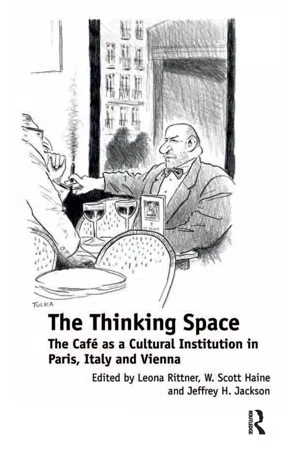
The Thinking Space
The Caf�s a Cultural Institution in Paris, Italy and Vienna
- 286 pages
- English
- ePUB (mobile friendly)
- Available on iOS & Android
eBook - ePub
The Thinking Space
The Caf�s a Cultural Institution in Paris, Italy and Vienna
About this book
The cafe is not only a place to enjoy a cup of coffee, it is also a space - distinct from its urban environment - in which to reflect and take part in intellectual debate. Since the eighteenth century in Europe, intellectuals and artists have gathered in cafes to exchange ideas, inspirations and information that has driven the cultural agenda for Europe and the world. Without the café, would there have been a Karl Marx or a Jean-Paul Sartre? The café as an institutional site has been the subject of renewed interest amongst scholars in the past decade, and its role in the development of art, ideas and culture has been explored in some detail. However, few have investigated the ways in which cafés create a cultural and intellectual space which brings together multiple influences and intellectual practices and shapes the urban settings of which they are a part. This volume presents an international group of scholars who consider cafés as sites of intellectual discourse from across Europe during the long modern period. Drawing on literary theory, history, cultural studies and urban studies, the contributors explore the ways in which cafes have functioned and evolved at crucial moments in the histories of important cities and countries - notably Paris, Vienna and Italy. Choosing these sites allows readers to understand both the local particularities of each café while also seeing the larger cultural connections between these places. By revealing how the café operated as a unique cultural context within the urban setting, this volume demonstrates how space and ideas are connected. As our global society becomes more focused on creativity and mobility the intellectual cafés of past generations can also serve as inspiration for contemporary and future knowledge workers who will expand and develop this tradition of using and thinking in space.
Information
PART I Vienna
1 The Vienna Coffee House: History and Cultural Significance
DOI: 10.4324/9781315552279-1
“For the Viennese, the coffee house is an institution,” says Ludwig Plakolb in the afterword to the volume Kaffeehause. 1 Plakolb continues:
If it is necessary, one can live without an apartment (what are hotels for?), without an office (why work?), without a wife (why one’s own?), and in case of real need even without money (what are head waiters for?), but not without a coffee house, which basically can replace all of the above. 22 Ibid.
In some ways, a Viennese coffee house fulfills many of the same functions as a London club or a Paris salon. But there are important differences. In a salon or a club, there are rules and conventions governing social etiquette; in a coffee house, you can be alone or in company, as you choose. You can feel perfectly free of responsibilities and duties. Unlike a salon, there is no need for conversation; unlike a club, a coffee house has no membership fees. Marcel Brion observes:
One might write an interesting analysis of capital cities by describing the nature of cafés in each country, and one would obtain at the same time a considerable source of information on the psychology, the habits and feelings of different races by examining what a café means to each of them. (I, 49)
Like all cafés, Viennese coffee houses offer their patrons a choice between solitude and sociability. But they offer more: the waiter will address you as Herr Direktor if you look like a business man; as Herr Doktor if you look like a young intellectual; Herr Professor if you look like an older one. (Herr Baron has gone out of fashion, except for ultra-conservative establishments.) By your third visit, he will know you by name and escort you to your favorite table. There, he will not only bring you a cup of coffee, chosen from a bewildering array of options with enticing names like Einspanner, Melange, Mokka, Kapuziner, eine Schale Gold, eine Tasse Nussbraun—all of them with or without Schlag. He will also bring a huge pile of newspapers and journals, as well as a glass of water which will be periodically refilled, whether or not you order anything else. And you can sit there all day and all evening until closing time.
It is not unusual for a Viennese to visit their favorite coffee house (the Stammcafé) three times a day: for breakfast, when the coffee is accompanied by a Semmel or a Kipfel; for a mid-afternoon break called Jause, which includes at least one piece of the world-famous Viennese pastry, cake or Torte; and for an extended stay in the evening. Without this daily ritual, well over 200 years old, Vienna simply would not be Vienna. In Vienna, as Hermann Kesten puts it, “there flourished girls and tourists, coffee houses, feuilletons, psychoanalysts, songs and music.” 3
To be sure, the institution of the coffee house was not invented in Vienna. Coffee houses have been a flourishing tradition in the Near East since the Middle Ages; in Europe they existed in Venice, Marseilles, and London before coming to Vienna. But the Viennese gave them a special flavor. Plakolb quotes an unidentified source from the year 1845: “There has to be a coffee house; it is part of our social well-being. … Coffee houses are adjuncts of our existence which have become indispensable.” 4
It might be appropriate to give a brief summary of the history of coffee and coffee houses BV (before Vienna). The word “coffee” (in its various spellings in different languages) probably comes from the Ethiopian province of Kaffa, where the plant was called “bunn” and from where it came to the North African Arab countries, probably before the year 800. According to a medieval legend, its properties as a stimulant were discovered by some shepherds who observed the increased activity of their goats after eating the berries. But whether this is fact or fiction, the original use of coffee was by chewing the beans, either raw or roasted, sometimes mashed or ground into powder. The Swiss Protestant minister Pierre Dumant claimed that the porridge for which Esau sold his birthright was coffee, rather than lentils.
The early Arab physician Rhazes, a follower of Galen and Hippocrates and the author of a medical treatise, first mentioned the curative properties of coffee in his book Al-Haiwi, written about ad 800. Pottery containers used for brewing and drinking coffee, dating from about 1350, were discovered in Persia, Egypt, and Turkey. Public coffee houses must have been in existence in Mecca as early as 1500; Kair Bey, the governor of Mecca, ordered them closed in 1524 because of disorder. His successor, however, allowed them to reopen under license. In 1551, under the reign of Suleiman the Magnificent, the first coffee houses opened in Constantinople. From there, the institution spread throughout the Ottoman Empire, and coffee became known as “the wine of Islam.”
Knowledge of coffee was brought to Europe by travelers returning from the Near East. The German physician and botanist Leonhard Rauwolf of Augsburg was the first to refer to the beverage in print. In his book Eigentliche Beschreibung der Raisz so er vor dieser Zeit gegen Auffgang in die Morgenlander vollbracht (Laugingen 1582), he wrote:
If one has the desire to eat or drink something, they commonly have open shops, in which they sit together on the ground or on carpets and feast together. Among other liquors, they have a good drink which they hold in high esteem, named CHAUBE by them. It is as black as ink and very useful for sickness, especially of the stomach. … They drink it out of earthenware or porcelain cups as hot as they can stand it. 55 Quoted in William A. Ukers, All About Coffee (New York: Tea and Coffee Trade Journal Co., 1935), 20.
The curative properties of coffee were also proclaimed in the oldest European book devoted entirely to caffeine products, Phillippe Sylvestre Dufour’s Traités Nouveaux et curieux du Café, du The et du Chocolate. 6
In 1585, Gianfrancesco Morosini reported to the Venetian senate on the use by the Turks “of a black water, being the infusion of a bean called cavee.” 7 Coffee was introduced to Venice in 1616 by Pietro Della Valle, and the first coffee house opened there in 1645. A Venetian coffee house, probably Florian’s, is the place of action of Carlo Goldoni’s comedy La Bottega del Caffè (The Coffee House) of 1750.
Coffee was brought to Holland from Mocha, a Yemen seaport, in 1616 by Pieter van den Broecke. The first coffee house was established in The Hague in 1664. A painting by Adriaen van Ostade, about 1650, is probably the first depiction of a coffee house in Western Europe. In 1644, the French traveler Pierre de la Roque, upon his return to Marseilles from a trip to the Levant, brought with him not only some coffee but also “all the little implements used about it in Turkey, which were then looked upon as great curiosities in France.” 8
One of the earliest English references to coffee is in a book by Captain John Smith (founder of the colony of Virginia) called Travels and Adventure, published in 1603. He says of the Turks: “Their best drink is coffa of a graine they call coava.” 9 In his Sylva Sylvarum of 1624, Sir Francis Bacon wrote:
They have in Turkey a drink called coffa, made of a berry of the same name, as black as soot, and of a strong scent, but not aromatical; which they take, beaten into powder, in water, as hot as they can drink it; and they take it, and sit at it in their coffee houses, which are like our taverns. This drink comforteth the brain and heart, and helpeth digestion. 1010 Quoted in William A. Ukers, All About Coffee, 35.
Coffee drinking was introduced to England in 1637 by Nathaniel Conopius, a Cretan student at Oxford; the first coffee house was opened in London in 1650 by a man named Jacobs. By 1667, the institution was sufficiently well known to be featured in Samuel Pepys’ diary. He notes that he went to a performance of Thomas St. Serf’s comedy Tarugo’s Wiles or the Coffee House, also attended by Charles II and the Duke of York. Pepys called it “the most ridiculous and insipid play I ever saw in my life.” 11
From England, the use of coffee was introduced into northern Germany about 1670; the drink is mentioned at the court of the Elector of Brandenburg in 1675, and an English merchant established a coffee house in Hamburg in 1679. The institution, however, did not flourish there.
In the meantime, the spread of the Ottoman Empire into southeastern Europe continued. Around 1460, Serbia and Bosnia were conquered; the Crimea, Moldavia, Transylvania and eventually Hungary followed in the sixteenth century, culminating in a brief and unsuccessful siege of Vienna in 1529. With victorious Islam came the use of coffee. Finally, in 1683 the Turks stood once more before the hastily fortified gates of Vienna: a second siege began and the fall of the city seemed imminent. Emperor Leopold I had fled and was trying to persuade the Prince-Electors of the Holy Roman Empire and the King of Poland to mount a counter-attack.
The story of what happened next is best told by Carl von Peez. 12 It is the tale of Georg Franz Kolschitzky, a figure of history and legend after whom a street in Vienna’s fourth district is named. The original spelling of his name was Kulczycki; although he had claimed to come from Poland, it is more likely that he was born around 1650 in the south Hungarian town of Sombor, near the border with Serbia, in territory controlled by Turkey. In all probability, his father was a Pole captured as a slave by the Turks, and his mother a Serbian woman. He grew up multilingual, speaking Polish, Serbian, and Turkish as well as German. As a young man, he worked at the Belgrade office of the Oriental Company, an Austrian trade association for which he served as an interpreter. He came to Vienna in the 1670s; his name appears for the first time in an imperial decree of June 6, 1678, granting him a license as importer of oriental wares.
At the beginning of the siege, he volunteered for military service and allegedly fought bravely. When the need arose to send messages through the enemy lines to the emperor’s army, he was recommended to the commander of the imperial forces in Vienna, Count Ernst Rudiger von Starhemberg. Dressed in Turkish clothing and accompanied by the Serb Georg Mihailowitsch as his servant, he claimed to be a Turkish merchant from Belgrade trading with the Sultan’s army. He left Vienna on August 13 at 10:00 at night, accomplished his mission, and returned on August 17 at 4:00 in the morning. He claimed to have undertaken at least three similar journeys, which are not documented. In any event, he successfully delivered his messages—undoubtedly contributing to the lifting of the siege on September 12, when the Polish relief army under King Jan Sobieski arrived. The Turks fled, leaving behind 25,000 tents, 10,000 oxen, 5,000 camels, and 100,000 bushels of grain, among them many sacks filled with coffee. The relief troops were not familiar with the strange beans and did not know wha...
Table of contents
- Cover
- Halftitle Page
- Title Page
- Copyright Page
- Contents
- Notes on Contributors
- Preface
- Acknowledgments
- Introduction
- PART I: VIENNA
- 1 The Vienna Coffee House: History and Cultural Significance
- 2 The End of a False Summer: Aspects of Viennese Literary Culture around 1900
- 3 Jewish Modernism and Viennese Cafés, 1900–1930
- PART II: PARIS
- 4 Bad Places: Sedition, Everyday Speech, and Performance in the Café of Enlightenment Paris
- 5 From the Spectator to Goldoni: Coffee-house Culture and Wishful Thinking in the Eighteenth Century
- 6 A Café in the High Time of Haussmannization: Baudelaire’s Confrontation with the Eyes of the Poor
- 7 When Objective Chance Takes over Cafés
- 8 At the Time of Le Boeuf sur le Toit (The Ox on the Roof) Cabaret
- 9 Arguing About Jazz in the Parisian Café: Jazz, Race, and Literary Communities in 1920s Paris
- 10 Jean-Paul Sartre: Cafés, Ontology, Sociability, and Revolution in Occupied Paris, 1940–1944
- PART III: ITALY
- 11 Art at Il Caffè Florian
- 12 Casanova’s Coffeehouse: Sociability, Social Class, and the Well-bred Reader in Histoire de ma vie
- 13 The Giubbe Rosse Café in Florence: A Literary and Political Alcove from Futurism to Anti-Fascist Resistance
- 14 The Writer’s Provincial Muse: Piero Chiara in the Coffeehouse
- PART IV: REFLECTIONS
- 15 Three Scenes from Italian Cafés
- Index
Trusted by 375,005 students
Access to over 1.5 million titles for a fair monthly price.
Study more efficiently using our study tools.
Frequently asked questions
Yes, you can cancel anytime from the Subscription tab in your account settings on the Perlego website. Your subscription will stay active until the end of your current billing period. Learn how to cancel your subscription
No, books cannot be downloaded as external files, such as PDFs, for use outside of Perlego. However, you can download books within the Perlego app for offline reading on mobile or tablet. Learn how to download books offline
Perlego offers two plans: Essential and Complete
- Essential is ideal for learners and professionals who enjoy exploring a wide range of subjects. Access the Essential Library with 800,000+ trusted titles and best-sellers across business, personal growth, and the humanities. Includes unlimited reading time and Standard Read Aloud voice.
- Complete: Perfect for advanced learners and researchers needing full, unrestricted access. Unlock 1.5M+ books across hundreds of subjects, including academic and specialized titles. The Complete Plan also includes advanced features like Premium Read Aloud and Research Assistant.
We are an online textbook subscription service, where you can get access to an entire online library for less than the price of a single book per month. With over 1.5 million books across 990+ topics, we’ve got you covered! Learn about our mission
Look out for the read-aloud symbol on your next book to see if you can listen to it. The read-aloud tool reads text aloud for you, highlighting the text as it is being read. You can pause it, speed it up and slow it down. Learn more about Read Aloud
Yes! You can use the Perlego app on both iOS and Android devices to read anytime, anywhere — even offline. Perfect for commutes or when you’re on the go.
Please note we cannot support devices running on iOS 13 and Android 7 or earlier. Learn more about using the app
Please note we cannot support devices running on iOS 13 and Android 7 or earlier. Learn more about using the app
Yes, you can access The Thinking Space by Leona Rittner,W. Scott Haine in PDF and/or ePUB format, as well as other popular books in Historia & Historia del siglo XIX. We have over 1.5 million books available in our catalogue for you to explore.