eBook - ePub
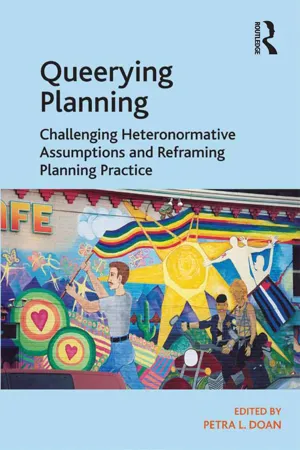
Queerying Planning
Challenging Heteronormative Assumptions and Reframing Planning Practice
- 294 pages
- English
- ePUB (mobile friendly)
- Available on iOS & Android
eBook - ePub
Queerying Planning
Challenging Heteronormative Assumptions and Reframing Planning Practice
About this book
Current planning practices have largely neglected the needs of the Lesbian, Gay, Bisexual, and Transgender (LGBT) community for safe urban spaces in which to live, work, and play. This volume fills the gap in the literature on the planning and development of queer spaces, and highlights some of the resistance within the planning profession to incorporate gay and lesbian concerns into the planning mainstream. Planning lags behind other disciplines concerned with queer urban issues. In contrast, the field of geography has developed a rich sub-specialty in the geographies of sex and gender that examines spaces and the variety of non-heteronormative populations that inhabit them. This volume brings together both planners and geographers with experience in planning to examine some of the fundamental assumptions of urban planning as they relate to the LGBT community. The first few chapters are substantial revisions and expansions of earlier influential work on planning for non-conformist populations and the preservation of LGBT neighborhoods. Subsequent chapters comprise original contributions that draw on the rich literature from queer theory, planning theory and the geography of sexualities to explore the ways that nonconformist populations struggle with heteronormative expectations embedded in planning theory and procedures. These chapters consider the intersection of planning and a range of populations including transgendered and gender variant individuals. Subsequent chapters examine the ways that variations in the scale of urban and regional governance influence local politics around the implementation of more equitable policies at the city level. In addition, several chapters critically examine the implications of using the tolerance component of Richard Florida's "creative cities" arguments. The final section consists of two chapters that explore the ways that urban planning regimes have been used to regulate sexually-oriented businesses and the way this regulation of sexualized spaces has implications on the heteronormativity of plans and planners. In summary, these chapters interrogate planning practice and pose questions for academic and professional planners about the ways that the queer community and its needs for spaces have shifted. What do those changes mean for the practice of planning 40 years after the North American Stonewall rebellion and looking forward to the next 40 years? To what extent does existing planning practice constrain the evolution of queer communities or seek to commercialize such spaces to the benefit of large developers and the detriment of marginalized members of the community? How might planning practice change to provide more direct support to the evolution of queer people and the spaces in which they live? This volume draws on these insights as well as the experiences of the various authors to lay out possible future directions for the field of planning to create truly inclusive urban areas.
Chapter 1
Why Question Planning Assumptions and Practices about Queer Spaces
This volume, Queerying Planning: Challenging Heteronormative Assumptions and Reframing Planning Practice, poses a set of queer questions (“queeries”) for planning practitioners and scholars interested in urban development issues about the ways that current planning practices have neglected the needs of the Lesbian, Gay, Bisexual, and Transgender (LGBT) community for safe urban spaces in which to live, work, and play. The authors in this volume seek to redress this oversight by raising questions about the intentions of many urban redevelopment objectives, municipal land use regulations, and economic development strategies that fail to consider the requirements of the LGBT population for urban spaces.
Many LGBT neighborhoods that have developed over the past 50 years are experiencing severe development pressure that threatens the vitality of these places as centers of LGBT life in the city (Dubrow, Chapter 3). In 2007 the author of this introduction took a tour of key sites in the gay history of San Francisco, and found it quite sobering to find that many of the iconic gay spaces in the city from the 1950s and 1960s had disappeared. Most of these places have been obliterated by urban redevelopment and by the failure of historic preservation to consider the importance of these historic monuments for the LGBT community (Doan and Higgins, 2011). Although the Castro District in San Francisco remains a highly visible gay neighborhood (gayborhood) for those who can afford to live there, the high property values and rents have made living, working, and organizing in this area difficult for many in the LGBT community. In addition, the desirability of this gentrified space means many upper middle class people who do not identify as gay are moving into the neighborhood, sparking some serious reflections about “whether gays and lesbians should assimilate into mainstream culture as they gain acceptance or maintain a separate place” (Buchanan, 2007).
The contributions in this volume go beyond descriptive accounts of queer spaces and practices around the globe, and seek to interrogate planning practice and pose questions for academic and professional planners about the dynamic nature of the LGBT community. Several of the chapters seek to integrate queer theory with planning theory and practice in ways that highlight the fluid nature of this community’s need for safe and welcoming spaces since the mid twentieth century. Although previous planning efforts often restricted the development of sexual minority communities in the name of order and public safety, several chapters highlight the ways that current planning policies have sometimes acted to exploit the “success” of gay villages and encourage the large scale commercialization of such spaces. The result of ill-considered commercialization is that well-financed developers receive large benefits and some of the most marginalized members of the urban community are left without a neighborhood (for example homeless, gender queer youth and retired LGBT people). Other chapters analyze the ways queer–friendly spaces are emerging in urban and suburban locations that stretch existing assumptions about what constitutes a gayborhood.
The over-arching theme of the book is that it is critical to examine the impacts of urban planning and development decisions on the LGBT community that are repeated in US cities as well as other countries, such as Canada, Australia, and the United Kingdom. In spite of claims that the field of planning has learned to value diversity and inclusivity, it is not clear whether some changes to planning codes and practice represent conscious acts of discrimination or are merely taken in ignorance of the needs of the LGBT population. The various contributors argue that it is essential to reframe planning practice to be more inclusive and to provide more direct support to the changing nature of the LGBT community and its evolving need for spaces in which to gather, reside and recreate.
Planning and Inclusion within the American Context
In order to understand how to reframe planning practice to be more inclusive of LGBT people it is useful to consider similar efforts to open the field of planning to women and minorities. There is by now fairly widespread agreement among planning theorists around the globe that concepts like multiculturalism, diversity, and inclusion must be integral components of current planning discourse. In the United Kingdom Healey (1997) has promoted a form of collaborative planning discourse that requires the recognition of difference among various stakeholders. Campbell (2006: 100) also in the UK context has urged that the process of planning include a broad concept of justice that is not restricted “to those with whom we share a common identity and/or encounter through face-to-face contact.” In the Australian context Gleeson and Low (2000) argue that multiculturalism takes the form of cultural pluralization where culture is broader than ethnicity, but includes the expression of any human social identity. Finally, Sandercock (2003) adds the notion of justice suggesting that a just city is one that is socially inclusive, where difference is given recognition and respect.
However, for many years this was not a commonly held perspective. For instance, Sandercock has taken to task the narrowness of “mainstream planning” in the introduction to her edited volume on multiculturalism.
At the most fundamental level there has been a failure to address two basic questions in these mainstream modernist planning histories. What is the object of planning history? And who are its subjects? (Sandercock, 1998: 6)
An important consequence of this failure has been the silencing of the contributions of women, people of color, and LGBT people. Historically the field of urban planning has been intellectually inclusive, drawing upon urban theories from the related fields of geography, economics and sociology as well as civil engineering and architecture. However, the practice of planning has been much less open to different perspectives, especially as they relate to minority communities and their particular needs. Because the ways in which planning has been opened to broader participation vary within different national contexts, this section will focus mainly on the American context.
Recently, urban planners in the United States celebrated the one hundredth anniversary of the first American city planning conference, held in May of 1909 in Washington, DC. This conference brought together representatives of two distinct movements with different visions of the city, the Social Reform and the City Beautiful Movements (Peterson, 2009). In the aftermath of this conference proponents of the City Beautiful Movement solidified their grasp on the profession, effectively muting the social reformers’ concerns with the congestion and deplorable conditions experienced by inner city slum dwellers. Peterson describes the planning profession at that time as “mostly Protestant, upper and upper-middle class, college-educated, and active in local business and professional life and still beholden to late-Victorian social norms and genteel modes of taste” (2009: 124). Peterson does not mention gender or ethnicity in his description, because at the time there was no diversity since all of these early purveyors of urban order were white men.
This lack of inclusion is not surprising since the practice of planning is intricately interwoven with the exercise of power, primarily through the use of information (Forester, 1982), but also through the refusal to acknowledge information relevant to those who lack power. Although there are few academic planners who would claim that planning is a wholly technical and therefore unbiased field, the behavior of planners over the last century suggests otherwise. Fainstein and Fainstein (1971: 344) observed that, “traditional planning has as its principal goal the original aim of the planning movement: the creation of an orderly urban environment.” Fainstein and Fainstein argued that the critical issue was who determined the definition of orderly (the goal) and the means of achieving that objective. Thirty years later Frisch (2002) argued that the “order” desired by many planning practitioners continued to be narrowly heterosexist, favoring white, male, and heterosexual conceptions of orderliness.
In the American context, Birch and Silver (2009) have provided a list of ten critical points for future planners. The first nine involve mostly technical skill development, but the tenth and final point highlights the fact that planners need to develop a different kind of proficiency:
[to] identify and interact with diverse interests, mediate differences, and undertake negotiation and consensus building to help different constituencies reach agreement in the face of new global energy and climate challenges. (Birch and Silver, 2009: 121)
This last skill recognizes the importance of diverse perspectives, although it has taken nearly a century for the profession to acknowledge so publicly the value of diversity. Unfortunately, there is less unity on how to achieve such diversity and who should be included in a set of diverse perspectives. In a review article for the one hundredth anniversary of the first planning conference, Dalton (2009) reviewed a list of the most influential books in planning submitted by the members of the Editorial Board of the Journal of the American Planning Association and concluded that much work remains to be done since issues of race, poverty, and gender were almost completely ignored.
Planning and Women
The struggle for full inclusion of women within the field of planning provides a number of important lessons for making planning more aware of and inclusive of LGBT people. In the United States the movement to incorporate women in planning took many years and only happened through determined advocacy, first around the right to vote, and later around the right to work. At the beginning of the last century women were not allowed to vote, cities were considered unsafe places for women, and planning was thought to be an unsuitable career for a woman (Hendler and Harrison, 2000). Wilson (1991) suggests that during this period urban reformers (who at the time happened to be almost exclusively male) viewed the presence of unaccompanied women in the city as a sign of moral turpitude and a cause of urban disorder. Spain (2001) provides a quite different account of the ways that women organized to make cities better places during the late nineteenth and early twentieth centuries by creating a variety of redemptive places such as settlement houses and women’s organizations. Women like Catherine Bauer (Birch 1994a) and Mary Kingsbury Simkhovitch (Wirka, 1994) were not formally employed as planners but made significant contributions to the field of housing as well as broader social reform which at the time was labeled “municipal housekeeping” (Birch, 1994b).
The women’s movement also demonstrated the importance of defining more precisely the link between planning and women’s lives which has important ramifications for the contemporary struggle to include LGBT issues within mainstream planning. After the vast suburban expansion of the post-World War Two era feminist planners pointed out the sexist nature of cities and the planners who shaped them (Hayden, 1981). Others have argued persuasively that cities and their public spaces are distinctly gendered and that planning needs to expand to include a gender agenda (Sandercock and Forsyth, 1992). Some scholars have argued that it is important to first identify and then work to reduce the visible and invisible boundaries that constrain women’s full participation in the life of the city (Miranne and Young, 2000). Fainstein and Servon (2005) have suggested that a gendered lens provides a perspective that allows broad issues such as universal childcare, transportation solutions that relieve the double burden of home-making and paid labor, and housing design that makes life easier for families.
Furthermore, several scholars argued that in order to expand planning practice to include women’s issues, more women needed to be included within the profession. Leavitt (1981) noted that during the 1950s the number of professional planners doubled from 1,000 to 2,000, but only 100 of these were women and by the 1970s less than fifteen percent of professional planners were women. The 1979 decision of the American Planning Association to create a Division of Women and Planning was a critical step in recognizing the importance of women’s roles in the city and opening the field of planning to women. The formation of this Division generated considerable opposition from some APA board members who felt that it was not appropriate to create a division for the purposes of advocacy (Macris, n.d.). In response, the newly formed Division leadership opted to focus on “the impact of planning on the needs of women as clients, rather than on the status and needs of professional women planners” (Macris, n.d.: 3).
Opening the profession to women was a first step, but ensuring that more women were trained in the field of planning required more work within the planning academy. In 1986 a group of women who taught in planning schools held an initial meeting in which they noted the lack of women in faculty positions within the academy as well as difficulties in getting feminist oriented publications accepted by mainstream planning journals (Howe and Hammer, 2002). The subsequent creation of the Faculty Women’s Interest Group (FWIG) within the Association of Collegiate Schools of Planning in 1991 marked another milestone in making the planning academy fully accessible to and sensitive to the perspectives of women.
Planning and People of Color
Similarly, there are important lessons for the inclusion of LGBT individuals and community concerns within the field of planning that can be drawn from the track record of planning with respect to race and ethnicity. First it is essential to acknowledge the pernicious effects of discrimination and racism both in local government and within the field of planning. Unfortunately persistent racism during much of the twentieth century complicated efforts by some planners to address issues of urban inequality. After the 1909 planning conference which emphasized the City Beautiful over the Social Reform movement, years of discrimination and neglect by municipal officials and planners resulted in inner cities that were characterized by poverty, violent crime, and despair. Urban policies such as restrictive covenants and redlining had also reinforced racially distinct neighborhood boundaries. Planners had contributed to this dysfunction by adopting zoning codes based on family definitions that pathologized the African-American family (Ritzdorf, 2000). The abuse of municipal regulations had created a separate and unequal society (Goldsmith and Blakeley, 1992), a virtual American version of apartheid (Massey and Denton, 1993).
This pattern of discrimination was met with organized and determined resistance by the African-American community through a variety of protest actions that demanded full civil rights. Though these marches and sit-ins attracted widespread attention, real change was slow in coming. During the long hot summers of the 1960s race riots erupted in the Watts neighborhood of Los Angeles, as well as neighborhoods in Detroit, Chicago, and Washington, DC, forcing urban officials and planners to sit up and begin to pay closer attention. Furthermore, the assassination of Dr. Martin Luther King touched off such widespread rioting in 168 US cities (Kweit and Kweit, 1998) and profoundly re-shaped the planning agenda with regard to the “inner city.”
In the aftermath of these protests, local government officials began to take notice of conditions in the worst urban areas. Regrettably, there was little effort to gain detailed understanding of conditions in the inner city and few attempts to include minority community residents. For example, during slum clearance efforts in the West End of Boston in the 1960s, the failure of planning authorities to communicate with inner city residents during implementation exacerbated the negative impacts (Fincher and Iveson, 2008). June Thomas (1998: 201) suggested “that city improvement efforts, in the context of racial oppression, can be racially oppressive.” Huw Thomas (2000) has suggested that the categories of race and ethnicity must be deconstructed to highlight their socially constructed nature. This confusion of identity categories certainly added to the failure of planners to grasp the dynamics of life in the inner city and the lack of sensitivity to issues of injustice.
A greater understanding of the connections between the black urban experience and urban planning history could develop a higher level of awareness about racial injustice. Such awareness, combined with knowledge of practical tools for promoting equity, could go a long way toward allowing planners to help break the historic linkage between urban development and racial oppression. (J. Thomas, 1994: 9).
The above quote provides a critical lesson for increasing the inclusion of the LGBT community in planning decision-making. Although it is often acknowledged that planning requires the full participation of minority populations, the plethora of minority identity categories complicates the determination of who should participate. Early attempts to resuscitate the old Social Reform movement through “advocacy planning” (Davidoff, 1965) on behalf of minority groups had only limited success. A later effort to re-orient planning practice to promote “equity planning” with broader participation and more inclusive categories (Krumholz and Forester, 1990) was somewhat more successful.
Institutional support has been another critical step in bringing issues of race and ethnicity into sharper focus within planning discourse and the profession at large. For example the establishment of the Planning and the Black Community Division (PBCD) of the American Planning Association in 1989 provided a forum for planners, administrators, public officials, students, and other APA members to address issues of significance to communities of color and planners of color. However, there are still concerns about the low level of participation by minorities in planning. A recent PBCD newsletter promoted a conference to address the questions of “Why are so few people of color in the planning profession? Why are so few people of color APA members?” (PBCD Newsletter, November 2003: 6).
In recent years several other specialized divisions of the American Planning Association have been formed. In 2004 an Indigenous Planning Division was created followed in 2005 by the Latinos in Planning Division. This organizing by planners of color in a national institution has been an important element in raising critical issues from their various communities. Apparently minority planners do feel they have made a substantial contribution to enabling and empowering communities of color to engage with the planning process (J. Thomas, 2008), but there are not yet sufficient numbers to make a substantive impact. The formation of a Planners of Color Interest Group (POCIG) in 2008 within the Association of Collegiate Schools of Planning may reinforce the continuing need to recruit and train planners of color to work in the field of planning.
Some LGBT activists have argued that the experiences of women and people of color with respect to fighting discrimination should be the model for LGBT activists working for civil rights as well as for those who support increased inclusion in planning decisions that shape existing communities. This book takes the perspective that while these prior movements have important lessons for the inclusion of LGBT issues and needs within planning practice, there are also a number of important differences. Some queer theorists have criticized the LGBT civil rights movement as “minoritarian” (Corber and Valocchi, 2003) resulting in a set of fixed identity categories that may exclude other sexual and gender non-conforming minorities who do not identify as narrowly gay or lesbian, although they do challenge heteronormative expectations.
Resistance to Planning for the LGBT Community
The previous section on Planning and Inclusion makes clear that the planning agenda is in large part shaped by those in power, and does not readily expand to include other minority groups without sustained pressure from specific interest groups. It is therefore not surprising that there has been an ongoing struggle for the inclusion of the LGBT community into planning discourse as well as for the recognition that this minority community is affected by planning decisions. This continuing tension is evident from the controversy created after the American Planning Association (APA) first established a Gays and Lesbians in Planning Division (GALIP) in 1998. In response to the creation of this division, a number of planning practitioners expressed strong disapproval about an APA division oriented to LGBT planners through a series of “Letters to the Editor” in Planning Magazine, the official magazine of the American Planning Association (APA).1 Although this dissent did not torpedo the newly formed GALIP Division, it did highlight the fact that there was, and possibly still is, a good deal of anger at the idea that LGBT issues deserve planning attention. The following excerpts from some of these letters are a sobering reminde...
Table of contents
- Cover Page
- Dedication
- Title Page
- Copyright Page
- Contents
- List of Figures and Tables
- Notes on Contributors
- Acknowledgments
- 1 Why Question Planning Assumptions and Practices about Queer Spaces
- PART I PLANNING THEORY AND PRACTICE
- PART II GOVERNANCE AND POLITICAL ISSUES
- PART III REGULATING SEX IN THE CITY
- PART IV REFLECTIONS AND CONCLUSIONS
- List of References
- Index
Trusted by 375,005 students
Access to over 1.5 million titles for a fair monthly price.
Study more efficiently using our study tools.
Frequently asked questions
Yes, you can cancel anytime from the Subscription tab in your account settings on the Perlego website. Your subscription will stay active until the end of your current billing period. Learn how to cancel your subscription
No, books cannot be downloaded as external files, such as PDFs, for use outside of Perlego. However, you can download books within the Perlego app for offline reading on mobile or tablet. Learn how to download books offline
Perlego offers two plans: Essential and Complete
- Essential is ideal for learners and professionals who enjoy exploring a wide range of subjects. Access the Essential Library with 800,000+ trusted titles and best-sellers across business, personal growth, and the humanities. Includes unlimited reading time and Standard Read Aloud voice.
- Complete: Perfect for advanced learners and researchers needing full, unrestricted access. Unlock 1.5M+ books across hundreds of subjects, including academic and specialized titles. The Complete Plan also includes advanced features like Premium Read Aloud and Research Assistant.
We are an online textbook subscription service, where you can get access to an entire online library for less than the price of a single book per month. With over 1.5 million books across 990+ topics, we’ve got you covered! Learn about our mission
Look out for the read-aloud symbol on your next book to see if you can listen to it. The read-aloud tool reads text aloud for you, highlighting the text as it is being read. You can pause it, speed it up and slow it down. Learn more about Read Aloud
Yes! You can use the Perlego app on both iOS and Android devices to read anytime, anywhere — even offline. Perfect for commutes or when you’re on the go.
Please note we cannot support devices running on iOS 13 and Android 7 or earlier. Learn more about using the app
Please note we cannot support devices running on iOS 13 and Android 7 or earlier. Learn more about using the app
Yes, you can access Queerying Planning by Petra L. Doan in PDF and/or ePUB format, as well as other popular books in Social Sciences & Geography. We have over 1.5 million books available in our catalogue for you to explore.