- 184 pages
- English
- ePUB (mobile friendly)
- Available on iOS & Android
eBook - ePub
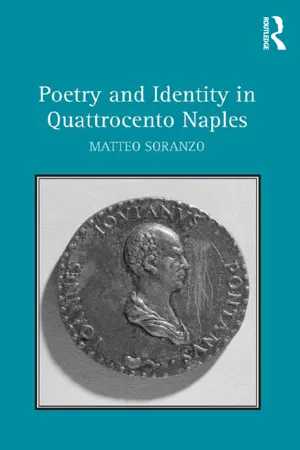
Poetry and Identity in Quattrocento Naples
About this book
Poetry and Identity in Quattrocento Naples approaches poems as acts of cultural identity and investigates how a group of authors used poetry to develop a poetic style, while also displaying their position toward the culture of others. Starting from an analysis of Giovanni Pontano's Parthenopeus and De amore coniugali, followed by a discussion of Jacopo Sannazaro's Arcadia, Matteo Soranzo links the genesis and themes of these texts to the social, political and intellectual vicissitudes of Naples under the domination of Kings Alfonso and Ferrante. Delving further into Pontano's literary and astrological production, Soranzo illustrates the consolidation and eventual dispersion of this author's legacy by looking at the symbolic value attached to his masterpiece Urania, and at the genesis of Sannazaro's De partu Virginis. Poetic works written in neo-Latin and the vernacular during the Aragonese domination, in this way, are examined not only as literary texts, but also as the building blocks of their authors' careers.
Information
Chapter 1
Latin at the Castle
Most people are shaped to the form of their culture because of the enormous malleability of their original endowment. They are plastic to the molding force of the society into which they are born.
—Ruth Benedict, Patterns of Culture
In 1450, King Alfonso I of Naples sent Beccadelli, Pontano and other men working at his court on a diplomatic mission to northern Italy.1 The initiative was part of a broader political design linked to the years of political turmoil that followed the death of Filippo Maria Visconti, Duke of Milan (1392–1447). In this period of interregnum, the Milanese territory, which was a desirable objective for many rulers from all over Europe by virtue of its wealth and strategic location, was turned into the fragile and short-lived Ambrosian Republic. As a result, the powerful warlord Francesco Sforza (1401–1466) tried to seize the vacant throne of Milan and start a new dynasty of Milanese dukes. For Alfonso, who already had had a taste of this condottiero’s military skills in 1442, Sforza’s ambitions over Milan were a threat that needed to be avoided at all cost.2 Hence, he began to form alliances with a number of smaller states of northern Italy, and most importantly with the members of the Este family who ruled over Ferrara and its surrounding territories. Alfonso’s newly formed elite of state bureaucrats, well trained in the studia humanitatis, played a crucial role in this diplomatic design, which would have modest political results but spectacular artistic repercussions.
For Pontano, a young and ambitious Latinist born and raised in Umbria, this diplomatic mission was an opportunity to make his debut as a politician and as a poet. Immediately after leaving the court of the Este and heading north toward Padua and Venice, both Beccadelli and his young protégé were given the opportunity to publish a specimen of their poetry in an anthology of love poems in Latin most probably crafted in Ferrara.3 This editorial initiative, whose success is testified by its dissemination in numerous manuscripts, presents the rediscovery of Latin love poetry taking place at the courts of Alfonso in Naples and Marquis Leonello d’Este in Ferrara as the direct continuation of Augustan elegy. Poetic production, in this way, was used as a visible sign of these rulers’ peaceful conduct, which at the same time was being publicized through artistic patronage, the organization of events such as Alfonso’s celebration of a triumph in Naples, intermarriages and reciprocal gifts.4 Charged with manifest political implications, the anthology included Pontano’s Amores, the first version of a collection of love poetry that eight years later was entitled Parthenopeus sive Amorum liber.5 Transcribed in countless manuscripts, and twice in prestigious dedication copies enriched by illuminations, Pontano’s first book was widely read among northern Italian intellectual elites long before its first authorized printed edition in 1498. It contributed also to the establishment of his reputation in the lively Neo-Latin literary scene of Quattrocento Italy.
This and the following chapter examine why and how Pontano used his literary debut as a tool to define his identity in relation to his colleagues at Alfonso’s court and his readers residing outside of Naples. In doing so, they focus on this collection’s style in a way that differs from the work of previous scholars. In general, scholars have approached Pontano’s Parthenopeus as a case of humanistic imitation, thus investigating the sources displayed in the last version of this text and emphasizing Pontano’s innovative reuse of ancient models.6 In addition, scholars have explored the textual history of this book and compared its four different versions to examine the author’s stylistic improvements and his growing expertise in the use of Latin as a literary language.7 Aspects of the author’s style, such as the choice of Latin as a literary language, the reuse of certain models such as Propertius’ elegies, the display of historical interlocutors or the inclusion of programmatic poems, however, can be discussed from the broader angle of cultural anthropology and interpreted as responses to other options available at the author’s time. In this chapter, therefore, Pontano’s style will be approached as a means of distinction, and his selection of historical interlocutors will be examined as a way of indexing social formations and groups that coexisted at Alfonso’s court. Rather than being simply the reflection of the author’s social status, Pontano’s identity is a work in progress that results from a careful negotiation within a system of distinctions and possibilities.
Latin at the Castle
It would be a mistake to assume that Pontano’s poetic identity sprang fully grown from his poems as Minerva from the brain of Jupiter. Recent research on identity has demonstrated that, rather than being the natural attribute of an individual or of a social group, identity is the result of a negotiation that changes depending on the situation – a work in progress, that is, which resides in an ongoing social and political process.8 These results are particularly evident in recent studies about social status and the use of formal registers in language, which have demonstrated how the use of deferential words does not necessarily stem from the status of speakers but is rather dependent on the needs of the moment of interaction.9 This is particularly relevant, moreover, for the study of language at large, including the composition and circulation of texts such as Pontano’s Parthenopeus. The choice of a linguistic code such as Latin instead of the vernacular, the adoption of a distinctive genre or the use of a specific metrical pattern are not the reflection of the writer’s identity or the consequence of his intellectual affiliations. They are all constitutive of an identity, which is produced in the course of an action situated in context.
Understanding the situation in which an act of cultural identity takes place, therefore, is particularly important for understanding this process in its complexity. This is not always the case, however, in scholarship on linguistic variation in general and more specifically on the use of Latin in a medieval and Early Modern context.10 In his groundbreaking history of the Latin legacy in the Early Modern and Modern periods, which focuses mostly on post-1600 Europe, François Wacquet only briefly discusses the Quattrocento revival of the Latin language and the formation of an enduring pedagogical paradigm based on the study of classical authors. After recalling Garin’s thesis on the moral value of humanistic pedagogy, and its difference from the more pragmatic conclusions of Grafton and Jardine, for whom the ideals boasted by the humanists were actually different from the mainly practical skills imparted in the classroom, Wacquet argues that, in the Quattrocento, Latin was still necessary for a number of professions, and so there was no need to defend its pursuit at that time.11 In an old, yet still influential essay on Renaissance Latin poetry, moreover, Spitzer tried to assess whether the use of an ancient language enhanced or limited the creativity of poets such as Petrarch, Poliziano and Pontano, whose first language was the vernacular. For Spitzer, the best Renaissance Latin poets succeeded in communicating personal emotions they experienced in the vernacular in a traditional language learned from books, according to a cult of poetic artificiality that foreshadowed Mallarmé and Valéry.12 In this perspective, the option of Latin as a literary language tends to be interpreted as a consequence of Renaissance humanism, regardless of the specific sociolinguistic situation in which these choices occurred.
Although acceptable on a general level, the arguments of Wacquet and Spitzer are rather vague when applied to a particular case such as Pontano’s choice of Latin to constitute his poetic identity. Pace Wacquet, a Quattrocento educated writer such as Pontano could switch not only from Latin to the vernacular, but also from one form of Latin to another depending on the situation. If one looks at the entirety of written documents signed by Pontano, it is clear that during his busy lifetime he used the pen for different reasons and that he was very careful to switch to the right language. When addressing his poems, letters, treatises and dialogs to his fellow scholars based in Naples or in other cities, for example, Pontano used an elaborate form of humanistic Latin modeled on Cicero and not always open to canonical authors. Humanistic Latin, however, was not an option when Pontano’s interlocutors were King Ferrante, whose Latin was notoriously lacking, or other members of the Aragonese family such as Ippolita or Federico of Aragon, who were dedicated to the study and imitation of a vernacular imported from Tuscany. In his diplomatic communications and in interacting with the Aragonese family, therefore, Pontano adopted a vernacular koiné, which was not his native language but a variety normally used by diplomats and courtiers across Italy.13 Furthermore, when he put his signature to the peace treaty between Florence and Naples signed in Rome in 1486, Pontano switched from the humanistic Latin used in his literary works to the straightforward variety used by notaries, diplomats and lawyers.14 In these kinds of circumstances, a mistake could have serious consequences. On December 22, 1470, for example, Pope Paul II rejected a document written in humanistic Latin by Bartolomeo Scala, Florentine ambassador in Rome. In a situation that required the variety of Latin normally used by notaries and lawyers, Scala’s humanistic Latin sounded like an oddity or, as the Pope himself put it, the work of a madman.15
Pace Spitzer, Pontano and his contemporaries working at Alfonso’s court were not simply torn between Latin, a traditional language learned from books, and a spontaneously learned vernacular that was fitting to channel their emotions. De Blasi et al. have shown that a writer working at the multicultural Aragonese court also had a variety of vernaculars from which to choose.16 Leaving aside the vernacular koiné used in the context of diplomatic communications, at the court of King Alfonso and at the other smaller courts of barons and urban nobles living in the kingdom, literary texts were written in at least four vernaculars. First, Castilian and Catalan vernaculars were still largely used to write poetry at court. In 1448, for example, Catalan poet Lleonard de Sors wrote an encomiastic poem entitled La Nau, which retells the poet’s voyage to Naples and describes the wonders of Alfonso’s kingdom.17 Other Spaniards attached to Alfonso’s court, moreover, were interested in the local vernacular of Naples and used it for literary purposes. A poet named Carvajal, for instance, composed a poem in which he gives voice to a woman from Aversa, and characterizes her speech by imitating the language spoken on the streets of Naples.18 Although less importantly than at the time of the Angevin domination, and less frequently than at the time of Ferrante, the urban nobility of Naples had also some knowledge of Tuscan vernacular, mainly because of the books imported by the numerous Florentine merchants and bankers residing in the city.19 Limiting our discussion to literary languages, therefore, humanistic Latin during Alfonso’s reign was one of at least four possibilities. What did the choice of this option entail?
The first version of Pontano’s Parthenopeus, as me...
Table of contents
- Cover Page
- Title Page
- Copyright Page
- Contents
- Acknowledgments
- Introduction
- 1 Latin at the Castle
- 2 Poetry and Patria
- 3 Elegies for a Bride
- 4 Pastoral Affiliations
- 5 Written in the Stars
- 6 The Cloud-Shrouded Tower
- Conclusion
- Works Cited
- Index
Trusted by 375,005 students
Access to over 1.5 million titles for a fair monthly price.
Study more efficiently using our study tools.
Frequently asked questions
Yes, you can cancel anytime from the Subscription tab in your account settings on the Perlego website. Your subscription will stay active until the end of your current billing period. Learn how to cancel your subscription
No, books cannot be downloaded as external files, such as PDFs, for use outside of Perlego. However, you can download books within the Perlego app for offline reading on mobile or tablet. Learn how to download books offline
Perlego offers two plans: Essential and Complete
- Essential is ideal for learners and professionals who enjoy exploring a wide range of subjects. Access the Essential Library with 800,000+ trusted titles and best-sellers across business, personal growth, and the humanities. Includes unlimited reading time and Standard Read Aloud voice.
- Complete: Perfect for advanced learners and researchers needing full, unrestricted access. Unlock 1.5M+ books across hundreds of subjects, including academic and specialized titles. The Complete Plan also includes advanced features like Premium Read Aloud and Research Assistant.
We are an online textbook subscription service, where you can get access to an entire online library for less than the price of a single book per month. With over 1.5 million books across 990+ topics, we’ve got you covered! Learn about our mission
Look out for the read-aloud symbol on your next book to see if you can listen to it. The read-aloud tool reads text aloud for you, highlighting the text as it is being read. You can pause it, speed it up and slow it down. Learn more about Read Aloud
Yes! You can use the Perlego app on both iOS and Android devices to read anytime, anywhere — even offline. Perfect for commutes or when you’re on the go.
Please note we cannot support devices running on iOS 13 and Android 7 or earlier. Learn more about using the app
Please note we cannot support devices running on iOS 13 and Android 7 or earlier. Learn more about using the app
Yes, you can access Poetry and Identity in Quattrocento Naples by Matteo Soranzo in PDF and/or ePUB format, as well as other popular books in Literature & Literary Criticism. We have over 1.5 million books available in our catalogue for you to explore.