- 194 pages
- English
- ePUB (mobile friendly)
- Available on iOS & Android
eBook - ePub
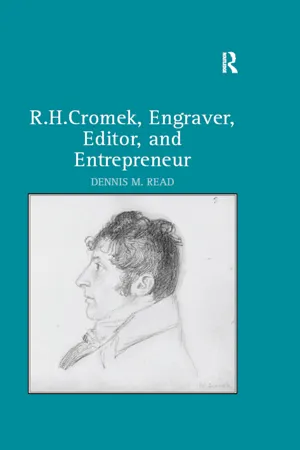
R. H. Cromek, Engraver, Editor, and Entrepreneur
About this book
Based on meticulous archival research, Dennis M. Read's study offers the most accurate and thorough account to date of the engraver, editor, and arts enthusiast R. H. Cromek. Though he is best known today as William Blake's nemesis, Cromek made significant contributions to the vitality of the arts in nineteenth-century Britain. Read traces Cromek's early years as an accomplished engraver, his collaborations and falling out with Blake, and his editing and publishing ventures, showing him to be a pioneer who recognized the opportunities of the emerging market economy. Read's descriptions of Cromek's disastrous associations with the Chalcographic Society, his publication of Robert Burns's unpublished works, and his duping by the perpetrator of a literary hoax make for fascinating reading and tell us much about the commercial art and publishing scenes in England and Scotland. Perhaps most important, Read salvages Cromek's reputation as an unscrupulous exploiter of Blake and others. A fuller and more balanced portrait emerges that shows Cromek's efforts to bring the arts to emerging cities of the midlands and beyond, describes his friendships and associations with luminaries of the fine arts and literature such as Leigh Hunt and Benjamin West, and challenges more biased reports of his successes and failures as an entrepreneur.
Information
Chapter 1
Father and Son
When Alexander Gilchrist’s monumental biography of William Blake was first published in 1863, Thomas Hartley Cromek was confronted with startling accusations about his father. Gilchrist portrayed Robert Hartley Cromek as a second-rate engraver who turned to speculating on “the talents of others.”1 Gilchrist accused him specifically of stealing Blake’s copyright to the Grave designs (p. 202) and of out-maneuvering Blake by commissioning a painting and engraving of the Canterbury Pilgrims after Blake had begun his own (p. 203). Cromek made much from the venture; Blake virtually nothing from his. Gilchrist also asserted that Cromek had deprived Robert Burns’ widow of payment after collecting and publishing his manuscripts (p. 235), and he repeated Peter Cunningham’s charge that Cromek stole from Sir Walter Scott a Ben Jonson letter to Drummond of Hawthornden (p. 238). His catalog of adjectives for Cromek includes “slippery,” “unscrupulous,” “wily,” “treacherous,” “shifty,” and “predacious.” In short, Gilchrist described Cromek as a rapacious exploiter whose only interest was personal gain at the cost of others, in particular, Blake.
Gilchrist’s characterization of Cromek begins with what Blake had written privately about him in his Notebook. His scurrilous verses and aphorisms scattered in his Notebook form the story: after he had entered into an agreement with Cromek in good faith, Cromek had acted first dishonestly, then maliciously towards him. Gilchrist unquestioningly accepted this story, painting Cromek as the villain and Blake as the victim in their several disputes. In this stance Gilchrist was following the traditional path of biographer as hagiographer. Anything that made Blake seem more admirable or sympathetic was useful. Investing Blake’s adversaries with the opposite qualities intensified Blake’s saintliness. Gilchrist’s interest in Cromek therefore was limited to advancing the portrayal of Blake as the misunderstood, exploited, ridiculed and neglected Romantic artist.
Thomas Hartley Cromek naturally took offence at Gilchrist’s sullying of his father’s reputation. But he was not in a good position to dispute it. Since he was only three years old when his father died in 1812, he knew his father almost entirely through the recollections of his mother (who had died in 1848) and other family members. These recollections not surprisingly stood at odds with Gilchrist’s version. Cromek had always understood that his father had been a hard-working engraver, a friend and respected associate among artists, writers, and publishers, and a successful editor and literary impresario. He had been given to believe that his father would have made a more lasting mark in British letters and the arts, had he not been struck down at the height of his career by consumption, dying at 42.
He had himself become an accomplished water-colorist partly to fulfill his father’s artistic legacy. Early in his life at Wakefield, he had shown a talent for drawing. As a child he studied briefly in London with the engraver James Hopwood (1752?–1819), then returned to Wakefield, where he received instruction from the portrait painter James Hunter. In 1826 he moved to Leeds to study with James Rhodes. In 1830 he traveled to Florence and Rome, and in subsequent years he visited sites of ancient ruins in Italy and Greece which he rendered in drawings and paintings. While residing in Florence in 1837 he taught drawing to the young Edward Lear. He settled in Rome, but was forced to return to England in 1849 by the Garibaldian civil war. In 1850 he was elected an Associate of the New Society of Painters in Water-Colours. He moved to Wakefield in 1851, remaining there for the duration of his life, dying in 1873.2
Thomas Cromek was encouraged by others to answer Gilchrist’s charges. Among them was the artist William Bewick, son of the celebrated wood-engraver, Thomas Bewick. He wrote Cromek on 12 February 1864:
I sincerely sympathise with you in your anxiety and vexation regarding the aspersions thrown out in the Life of Blake. Surely serious untruths, when published to the world, ought to be contradicted; the public ought to be set right if you are in a position to do so without much trouble to yourself.3
Six days later Bewick included in another letter to Cromek his recollection of an important informant in Gilchrist’s biography, John Thomas (Nollekens) Smith:
I remember him well. He was a notorious gossip, and I knew ladies who used to go to the Print-room [in the British Museum, where he was employed] to be amused by his endless and amusing tattle. He was a great retailer of anecdote and scandal, dealt largely in innuendo, and had a keen relish for any story of doubtful propriety.4
Other contemporaries of Cromek’s father disputed Gilchrist’s characterization. In a published review of Gilchrist’s biography, William M. Tartt wrote that Gilchrist “greatly wrongs” Cromek. “We met Cromek in 1808, as the guest of Mr. Roscoe at Allerton, and knew him afterwards; and we do not believe him to have been the mercenary in literature or art that he is here described. In his dealings both with Blake and Stothard he gave them what they required for the works he purchased; he faithfully fulfilled his engagements; and if he knew better than they did how to attract the attention of the public, he had a right to use such knowledge for his own advantage. It was only in this way that he made more by their works than they could have made themselves.”5
Cromek wrote to others from his home in Wakefield asking for recollections about his father, and he traveled to London to interview several of them. Bewick wrote to a Mr. Davison on 22 May 1864 that Cromek was currently enduring the “heat and turmoil” of London, “sweating in exhibitions or suffocated in omnibuses, fatigued by walking, and restored by Turkish baths!”6 His main mission, however, was searching for and meeting those who remembered his father. As a result, he was able to enlarge the manuscript “Memorials of the Life of R.H. Cromek … with the unpublished correspondence … and other papers relative to his professional and literary career,” which he had written about six months before Gilchrist’s biography had been published. Cromek described this volume in his letter of 18 January 1863 to W.H. Carpenter:
Since I last wrote to you, I have transcribed in a very fair hand, the whole of my Memorials of my father—to which I have made several valuable additions, in consequence of my frequent communications with Mr Pye, Miss Hopwood, & her sister in London (Mrs Eastwick)[.] Mr Pye has kindly revised two or three of his own letters, for insertion in the Appendix: these render my Memoir the more interesting, and they show what he thinks of my labours. I wish I could afford to publish it, even as a private book. The Publishers’ objection is, I think, a very foolish one—viz. it is not of sufficient interest to make it worth their while to speculate on it.7
While this copy of “Memorials” has not survived, two later versions have, one dated 23 December 1864 and the other dated 27 July 1865. Cromek also compiled a volume titled “Recollections of Conversations with Mr. John Pye …” dated May 1863. In still another volume, dated December 1863, he reproduced extracts from Gilchrist’s biography on the left-hand page and responded to them on the facing page. These volumes express Cromek’s consternation over the abuse of his father’s reputation, as well as the neglect or misuse of documents about his father he had provided to various people over the years.
Two instances of his providing information to others about his father stand out. Cromek reports that in 1833, during a brief stay in London, he lent to Allan Cunningham his copy of R.H. Cromek’s vituperative letter of May 1807 to Blake in which he refuses to buy from Blake his dedicatory design to The Grave for 20 guineas. Cunningham, Cromek states, never returned this unique document, instead passing it on to his son, Peter, who published it in the Gentleman’s Magazine of February 1852 with no acknowledgement of its source.8 Gilchrist included the letter in its entirety in his biography, again without indicating its source. Cromek ruefully writes, “The last person, in whose hands I placed that letter, was—Allan Cunningham; and I have never seen it since.”9
The second instance occurred after the publication of the biography of Thomas Stothard in 1852 by Stothard’s daughter-in-law, Anne Eliza Bray. Cromek states that on 8 October 1854 he wrote to Bray correcting misinformation about Stothard’s painting of The Canterbury Pilgrims. He previously had provided her with information that she had included in “Reminiscences of Stothard” (Blackwood’s Edinburgh Magazine, 39 [May, June 1836], pp. 669–88 and 753–68) with the acknowledgment, “the account [of The Canterbury Pilgrims] given to me by Mr. Cromek.” Bray forwarded Cromek’s corrections to Gilchrist, who included them in his biography of Blake but neglected to identify their original source. Cromek expostulates:
These facts were not communicated to any one but Mrs. Bray; nor could they be known to any one else, inasmuch as my father[’]s Memorandum book has never been out of my possession. The “other sources,” or rather, source to which Gilchrist alludes is myself and no one else, for Mrs. Bray, who must have given him the information, directly, or indirectly had most assuredly received it from me. Why, therefore[,] should all acknowledgement of valuable information be denied to me, and my name never once mentioned?10
Cromek’s effort to answer Gilchrist’s assertions, however, came to little effect. His “Memorials,” along with the papers and prints his father had left, remained with his heirs after his death in 1873. Over the years, occasional mention in print would be made of this cache. In his edition of Burns’s Works, W. Scott Douglas cites the owner of the original manuscript of “Elegy on Willie Nichol’s Mare” as Mrs. [Mary] Warrington, “the granddaughter of R.H. Cromek.”11 This is the daughter of Thomas Cromek who had handwritten his “Memorials” and other volumes; she had married John Warrington in 1875. In the 4 November 1882 Spectator John Bell reports that “there are papers in existence—now before me—belonging to the representatives of the late T.H. Cromek which throw much light upon his father’s transactions … and I need hardly point out that they give a most emphatic contradiction to the statements advanced in such a vindictive spirit by Blake’s biographers” (p. 1411). The “representatives” are not identified by Bell, but they probably are Thomas Cromek’s daughters, Mary, Clarinda, and Anastasia, as well as the husbands of Mary and Clarinda. In 1886, Samuel Richardson stated in his note to a plate engraved by Cromek, “Blake’s accusations, however, were refuted by Cromek’s son,” indicating that Thomas Cromek’s rebuttal had registered to some degree.12 And in the September 1917 Bookman of London, Davidson Cook reports on stumbling over Douglas’s reference and subsequently visiting Austin Warrington, son of Mary Warrington (who died in 1907), who “very kindly favoured me with the loan” of “Memorials.”13
By the time Cook inquired about the original Burns manuscripts, the Cromek heirs no longer had them. Cook surmises that they must have been the “Collection of Burns Manuscripts and Other Documents Relating to the Poet, made by Thomas H. Cromek (Son of the Author of the Reliques) in one volume folio” sold on 28 March 1877 at Dowell’s Auction Rooms in Edinburgh. Ten years earlier, in 1867, Cromek had given 119 engravings executed by his father, along with a drawing by Howard, another by Stothard, and a unique print by Blake, to the British Museum Print Room. A collection of 167 letters addressed to Thomas Cromek is now in the University of Edinburgh Library. Other documents and pieces of information relating to father and son are in various public and private collections in the United Kingdom and the United States. These, along with the scattered published references to Cromek and the projects he participated in, have always been available to the assiduous researcher. But the most important documents relating to Cromek’s career now are in the Princeton University Library. The collection, comprising nine bound volumes of papers relating to the careers of the two Cromeks, was sold at Sotheby’s (London) on 17 July 2008 by the heirs of the Warrington family to the antiquarian booksellers John Hart and Chris Johnson. Princeton purchased the lot in March 2009.14 Among the volumes are “Memorials,” “Recollections of Conversations with Mr John Pye,” and the critical commentary on Gilchrist’s biography of Blake.
The task that Thomas Cromek undertook still needs to be completed. His father still is regarded as the unscrupulous exploiter of Blake and others. In his having irreconcilable differences with Blake, Cromek had much company; Blake quarreled with nearly everyone, from Raphael to Reynolds. Certainly Cromek was no exemplar of altruism. But he hardly lived in an age of altruism. He was an ambitious and determined individual who recognized entrepreneurial opportunities in ...
Table of contents
- Cover
- Half Title
- Title Page
- Copyright Page
- Dedication
- Table of Contents
- List of Illustrations
- Acknowledgments
- List of Abbreviations
- 1 Father and Son
- 2 Cromek the Engraver
- 3 The Grave
- 4 The Canterbury Pilgrims
- 5 the Chalcographic society
- 6 Reliques of Burns
- 7 Remains of Nithsdale and Galloway Song
- 8 Last Days
- Appendix 1: the Grave portfolio Complete and In pieces
- Appendix 2: Coach travel in early Nineteenth-Century Great Britain
- Bibliography
- Index
Trusted by 375,005 students
Access to over 1.5 million titles for a fair monthly price.
Study more efficiently using our study tools.
Frequently asked questions
Yes, you can cancel anytime from the Subscription tab in your account settings on the Perlego website. Your subscription will stay active until the end of your current billing period. Learn how to cancel your subscription
No, books cannot be downloaded as external files, such as PDFs, for use outside of Perlego. However, you can download books within the Perlego app for offline reading on mobile or tablet. Learn how to download books offline
Perlego offers two plans: Essential and Complete
- Essential is ideal for learners and professionals who enjoy exploring a wide range of subjects. Access the Essential Library with 800,000+ trusted titles and best-sellers across business, personal growth, and the humanities. Includes unlimited reading time and Standard Read Aloud voice.
- Complete: Perfect for advanced learners and researchers needing full, unrestricted access. Unlock 1.5M+ books across hundreds of subjects, including academic and specialized titles. The Complete Plan also includes advanced features like Premium Read Aloud and Research Assistant.
We are an online textbook subscription service, where you can get access to an entire online library for less than the price of a single book per month. With over 1.5 million books across 990+ topics, we’ve got you covered! Learn about our mission
Look out for the read-aloud symbol on your next book to see if you can listen to it. The read-aloud tool reads text aloud for you, highlighting the text as it is being read. You can pause it, speed it up and slow it down. Learn more about Read Aloud
Yes! You can use the Perlego app on both iOS and Android devices to read anytime, anywhere — even offline. Perfect for commutes or when you’re on the go.
Please note we cannot support devices running on iOS 13 and Android 7 or earlier. Learn more about using the app
Please note we cannot support devices running on iOS 13 and Android 7 or earlier. Learn more about using the app
Yes, you can access R. H. Cromek, Engraver, Editor, and Entrepreneur by Dennis M. Read in PDF and/or ePUB format, as well as other popular books in Literature & Literary Criticism. We have over 1.5 million books available in our catalogue for you to explore.