eBook - ePub
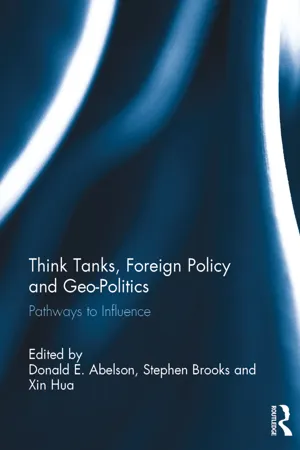
Think Tanks, Foreign Policy and Geo-Politics
Pathways to Influence
- 208 pages
- English
- ePUB (mobile friendly)
- Available on iOS & Android
eBook - ePub
Think Tanks, Foreign Policy and Geo-Politics
Pathways to Influence
About this book
Questions about the role and influence of think tanks in matters of foreign policy and geopolitics are both timely and important. The reconfiguration of global power, explosion of social media, shifts away from traditional print and oral-based ways of imparting knowledge, and the dramatic increase in the volume of information and ideas clamoring for the attention of policy-makers are changing the landscape of foreign policy-making and the pathways through which influence is achieved. This book explains the impact of think tanks on the framing of domestic and international conversations on matters of foreign policy and geopolitics. An international group of prominent experts examine these issues in specific countries and also across national and regional borders to better understand how governments and actors in civil society are influenced by the activities of think tanks.
Information
1 Struggling to be heard
The crowded and complex world of foreign-policy-oriented think tanks
Donald E. Abelson and Stephen Brooks
Introduction
It was a fairly typical week in mid-May, 2015, and the think tank world in Washington, DC was bustling with activity. At the Brookings Institution, experts were giving talks on “The future of Iraq,” “How to defuse the emerging US–China rivalry,” “Armenians and the legacies of World War I,” “Using data to exercise smart power,” “Understanding investment frontiers amid global uncertainty,” “Internal displacement in Ukraine” and “Peacekeeping and geo-politics in the 21st century.” At the Center for Strategic and International Studies’ (CSIS) new $100 million state-of-the-art building on Rhode Island Avenue NW, about a ten-minute walk from Brookings, expert talks and panels dealt with India’s nuclear policies, US interests in Eurasia, the state of Afghanistan’s security forces, Russia and the Korean Peninsula, and the future of US submarine forces. All of these events were videocast live. Another of the heavyweights in the world of Washington think tanks, the Council on Foreign Relations (CFR; headquartered in New York with a branch office in DC), had fewer events scheduled, but what it lacked in numbers it made up for in the stature of those speaking to CFR audiences. Florida senator Marco Rubio, a candidate for the 2016 Republican presidential nomination, outlined his vision for America’s role in the 21st century. Richard Haass, president of the CFR and a former senior diplomat, was the marquee speaker on a panel discussing the crisis in global governance.
There was much more going on that week. At the Woodrow Wilson Center for International Scholars, the Peterson Institute for International Economics, the American Enterprise Institute, the Cato Institute and the Carnegie Endowment for International Peace there were, between them, 14 talks and panels that dealt with foreign policy and geo-political (FP/GP) issues. Dozens of think tank experts appeared before various committees of Congress dealing with matters of foreign policy, including the House committees on Foreign Affairs, Homeland Security and Armed Services, and the Senate committee on Foreign Relations and the Armed Services committee.
The eight think tanks whose events schedules for a single week in May 2015 are described above are widely acknowledged to be among the most influential when it comes to shaping conversations surrounding the content and conduct of US foreign policy. There are, however, dozens more that may credibly claim to be vocal participants in the marketplace of ideas where hundreds of organizations, representing all ideological stripes, and actively engaged in research and advocacy, seek to make their presence felt in the think tank universe. That universe is diverse, large, eclectic, often influential and sometimes controversial. Determining which organizations are influential, and the conditions under which they are able to affect policy change, is often difficult to evaluate.
Washington, DC is still home to the world’s largest concentration of think tanks. It is the location of several policy institutes that are thought to wield enormous influence over US foreign policy and world politics. The web of connections that link think tanks to state officials, the media, interest groups and academe assumes a particular form in America, as it does in every country in which think tanks influence the FP/GP conversation. Pathways to influence depend on a number of factors, including the particular institutional characteristics of the state; such features of the think tank marketplace as the number, size, prestige and influence strategies of those organizations competing for the attention of policy-makers; and the personal linkages between think tanks and the state and media elites.
Washington is still the busiest, but the think tank scenes in London, Berlin and Brussels are very active, with dozens of major research institutions and advocacy organizations jostling to be heard. Paris, Madrid and Tokyo also are home to active and influential think tank communities, including organizations whose aim is chiefly to influence foreign policy and ways of thinking about geo-politics. In recent years, there has been an explosion in the number and, according to some commentators, the influence of think tanks in Beijing and Shanghai, such that China is now second only to the US in the number of such organizations. To provide a global perspective, the Think Tanks and Civil Societies Program at the University of Pennsylvania included 6,618 think tanks in its 2014 database, the majority of which have been established since the 1980s. “The drastic increase in think tanks that began in the 1980’s,” states the program’s director, James McGann, “can be largely attributed to greater democratization in formerly closed societies, trade liberalization, and the expansion of both market based economies and globalization.” (2007: 2) Although the pace of growth has slowed in recent years, the think tank universe has continued to expand. McGann’s think tank database included 5,035 organizations in 2007 compared with 6,618 in 2014. Most of this recent increase is accounted for by growth outside of North American and Western Europe. Although precise numbers do not exist, by all accounts there has been a significant increase in the number of think tanks whose focus is principally FP/GP and transnational issues.
Growth on such an explosive scale begs a number of questions. First, is it a response to increased demand for what think tanks offer? In market theory, an increase in demand for something, in this case information, ideas and policy advice, should lead to growth in the number of suppliers, so long as barriers to entry, including start-up costs, are low. But it is hard to believe that this demand among policy-makers emerged and grew as sharply as the dramatic growth in the number of think tanks between the 1970s and the 1990s, when more than half of all current think tanks were established. If, however, we broaden our understanding of demand to include, among the consumers of what think tanks produce, not only state officials, but others whose goal is to influence policy and ways of thinking about policy, then this growth becomes somewhat less startling. Corporations and industries, labor organizations, NGOs dedicated to a huge range of causes, political parties and social movements have all seen that their interests and values may be advanced through the activities of think tanks. Indeed, many have even assumed some aspects of the form and functions of think tanks, thereby contributing to the expanding think tank universe.
At this point a word on the definition of think tanks is probably in order. Many definitions have been offered and much has been written on why certain ways of conceptualizing and defining think tanks are preferable to others (McGann 2015: 7–29). We adopt a very inclusive definition of the sort that is used in McGann’s annual Global Go To Think Tank Index Report. Such a definition includes organizations that are independent of the state; others that are associated with the state in one way or another; think tanks that are the research and advocacy arms of political parties; labor organizations; groups focused on environmental, human rights, climate change and other issues; and those associated with universities. We are a very long way from the world of the early 20th century when the Carnegie Foundation (1910), the Brookings Institution (1916) and the Royal Institute of International Affairs (1920) established the original template for think tanks as non-partisan, independent research centers providing policy advice. It no longer makes very much sense to restrict the definition to “independent.” To do so would immediately exclude virtually all of the Chinese think tanks that have emerged in recent decades, on the grounds they lack sufficient independence from the one-party state in that country. Moreover, it would seem to exclude organizations like Human Rights Watch and Amnesty International, whose primary function is advocacy but whose research activities and strategies for influencing the policy conversation and government actions are often identical to those of organizations that conform to a more traditional definition of think tanks.
We define think tanks as organizations that carry out research and analysis of policy issues, whose primary function is to influence the ways those issues are thought about, and that produce policy advice and recommendations. Such a broad definition may be objected to on the grounds that it allows some interest groups and lobbying activities to be included in the universe of think tanks. In fact, however, the evolution of this universe has been such that what once were fairly distinct lines separating interest groups and lobbying from think tanks have become increasingly blurred. Some think tanks are essentially the research-advocacy arms of industries or labor, or even states attempting to influence policy in another country. Corporations have gotten into the act by creating their own think tanks, such as the JP Morgan Chase Institute, created in 2015 (JP Morgan Chase Institute 2015).
The paradox of plenty
Unless demand for what think tanks produce is totally elastic, and the barriers to entry extremely low, one would expect that suppliers will eventually experience diminishing returns, leading some of them to exit the market. This is particularly so when the product is one that is free. While not all of what think tanks provide is free – in fact some of what the best known and most influential think tanks provide is available only to members or donors who have paid considerable money for restricted-access information advice – much of it is free, even in the case of the largest and most prestigious suppliers of policy advice. This produces what Keohane and Nye call the paradox of plenty. “A plenitude of information,” they write, “leads to a poverty of attention. Attention becomes a scarce resource, and those who can distinguish valuable signals from white noise gain power. Editors, filters, interpreters and cue-givers become more in demand, and this is a source of power. . . . Brand names and the ability to bestow an international seal of approval will become more important.” (1998: 89)
In a normal market, a state of hyper-competition between too many sellers would drive many of them out of the market. The fact that so many think tanks have remained in the marketplace and that they are joined each year by new entrants, although at a slower pace than in the 1980s and 1990s, provokes a second question concerning the continued growth in the number of think tanks. We have already stated that one possible explanation is continuous growth in the demand for what think tanks provide, an explanation agreed with by McGann (2015: 13–26) and many others, combined with continued low barriers to entry. If Keohane and Nye are right that “a plenitude of information leads to a poverty of attention,” this ought to produce a winnowing out of the providers of policy advice. Steady growth in demand might account for the failure of this winnowing to occur. To be sure, many think tanks have a precarious revenue base and it is not uncommon for some to close up shop. But the evidence is clear: globally, for every think tank that exits the market at least one plus some fraction enters.
It is improbable that demand is elastic enough to explain this rather remarkable and continuing growth. Moreover, Keohane and Nye’s “paradox of plenty” suggests that even if demand remains high, non-dominant suppliers in this market should find it increasingly difficult to compete, thereby leading to a reduction in their number. That this has not happened may be explained in part by the highly segmented nature of the think tank market. It is a market divided by language, country, issue specialization, ideological orientation, communications strategies and more. Within a single country, a mere handful of think tanks are likely to dominate, at least according to reputational measures and the frequency with which these think tanks and their experts are cited, interviewed and tweeted. Globally, or at least in those parts of the world that do not practice media and Internet censorship, perhaps a dozen or so think tanks occupy center stage, mentioned more often by the BBC World Service, Al-Jazeera, The Economist and those relatively few newspapers that can legitimately claim to have an international readership.
These dominant think tanks are, of course, those that Keohane and Nye refer to as “brand names.” Their influence and credibility is said to derive from the “international seal of approval” placed upon them by those who decide which experts to turn to for a story, what studies and events to cover, and whether a think tank’s signature activity – such as an index of some phenomenon, like Transparency International’s annual Corruption Perceptions Index – will be treated as a routine and important part of the annual news cycle. The think tank universe is very lopsided and, indeed, oligopolistic if viewed from the perspective of media attention.
In the realm of think tanks that focus on FP/GP and transnational issues, oligopoly also appears to be the rule. In the US, for example, mentions in the New York Times during 2014 for the Brookings Institution and the CFR were several times greater than the number of mentions received by the vast majority of the other American think tanks in the FP/GP category (Brookings, 263; CFR, 177; Heritage, 90; Center for American Progress, 84; CSIS, 83; RAND, 63; Carnegie Endowment, 60; Atlantic Council, 53; Hoover Institution, 45; Wilson Center, 31; Center for a New American Security, 18).1 In Germany, the Bertelsmann Foundation, the Konrad Adenauer Foundation, the German Institute for International and Security Affairs and the German Development Institute are much more likely than other of the country’s think tanks to be cited by German media on matters of foreign and defense policy, geo-politics and transnational issues. Moreover, these leading German think tanks are also much more likely to be cited than Brookings, CSIS and other leading non-German FP/GP think tanks. The situation is very much the same in the UK, where Chatham House and the International Institute for Strategic Studies are far more likely than their national competitors to be mentioned in the media when it comes to FP/GP issues, and also much more likely to be mentioned than non-British think tanks.
These examples point to an important feature of the FP/GP think tank universe. National boundaries matter. The six US-based foreign policy think tanks in the Global Go To Index’s top ten for this category received a combined total of 656 mentions in the New York Times in 2014, compared to 66 for the four non-American think tanks in this category. The Stockholm International Peace Research Institute, ranked sixth in the world by the same index among foreign policy and international affairs think tanks, received only six mentions in the New York Times. The China Institutes of Contemporary International Relations (CICIR), ranked seventh, received none. A preference for analyses of a country’s foreign policy produced by experts and institutions that are part of that country is not surprising. But even in the case of what we might call mega think tanks that generate big picture analyses of geo-politics and that employ, or have associated with them, platoons of experts on various countries, regions, conflicts and transnational issues, we observe a preference in a country’s media system for think tanks based in that country rather than those abroad.
Part of this may be explained by factors as simple as language and ease of access. L’Institut français des relations internationales, based in Paris, produces reports, holds conferences and conducts its other activities in French. Some of what it does is translated into English, German and Russian, but there is much less content on the its website in these other languages. Its interlocutors – mainly French researchers, journalists, public officials and members of the attentive public – generally will be more at ease in French and expect to be communicated with in the language of Molière. So too in Berlin. The broadcaster Deutschewelle, the weekly Der Spiegel and the daily newspaper Die Zeit turn naturally to experts at the prestigious Stiftung Wissenschaft und Politik or Deutsche Gesellschaft für Auswärtige Politik, not to Washington-based CSIS or London-based Chatham House. It must be said, however, that many of the major non-American and non-British FP/GP think tanks do conduct some of their activities in English and, moreover, they often provide a good deal of English translation at their websites. American and British think tanks do not return the favor.
Ease of access is another factor that reinforces this national preference. In the age of Skype and satellite phones, it might seem that physical proximity ought no longer to matter. But it does, partly because for those who work at think tanks and those on whom they rely to communicate and amplify their ideas, information and advice are not wholly virtual entities. The webinar and real-time videocasts of workshops, briefings and other presentations continue to be rather second-best substitutes for the experience of sharing the same physical space with policy-makers, journalists, experts and advocates. People continue to choose to leave their offices to attend a briefing, speech or other event that could be watched on their iPhone in real time or at their leisure through a think tank’s video archive.
Part of the reason for this has to do with culture and personal relationships. Even if the think tank experts at Madrid’s Real Instituto Elcano, the journalists for El País and El Mundo, and Spanish policy-makers did not go to the same universities – although in fact the likelihood that they did is relatively high – they inhabit the same cultural space, which makes ...
Table of contents
- Cover Page
- Think Tanks, Foreign Policy and Geo-Politics
- Title
- Copyright
- Contents
- List of Figures
- List of Tables
- Notes on Contributors
- 1 Struggling to be Heard: The Crowded and Complex World of Foreign-Policy-Oriented Think Tanks
- 2 Feulner’s Pendulum: Moving Between Policy Research and Political Advocacy
- 3 Blending Advocacy and Research: The Attributes and Brand Identities of the Foremost Human Rights Advocacy Think Tanks
- 4 The Governance Turn in EU Foreign Policy: Are EU Think Tanks Out of the Picture?
- 5 Think Tanks American Style
- 6 Germany: The Think and the Tank
- 7 Think Tanks and Foreign Policy in the United Kingdom
- 8 Chinese Think Tanks’ Influence on Foreign Policy Making: A Case Study of the Role of CIIS and SIIS in the Making of China’s Europe Policy
- 9 Still Lagging Behind? Foreign Policy Think Tanks in Poland: Origins and Contemporary Challenges
- 10 Foreign Policies in Spain: The Role of Think Tanks in the Battle Between the Central State and Catalonia
- 11 And the Winner is . . . Why Measuring Think Tank Performance is Inherently Problematic: Lessons from Canada and Beyond
- Index
Trusted by 375,005 students
Access to over 1.5 million titles for a fair monthly price.
Study more efficiently using our study tools.
Frequently asked questions
Yes, you can cancel anytime from the Subscription tab in your account settings on the Perlego website. Your subscription will stay active until the end of your current billing period. Learn how to cancel your subscription
No, books cannot be downloaded as external files, such as PDFs, for use outside of Perlego. However, you can download books within the Perlego app for offline reading on mobile or tablet. Learn how to download books offline
Perlego offers two plans: Essential and Complete
- Essential is ideal for learners and professionals who enjoy exploring a wide range of subjects. Access the Essential Library with 800,000+ trusted titles and best-sellers across business, personal growth, and the humanities. Includes unlimited reading time and Standard Read Aloud voice.
- Complete: Perfect for advanced learners and researchers needing full, unrestricted access. Unlock 1.5M+ books across hundreds of subjects, including academic and specialized titles. The Complete Plan also includes advanced features like Premium Read Aloud and Research Assistant.
We are an online textbook subscription service, where you can get access to an entire online library for less than the price of a single book per month. With over 1.5 million books across 990+ topics, we’ve got you covered! Learn about our mission
Look out for the read-aloud symbol on your next book to see if you can listen to it. The read-aloud tool reads text aloud for you, highlighting the text as it is being read. You can pause it, speed it up and slow it down. Learn more about Read Aloud
Yes! You can use the Perlego app on both iOS and Android devices to read anytime, anywhere — even offline. Perfect for commutes or when you’re on the go.
Please note we cannot support devices running on iOS 13 and Android 7 or earlier. Learn more about using the app
Please note we cannot support devices running on iOS 13 and Android 7 or earlier. Learn more about using the app
Yes, you can access Think Tanks, Foreign Policy and Geo-Politics by Donald E. Abelson, Stephen Brooks, Xin Hua, Donald Abelson,Stephen Brooks,Xin Hua,Donald E. Abelson, Donald Abelson, Stephen Brooks, Xin Hua in PDF and/or ePUB format, as well as other popular books in Politics & International Relations & Politics. We have over 1.5 million books available in our catalogue for you to explore.