eBook - ePub
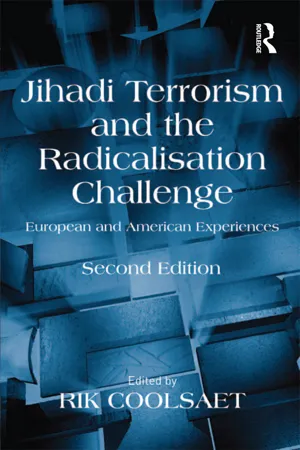
Jihadi Terrorism and the Radicalisation Challenge
European and American Experiences
- 340 pages
- English
- ePUB (mobile friendly)
- Available on iOS & Android
eBook - ePub
About this book
Osama bin Laden's demise in May 2011 marked only the symbolic end of an era. By the time of his killing, he no longer represented the Robin Hood icon that once stirred global fascination. Ten years after the 11 September 2001 attacks, jihadi terrorism has largely lost its juggernaut luster. It now mostly resembles a patchwork of self-radicalising local groups with international contacts but without any central organisational design - akin to the radical left terrorism of the 1970s and the anarchist fin-de-siècle terrorism. This volume addresses two issues that remain largely unexplored in contemporary terrorism studies. It rehabilitates the historical and comparative analysis as a way to grasp the essence of terrorism, including its jihadi strand. Crucial similarities with earlier forms of radicalisation and terrorism abound and differences appear generally not fundamental. Likewise, the very concept of radicalisation is seldom questioned anymore. Nevertheless it often lacks conceptual clarity and empirical validation. Once considered a quintessential European phenomenon, the United States too experiences how some of its own citizens radicalise into terrorist violence. This collective work compares radicalisation in both continents and the strategies aimed at de-radicalisation. But it also assesses if the concept merits its reputation as the holy grail of terrorism studies. The volume is aimed at an audience of decision makers, law enforcement officials, academia and think tanks, by its combination of novel thinking, practical experience and a theoretical approach.
Trusted by 375,005 students
Access to over 1.5 million titles for a fair monthly price.
Study more efficiently using our study tools.
Information
The State of the Threat
Chapter 1
Jihadi Terrorism: A Global Assessment of the Threat
Jihadi terrorism is the type of international terrorism that draws on extreme interpretations of Islam for its rationale, its ideology and to varying degrees its motivation, and whose focus is not limited to any one national or ethnic milieu. It does not revolve around any single conflict or campaign. So defined, it is a diverse phenomenon that takes many forms. It is also not to be equated with all Islamist terrorism. Major differences separate, say, Osama bin Laden’s al-Qaeda, which is the best known exemplar of jihadi terrorism, from the Palestinian group Hamas, which is Islamist but whose objectives are focused on political power in Palestine rather than on Bin Laden’s aspiration to re-establish a caliphate.
Questions are frequently raised about the extent and severity of the threat from jihadi terrorism. The questions are appropriate and understandable in light of the priority governments give to countering terrorism in general and jihadi terrorism in particular, with substantial resources allocated to that purpose. Is such terrorism the defining threat of our time, as is sometimes said, or is the threat exaggerated? Do the fears focused on this brand of terrorism reflect the actual danger? And is the phenomenon growing or fading? This chapter sketches the status and shape of jihadi terrorism today, as a baseline for the chapters that follow. It summarises the reasons why jihadi terrorism presents the threat that it does and the principal reasons why it may be waxing or waning.
As the years have passed since the spectacular attack on the United States in September 2001, a specific question frequently asked is: Why have jihadis not conducted another major operation in the United States since then, or an attack anywhere in the world comparable in magnitude to 9/11? The premise of the question conveys a misplaced sense of security. The question has some valid answers, but none that should leave one at all surprised if another major jihadi attack were to occur in the United States or Europe tomorrow. Enhanced security measures have had an effect. At least as important is the long time frame of terrorists, in which planning for individual operations has been known to take a couple of years, and the process of adapting tactics and strategy to new security measures takes even longer. Something like an absence of further major attacks on US soil since 9/11 thus should not by itself be taken as a sign of weakness in jihadi terrorism.
Assessing the Threat
Any attempt to gauge the severity of the threat from jihadi terrorism encounters the problem that there is no single and reliable measurement for doing so. An obvious and commonly used measurement is actual terrorist attacks. That measurement has serious limitations. Statistics on terrorist incidents are sufficiently slippery that they can be manipulated to demonstrate just about any proposition that the user of the statistics wants to demonstrate. Among other problems, terrorist attacks – at least significant ones – are what mathematicians would describe as rare events. They punctuate history at odd intervals in staccato fashion but do not lend themselves very well to analysis of trends, at least not without greater passage of time than we have experienced even in the decade since 9/11 and without more of the perspective that history can provide.
Perhaps the most fundamental complication in attempting to assess the seriousness of the threat is that ultimately such seriousness is a state of mind in us, the intended audience of the terrorist. That mental effect is, after all, most of what terrorism is about. It is what terror is quite literally about, given the original meaning of the term. Does that mean we should look more to public responses in evaluating the severity of the problem, or rely on objective measures such as number of attacks or number of deaths, notwithstanding the shortcomings of such statistics? John Mueller (2006) argues persuasively that public responses to terrorism are far out of proportion to the damage that terrorism inflicts, and that the responses have been much more costly than the terrorism itself. That argument would suggest a conclusion that current international terrorism, including the jihadi variety of it, should be assessed as less serious than it is generally perceived as being. But that may not be a helpful conclusion for political leaders having to deal with the reality of substantial public concerns and fears about jihadi terrorism.
The extent to which jihadi terrorism, like any other variety, appears to be a major security problem depends heavily on the political context in which the terrorism is viewed. The level of concern about terrorism has varied enormously over time, even within a single country such as the United States, with the variation having to do at least as much with changes in the political climate as with actual terrorist activity (Jenkins 2003). This will probably continue to be true in the future, amid hopeful thoughts of when the jihadi terrorist phenomenon might ever end. How different terrorist groups and movements in the past have ended their activities can be studied rigorously and some conclusions can be drawn from this experience (Cronin 2009). Any end to our preoccupation with jihadi terrorism, however, will be more a function of the political temperament and alternative priorities of Western publics.
Sources of Strength
With those caveats about the hazards of assessing the jihadi terrorist phenomenon, the first and most fundamental observation to make about that phenomenon is that it remains by several measures the pre-eminent type of terrorist threat today. It certainly is the variety of terrorism against which more Western security services devote more of their counterterrorist efforts than against any other variety. It is the brand of terrorism about which more Western publics evince concern than any other. This focus of attention may have been accentuated in recent years by the demise or relative inactivity of groups representing other types of terrorism. These include, for example, the Liberation Tigers of Tamil Eelam, crushed in a final Sri Lankan military offensive in 2009, and the Basque Euskadi Ta Askatasuna (ETA), which declared a new ceasefire in 2010, although other separatist or leftist groups still account for more terrorist plots than Islamist groups. But even without these turns in the fortunes of non-Islamist groups, jihadi terrorism had already become synonymous with international terrorism in the minds of most Western publics.
It is easy to make a case that these Western efforts and concerns are appropriate. The jihadi phenomenon comprises terrorist capabilities that have touched interests and have touched them recently, not only in the West but also elsewhere around the globe. Several admittedly non-systematic, non-quantitative indicators suggest that the phenomenon remains robust. One is the geographic pattern of jihadi terrorist attacks, which have appeared in much of the world, from Western Europe to South Asia, in the decade since 9/11. Despite the understandable attention in Western countries to terrorism within the West, most jihadi terrorist attacks occur in Muslim-majority countries. Another is widening participation, extending to more nationalities, in this brand of terrorism, as is exemplified by British and US citizens who have been involved in several attacks or attempted attacks during the most recent few years. Another is the jihadi coloration assumed by much of the violence in conflicts that may have arisen for largely non-jihadi reasons, such as in Iraq or Chechnya. Yet another is the wider resonance that some jihadi themes have among broader populations, finding some sympathy among people who have no connection with terrorism themselves.
Several complementary explanations account for the strength and persistence of jihadi terrorism. One concerns the economic and political conditions that prevail in much of the Muslim world and especially in Arab countries of the Middle East. The conditions include sclerotic, state-centric economies that discourage entrepreneurship and frustrate many who would otherwise hope to work their way to a better life. They also include closed, undemocratic political systems that offer few if any peaceful channels for responding to the frustrations and grievances. This leads a small subset of people in the relevant populations to resort to violence. In this respect the economic and political conditions constitute roots of jihadi terrorism. The roots have persisted, although the recent upheaval on behalf of popular sovereignty in the Arab world offers the best chance so far to cut some of those roots. The same conditions that underlie the popular unrest also underlie the resort by far fewer people to terrorism.
Much commentary questions this view of the roots of jihadi terrorism. The commentary relies heavily on counter-examples. Regarding economic conditions, for example, one hears that economic status cannot be a root cause of jihadi terrorism because terrorists such as the 9/11 hijackers were not conspicuously poor, and the most prominent jihadi of all, Bin Laden, was conspicuously wealthy. But such arguments tend to erase important distinctions between abject poverty, which may not be associated with proclivity for terrorism, and frustration of ambitions for economic and social advancement, which is. The arguments also tend to blur distinctions between the backgrounds of prominent leaders or practitioners and conditions that can affect broader patterns of sympathy and support for terrorism, and sometimes recruitment for low-level participation in it.
Commentary that challenges the relevance of undemocratic political conditions usually points out that the most prominent instances of jihadi terrorism have occurred within liberal democracies, in places such as New York, Madrid or London. But this says much less about the roots of terrorism than about the practical fact that terrorist operations tend to be easier to execute in open societies than in tightly controlled police states. Research that separates the origins of terrorists from the locale of their operations demonstrates a significant correlation between the lack of political and civil liberties and the likelihood that a country will produce terrorists (Krueger 2008).
Against this backdrop of economic and political conditions that provide fertile soil for the growth of extremism is an ideological context that gives much of the extremism that does emerge an Islamist flavour. Jihadi terrorism is the most extreme manifestation of a far larger, and overwhelmingly peaceful, phenomenon known as political Islam, which in turn is the most significant variety of political expression, and especially political opposition, in much of the Muslim world. Whenever a particular ideology, vocabulary or perspective (and political Islam is not a single ideology) becomes a dominant mode of political discourse, so too can the more extreme variants of that perspective be expected to dominate the sub-world of political extremism. A similar pattern would be apparent if, say, leftist or communist perspectives were still as prevalent as they were 30 years ago. And it is true today of the political Islamist perspective. That perspective may have arrived at its current pre-eminence in large part by default, because other perspectives and ideologies, such as the secular Arab nationalism of Gamal Abdel Nasser, have been tried and found wanting. Until a more promising and attractive alternative comes along, however, and until political Islam itself has been tried and found wanting, it can be expected to continue to prevail as a major form of discourse in much of the world.
Another basis for the persistence and strength of jihadi terrorism is the cumulative effect of jihadis’ experience, including the acquisition of proficiency and the expansion of recruitment. Each conflict provides a foundation for waging later conflicts. The prime model and pacesetter for modern armed jihads – the one against the Soviets in Afghanistan in the 1980s – has made multiple contributions to later jihads, with effects that are still felt today. The insurgency in Afghanistan was a training ground in which militants acquired skills in the use of firearms and explosives. The skills were used there in a rural guerrilla war, but they can also be employed in urban terrorism. The Afghan insurgency was also a splendid radical networking opportunity, in which militants of diverse nationalities forged ties that are reflected in the jihadi networks of today, even if these personal bonds tend to become less marked with the passing of time. Finally, the Afghan campaign was an inspiration to jihadis because it eventually led to the Soviets giving up the fight and, three years later, to the fall of their client Afghan regime under Najibullah. It was taken as a lesson that if a rag-tag force could defeat one of the then superpowers (with the defeat contributing to that superpower’s subsequent dissolution), then similarly motivated jihadis participating in other conflicts could accomplish great things as well – including defeating the remaining superpower. No other modern jihad has had such effects to quite the same degree as the anti-Soviet war in Afghanistan, mainly because none has ended with as clear a victory. But jihadi efforts in places such as Bosnia, Chechnya and Iraq have maintained some of the momentum from the Afghan campaign.
Salient conflicts in and along the borders of the Muslim world have helped to fuel jihadi terrorism. The phenomenon derives energy from friction along the fault lines between the Muslim world and other domains, especially but not exclusively the West. The lines correspond roughly to the fronts along which Samuel Huntington (1998) observed that Islam has bloody borders, but one does not have to accept totally hypotheses about civilisation-based clashes to see how much friction, based in large part on differences of culture and religion, is occurring along those lines. Also apparent is how much that friction plays into jihadi themes, including notions of cultural imperialism, oppression of Muslims and lack of respect for religion.
The specific points of friction include things as insubstantial as satirical cartoons of the Prophet in Western publications. They also include things as major as festering international conflicts that have spawned interstate wars. In South Asia the dominant conflict is between India and Pakistan, with the disputed status of Kashmir at the centre. Kashmir-related armed resistance to India has evolved over the last couple of decades, with the role of secular Kashmiri nationalists having largely been supplanted by Islamists. The most potent and threatening jihadi terrorist group involved is Lashkar-e-Taiba, which began with a focus on Kashmir but has since become capable of major operations farther afield. Its most prominent and deadly action was the attack on Mumbai in November 2008, which killed 164 people and wounded nearly twice as many.
In the Middle East, the most salient conflict has long been the one between Arabs and Israelis, and especially the dispute between Israelis and Palestinians over the status of land conquered in the war of 1967 and still occupied by Israel. Jihadi groups have played very little direct role in the conflict, but the salience and persistence of the conflict make it promising material for jihadi propagandists to exploit. It is promising as well because of other attributes that conform to the jihadi narrative. Israel is widely seen as an extension of the West and as a continuation and reminder of Western subjugation of Muslim peoples and especially Arabs. Its occupation of disputed territory is perceived as a form of Western-backed colonialism. All of these notions play into the jihadi narrative of Western predation against the Muslim world.
Western powers have helped to sustain the narrative through some of their own policies, of which the US support for Israeli policies and practices is only one. The US-initiated war in Iraq (2003) has also boosted the jihadi movement. The US intelligence community assessed that the war became a cause célèbre for jihadis, ‘shaping a new generation of terrorist leaders and operatives’ exploited by al-Qaeda ‘to attract new recruits and donors’, and fuelling the spread of the global jihadi movement (DNI 2006). The withdrawal of US troops, if completed on schedule by the end of 2011, will reduce the immediate effects of the Iraq conflict on the success of the jihadi message, but other effects will be long-lasting, as was true of the jihad against the Soviet presence in Afghanistan in the 1980s.
Weaknesses and Limitations
Counteracting these sources of strength to some extent are factors that have tended to weaken or limit the jihadi movement. One of those factors is the enhancement of counterterrorist efforts, not only by Western governments but also by regimes in Muslim-majority countries. For the most part governments have basically the same assortment of tools to combat terrorism that they always have had, but the effectiveness with which the tools can be used depends heavily on the attitudes of their publics and of other governments. The 9/11 attack stimulated a substantial increase in public support, especially in the United States, for vigorous counterterrorist efforts. Measures this support has made possible extend to the use of military force, including the US-led and UN-approved intervention in Afghanistan in late 2001 and the subsequent use of unmanned aerial vehicles to attack individual militants in northwest Pakistan. These operations have disadvantages in the form of widespread resentment over casualties among innocent persons and related collateral damage – resentment that over the long term may help to sustain the jihadi narrative. But they also have had the more immediate effect of taking some jihadi terrorists (especially members of al-Qaeda) out of action and to keep others off-balance. The principal methods of attacking the jihadi terrorist infrastructure, however, remain non-military means utilised by police, intelligence and security services.
Improved international cooperation on counterterrorism made possible by the attitudinal changes wrought by 9/11 has increased the effectiveness of all of these methods. In the decade since that attack, more governments have become more willing to do more to uncover and arrest individual jihadis, to break up their cells and to intercept the flow of their money. All of these actions have had a significant effect, albeit impossible to measure accurately, on the operational capabilities of jihadi terrorist groups.
The post-9/11 improvements in counterterrorism reflect not only greater willingness to cooperate with Western governments but also greater incentive for governments in some Muslim-majority countries to do more on their own. The outstanding case is Saudi Arabia. Earlier the Saudi government was content to export its jihadis rather than to combat them, given that the kingdom itself was suffering little direct harm. That attitude changed abruptly after al-Qaeda’s initiation in 2003 of operations against targets within Saudi Arabia. Henceforth Saudi authorities vigorously went after the al-Qaeda infrastructure in their midst, crippling it and driving its remnants into Yemen.
The story of cooperation by governments in the Muslim world has not entirely been one of improvement. Yemen, to which the Saudi extremists repaired, has become more of a trouble spot in recent years, with a regime that has focused more on other sources of instability and challenges to the government than on the jihadis. Pakistan is another country where cooperation falls short of Western expectations. This is due chiefly to the preoccupation with confronting India, which reduces official Pakistani willingness to devote attention and resources to confronting jihadi militants. The same preoccupation has motivated Pakistan to maintain its own ties with militants in Afghanistan, partly as a counterweight to Indian influence there.
The principal factors weakening or limiting jihadi terrorism have more to do with what the movement stands for and what it has done, or has not done. One of those factors is a growing realisation that the movement’s ideology – despite the aspects that still give it appeal – is ultimately bankrupt. The jihadis exploit dissatisfaction with the existing order in much of the Muslim world, but they do not offer an alternative that removes the sources of that dissatisfaction. They are not proposing anything that offers greater opportunities for economic and political fulfillment than what their would-be constituents have now. And they offer nothing that would mean a visibly, materially better way of life. As long as people focus on their cur...
Table of contents
- Cover Page
- Half-Title Page
- Title Page
- Copyright Page
- Table of Contents
- List of Tables
- Notes on Contributors
- Introduction
- Part I The State of the Threat
- Part II Cycles of Terrorism and Radicalisation
- Part III Radicalisation in Europe and the US
- Part IV De-radicalisation Experiences
- Epilogue Terrorism and Radicalisation: What Do We Now Know?
- Appendix
- Bibliography
- Index
Frequently asked questions
Yes, you can cancel anytime from the Subscription tab in your account settings on the Perlego website. Your subscription will stay active until the end of your current billing period. Learn how to cancel your subscription
No, books cannot be downloaded as external files, such as PDFs, for use outside of Perlego. However, you can download books within the Perlego app for offline reading on mobile or tablet. Learn how to download books offline
Perlego offers two plans: Essential and Complete
- Essential is ideal for learners and professionals who enjoy exploring a wide range of subjects. Access the Essential Library with 800,000+ trusted titles and best-sellers across business, personal growth, and the humanities. Includes unlimited reading time and Standard Read Aloud voice.
- Complete: Perfect for advanced learners and researchers needing full, unrestricted access. Unlock 1.5M+ books across hundreds of subjects, including academic and specialized titles. The Complete Plan also includes advanced features like Premium Read Aloud and Research Assistant.
We are an online textbook subscription service, where you can get access to an entire online library for less than the price of a single book per month. With over 1.5 million books across 990+ topics, we’ve got you covered! Learn about our mission
Look out for the read-aloud symbol on your next book to see if you can listen to it. The read-aloud tool reads text aloud for you, highlighting the text as it is being read. You can pause it, speed it up and slow it down. Learn more about Read Aloud
Yes! You can use the Perlego app on both iOS and Android devices to read anytime, anywhere — even offline. Perfect for commutes or when you’re on the go.
Please note we cannot support devices running on iOS 13 and Android 7 or earlier. Learn more about using the app
Please note we cannot support devices running on iOS 13 and Android 7 or earlier. Learn more about using the app
Yes, you can access Jihadi Terrorism and the Radicalisation Challenge by Rik Coolsaet in PDF and/or ePUB format, as well as other popular books in Politics & International Relations & Politics. We have over 1.5 million books available in our catalogue for you to explore.