- 224 pages
- English
- ePUB (mobile friendly)
- Available on iOS & Android
eBook - ePub
About this book
The war against the Ottomans, on Gallipoli, in Palestine and in Mesopotamia was a major enterprise for the Allies with important long-term geo-political consequences. The absence of a Turkish perspective, written in English, represents a huge gap in the historiography of the First World War. This timely collection of wide-ranging essays on the campaign, drawing on Turkish sources and written by experts in the field, addresses this gap. Scholars employ archival documents from the Turkish General Staff, diaries and letters of Turkish soldiers, Ottoman journals and newspapers published during the campaign, and recent academic literature by Turkish scholars to reveal a different perspective on the campaign, which should breathe new life into English-language historiography on this crucial series of events.
Chapter 1
Introduction
Stop wayfarer! … Bend down and lend your ear, for this silent mound / Is the place where the heart of a nation sighs.
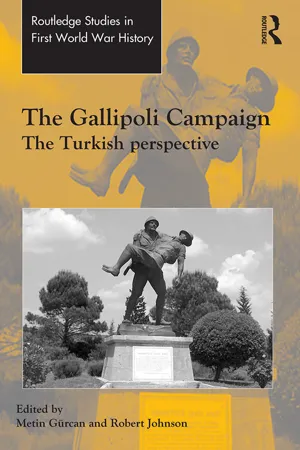
With its evocative azure blue colour, the Dardanelles Strait connects the Sea of Marmara to the Aegean Sea and separates two ranges of hills, both of which are surmounted by narrow plateaux. On the upper bluffs, close to the city of Çanakkale, there is a pale brown hill on which a contrasting white crescent and star are drawn. Beneath them are large white numbers, which are best seen from the ferry that heads for Eceabat on the Gallipoli peninsula. It boldly announces: ‘18 March 1915’. Further away, across the straits and also clearly visible from the Gallipoli Peninsula, is the ancient castle guarding the region known locally as Kilitbahir [the Lock of the Sea]. Above this fortress, on a hilltop to the north, is a huge silhouette of a 1915 Turkish soldier carved in white. In one hand he holds a rifle, while his other arm is outstretched towards a Turkish inscription, a verse taken from the poem of Necmettin Halil Onan, entitled To a Traveller. It states: ‘Stop wayfarer! Unbeknownst to you this ground / You come and tread on, is where an epoch lies; / Bend down and lend your ear, for this silent mound / Is the place where the heart of a nation sighs’. The word ‘epoch’ in these verses does not simply refer to the defeat of the Allied forces in a campaign that took place in 1915 within the context of the First World War. For some, it suggests that the old colonial empires of Britain and France were somehow brought to an end, here, at the hands of ‘Mehmetçik’, the ordinary Turkish soldiers, and ushered in a new beginning for the nation-state of Turkey. This interpretation seems more plausible if the whole of Necmettin Halil Onan’s poem is recalled:
To the left of this deserted shadeless lane
The Anatolian slope now observes you well;
For liberty and honour, it is, in pain,
Where wounded Mehmetçik laid down his life and fell.
This very mound, when violently shook the land,
When the last bit of homeland passed from hand to hand,
And when Mehmetçik drowned the enemy in flood,
Is the spot where he added his own pure blood.
Think, the consecrated blood and flesh and bone
That make up this mound, is where a whole nation,
After a harsh and pitiless war, alone
Tasted the joy of freedom with elation.
In light of these lines, the inscription on the hillside has a more profound sense. Necmettin Halil Onan commands us to stop and reflect on the mass of earth called the Gallipoli Peninsula, since, here, he maintains, beats the heart of whole ‘epoch’ of Turkish national life. It was here in 1915 that Mehmetçik voluntarily laid down his life for the freedom of Turkey. For Turks, he paid for that freedom with his own blood. Onan’s poem is as well known in Turkey as a hymn of patriotic praise to those who defended the Ottoman Empire from the invaders of 1915. For Turks, it is only necessary to quote the first two lines on the Kilitbahir memorial for the sentiments of the whole poem to be recalled. ‘Stop wayfarer!’ is the motto which reminds everyone of the price the Ottoman Empire paid for victory at Gallipoli: some 49,882 dead and over 164,000 wounded.1 For many Turks, the date of 18 March 1915 also marked the end of the Royal Navy’s dominance as a force with global reach. That is why, in Turkey, there are many scholars who tend to present the motto of ‘Stop wayfarer!’ as the first check, by the Eastern world, on Western imperialist domination in spite of its overwhelming technological superiority.2 Taking this symbolic significance of the motto of ‘stop wayfarer!’ in Gallipoli one step further, by not limiting it to the Eastern world, Edward J. Erickson, the eminent American scholar of the Ottoman Empire, suggests that this ‘spirit’ is of huge psychological importance, not only for Turkey but for Australia and New Zealand, as it represents ‘a coming of age of a people about to test themselves against the currents of the twentieth century’.3
During the preparations for the campaign, if the decision-makers in the Allied army under General Sir Ian Hamilton’s command, who attempted to seize the Gallipoli Peninsula with insufficient forces, could have read Onan’s poem symbolising the resilience of Turkish soldiers, and if they had known that they would have to test their strength against these Turkish soldiers yard by yard in the battles of Krithia, Kereves Dere, Gully Ravine, Achi Baba Nullah, Sari Bair, Lone Pine, Chunuk Bair, Suvla, Anafarta and Scimitar Hill, would they have changed their initial operational plans? We do not know the answer to this counter-factual question of course, although there is empirical evidence to show that the British underestimated the Ottoman Army. After defeats in the Balkans in 1912–13, the Ottoman armed forces were undergoing extensive reorganisation just before the war broke out. In late 1914, British and Indian formations had driven the Ottomans out of Basra in Mesopotamia, and the Ottomans had been defeated in the Sinai and in the Caucasus. All the indications were that the Ottomans were riven with political disunity and military inefficiency.
What we know for sure is that orthodox Anglocentric discourse would now prefer to suggest that the campaign’s failure was the result of incompetence in the Allied forces at the strategic-political level. This conceptualisation of the Gallipoli Campaign as the Allies’ ‘strategic failure’ does not seem, however, to recognise that it was an Ottoman victory. While it is true to highlight the Allies’ strategic and operational mistakes, this should not automatically imply that, had they not made these mistakes, the Allies would have won. In much of the Anglophone discussions, the main research question, which has directed scholars for decades, is: ‘what was the causal mechanism that led to a strategic failure in the Gallipoli Campaign?’ To seek answers to this question, starting with the famous British Dardanelles Commission in 1917, many scholarly works reflect the orthodox Anglocentric perspective of Allied failure. This volume offers the opportunity to reformulate the old question as: ‘what was the causal mechanism that led to the victory of the Ottoman army in the Gallipoli Campaign?’ In the Turkish literature, there are five explanatory approaches to answer this question.
First is the ‘Atatürkist’ discourse which emphasises the agency of Mustafa Kemal’s skills as a commander as the crucial factor in the Ottoman victory, especially his foresight and charismatic leadership. Hakan Uzun asserts that, for the Turks, inspired by the heroic act of Lieutenant Colonel Mustafa Kemal, soldiers voluntarily rushed to defend their country and formed a heroic human shield to make it impossible for the Allies to pass through the straits or traverse the Peninsula.4 Uzun tends to describe the Gallipoli Campaign as an ‘unusual context’ that gave birth to a hero who, following the Turkish War of Independence (or Turkish National Struggle), laid the foundations of modern Turkey. Mustafa Kemal’s successful operation confined the Allies to a narrow strip of shore and eventually put a halt to the Allies’ advance up the Peninsula. Uzun’s central question is whether Mustafa Kemal came to be known as ‘the hero of Gallipoli’ because he was ‘Atatürk’ or whether his heroic acts at Ariburnu and Suvla Bay paved the way for him to become ‘Atatürk’.5 It is also worth mentioning that Uzun develops his argument only by examining Mustafa Kemal’s former career, his role at Gallipoli, various quotations from memoirs and the reports of those who had participated in the campaign, including those of Mustafa Kemal himself. On the other hand, İsmet Görgülü, a retired colonel who has studied many of the academic works on the campaign, asserts that the land battles of the Gallipoli Campaign, which lasted almost eight months, could have ended within a day if the Ottoman soldiers had been commanded properly. Dismissing the senior command, he places the emphasis on the agency of Mustafa Kemal.6 For him, during the campaign, Kemal saved İstanbul, the capital of the Ottoman Empire, no less than five times. Görgülü argues:
The first time Mustafa Kemal saved İstanbul was on 25 April 1915, the first day of the battle. As the Allied forces landed troops on the shore of Arıburnu, also known as Anzac Cove, the Turkish forces were quantitatively outnumbered by the enemy forces. They were unable to stop the Allies. The enemy was well on the way to Chunuk Bair. If Chunuk Bair was captured by the Allies, the defence in Çanakkale would be impossible and our forces there would be eliminated, and eventually both the land and the sea route to İstanbul would be wide open; and thus İstanbul would fall. At that vital moment, Lieutenant Colonel Mustafa Kemal divined the crucial attack upon the enemy landing at Arıburnu and asked the corps commander’s permission to execute his plan. The corps commander was unable to decide by himself as Mustafa Kemal’s division was the reserve of the army. For the assault, permission had to be given by the army general. At the same time, there came the news of the enemy’s simultaneous landing in three different areas. If Mustafa Kemal’s 19th Division was to be committed at Arıburnu, there would be no force left to be used in case of emergency in any of the other areas. It was then learned that the army general had gone to the Gulf of Saros, which could mean the enemy was probably landing its troops there too. There was no certain knowledge about any of the landings. Therefore, the corps commander first tried to reach the general via telephone and then decided to go to the Saros region himself, which, being some 40km away, would take two hours. Yet the Allied forces would not wait for his return that afternoon for their attacks. At that exact moment, Mustafa Kemal decided to make an assault on the enemy without waiting for the order from the corps commander or the army general, and thus he alone changed the fortunes of the Battle of Çanakkale.
After this critical decision, Görgülü continued:
The second time Mustafa Kemal saved İstanbul was 7 August, when he was the commander of the 19th Division. The enemy was making an assault on the front line, and one wing of the Allies was surrounding Chunuk Bair. There were only 30 or 40 Turkish [Ottoman] soldiers there and it was clear that they would be insufficient to stop the enemy. In addition, this area was totally out of Mustafa Kemal’s responsibility. Despite this fact, and the attack on his own front, Kemal sent all his remaining forces (about 1.5 battalions) to Chunuk Bair. He, thus, prevented the fall of Chunuk Bair for the second time, and, therefore, he saved İstanbul for a second time.
The third occasion Mustafa Kemal saved İstanbul was 9 August. Upon having had no concrete results from three months of assaults, the English [British] planned a great attack with new forces, supporting the Anzac Corps at the Arıburnu region with 17,500 soldiers from Sedd-el-Bahr [Cape Helles] on 4–5 August. They began a huge attack at Arıburnu on 6 August. Then they started to land troops on the shores of Suvla Bay at night and which continued on 7 and 8 August. The British Corps was of four divisions, some 43,000 soldiers. In the following days, this number reached 80,000. Their aim was to capture V Beach [Teke Bay] and Kocaçimen Hill and thus, after the capture of Chunuk Bair, control the Bosphorus.
Görgülü attributed the defence of Chunuk Bair entirely to the military genius of Kemal:
The fourth time [was] 10 August. [Kemal] became the commander of the Anafarta Detachment on the 8th, achieved the ‘First Anafarta Victory’ on 9 August, and concluded that the enemy would attack Chunuk Bair with their overwhelming numbers both to take revenge for the previous day’s defeat and to reach a certain result by 10 August. [Kemal] decided to attack from Chunuk Bair in order to disrupt the enemy’s offensive. He came to Chunuk Bair at night. What matters here is that the forces at the Bair were too weak to prevent an enemy assault the following morning, but he had made a decision and it would not be possible to take reinforcements from any other point during the night. He thought to attack the enemy with the forces that were too weak to defend their area. That was his military prodigy: heroism combined with his wisdom.
Emphasising his prowess, his heroism, and his insight during the Second Anafarta Battle, Görgülü wrote:
The enemy started an assault with their six divisions (about 70,000 strong) on Anafarta Plain on 21 August. There were two Turkish divisions (about 18,000 troops) facing them. It was not possible to stop this great attack under the heavy fire of the Allies’ navy with so few Turkish soldiers. One Turkish division was in the reserve line and it was impossible for them to move up before the enemy overran the front line. The conditions were so critical that time was needed to get this division to the front. Herein he showed his military prodigy once more. There was only one formation available, and the commander of the Anafarta Detachment, Mustafa Kemal, ordered his men to vault over the defending line of troops and counter attack the charging enemy. The time needed for the reinforcements was thus obtained.7
This form of hagiography of Kemal was persistent for decades, but has been challenged.
The second explanatory discourse is the ‘modernist-institutionalist’ one which puts emphasis on the ‘military effectiveness’ of the Ottoman 5th Army in the Gallipoli at the tactical (that is, battalion and below) and operational (that is, regiments/brigades and above) levels. Edward J. Erickson, as an ardent advocate of this argument, begins with the initial assumption that many of the ‘myths’ that persist in the Anglocentric orthodoxy are simply due to lack of accurate information available from Turkish archives, most of which remain closed to foreign scholars. He then argues that, during the war, while the Ottoman Empire itself might have been declining, its army was still strong and increasingly adept at the tactical and operational level. What it could not overcome were weaknesses in political decision-making and strategic planning. According to Erickson, for instance, the Ottoman 5th Army’s reporting system was, in comparison to the Allies’ at Gallipoli, much more effective because of its standardised formations and ‘bottom-up’ requirements. The 5th Army commanders’ cadres, particularly the junior officers at the tactical and lower echelons of the senior officers (that is, regimental and divisional commanders) at the operational levels, were consistently in possession of accurate and timely information that enabled them to make rapid and effective decisions. This also created a superior ‘situational awareness’, that is, local intelligence, amongst the division commanders, which enabled them to calculate risks and use their initiative in a timely fashion.
For Erickson, cumulatively these factors led to the capability to mass the available forces in an effective and efficient manner. Four operations illustrate this point: Lt Colonel Şefik (The 27th Regiment Commander) and Mustafa Kemal’s coordinated attack on 25 April; Kemal’s subsequent massed night attacks between 25 April and 16 May; Mahmut Sabri’s (3rd Battalion Commander of the 26th Regiment) defence of the Cape Helles; and Nicolai’s massing at Kumkale for 32.5 hours on 25–6 April.8 In each case, the Turks brought their forces to the right place in time to thwart the Allied offensives.9...
Table of contents
- Cover
- Title
- Copyright
- Contents
- List of figures
- List of tables
- Contributors
- 1 Introduction
- 2 Contested historiography: Allied perspectives on the Gallipoli Campaign
- 3 A critique of the defence plans in the Gallipoli battles: Liman von Sanders, Turkish commanders and the conduct of operations
- 4 Taking the initiative at the tactical level in the Gallipoli Campaign and its effects
- 5 Ottoman defences and Allied naval operations in the Çanakkale Straits
- 6 The Çanakkale naval battles in Turkish official records
- 7 Talking to hearts and minds: Influencing strategies in the Gallipoli Campaign
- 8 Recognising the other: Contested identities at Gallipoli
- 9 The meaning of Gallipoli in Turkish national identity
- 10 Contemporary Turkish perceptions of the Gallipoli Campaign
- 11 Reflections on the Gallipoli Campaign in Turkish literature
- Index
Trusted by 375,005 students
Access to over 1.5 million titles for a fair monthly price.
Study more efficiently using our study tools.
Frequently asked questions
Yes, you can cancel anytime from the Subscription tab in your account settings on the Perlego website. Your subscription will stay active until the end of your current billing period. Learn how to cancel your subscription
No, books cannot be downloaded as external files, such as PDFs, for use outside of Perlego. However, you can download books within the Perlego app for offline reading on mobile or tablet. Learn how to download books offline
Perlego offers two plans: Essential and Complete
- Essential is ideal for learners and professionals who enjoy exploring a wide range of subjects. Access the Essential Library with 800,000+ trusted titles and best-sellers across business, personal growth, and the humanities. Includes unlimited reading time and Standard Read Aloud voice.
- Complete: Perfect for advanced learners and researchers needing full, unrestricted access. Unlock 1.5M+ books across hundreds of subjects, including academic and specialized titles. The Complete Plan also includes advanced features like Premium Read Aloud and Research Assistant.
We are an online textbook subscription service, where you can get access to an entire online library for less than the price of a single book per month. With over 1.5 million books across 990+ topics, we’ve got you covered! Learn about our mission
Look out for the read-aloud symbol on your next book to see if you can listen to it. The read-aloud tool reads text aloud for you, highlighting the text as it is being read. You can pause it, speed it up and slow it down. Learn more about Read Aloud
Yes! You can use the Perlego app on both iOS and Android devices to read anytime, anywhere — even offline. Perfect for commutes or when you’re on the go.
Please note we cannot support devices running on iOS 13 and Android 7 or earlier. Learn more about using the app
Please note we cannot support devices running on iOS 13 and Android 7 or earlier. Learn more about using the app
Yes, you can access The Gallipoli Campaign by Metin Gürcan,Robert Johnson in PDF and/or ePUB format, as well as other popular books in History & 20th Century History. We have over 1.5 million books available in our catalogue for you to explore.