eBook - ePub
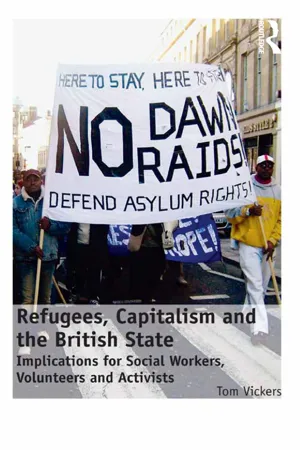
Refugees, Capitalism and the British State
Implications for Social Workers, Volunteers and Activists
- 222 pages
- English
- ePUB (mobile friendly)
- Available on iOS & Android
eBook - ePub
Refugees, Capitalism and the British State
Implications for Social Workers, Volunteers and Activists
About this book
Today, in a period of economic crisis, public sector cuts and escalating class struggle, Marxism offers important tools for social workers and service users to understand the structures of oppression they face and devise effective means of resistance. This book uses Marxism's lost insights and reinterprets them in the current context by focussing on one particular section of the international working class - refugees and asylum seekers in Britain. Vickers' analysis demonstrates the general utility of a Marxist approach, enabling an exploration of the interplay between state policies, how these are experienced by their subjects, and how conflicts are mediated. The substantive focus of the book is twofold: to analyse the material basis of the oppression of refugees in Britain by the British state; and to examine the means by which the British state has 'managed' this oppression through the cultivation of a 'refugee relations industry', within a broader narrative of 'social capital building'. These questions demand answers if social workers and other practitioners are to successfully work with refugees and asylum seekers, and this book provides these through a detailed Marxist analysis.
Information
Chapter 1
Introduction
During the first years of the twenty-first century, refugees, as I define all those who seek asylum,1 have arrived in Britain with backgrounds often including trauma, abuse and health problems. These have been compounded within Britain by factors, mostly driven by the British state, including destitution, periodic detention, and the constant psychological stress of threatened deportation to situations of extreme danger. According to the values considered by many to be fundamental to professions such as social work, community development and youth work, this should call for urgent intervention. However, at the same time workers have increasingly found opportunities to make such interventions being closed to them. The policy approach of recent Labour governments has been characterised as a split approach, combining strategies of forceful assimilation with punitive segregation. This includes, in the case of asylum seekers, removal of rights to many mainstream welfare services, a prohibition on paid work, and forced dispersal across Britain (Humphries 2004: 101; Prior 2006: 7). Despite enjoying greater formal freedom than statutory services, voluntary sector projects have also come under growing funding pressures in relation to work with asylum seekers (Fell 2004). It has been argued that social workers are not only providing inadequate support for migrants, but are increasingly playing ‘a role of constriction and punishment’ (Humphries 2004: 93–4), and acting as gatekeepers separating vulnerable people from vital resources (Hayes 2005: 191–2; also Briskman and Cemlyn 2005; Morris 2007; Valtonen 2008).
However, little has been done to analyse these conditions and demands in the wider context of contemporary British capitalism and the British state. Where the wider context has been considered with a critical eye, consideration has generally not moved any closer to the coalface of practice than evaluating national and international policy (e.g. Back et al. 2002; Craig 2007a; Hoogvelt 2007; a notable exception is the combination of practice case studies with broad structural considerations in Dominelli 1997). This leaves a large and significant hole in the literature. Whose interests does the British state represent? Why are refugees being treated so poorly, even when they have frequently brought skills which are in short supply and in demand by the local economy? (a question raised by Dumper 2002, Phillimore and Goodson 2006 and Bloch 2007, among others). In what ways and to what extent do refugees consent to their treatment? What is the relationship between the interests of refugees and other groups of service users? These questions demand answers if social workers and other practitioners are to successfully navigate their role, and this book sets out to provide these through a Marxist analysis.
The Combination of Empirical Qualitative Data with a Marxist Analysis
Today, in a period of economic crisis, public sector cuts and escalating class struggle, Marxism remains largely forgotten, but offers important tools for social workers and service users to understand the structures of oppression they face and devise effective means of resistance. This book sets out to reclaim lost insights of Marxism and reinterpret them in the current context. It does this by focussing on one particular section of the international working class, refugees and asylum seekers in Britain. The analysis of this particular section demonstrates the more general utility of a Marxist approach, enabling an exploration of the interplay between state policies, how these are experienced by their subjects, and how conflicts are mediated. The approach taken owes much to Williams et al. (1979). The substantive focus of the book is twofold: to analyse the material basis of the oppression of refugees in Britain by the British state; and to examine the means by which the British state has ‘managed’ this oppression through the cultivation of a ‘refugee relations industry’, within a broader narrative of ‘social capital building’. A central concern within this critique is the role played by those refugees and asylum seekers who perform key roles, often unpaid, within the refugee relations industry. The book weaves together theoretical insights from classical and contemporary Marxism, the recent history and literature on refugee flight and settlement in Britain, and empirical data which draws on research I conducted in Newcastle between 2005 and 2010. This included a mapping exercise of organisations active in Newcastle between 1962 and 2008 which explicitly related to migrants or ethnic minority people, of which three organisations were investigated in more detail as historical case studies, and five as contemporary case studies. A search of local archives was combined with in-depth qualitative interviews with 12 paid workers across these eight organisations and with eighteen refugees working as volunteers with four of the five contemporary case study organisations. This research enabled an exploration of the impacts, of the life histories, understandings and agency among those policies target, on the outcomes of policies and practices (a more detailed description of the methodology including descriptions of the case studies is included as an appendix).
The Wider Relevance of this Book
The questions raised above are not new; neither are they unique to refugees and those who seek to engage with them. Social workers and related practitioners have always had to struggle with the contradiction between a duty of care and a mission of social control (OU 1978b: 41). In many cases this has been particularly acutely felt where the same individual has been both a member of a target user group and fulfilling a practitioner role. For example, Ahmad (1993) recounts the pressures and expectations placed on black social workers, while Sawbridge and Spence (1991) discuss the issues faced by women in community and youth work roles. The loose collection of voluntary and community sector organisations which form the ‘refugee sector’ have been reliant on the work of refugees themselves for a long time, many in unpaid roles. As a part of the rapid expansion of the sector over the last decade, as refugees were ‘dispersed’ around Britain following policy changes in 1999, this has developed in new and sometimes unexpected ways. In the present context of economic crisis and wholesale cuts to both the public sector and voluntary and community funding, it seems likely that many other organisations will be forced to follow the same pattern, falling back on unpaid labour of community members as funding is withdrawn and unmet needs increase. While focussing on the position and experiences of refugees, this book therefore offers important lessons to much wider circles of practitioners and community activists. Likewise, while the book focuses on the distinctive approaches employed by Labour governments between 1997 and 2010 to manage refugees’ oppression, I draw lines of continuity both backwards into the history of British welfare and its relationship to different forms of migration, and forwards to the Conservative–Liberal Democrat Coalition’s concept of the ‘Big Society’.
Distinctive features of Newcastle also need to be taken into account when considering the wider relevance of the research this book draws on. These include the city’s relative physical isolation from other urban centres, with ‘the Cheviot Hills to the north, Pennines to the west, North Sea to the east and a great swathe of farmland between the north east of England and Yorkshire’ (Robinson 1988: 189), and longstanding deprivation relative to other parts of Britain (Robinson 1988: 194–6). Formerly a centre of shipbuilding and related industries, these industries have been in long-term decline, which accelerated in the 1960s and into the 1970s. It is an area commonly thought of as virtually ‘monocultural’ until very recently (e.g. Robinson 1988: 190), although this leaves out a history of migration stretching back hundreds of years (MacDermott 1977; Lawless 1995; Archive Mapping and Research Project 2007; Renton 2007). These features need to be considered when comparing the detailed accounts of Newcastle with other parts of Britain, and have required a moderate level of detail on the local situation in order to aid the reader in contextualising the accounts of refugees and others which are quoted in this book.
Forced Migration in Context: ‘Capitalism is Crisis’
To understand the process by which people arrive in Britain as refugees, we need to consider the particular international context in which millions of people every year are forced to migrate, whether through ‘crippling destitution, war or persecution’ (Hayes 2005: 185). The remainder of this chapter outlines the key features of a Marxist analysis of the current international situation, including the division of the world into oppressed and oppressor nations, the impetus towards inter-imperialist rivalry and war, and the implications of this for migration to Britain, including gender dimensions. The functioning of an ‘international reserve army of labour’ is illustrated using historical and contemporary data at local and national levels, interwoven with theoretical reflections. As the receiving country under investigation, particular attention is paid here to Britain’s relations to the situations refugees flee. This sets the context for the relation of interests between refugees and the British ruling class, and the state policies which follow from this, discussed in Chapter 2.
The Roots of the Capitalist Crisis
In recent years, the international crisis of capitalism, which has been building since the 1960s, has come to public prominence. Beginning with the subprime mortgage crisis in 2007, major banks wrote down debts by massive amounts, removing swathes of fictitious wealth from the global economy. This had knock-on effects throughout the international banking system, with mechanisms of commercial credit collapsing one after another (Palmer 2008: 3). This represented a serious failure of a key measure by which ruling classes had been able to put off or to mitigate capitalism’s underlying tendencies to crisis since the period of post-war rebuilding in the 1940s and 1950s, with a seemingly endless extension of credit pursued by the most economically advanced capitalist countries. The credit system expanded to encompass an entire ‘shadow banking’ system including unregulated institutions such as hedge funds and private equity, and accounting for large parts of the international economy with what amounts to gambling on an international scale. By 2005 the US was spending 6.4 per cent of GDP more than it was earning, leading to a rising net debt to the rest of the world, estimated at $2.55 trillion at the end of 2005 (Yaffe 2006: 9). The series of ‘bail-outs’ since then – in other words massive injections of cash into the financial system by the state – did not resolve the crisis, but only postponed some of its worst consequences. The bail-outs will have massive and sustained consequences for large sections of the working and middle classes in many countries, including Britain, as the money paid out by the state is clawed back through significant reductions in the public sector, including cutting essential services and redundancies for tens of thousands of state employees (Yaffe 2009b; HM Treasury 2010a, 2010b). Meanwhile, the underlying problems in the capitalist system, which the expansion of credit played a role in covering over, remain, as evidenced by the ongoing debt crisis in the Eurozone as of summer 2012, following further bail-outs of Ireland and Greece and devastating austerity programmes across Europe.
Well before the financial crisis of 2008, it was evident that capitalism was entering a crisis of serious proportions. Comparing the periods 1960–1980 and 1980–2000, world per capita income growth fell from an average of 3 per cent to 2 per cent, a significant fall given the numbers involved. In 54 out of 155 countries for which data is available, average incomes actually fell during the 1990s, and only thirty countries had annual income growth above the 3 per cent necessary to reduce poverty if inequality levels remained constant (Hoogvelt 2007: 24). By 2005, business investments in Britain were at the lowest level in relation to the rest of the economy since 1967, unemployment was at the highest level for three and half years, insolvencies were at record levels, mortgage repossessions at a thirteen-year high, and consumer debt stood at £1,160 billion, almost the size of Britain’s GDP, and three times the level of the 1990s (Yaffe 2006: 10).
The crisis is fundamentally one of profitability. Marx identified that the rise in the organic composition of capital, that is fixed capital (the value of the means of production) relative to variable capital (the value of labour power), which results from technological development and capital accumulation, produces a tendency for the rate of profit to fall (Marx [1894] 2006). Strategies available to capitalists to counteract this tendency include increasing the total mass of profits, requiring new markets for the realisation of surplus value, and exporting capital from areas with a high organic composition of capital to those with a low composition (Kemp 1967: 27–8). It is therefore misleading to suggest, as Hoogvelt (2007: 19) does, that ‘In the past, it was assumed not only by liberal economists but also those standing in the Marxist tradition, that the world market system (or capitalism) was inherently and forever expansive in character’. This characterisation of Marxist analysis ignores the understanding that, while perpetual growth is necessary for capitalism to avert crises, history demonstrates that this expansion is uneven in space and time, and periodically breaks down (Grossman [1929] 1992). This produces conditions of crisis in the system, which in the recent period has been expressed in the phenomena of ‘globalisation’ (Yaffe 2000).
A key feature of globalisation has been increasingly rapid international movements of capital in search of new sources of profit, which have facilitated the growth in size and power of multinational companies exerting monopoly power (UNCTAD 2007; Felices et al. 2008). Lenin ([1916] 1975) identified a tendency within capitalism, accentuated at times of crisis, for enterprises to both combine together (Lenin [1916] 1975: 18–20), and be bought up by large banks, resulting in an increased ability to compete with other firms through a monopoly position, and the distribution of profits over a smaller amount of capital (Lenin [1916] 1975: 52–3). This tendency was acutely expressed in the mergers and acquisitions boom of the late 1990s, where a large portion of the Foreign Direct Investment (FDI) investment between advanced capitalist countries represented the combination of existing capital rather than new ‘greenfield’ capital investment (UNCTAD 2001: xiii, 53). By 2002, in the automobile sector the top six multinational companies accounted for more than 75 per cent of the global market. In information technology hardware, the top three firms accounted for 71 per cent of the global supply of servers, two-fifths of the global sales of PCs and three-fifths of the global sales of mobile phones (Hoogvelt 2007: 23). This process has continued the tendency towards centralised ownership and control of capital in a handful of advanced capitalist countries, which, by dint of this, occupy an imperialist position within the wider system. Kundnani (2007) gives an articulate account of this process:
… under the auspices of ‘globalisation’ and the ‘war on terror’, multinational companies have assumed unfettered power over most of the world’s national economies and Western governments have arrogated to themselves the right to openly intervene anywhere in the world. (Kundnani 2007: 2)
This is strikingly similar to the account provided by Lenin at the time of the First World War:
A monopoly, once it is formed and controls thousands of millions, inevitably penetrates into every sphere of public life, regardless of the form of government and all other ‘details’. (Lenin [1916] 1975: 55)
In 2008, five countries were together responsible for more than 50 per cent of accumulated outward stock of FDI, and ten countries were responsible for more than 70 per cent. Around 30 per cent of this stock was invested in materially underdeveloped countries (UNCTAD 2009: 251–4).
The increasing concentration of production has taken place together with the combination of banking and manufacturing capital into monopolistic ‘finance capital’, with banks controlling shares in many supposedly ‘independent’ companies, and interlocking with national governments (Lenin [1916] 1975: 44–8; Vincent 2005). Monopoly control of production by finance capitalists ensures monopoly returns on loans to other banks and companies, thus: ‘With a stationary population, and stagnant industry, commerce and shipping, the [imperialist] “country” can grow rich by usury’ (Lenin [1916] 1975: 51–2). Lenin observed that, while monopolies develop in response to capitalists’ attempts to survive crises, their uneven development across different industries and countries increases the anarchy and tendency of the system towards crisis even further, in turn providing more pressure to combine into monopolies (Lenin [1916] 1975: 28–9). This has been evident over the last decade, where neo-liberal policies including deregulation of international movements of capital and finance have not only wrecked whole countries, but laid the foundations for the most severe crisis of the international financial system in a century (Yaffe 2009a). This crisis has contributed to a further destabilisation of the world, with increasingly aggressive attempts by the main imperialist states to advance their interests against their rivals in every corner of the world, squeezing oppressed countries ever tighter in their search for profits and increasingly resorting to direct military intervention: war. This has profound implications for the displacement of millions of people in oppressed countries.
Britain’s Relation to Refugees’ Countries of Origin: Capitalist Crisis and National Oppression
I use the concept of ‘imperialism’, not ‘in the most general sense of the naked use of force to impose the will of major powers on smaller states’ (Callinicos et al. 1994: 11), but rather to refer to a specific system, the current stage of capitalism. Within this system, states may employ a range of policies contingent on circumstances, of which the naked use of force is only one possible outcome. Some may argue against use of the term due to its politically-loaded character and prior assumptions. It may be responded that such objections merely serve to defend the interests and objectives of those people, processes and practices, which theories of imperialism seek to expose and critique, and therefore have no place blocking discussion (Kemp 1967: 1).
The establishment of capitalism in the nineteenth century required a massive accumulation of wealth in the capitalist centres, much of which was achieved through the extraction of wealth from areas such as India and the Caribbean through direct colonialism and uneven trade relations (Kemp 1967: 18–19). This was politically enforced through ‘gun point diplomacy’ and ‘intellectually legitimised by racism’ (Kyriakides and Virdee 2003: 285; also Kundnani 2007: 26–7). Under colonialism, uneven development and relationships of dependency between countries established an increasingly international division of labour. This expanded on British capitalism’s earlier use of rural labourers forced off the land to work in the new industrial centres, to create an international reserve army of labour under constant pressure to move wherever capital had a use for them (Miles and Phizacklea 1987: 16–17, 142–3).
In the first decades of the twentieth century, Lenin ([1916] 1975: 16–17) observed the growth of industry and the concentration of production in ever-larger industries to be ‘one of the most characteristic features of capitalism’, tending towards increasingly uneven development between capital-intensive imperialist countries and underemployed oppressed countries, and constituting a distinct stage of capitalism as monopoly increasingly replaced free competition (Kemp 1967: 2). The fusion of banking and manufacturing capital into finance capital is a defining feature of the imperialist stage of capitalism. Imperialist finance capital is organised in companies whose operations are multinational but whose control and ownership remain concentrated in particular advanced capitalist countries, which become increasingly wealthy as a result of returns on capital invested in poor and less industrially-developed countries. This creates a situation that, at a high level of abstraction, can be characterised as a division of the world between imperialist, oppressor countries, where ownership and control of capital is concentrated, and oppressed, impoverished countries, whose economic development is held back and whose labour and resources are systematically plundered to the benefit of imperialist countries (Lenin [1916] 1975).
The characterisation of a division between imperialist and oppressed countries does not rule out the potential for oppressed countries to engage in antagonistic and oppressive relations with other oppressed countries, the movement of capital and labour to and from bot...
Table of contents
- Cover Page
- Title Page
- Copyright Page
- Contents
- List of Tables
- Acknowledgements
- 1 Introduction
- 2 Racism and the Political Economy of Refugee Reception
- 3 Refugees and the British State
- 4 Introducing the Refugee Relations Industry
- 5 Social Capital and the Management of Refugees’ Oppression
- 6 Conclusion
- Appendix: Methodology and Research Background to the Book
- References
- Author Index
- Subject Index
Trusted by 375,005 students
Access to over 1.5 million titles for a fair monthly price.
Study more efficiently using our study tools.
Frequently asked questions
Yes, you can cancel anytime from the Subscription tab in your account settings on the Perlego website. Your subscription will stay active until the end of your current billing period. Learn how to cancel your subscription
No, books cannot be downloaded as external files, such as PDFs, for use outside of Perlego. However, you can download books within the Perlego app for offline reading on mobile or tablet. Learn how to download books offline
Perlego offers two plans: Essential and Complete
- Essential is ideal for learners and professionals who enjoy exploring a wide range of subjects. Access the Essential Library with 800,000+ trusted titles and best-sellers across business, personal growth, and the humanities. Includes unlimited reading time and Standard Read Aloud voice.
- Complete: Perfect for advanced learners and researchers needing full, unrestricted access. Unlock 1.5M+ books across hundreds of subjects, including academic and specialized titles. The Complete Plan also includes advanced features like Premium Read Aloud and Research Assistant.
We are an online textbook subscription service, where you can get access to an entire online library for less than the price of a single book per month. With over 1.5 million books across 990+ topics, we’ve got you covered! Learn about our mission
Look out for the read-aloud symbol on your next book to see if you can listen to it. The read-aloud tool reads text aloud for you, highlighting the text as it is being read. You can pause it, speed it up and slow it down. Learn more about Read Aloud
Yes! You can use the Perlego app on both iOS and Android devices to read anytime, anywhere — even offline. Perfect for commutes or when you’re on the go.
Please note we cannot support devices running on iOS 13 and Android 7 or earlier. Learn more about using the app
Please note we cannot support devices running on iOS 13 and Android 7 or earlier. Learn more about using the app
Yes, you can access Refugees, Capitalism and the British State by Tom Vickers in PDF and/or ePUB format, as well as other popular books in Social Sciences & Emigration & Immigration. We have over 1.5 million books available in our catalogue for you to explore.