eBook - ePub
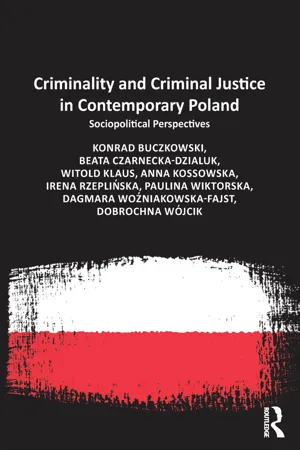
Criminality and Criminal Justice in Contemporary Poland
Sociopolitical Perspectives
- 208 pages
- English
- ePUB (mobile friendly)
- Available on iOS & Android
eBook - ePub
Criminality and Criminal Justice in Contemporary Poland
Sociopolitical Perspectives
About this book
Criminality has accompanied social life from the outset. It has appeared at every stage of the development of every community, regardless of organisation, form of government or period in history. This work presents the views of criminologists from Central Europe on the phenomenon of criminality as a component of social and political reality. Despite the far advanced homogenisation of culture and the coming together of the countries that make up the European Union, criminality is not easily captured by statistics and simple comparisons. There can be huge variation not only on crime reporting systems and information on convicts but also on definitions of the same crimes and their formulations in the criminal codes of the individual European countries. This book fills a gap in the English-language criminological literature on the causes and determinants of criminality in Central Europe. Poland, as the largest country in the region, whose political post-war path has been similar to the other countries in this part of Europe, is subject to an exhaustive and original look at criminality as part of the political and social reality. The authors offer a contribution to the debate in the social and criminal policy of the state over the problems of criminality and how to control it.
Chapter 1
Criminality Today and Tomorrow: Structural Stability and Variability
There is a generally held view that crime is a certain identifiable form of conduct that can be defined by law and which is recognised as not conforming to the conventional behavioural model of a given culture. Governments therefore take steps to discourage individuals from engaging in such conduct and punish actions defined as criminal through the application of sanctions of various kinds. But that is where the consensus ends. Governments may well deem specific actions criminal but they are driven by different imperatives. Criminal law systems are based on religious and cultural systems as well as on different interpretations of morality (Ram 2012, pp. 23–4). There is no single definition of crime in the criminal law, let alone in criminology. An exhaustive look at just what is meant by criminality would seem warranted in a book devoted to its various contemporary contexts. What factors decide whether a specific action is deemed criminal? What would the constituent components of a definition of crime look like? Who decides which actions are to be subject to penalty and on what basis? And finally, why is the concept of crime subject to continuous change?
At this point, a criminologist would ask what, in that case, constituted the substance of a crime. Who decides what actions are to be included in criminal legislation? Why are some actions crimes and others merely petty offences? And where is the line to be drawn? Why is everybody not criminally liable to the same extent?
The sources of this ‘substance of crime’ have always been specified differently depending on time and place. In the canonistic doctrine (i.e. based on canon law) that prevailed in Europe until the seventeenth century, crime was understood as being identical to sin and as disobedience to the will of God. During the period of absolutism that followed, crime was seen as inimical to the wellbeing of society. The theory of natural law held that crime was incompatible with the laws of nature and detrimental to society and its citizens. Kant said that crime was a violation of moral law, while according to Hegel it was ‘an intentional deviation of the will of the individual from the universal law’ (Andrejew 1988, p. 59).
If we look at the issue of crime from an historical perspective, we can see that the principles of criminal liability have varied considerably. The idea of society having a general welfare could not have been conceived until some sort of state structures had been set up. It was statehood that gave rise to the problem of crime. But only those few actions intended to harm the interests of the authorities qualified as public crimes and only these were prosecuted by the state. The vast majority of crimes were considered private and the burden of prosecuting them lay entirely with the aggrieved party or his/her family.
The Criminal Code currently in force1 does not have a clear-cut definition of crime, although it frequently makes use of the concept. The definition cited at the beginning of this chapter is theoretical and clearly follows directly from the rules formulated in the Code. The Criminal Code, however, defines a prohibited act as follows: ‘A prohibited act is any conduct with features defined by the criminal law’ (Art. 115 § 1). This is a broader concept than crime. Prohibited acts can be subdivided into petty offences, summary offences and indictable offences. Only the last two qualify as crimes; petty offences are not formally crimes and, as such, are subject to a lower degree of criminal liability. This type of classification has a tradition going back many centuries.
During the Middle Ages, crimes were distinguished from transgressions, although the criteria for this division varied considerably (e.g. the extent of the damage or injury and/or the nature of the penalty) (Sójka-Zielińska 2009, p. 153). This division has been strongly criticised in modern times (Andrejew 1988, p. 67). Despite these reservations, many European countries maintain this classification of crimes as being either serious or minor, e.g. the Austrian model classifies one group of petty offences as the most minor crimes and another as administrative infringements that are not regarded as crimes and which are adjudicated by the Administrative Courts (Bojarski and Radecki 2006, p. 5). This, however, is not the only model, e.g. petty offences are considered crimes in France, where crimes are classified as petty offences, summary offences and indictable offences depending on their gravity (Bojarski and Radecki 2006, pp. 5–6). Petty offences are not seen as being essentially different from crimes in Poland (Bojarski 2009, p. 56). It has to be conceded, then, that the nineteenth-century prison reformers were correct when they spoke of assigning acts to specific categories on a purely formal basis. This is because there are no clear-cut rules, and any general prerequisites, e.g. the harm to society resulting from the act, have been interpreted differently at different times. For this reason, some summary offences were automatically made petty offences in Poland in 1966.2 Larceny, conversion, receiving stolen goods and damaging property were among the offences that were decriminalised. These same kinds of acts can be found in the Criminal Code, the only difference being the value of the property constituting the object of the crime. In any case, this value is flexible and subject to fairly arbitrary changes. Stealing property to the value of 400 PLN, for example, is a petty offence at the time of writing (2014) and is punishable by fine, community sentence or arrest for up to 30 days. Anything above that amount is a crime and is punishable by three months’ to five years’ imprisonment. This makes a huge difference to the perpetrator.
Petty offences, however, can also be upgraded to crimes. Driving a vehicle while under the influence of alcohol was a petty offence until 2000. As this type of behaviour was fairly common, all the more so as it enjoyed a great deal of social approval, the legislature decided to make it more serious by criminalising it, i.e. by upgrading it from a petty offence to a crime and substantially increasing the penalty (CC Art. 178a).3
Whether something is a crime is also relative with regard to the perpetrator. For the same or a very similar act, one person will be penalised, another will bear a partial or reduced liability, and yet another will not be liable at all. It all depends on who the perpetrator is, i.e. his/her age, judgement, mental condition and sanity at the time of committing the act. These are objective conditions that the court takes into account, along with any issues shielding the actions of some perpetrators from the justice system. There is more on this below.
Criminal liability for an action in respect of the perpetrator appears to have varied considerably at different times in history. The family, and sometimes even the neighbours, of the perpetrator were held collectively liable in early mediaeval Europe and householders were long held liable for the crimes of household members under their authority. Moreover, every person who participated in a crime was given the same punishment, regardless of the nature and extent of his/her participation (Sójka-Zielińska 2009, pp. 146–7). That men and women were equally aware of their actions, and that culpability for committing prohibited acts could therefore be ascribed to women, was first recognised in the late Middle Ages. Men and women were made equally criminally liable on the basis of this major turnaround in thinking (Sójka-Zielińska 2009, p. 160). Juveniles were treated more leniently, as they could not be credited with the same degree of culpability as adults. There was no upper age limit but awareness and intellectual development were taken into account (Sójka-Zielińska 2009, p. 160). Mental illness was an extenuating circumstance that mitigated liability in some fourteenth-century cases (Sójka-Zielińska 2009, p. 168).
In addition to ‘forbidden act’ and ‘crime’, is the concept of ‘punishable act’. This is defined in the Act on Proceedings Involving Juveniles (1982).4 A ‘punishable act’ is any crime, fiscal offence or petty offence enumerated in the Act and committed by a person 13 years and above but under the age of 17.
Juveniles form a special category. An act that satisfies the definition of a crime will not, as a general rule, be recognised as such in their case. Whether a given act formally qualifies as a crime therefore depends on the characteristics of the perpetrator as well. As mentioned above, the perpetrator’s maturity and awareness of what he/she has done were taken into consideration in the past. The legislature currently applies an arbitrarily fixed age limit to determine whether the perpetrator is a juvenile or has to answer the charge(s) as an adult. Some legislatures acknowledge that children below a certain age limit cannot be made to answer for committing a prohibited action, e.g. a person who has committed an action and who is 14 years and over but under the age of 18 is considered a juvenile in Hungary, Germany and Russia, whereas a juvenile is a person between the ages of 10 and 18 in England and Wales (Woźniakowska-Fajst 2010, p. 20). Moreover, many European countries have special rules for criminal proceedings involving juveniles (Gaberle 2006, p. 175). In Poland, the term ‘juvenile’ refers to three age groups, there is no fixed lower limit for liability, and a punishable act can be committed by a person between the ages of 13 and 17, although every so often the necessity of lowering the age limit for criminal liability is raised, especially in the case of the most serious crimes. On the other hand, the Criminal Code (Art. 10 § 3) provides for educational measures in lieu of a penalty for 17-year-olds. Accepting an artificially specified age limit is obviously more convenient from the standpoint of the judiciary as it frees the judge from having to go through all the minutiae of establishing the maturity of the perpetrator on a case by case basis. There are, however, various classifications to determine age distribution and establish criteria to distinguish particular phases in psychologically different ways. Arbitrarily defining a juvenile as someone under the age of 17 and an adult as someone 18 years and above is difficult to defend from a psychological standpoint (Domachowski 2005, p. 69).
If a prohibited act of a criminal nature is not in fact a crime when committed by a juvenile, then what is it? This mostly depends on the age of the perpetrator. If he/she has not yet turned 13, then Polish law confines the act to one involving depravity. The indications of depravity are enumerated, e.g. in the Act on Proceedings Involving Minors (1982), and one of them is the commission of a prohibited act. Educational measures can be applied to the perpetrator. In the case of a person who has turned 13, however, a criminal act is involved. For practical purposes, this is not a significant difference. Apart from educational measures, juveniles can be sent to youth detention centres as a corrective measure.
There is, however, one exception to the rule that a juvenile cannot commit a crime, viz. in the case of a very serious crime (e.g. homicide, causing serious health damage, armed robbery, aggravated sexual assault and rape), a perpetrator aged 15 years and over has the same liability as an adult (CC Art. 10 § 2). This provision raises all sorts of questions. In particular, Andrzej Gaberle has pointed out that according to Art. 10, the maturity of the perpetrator has to be recognised before any culpability can be imputed to him/her.
It has to be acknowledged, however, that given what is known about human development, a person who has not yet turned 17 achieves physical, emotional and social maturity in a sporadic manner (Gaberle 2006, pp. 178–9). Gaberle (2006, pp. 181–2) plainly states that ‘the seriousness of the act committed by the juvenile is generally manifest proof of his immaturity as it clearly expresses his inability to comprehend the social consequences of his actions’. The legislature might have accepted the premise that a juvenile perpetrator should bear a lesser degree of culpability than an adult perpetrator and consequently imposed lesser penalties (Hałas 2006, p. 116), but research shows that juveniles charged under the Criminal Code (Art. 10 § 2) are punished severely. The courts have even sentenced 15- and 16-year-olds to 10–20 years’ imprisonment (Rzeplińska 2007, p. 518).
The definition of crime also contains the concept of an illegal act. An act that ostensibly has all the elements of a crime will nevertheless not be a crime if it complies with the law on the basis of other regulations (Gardocki 2008, p. 111). These situations include lawful defence (i.e. the defence of legally protected interests from direct attack), necessity (forfeiting one good to protect another), acting under authorisation or obligation (e.g. a police officer using force to arrest a suspect), and innovation risk (e.g. conducting medical experiments to test a new drug).
Apart from the justifications laid out in the Criminal Code and several statutes, criminal law doctrine describes a few extra-statutory justifications. The very existence of these is further evidence that the word ‘crime’ is anything but unequivocal.
Extra-statutory justifications must, however, have some sort of authority in law, as their admissibility cannot be left to the sole discretion of the prosecutor or the judge when raised in a particular case. They are actually defined on the basis of an interpretation that draws on the principle of negligible social consequences. Customs and sporting risks are accepted as extra-statutory justifications.
One issue that always crops up is that boxing is a sport that people can engage in legally. In fact, it has its own official rules and is even an Olympic discipline. So long as the ‘perpetrator’ observes the rules of the sport, however, breaking noses and other bones, damaging internal organs, causing contusions and inflicting other serious injuries are not criminal acts. Vale tudo bouts, on the other hand, are considered illegal and anyone participating in one is subject to criminal liability.5 The sporting risks justification has no application here. Pretty much the same goes for customs. The interpretation of what behaviour is acceptable is subject to constant change. The Polish custom of pouring buckets of water over people on Easter Monday (Śmigus-Dingus) can now be considered a justification so long as those who take part are known to each other and the doused person expresses consent. If, however, these conditions are not met, it can be considered harm to somebody’s bodily inviolability (CC Art. 217).
As mentioned above, despite the conditions of social harm being clearly set out in the Criminal Code, prosecutors and judges are given a lot of leeway in how they interpret them. In any case, this doctrine has not withstood the test of time due to changing customs and a new understanding of what conduct is acceptable and what should be prohibited outright. A good example of this is castigating minors, which was a justification until recently (Gardocki 2008, pp. 129–31). To put it bluntly, this concerned the issue of whether a parent or guardian could hit a child. Proponents of this justification even worked out an elaborate set of rules. According to them, hitting a child does not constitute battery when it is done by a parent or legal guardian for an allegedly educational purpose and does not exceed a certain limit of intensity. Despite the obvious absurdity of this sort of reasoning and despite the fact that the doctrine never recognised it, some criminal law experts argued for its existence. All these questions were rendered moot when Art. 961 was inserted into the Family and Guardianship Code in 2010. This plainly states that ‘No person exercising parental authority over, or otherwise having care or custody of, a minor shall administer corporal punishment’.6
The Polish criminal law system is structured in such a way as to make the individual guilt of the perpetrator the basis of criminal liability (Marek 2010b, p. 5). Whether culpability for committing a crime (intentionally or unintentionally) can be ascribed to the perpetrator in a given case therefore mostly depends on whether crime and perpetrator liability are applicable. The perpetrator’s degree of liability is also connected with the applicable penalty. This is because the appropriate and just response to the act should directly correspond with the degree of culpability.
Proving that a particular individual committed an act is not sufficient to have that act considered a crime. The key question is whether the act was the result of a decision on the part of the perpetrator and whether that decision was made through an exercise of free choice. The constitutional principle of justice requires the state to ‘configure the foundations of criminal liability so as to exclude the application of repressive punishment to a person who was unable to avoid committing the act in which that liability lies’ (Wróbel and Zoll 2010, p. 322). Before a perpetrator can formally be culpable of anything, he/she must have reached the age specified in the penal act (i.e. 17 or 15 in special cases). The material circumstances are those that prove that the perpetrator was capable of recognising the significance of his/her act and of making a free decision as to which act or omission he/she would undertake. A perpetrator who is not sufficiently mature mentally to recognise the significance of what he/she has done or who was non compos mentis at the time he/she acted, might therefore not be culpable, especially if the act was committed in circumstances that prevented him/her from making a free decision (e.g. threats, blackmail, fear or orders) (Wróbel and Zoll 2010, pp. 328–30). The criminal law also makes use of the concepts of wilful misconduct (a prohibited act qualifies as wilful misconduct when ‘the perpetrator intends to commit it, i.e. when he/she either wants to commit it or can foresee the possibility of its being committed and is agreeable thereto’ [CC Art. 9 § 1]) and unintentional misconduct (‘when the perpetrator does not intend to commit it [i.e. the act] but nevertheless does so through failure to exercise due care in the circumstances, even though he/she foresaw or could have foreseen the possibility of committing the act’ [CC Art. 9 § 2]). In other words, some conduct can also be punishable when the perpetrator demonstrates a certain lack of care in his/her actions, even though his/her level of maturity and intellectual development indicate that he/she should have assessed the consequences of his/her actions otherwise. There is a presumption in Polish law that the perpetrator is capable of understanding the significanc...
Table of contents
- Cover Page
- Title Page
- Copyright Page
- Contents
- Notes on Contributors
- List of Figures
- List of Tables
- Introduction
- 1 Criminality Today and Tomorrow: Structural Stability and Variability
- 2 The Status of Criminality in Poland since 1918
- 3 Social Change and Criminality: Mutual Relationships, Determinants and Implications
- 4 The Relationship between Poverty, Social Exclusion and Criminality
- 5 Preventing Criminality: The Social Policy of Preventing Social Exclusion
- 6 Justice and Its Many Faces
- 7 Controlling Criminality
- 8 Supervised Freedom
- 9 The Social Perception of Criminality
- 10 Criminality and the Media
- References
- Index
Trusted by 375,005 students
Access to over 1.5 million titles for a fair monthly price.
Study more efficiently using our study tools.
Frequently asked questions
Yes, you can cancel anytime from the Subscription tab in your account settings on the Perlego website. Your subscription will stay active until the end of your current billing period. Learn how to cancel your subscription
No, books cannot be downloaded as external files, such as PDFs, for use outside of Perlego. However, you can download books within the Perlego app for offline reading on mobile or tablet. Learn how to download books offline
Perlego offers two plans: Essential and Complete
- Essential is ideal for learners and professionals who enjoy exploring a wide range of subjects. Access the Essential Library with 800,000+ trusted titles and best-sellers across business, personal growth, and the humanities. Includes unlimited reading time and Standard Read Aloud voice.
- Complete: Perfect for advanced learners and researchers needing full, unrestricted access. Unlock 1.5M+ books across hundreds of subjects, including academic and specialized titles. The Complete Plan also includes advanced features like Premium Read Aloud and Research Assistant.
We are an online textbook subscription service, where you can get access to an entire online library for less than the price of a single book per month. With over 1.5 million books across 990+ topics, we’ve got you covered! Learn about our mission
Look out for the read-aloud symbol on your next book to see if you can listen to it. The read-aloud tool reads text aloud for you, highlighting the text as it is being read. You can pause it, speed it up and slow it down. Learn more about Read Aloud
Yes! You can use the Perlego app on both iOS and Android devices to read anytime, anywhere — even offline. Perfect for commutes or when you’re on the go.
Please note we cannot support devices running on iOS 13 and Android 7 or earlier. Learn more about using the app
Please note we cannot support devices running on iOS 13 and Android 7 or earlier. Learn more about using the app
Yes, you can access Criminality and Criminal Justice in Contemporary Poland by Konrad Buczkowski,Beata Czarnecka-Dzialuk,Witold Klaus,Anna Kossowska,Dobrochna Wójcik,Irena Rzeplińska,Dagmara Woźniakowska-Fajst in PDF and/or ePUB format, as well as other popular books in Law & Criminal Law. We have over 1.5 million books available in our catalogue for you to explore.