Scholars have made conflicting claims for Byzantine hospitals as medical institutions and as the forebears of the modern hospital. In this study is the first systematic examination of the evidence of the xenôn texts, or Xenonika, on which all such claims must in part rest. These texts, compiled broadly between the ninth and thirteenth centuries, are also transcribed or edited, with the exception of the combined texts of Romanos and Theophilos that, the study proposes, were originally a single manual and teaching work for doctors, probably based on xenôn practice. A schema of their combined chapter headings sets out the unified structure of this text. A short handlist briefly describes the principal manuscripts referred to throughout the study. The introduction briefly examines our evidence for the xenônes from the early centuries of the East Roman Empire to the fall of Constantinople in 1453. Chapter 3 examines the texts in xenon medical practice and compares them to some other medical manuals and remedy texts of the Late period and to their structures. The xenôn-ascribed texts are discussed one by one in chapters 4–8; the concluding chapter 9 draw together the common, as well as the divergent, aspects of each text and looks to the comparative evidence for hospital medical practice of the time in the West.
eBook - ePub
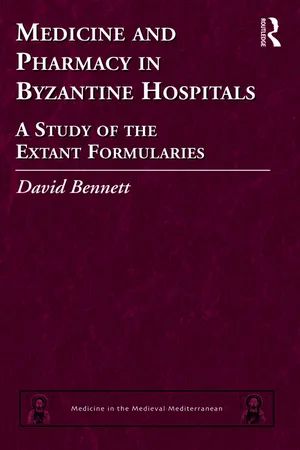
Medicine and Pharmacy in Byzantine Hospitals
A study of the extant formularies
- 250 pages
- English
- ePUB (mobile friendly)
- Available on iOS & Android
eBook - ePub
Researching the history of the Byzantine hospital
1
From hostel to hospital
The Byzantine xenôn
For the World, I count it not an Inn, but an Hospital;
and a place not to live, but to dye in.
Thomas Browne, Religio Medici, II, 11
The sombre assessment by the physician and surgeon Sir Thomas Browne (1605–1682) of the world that he inhabited is a melancholy simile. He spoke figuratively and of his time. We may counter Thomas Browne’s reflection on his mortality by an optimistic view of the first recognisable hospitals by the Greek historian of medicine Georges C. Pournaropoulos (1909–1992). In the course of an address to the Seventeenth International Congress of the History of Medicine held in Athens and Cos in 1960, he said, “Byzantium’s philanthropic, social welfare and medical assistance institutions… were in every respect perfect and nearly similar to present day institutions of this kind. In any case they were the first fully equipped European hospitals.” 1
More lasting, however, than the bricks and mortar of the Byzantine hospitals – xenônes – are their few surviving formularies (x enônos iatrosophia) 2 in manuscripts recording remedies and ingredients. Setting aside modern conceptions of a hospital, we have to visualise what the leading historian of the Byzantine xenôn, Timothy Miller, has so painstakingly reconstructed from extant records and manuscripts. 3
The first attempt to undertake a historical assessment of Byzantine hospitals took place in 1680 when the French Byzantinist Charles du Fresne, Sieur du Cange (1610–1688) reckoned that thirty-five charitable institutions existed in Constantinople. 4 Present estimates number some 115 xenônes, xenodocheia and nosokomeia by the mid-ninth century in the city. 5 Throughout the time of the Byzantine Empire, not least in Egypt, xenônes were established, often small and local as befitted local needs.
The xenôn as hospital
Distinguishing between xenôn, xenodocheion and nosokomeion is not always simple. In broad terms, we may see xenôn and nosokomeion as generally used of a hospital – that is, an institution for the treatment of the sick or injured. The word nosokomeion, still current in present-day Greek, patently indicates its purpose – that is, a place where the sick may be tended. As for xenôn, guest chamber was its etymological meaning, in the sense of hostel. 6 How then, in Byzantine society, did the meaning come to change to that of hospital? Did one succeed the other at some distinguishable point in time? Was there a gradual overlapping of functions? Are hostel and hospital to be equated? Is the attendance of physicians at the bedside the mark of a hospital, one that distinguishes it from the hostel? More critically, are these the right questions to ask?
The word xenodocheion, whose essential meaning is that of a place at which strangers may lodge, is recorded in the hostel foundations of Bishop Leontios, patriarch of Antioch (344–358). We find these hostels sometimes described as xenônes, but there is no evidence that they were founded for the care of the sick, although they probably took in, by chance or charity, travellers with infirmities and disease not necessarily patent. In the sixth century, the Byzantine historian Prokopios (ca. 500–565) in his monograph Buildings, 7 uses several terms, including xenodocheion, for institutions that cared for travellers and the sick (see Table 1.1). In later centuries, xenôn and nosokomeion are used, sometimes it seems, interchangeably, for an institution giving in-patient treatment. 8
Hence the protean word hospital inescapably calls for definition when used to translate xenôn. Its meaning may depend on the period in which the texts where the word appears were written. 9
The earliest Byzantine hospital was possibly the Basiliad or ptôcheion built ca. 370 in Caesarea by Basil of Caesarea (329 or 330–379), 10 called by Gregory of Nazianzus (ca. 329–389 or 390) “a storehouse of piety’’. 11 In these early centuries John Chrysostom (ca. 347–407) had oversight of hospitals, and ptôcheia built in his see in Constantinople. The Oxford theologian John Norman Davidson Kelly (1909–1997) remarks that it seemed “reasonable to suppose that he centralised their administration and brought them under his personal supervision”. 12 John Chrysostom also established a leper hospital as well as other “general” hospitals within his see. 13 These hospitals were often linked to monastic foundations, but the extent to which they resembled the modern hospice rather than hospital remains a matter for debate.
Four centuries later the concept of the hospital had spread widely. We read of the exhortation from Alcuin of York (730/740–804) to his pupil Eanbald (d. ca. 808 or 830) to think where in the diocese of York he could establish xenodocheia. id est hospitalia. 14 In the twelfth century, the Byzantine princess Anna Komnena (1083–1153) records in the Alexiad the history of her father, the emperor Alexios I Komnenos (emp. 1081–1118), including his final illness. 15 They both lived in the Mangana Palace in Constantinople, and her record includes an ambiguous reference to “the Mangana”, whether palace or hospital is not clear.
Table 1.1 Terminology for charitable institutions in Procopius, Buildings
| References to text | Ed. and tr. Dewing and Downey 1940 | Tr. and comm. Roques 2011 | Terminology |
| | |||
| I.ii.14 | 36-37 | 83 | ξενών, ἀνθρώποιs ἀνειμένοs ἀπορουμένοιs τε καὶ νοσοῦσι (The Sampson xenôn) |
| I.ii.17 | 36-37 | 83 | δύο ξενῶναs . . . ἔθετο ἐν ταῖs Ἰσιδώρου τε καὶ Ἀρκαδίου καλουμέναιs οἰκίαιs |
| I.vi.6-7 | 62-63 | 89-90 | τέμενοs . . . οἰκοδομίαν, ἐπειδάν τέ τινεs ἀρρωστήμασιν ὁμιλήσαιεν ἰατρῶν κρείττοσιν |
| I.ix.12 | 78-79 | 94 | . . . πτωχῶν ἦν ἐκ παλαιοῦ καταγώγιον οἷσπερ ἡ νόσοs τὰ ἀνήκεστα ἐλωβήσατο |
| I.xi.27 | 96-97 | 99 | ξενῶναs ὑπερμεγέθειs ἐδείμαντο, τοῖs τὰ τοιαῦτα ταλαιπωρουμένοιs . . . |
| II.x.25 | 172-173 | 171-172 | προὐνόησε δὲ καὶ τῶν ἀρρωστήμασι πονουμένων ἐνταῦθα πτωχῶν, οἰκία τε σφίσι καὶ τὰ ἐs τὴν ἐπιμέλειαν καὶ τῶν νοσημάτων ἀπαλλαγήν . . . |
| V.iii.20 | 330-331 | 359 | τὸ τῶν νοσούντων ἀναπαυστήριον . . . |
| V.iv.17 | 334-335 | 360 | ξενῶναs . . . ἐδείματο καὶ ὅσα ἄλλα ἐνδείκνυται πόλιν εὐδαίμονα. |
| V.vi.25 | 348-349 | 364 | ξενῶνεs . . . δύο, . . . ἅτεροs μὲν ξένοιs ἐνδημοῦσι καταλυτήριον, ὁ δὲ δὴ ἔτεροs ἀναπαυστήριον νοσοῦσι πτωχοῖs. |
| V.ix.4 | 356-357 | 367 | ξενῶνα ἐν Ἰεριχῷ(numbered among the monasteries restored in Jerusalem) |
The remaining references to charitable institutions in Buildings are to the restoration or renewal of four πτωχεῖα (V.ix.22,27, 34 and 38 [ed. and tr. Dewing and Downey 1940: 358-359 and 360-361; tr. and comm. Roques 2011: 368-369]) and the οἴκον of the Sts. Cosmas and Damian in Pamphylia (V.ix.37 [ed. and tr. Dewing and Downey 1940: 360-361; tr. and comm. Roques 2011: 369]).
Healing in xenônes
Scholars once traced the distinction between hostel and hospital in Byzantium to a gradual process of separation of functions over the centuries. The xenôn qua hospital did not spring fully armed, as it were, from the pious and charitable institutions that once sheltered travellers and the poor. The early hostels’ provision of elementary charity and shelter for travellers paved the way for the dedication of these institutions to the treatment of the sick as chief objective. The importance of this process of change from first aid and shelter to institutional medicine lies in the evolution of a public medicine for which there is no discernible historical precedent. 16
Evidence of what kind of medical practice a xenôn might undertake in these earlier centuries is hard to come by. The caution expressed by Vivian Nutton about the inadvisability of relying on lives of the saints for evidence 17 applies particularly to the Miracles of St. Artemios, a text written in the mid-seventh century that makes a number of useful references to xenônes in the course of describing that saint’s healing of genital diseases and hernias. 18 Miracle 22 gives some indication of hospital practice at the Christodotes xenôn when its xenodochos, or administrator, who was also “prominent in the patriarchal retinue”, saw a sixty-two-year-old man with incipient dropsy who lived alone: 19
[He] had him put to bed in the… hospital after enjoining the chief physicians and their assistants to care for him. The patient spent a period of ten months thus and was diligently treated by the physicians to the best of their ability, but received no benefit at all.
In this time the old man had developed a secondary affection of his testicles that, though beyond the power of the physicians to remedy, was healed by the saint. There is much of interest here to the historian of the xenôn, making all due allowance for its narration perhaps long after the event and one that was intended at ...
Table of contents
- Cover
- Title
- Copyright
- Contents
- List of tables
- Foreword
- Writings
- Acknowledgements
- Introduction
- PART I Researching the history of the Byzantine hospital
- PART II Exploring the textual evidence
- PART III The search for healing in Byzantine xenônes
- PART IV Consulting hospital formularies
- Bibliography
- Index
Trusted by 375,005 students
Access to over 1.5 million titles for a fair monthly price.
Study more efficiently using our study tools.
Frequently asked questions
Yes, you can cancel anytime from the Subscription tab in your account settings on the Perlego website. Your subscription will stay active until the end of your current billing period. Learn how to cancel your subscription
No, books cannot be downloaded as external files, such as PDFs, for use outside of Perlego. However, you can download books within the Perlego app for offline reading on mobile or tablet. Learn how to download books offline
Perlego offers two plans: Essential and Complete
- Essential is ideal for learners and professionals who enjoy exploring a wide range of subjects. Access the Essential Library with 800,000+ trusted titles and best-sellers across business, personal growth, and the humanities. Includes unlimited reading time and Standard Read Aloud voice.
- Complete: Perfect for advanced learners and researchers needing full, unrestricted access. Unlock 1.5M+ books across hundreds of subjects, including academic and specialized titles. The Complete Plan also includes advanced features like Premium Read Aloud and Research Assistant.
We are an online textbook subscription service, where you can get access to an entire online library for less than the price of a single book per month. With over 1.5 million books across 990+ topics, we’ve got you covered! Learn about our mission
Look out for the read-aloud symbol on your next book to see if you can listen to it. The read-aloud tool reads text aloud for you, highlighting the text as it is being read. You can pause it, speed it up and slow it down. Learn more about Read Aloud
Yes! You can use the Perlego app on both iOS and Android devices to read anytime, anywhere — even offline. Perfect for commutes or when you’re on the go.
Please note we cannot support devices running on iOS 13 and Android 7 or earlier. Learn more about using the app
Please note we cannot support devices running on iOS 13 and Android 7 or earlier. Learn more about using the app
Yes, you can access Medicine and Pharmacy in Byzantine Hospitals by David Bennett in PDF and/or ePUB format, as well as other popular books in History & World History. We have over 1.5 million books available in our catalogue for you to explore.