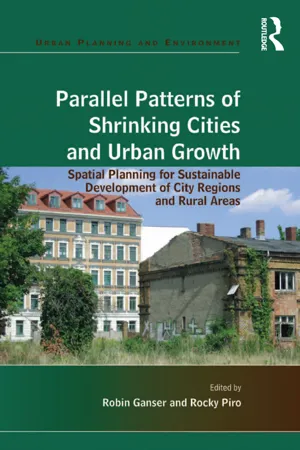
eBook - ePub
Parallel Patterns of Shrinking Cities and Urban Growth
Spatial Planning for Sustainable Development of City Regions and Rural Areas
- 312 pages
- English
- ePUB (mobile friendly)
- Available on iOS & Android
eBook - ePub
Parallel Patterns of Shrinking Cities and Urban Growth
Spatial Planning for Sustainable Development of City Regions and Rural Areas
About this book
Focussing particularly on urban fringe and rural areas, this book addresses the parallel phenomena of growth and decline. In doing so, it not only broadens a debate which generally concentrates on urban municipalities, especially inner city areas, but also covers new ground by starting to build a new theoretical framework for the spatial planning related assessment of these phenomena. Bringing together contributions from internationally renowned authors, such as Sir Peter Hall, Steve Ward and Johann Jessen, the book compares international case studies and highlights their relationships with one another. It concludes by emphasizing common themes that are addressed, as well as showing applicability to other urban and rural regions. Overall, the book provides a timely and comprehensive analysis of the spatial consequences and related spatial planning concepts in theory and practice which aim to further sustainable development of city regions, urban fringe and rural areas experiencing growth and decline.
Information
Chapter 1
Spatial Planning Approaches to Growth and Shrinkage: A Historical Perspective
Introduction
Initially in western nations, but increasingly throughout the world, the functioning of increasingly complex economies has required the growing concentration of population in towns and cities. Modern spatial planning appeared as a series of ideas and actions to manage the various economic and social contradictions which followed from that urban growth. It soon began to include localised attempts to slow, relocate and even, to some extent, reverse or prevent the effects of urban growth. This chapter reviews how and why these concerns appeared. It also considers the kinds of practical remedies that were proposed and applied. Finally, it reflects on the main factors which generated changes in thought, policy and practice.
The main elements and examples used in this story are from western Europe and North America since this was where modern urban and regional planning largely emerged during the later nineteenth century. Just as would later prove the case elsewhere, the appearance of this new approach to organising human settlements was spurred by urban growth. The first modern planners were not, initially at least, faced with any need to manage urban decline. In most countries, the relative shift to mass urban living began against a background of marked absolute population growth. This ensured that urbanisation was initially accompanied by a decline that was only relative even within the rural regions from where most of the new urbanites came.
Increasingly, however, as urbanisation continued and overall population growth slowed, rural regions experienced real population shrinkage, albeit earlier and more acutely in some countries than others. Later cyclical and structural shifts within industrialised economies introduced further areas of decline as older urbanised industrial regions dwindled and new economic activities arose elsewhere. Within planning various ways of addressing decline were developed, from seeking its outright reversal through a less ambitious acceptance and management or even acceleration of decline.
Urban growth, spontaneous and otherwise
These later planning responses did not appear immediately. Few of the first generation of European and American planning theorists and practitioners did other than accept the inevitability of a relatively spontaneous process of urban growth. In 1899 the American statistician, Adna Ferrin Weber, showed just how dramatic and widespread had been the phenomenon of urban growth during the century that was just ending (Weber 1963 [originally 1899]). Its scale went far beyond that which could have been achieved by the conscious actions of local or even national governments. Already, through trade and colonial exploitation, urbanisation was spreading across the globe, exceeding all previous experiences of urban civilisation.
In the core regions of Europe and equivalent parts of the United States, cities themselves needed to do little to make growth happen. This was not so in more marginal regions, however. Here, where capital, technical knowledge and labour skills were scarce, civic and business leaders had to compete hard to attract these factors of production. The result was that, during the nineteenth and early twentieth centuries, many ambitious cities in these regions adopted boosterish and promotional policies.
Particularly notable were the subsidies that towns and cities in the southern and western states of the United States and in Canada gave to attract railroads and manufacturing industries from around 1850 (Ward 1998: 9–25, 145–50). Such place competition was particularly intense in North America because, unlike Europe, there was simultaneous competition to populate and build up both cities and rural territories as the settlement frontier moved westward. Cities subsequently as important as Los Angeles, Atlanta and Winnipeg gave incentives to foster growth in their early history. However, the major givers of subsidies to private businesses during this period were typically less prominent manufacturing cities such as Kitchener (originally Berlin) and Oshawa in Canada (Bloomfield 1983).
There was nothing comparable at the time in Europe but some cities (and higher governments) offered incentives to offset the effects of foreign competition. The city of Łódź, shielded by tariff walls set up by the (Russian) Kingdom of Poland, deliberately attracted large numbers of German textile workers to settle in the early nineteenth century (Koter, et. al.1993: 12–18). Their own German markets had been lost to more advanced mechanised production from the cotton mills of Lancashire in Britain. Łódź became a haven where they could adjust to the new technologies and market realities, allowing the city to make itself into ‘Poland’s Manchester’.
Fascinating though they are, such early local policy innovations to kick-start urban growth on the margins were far from typical. Even cities which indulged in such practices for a time were quick to wean themselves off the most draining subsidies. And they had little impact on the ideas and practices associated with urban planning emerging later in the century. The new movement’s dominant concerns were to give urban growth a physical form that was, in varying degrees, efficient, healthy and beautiful. Due attention was given to the enhancement of urban infrastructures that would assist the future prosperity of business but this was scarcely dominant. Planning was also a movement to civilise the ugliness and squalor of the dynamic cities that industrialism was creating. Interestingly, boosterish cities were often amongst the first to make this policy transition. They were usually eager to show how far they had moved beyond the crude upstart places of just a few years earlier (Scott 1969: 1–46).
The garden city as a model of balanced spatial development
The earliest theorists of planning did not question the process of urban growth itself. There had been utopian thinkers and communitarian activists who had imagined or attempted to build small model settlements that rejected the big concentrated city. The pastoral impulse which romanticised the pre-industrial, rural life was also strong, especially so in Britain where the extent of nineteenth century urbanisation was then unprecedented. The recent acceleration of similar trends in Germany and the United States was also encouraging similar sentiments.
It was not until 1898 that such concerns were convincingly drawn into the emergent discourse of planning. In that year, a hitherto obscure Englishman, Ebenezer Howard, published his important book, To-Morrow: A Peaceful Path to Real Reform (Howard 2003). Famous for introducing the key planning idea of the garden city, Howard was also notable in the present context for his theorising and questioning approach to urban growth and uneven development. In the well-known ‘Three Magnets’ diagram from his book, he highlighted the contrast between the two extremes of late nineteenth century urban development – the big, concentrated city and the declining countryside. The former could offer high wages, social opportunity and places of entertainment but at the price of congestion, poor environment and high living costs. The latter had all the beauties and healthful qualities of nature but also low wages, poor opportunities and living conditions.
He characterised the prevailing pattern of urban development as a product of the capitalist land development process. The key to change lay in the surplus value that arose when land was converted from rural to urban use. If this increase could be harnessed for communal purposes rather than, as it usually was, retained for individual profit, Howard argued that a more balanced pattern of spatial development could be achieved. His vision was of a network of small, low density garden cities, closely integrated with a well-populated intervening countryside. He called this new pattern the ‘social city’ and wanted it to replace the dense urban concentrations of populations that were such a feature of the age. First the new garden cities would be set up, each one limited to a modest size of 32,000. Then the old concentrated cities would gradually wither away and be rebuilt as new social cities. In this new pattern, everyone could enjoy economic and social opportunities but combined with a healthy, beautiful environment and affordable, pleasant housing conditions.
Howard was not a lone voice but was giving the most coherent and widely acceptable expression to ideas that were ‘in the air’. In Germany, the right-wing political activist and polemicist, Theodor Fritsch, had advocated his own vision in his book Die Stadt der Zukunft (The City of the Future) in 1896 (Schubert 2004). This had many features in common with Howard and Fritsch also saw land reform as the key to change. Underlining the similarities, the second edition of Fritsch’s book carried the subtitle ‘garden city’. Yet there were important differences. Fritsch’s purpose was fundamentally agrarian, to forestall urbanisation, which was less advanced in Germany than in Britain. In addition, Fritsch’s anti-metropolitan vision was grounded in rabid anti-Semitism and proto-Nazi thinking. This severely limited his political reach although his ideas enjoyed some vogue in extreme right wing circles, especially during the Nazi era.
Others spawned their own variants of the garden city. The French architect, Tony Garnier exhibited his vision of the Cité Industrielle, in 1904 (though published it in extended form only in 1917) (Pawlowski, Vechambre J.-M 1993). Like Howard, Garnier favoured a settlement ideal that combined industrialism with a rejection of the giant city. Yet Garnier’s was essentially an architectural vision, premised on an ideal socialistic and regionalised society but with no clear sense about how it might be achieved. It had great appeal for the first generation of self-consciously modernist architects and planners in the 1920s. But it too lacked the wider appeal of Howard’s garden city.
Together, however, these anti-metropolitan visions showed that emergent opinion was by the early twentieth century seeking more balanced forms of urbanisation. Henceforth planning would be characterised by efforts to modify urban growth to mitigate rural decline and the alienation of city from countryside.
Concepts to balance metropolitan growth
In practice, Howard’s social city gradually metamorphosed during the 1920s and 1930s from a complete replacement of the concentrated city into several distinct ways for managing its growth. The first signs came in 1912 when the garden city planner, Raymond Unwin, imagined a pattern of growth that replaced continuous peripheral suburban development with planned satellite suburbs (Miller 1992: 134–38). This was an idea that was taken further between the wars especially by the German planner Ernst May, first at Breslau (now Wrocław in Poland) in 1921 and, more famously, at Frankfurt-am-Main during the later 1920s (Bullock 1978). Compared to the usual pattern of suburbanisation, planned satellite towns (as they were called) offered clear physical separation from surrounding urbanisation with the possibility of greater community identity linked to local service provision, usually grouped around transport hubs.
These early German examples were widely admired and emulated. The term ‘satellite town’ became part of the evolving terminology of the garden city movement between the wars. Though often applied rather loosely, the label was used in British planning proposals by the late 1920s. A pioneer was May’s mentor, Raymond Unwin who, during 1929–31, produced advisory plans for the Greater London Region (Miller 1992: 189–209). Though never implemented, they were important as rehearsals for post-war proposals. The interwar plans reacted to the massive growth of relatively low density suburbs around London and other big cities. This growth enlarged the built up area of Britain by an estimated 40 per cent in just twenty years. It reflected a combination of both subsidised, largely municipal, housing construction and, especially in the 1930s, a huge boom in private housebuilding.
Already by the late 1920s, there were growing calls to find some alternative. Conceptually, Unwin’s plans can be seen as marking the completion of the shift from Howard’s social city model. There was no longer any suggestion that London would ultimately wither away. Instead various elements of the repertoire of garden city planning were deployed to encourage the growth of industrial garden cities, at some distance from the city and with their own strong local employment bases. Nearer to the suburban fringe there would be satellite towns, more connected to the core metropolitan economy. The physical separateness of both would be maintained by an encircling belt of open country. The latter drew on Howard’s proposal for an agricultural belt limiting the spread of his garden city. But it was also influenced by German precedents, especially Fritz Schumacher’s 1923 plan for Cologne. Unwin even labelled the London country belt as a ‘green girdle’, directly drawn from the German term ‘Grüngürtel’ (Greater London Regional Planning Committee (GLRPC) 1929: 44–49).
This last was the only part of these proposals that began to be implemented before 1939 (though using the more enduring term ‘green belt’). However, other British cities began to adopt parts of this ambitious new decentralist agenda for metropolitan expansion (Ward 2004: 47–55). Although the most typical growth pattern remained peripheral expansion accomplished through a combination of private and municipal construction, ideas to protect some parts of the urban fringe from suburbanisation had begun to take hold. Cities such as Birmingham and Sheffield had begun to sterilise large rural areas by 1939. Other cities also adopted the notion of satellite towns. A notable example with some tangible results by 1939 was Wythenshawe in Manchester, which ultimately housed about 100,000 people (Deakin 1989). It was planned in 1931 by one of the leading garden city planners, Barry Parker. Another satellite town, planned a few years later was the smaller example of Speke in Liverpool (Post-War Redevelopment Advisory (Special) Committee (PWRASC) 1947: 32–37). What was notable about both these examples is that they had local employment, if never enough for all the resident local workers (an aspect which will be considered further in the next section.)
Another, more convoluted, strand in the thinking about planning urban growth grew from an amalgamation of Howard’s ideas with those of the Spanish engineer Soria y Mata (1996). Soria had in 1882 proposed the idea of a linear city, a low density ribbon of development along a transportation artery such as a tramway or rail line. Relatively little notice was taken of this, despite Soria’s launch of a small demonstration project in Madrid in 1894. He also proposed vast linear cities that would span continents. In the ferment of planning ideas in the first decade of the twentieth century, however, elements of his thinking were taken up elsewhere. In Britain, James William Petavel, a prolific writer on social and Indian matters at this time, advocated closer linkage of transport investments and improved housing development in British cities (Petavel 1909).
Petavel’s ideas partly followed Howard’s reasoning and this link was pressed with more energy when it was taken up by the French reformer and garden city enthusiast, Charles Benoît-Levy (Buder 1990: 138–40). This was an unorthodox direction compared to the mainstream of the garden city movement but it bore some conceptual fruit after 1919. There was notable interest amongst some city planners within the new Soviet Union where different variants of the linear concept briefly flowered (Miljutin 1974). Some of this knowledge spread back to Western Europe during the 1930s. It could be detected as a minor theme in planning in many countries. One of its clearest expressions came in the proposals made by the British Modern Architectural Research (MARS) Group for the linear expansion of London (Gold 1997: 145–63). These appeared in a mature form in 1942. At this time, however, these fascinating ideas had no real practical effect.
Planning in a context of decline
The interwar decades were also notable because they marked a period of real crisis in global economic and urban growth. This had important implications for those towns, cities and regions which depended on declining economic sectors. The most acute contractions occurred in areas dependent on primary production for export markets but many export-dependent sectors of manufacturing were also very badly affected. Where impacts were especially severe and prolonged, they were likely to bring population loss and simultaneous contraction of tax revenues and increase in need for public services. In Britain, for example, local tax bases had to bear the costs of relieving poverty which became a crippling charge (amounting to 50 per cent or more of total local expenditure) in the most depressed areas (Ward 1988: 155–206). This was despite the fact that central government increasingly funded most payments to relieve short and medium term unemployment. The consequences were that local governments in such areas found it very difficult to fund capital projects that might have created new employment and improved the area’s attractiveness for new industries.
There was also great central reluctance to sanction public capital spending, in the belief that doing so would encourage people to stay in areas without long term prospects (Ward 1986). This ensured that these areas quickly had noticeably worse standards of welfare and infrastructure than elsewhere. Explicit policies to encourage labour out-migration were also introduced from the mid-1920s. These accelerated an existing process whereby the most able-bodied and skilled workers departed, leaving behind a progressively more dependent population. Meanwhile, the main business ministry rather disingenuously encouraged (but gave no financial support for) local and regional boosterish initiatives.
Many of the areas most acutely affected were relatively small mining settlements. However some were significant towns such as Merthyr Tydfil (in South Wales) and Jarrow on Tyneside. The financial impacts of the depression on the former (which had had over 70,000 inhabitants at the end of World War I) were so acute that a Royal Commission on the town was established. In 1936 this recommended downgrading the town’s municipal status to transfer poverty relief to the county’s geographically wider tax base (Royal Commission ...
Table of contents
- Cover Page
- Dedication
- Title Page
- Copyright Page
- Contents
- List of Figures
- List of Tables
- Acknowledgements
- Notes on Contributors
- Introduction
- 1 Spatial Planning Approaches to Growth and Shrinkage: A Historical Perspective
- 2 Balancing European Territory. The Challenge of the Post-Neoliberal Era
- 3 Conceptualizing Shrinking Cities – A Challenge for Planning Theory
- 4 Shrinking Cities in the Growth Paradigm: Towards Standardised Regrowing Strategies?
- 5 Urban Transformations –The Dynamic Relation of Urban Growth and Decline
- 6 The Importance of Strategic Spatial Goals for the Planning Process under Shrinkage Tendencies
- 7 Regional Land use Management under Shrinkage Tendencies in the Region Halle-Leipzig
- 8 Germany’s Post-War Suburbs: Perspectives of the Ageing Housing Stock
- 9 The Housing Market in Growing and Declining Regions – Political Implications for Housing Policy and Urban Planning
- 10 Sustainable Suburbia through the Perspective of Lower Density and Shrinkage: The Case Study of the Nagoya Metropolitan Region in Japan
- 11 Population Growth and Change in Non-Metropolitan Coastal Australia
- 12 Counterurbanisation and Subjective Well-Being
- 13 Socio-Environmental Impacts of New Housing Development at Infill and Greenfield Sites – Methodical Design for a Multicriteria Assessment
- 14 Redeveloping the Redundant Defence Estate in Regions of Growth and Decline – Challenges for Spatial Planning
- 15 The Regeneration of a Naval City: Portsmouth
- Conclusions Spatial Planning for the Dichotomy of Growth and Shrinkage
- Index
Trusted by 375,005 students
Access to over 1.5 million titles for a fair monthly price.
Study more efficiently using our study tools.
Frequently asked questions
Yes, you can cancel anytime from the Subscription tab in your account settings on the Perlego website. Your subscription will stay active until the end of your current billing period. Learn how to cancel your subscription
No, books cannot be downloaded as external files, such as PDFs, for use outside of Perlego. However, you can download books within the Perlego app for offline reading on mobile or tablet. Learn how to download books offline
Perlego offers two plans: Essential and Complete
- Essential is ideal for learners and professionals who enjoy exploring a wide range of subjects. Access the Essential Library with 800,000+ trusted titles and best-sellers across business, personal growth, and the humanities. Includes unlimited reading time and Standard Read Aloud voice.
- Complete: Perfect for advanced learners and researchers needing full, unrestricted access. Unlock 1.5M+ books across hundreds of subjects, including academic and specialized titles. The Complete Plan also includes advanced features like Premium Read Aloud and Research Assistant.
We are an online textbook subscription service, where you can get access to an entire online library for less than the price of a single book per month. With over 1.5 million books across 990+ topics, we’ve got you covered! Learn about our mission
Look out for the read-aloud symbol on your next book to see if you can listen to it. The read-aloud tool reads text aloud for you, highlighting the text as it is being read. You can pause it, speed it up and slow it down. Learn more about Read Aloud
Yes! You can use the Perlego app on both iOS and Android devices to read anytime, anywhere — even offline. Perfect for commutes or when you’re on the go.
Please note we cannot support devices running on iOS 13 and Android 7 or earlier. Learn more about using the app
Please note we cannot support devices running on iOS 13 and Android 7 or earlier. Learn more about using the app
Yes, you can access Parallel Patterns of Shrinking Cities and Urban Growth by Rocky Piro, Robin Ganser in PDF and/or ePUB format, as well as other popular books in Architecture & Urban Planning & Landscaping. We have over 1.5 million books available in our catalogue for you to explore.