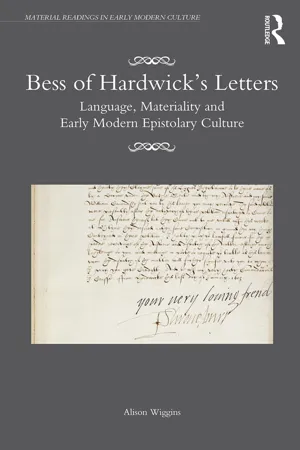
Bess of Hardwick's Letters is the first book-length study of the c. 250 letters to and from the remarkable Elizabethan dynast, matriarch and builder of houses Bess of Hardwick (c. 1527–1608). By surveying the complete correspondence, author Alison Wiggins uncovers the wide range of uses to which Bess put letters: they were vital to her engagement in the overlapping realms of politics, patronage, business, legal negotiation, news-gathering and domestic life. Much more than a case study of Bess's letters, the discussions of language, handwriting and materiality found here have fundamental implications for the way we approach and read Renaissance letters. Wiggins offers readings which show how Renaissance letters communicated meaning through the interweaving linguistic, palaeographic and material forms, according to socio-historical context and function. The study goes beyond the letters themselves and incorporates a range of historical sources to situate circumstances of production and reception, which include Account Books, inventories, needlework and textile art and architecture. The study is therefore essential reading for scholars in historical linguistics, historical pragmatics, palaeography and manuscript studies, material culture, English literature and social history.
eBook - ePub
Bess of Hardwick’s Letters
Language, Materiality, and Early Modern Epistolary Culture
- 224 pages
- English
- ePUB (mobile friendly)
- Available on iOS & Android
eBook - ePub
About this book
Information
1
Composing and scripting letters
1.1 ‘Sett downe the matter plainly’: situating epistolary composition within the genre of early modern letter-writing
I coulde not by any possible meanes prevayle with hir to sett downe the matter plainly, as I desired she woulde in fewe lynes / Theise strange courses ar wonderfull to me.1
When Bess discussed the best way to write a letter, she used the everyday metaphor of ‘plain language’. Here she described the advice she had given to her wayward granddaughter, Arbella Stuart, in an attempt to encourage Arbella to make her point ‘plainly’, a term she also used elsewhere to refer to her own language and to instruct others.2 Plainness in this context meant language that avoided elaborate literary embellishments or ornamentation and that followed the precept of ‘brevity and aptness’ by getting to the point ‘in fewe lynes’.3 It is language that avoided copiousness or prolixities of the kind found in Arbella’s ‘wonderfull’ and ‘strange courses’ of which Bess here thoroughly disapproved. In this way, Bess’s own comments revealed her awareness of contemporary theories about letter-writing, as advised by epistolary manuals or observed in practice. Declarations of ‘plainness’ themselves had a rhetorical function as they served to frame language as being sincere and ‘earnest’ while drawing on contemporary Protestant discourses of manifest truthfulness.4 As Bess’s chosen modus operandi, when we read Bess’s letters we can observe that for her ‘plainness’ was associated with finding the most effective way to present a case or request according to available epistolary models and conventions. Her letter-writing involved a disciplined approach to matters of decorum and attended to matching the letter’s form to its intended purpose and function. Her letter-writing was precisely orientated towards a goal or desired outcome.5 Where textualised emotion was included, it had a strategic purpose and was mindful of its anticipated reception. This goal-orientated attitude to letter-writing was quite the opposite of any notion of letters as vehicles for uncontrolled emotional catharsis or psychological release whereby the desire for an outpouring of expression took precedence over concerns with outcomes and reception.
What the concept of ‘plain’ language did not mean was that there was only one way to write and compose a letter, or only one epistolary style for each person. On the contrary, Bess, like many of her contemporaries, deployed an array of epistolary styles according to context and purpose. The concern of this chapter is to explore these distinctive epistolary styles deployed in the letters Bess sent. The aim is to show how the rhetorical forms of Bess’s letters matched their pragmatic and socio-historical functions: how different epistolary styles were shaped in relation to the anticipated reception of the letter, its purpose and goal, as well as in relation to the relative social status of her correspondents, their familiarity with Bess and the topics covered in the letter. As Lynne Magnusson, James Daybell and others have shown, early modern letters encoded social and power relations; as Daybell puts it specifically in relation to Bess’s letters, they ‘textualise family and other relationships, mirroring the social and gender hierarchies of their social worlds, through modes of address, language, style and tone’.6 The concern here is to track these social relations through identification and analysis of particular epistolary styles and linguistic scripts. The argument made is that these distinct epistolary styles can be associated not only with sets of available linguistic scripts but also with particular compositional scenarios, which were often collaborative. That is to say: it was through diverse methods of composition – autonomous composition, dictation to a scribe, collaborative composition, co-sending or instructions to a scribe – that Bess’s range of epistolary styles were forged. As such, Bess’s letters provide us with an opportunity to interrogate early modern processes of composition, which incorporated fluctuating modes of collaborative and individual composition, and which show that Bess was alert to the suppleness and flexibility of the epistolary genre.
We are immediately struck, when we read the letters from Bess, by their range of different types of confident, assured and authoritative styles of writing.7 We know of other Tudor women who generated bold, forceful and authoritative letters. Some of these women, such as Anne Lady Bacon (née Cooke), created linguistic capital through mastery of classical languages and engagement with intellectual debates, whereas this was not an option available to Bess, who had nothing like Anne Bacon’s level of education.8 While lacking in humanist educational resources, due to her more modest social background and educational start in life, the argument here is that Bess was nonetheless able to generate symbolic and linguistic capital and to use letters for expression and to enact her agency. Letters allowed her to achieve a series of empowered roles through which she was able to persuade, defend, assuage, cajole, reprimand, command or enhance emotional bonds. Letters allowed her to respond by changing the emotional tone or temperature of a situation or by redirecting another person’s projected disrespect, indifference or anger. To do so, Bess, in her letters, skilfully combined techniques that included deployment of contemporary epistolary scripts and cultural models, collaboration with scribes and co-senders, precisely situated textualised emotion and projected confidence in her self-perception of her own power.9
Social historians over the past two decades have succeeded in mapping out early modern women’s participation in a range of social roles, in particular as mothers, wives and mistresses of households. As Bess’s letters so richly document her activities, they illustrate how one woman could move between different roles during her lifetime and deploy epistolary styles to be appropriate and advantageous to herself as, variously, mistress of the household, estate manager, spousal partner, business negotiator, political friend, grandmother, petitioner, estranged wife, female friend or affectionate mother.10 Because we have a range of letters from Bess from across her lifespan that involved different correspondents, topics and collaborators, we are able to build a detailed and dynamic picture that shows how epistolary styles came in and out of use, or were called into service at particular moments. Over time, we can observe Bess’s increased confidence, which grew as she gathered experience in negotiations, acquired expertise in legal matters and achieved financial independence.11 These epistolary styles were available to Bess throughout her life, and as her circumstances fluctuated we see different levels of self-assurance or, conversely, insecurity emerge and recede. While the styles and tones deployed vary dramatically, underlying her letters we can detect a force of personality, which is apparent in the stances she chose to take, the subject positions from which she argued and her control of epistolary forms. At times she remained within the boundaries of expected convention; at other moments she tested the limits of acceptable behaviour and, when required, she was not afraid to offer direct challenges to authority through her letters.12
We have a total of one hundred letters existing from Bess and, of these, eighteen are entirely autographed by her; that is, eighteen letters exist where the whole letter, including the main body of the letter, was penned by Bess herself.13 There has been a tendency, among editors and biographers seeking to find letters to represent Bess, to prioritise these entirely autograph letters. It is perhaps not surprising that commentators have so often cited from among this cluster of letters when seeking to represent Bess: it is a reflection of the strong general tendency to associate autograph writing with a somehow more authentic voice of the sender. However, there have been two problems here. On the one hand, there have been some drastic misreadings by earlier editors and biographers of these autograph letters, which have reverberated throughout the biographical tradition and resulted in various distortions or misrepresentations. In particular, we find that, in early edited versions, Bess’s voice was blended with and supplemented by editorial voices to create a forged hybrid voice.14 On the other hand, and apart from problems with the unreliability of earlier editions, the argument made here is that we need to be careful of prioritising autograph writing based on the assumption that it is automatically closer to, or a better reflection of, the signer’s personality or interior life. There are a number of reasons for caution and in favour of extending the category of a person’s letters to include letters penned in the hands of scribes.15 First, autograph writing was not hermetically sealed off from scribal writing or scribal influence; rather, letters penned in Bess’s own hand can be shown in some cases to have involved direct input from scribes or collaborators. Second, letters penned in the hands of scribes or collaborators were, likewise, not hermetically sealed off from Bess’s authorial influence; rather, letters written in the hands of scribes involved a range of types and levels of input from Bess and, in all cases, there is good evidence that Bess retained a high level of control and a final say over each letter that was sent out. Third, both the autograph letters and the scribal letters that Bess sent deployed well-established epistolary styles and linguistic scripts, selected to match their interpersonal function. Therefore, while we can detect Bess’s own distinct personality throughout her letters, we do not find, neither in her autograph nor in her scribal writing, unique or highly innovative styles. Rather, all her letters are deeply implicated in contemporary cultural scripts and generic forms, which are deployed and shaped to purpose. To put it another way: letters do not themselves constitute the sender’s language; they are always representations of the sender’s language, whether scribal or autograph.
In order to illustrate these points, the remainder of this section discusses a selection of the letters Bess sent, which have been chosen to represent the main epistolary styles she deployed during her life and to allow for examination of her methods of composition. There are inevitably blurred lines between these different epistolary styles, and some letters switch between different styles. However, for the purpose of providing an overview, four distinct epistolary styles are identified here and letters that deploy these styles are grouped as follows: letters of household and estate management to her servants; letters of spousal partnership to her fourth husband, the earl of Shrewsbury; letters of petition and political friendship; letters in curial prose concerned with business and legal matters. For each, the discussion presents example letters, points out formal features of the style and then assesses the compositional scenarios and involvement, or not, of collaborators. While the focus here is upon questions of genre and authorship, at the same time the letters selected serve to portray vividly Bess’s active involvement in political life and in spheres traditionally considered to be male realms of activity. We know that Tudor women were far more actively involved in these areas than depicted in contemporary prescriptive literature or given credit for in earlier historical accounts of the period, and the letters Bess sent strongly confirm this view.16 We see Bess as estate manager and builder, responsible for directing male servants and workmen. We see her as a partner and advisor to her husband during the period of the keeping of Mary, Queen of Scots, when the management of their households was a matter of state security. We see her directly involved in political life as a petitioner with an interest in bills going through parliament and who was required to navigate Court power relations. And we see her hands-on involvement in business and legal matters, resolving issues with kin and neighbours and developing her own financial interests.
Letters of household and estate management to her servants
To reiterate, the p...
Table of contents
- Cover
- Title
- Copyright
- Contents
- List of plates
- Acknowledgements
- Conventions
- Abbreviations
- Introduction
- 1 Composing and scripting letters
- 2 Reading and writing letters
- 3 Sending and receiving letters
- Conclusions
- Bibliography
- Index
- Plates
Trusted by 375,005 students
Access to over 1.5 million titles for a fair monthly price.
Study more efficiently using our study tools.
Frequently asked questions
Yes, you can cancel anytime from the Subscription tab in your account settings on the Perlego website. Your subscription will stay active until the end of your current billing period. Learn how to cancel your subscription
No, books cannot be downloaded as external files, such as PDFs, for use outside of Perlego. However, you can download books within the Perlego app for offline reading on mobile or tablet. Learn how to download books offline
Perlego offers two plans: Essential and Complete
- Essential is ideal for learners and professionals who enjoy exploring a wide range of subjects. Access the Essential Library with 800,000+ trusted titles and best-sellers across business, personal growth, and the humanities. Includes unlimited reading time and Standard Read Aloud voice.
- Complete: Perfect for advanced learners and researchers needing full, unrestricted access. Unlock 1.5M+ books across hundreds of subjects, including academic and specialized titles. The Complete Plan also includes advanced features like Premium Read Aloud and Research Assistant.
We are an online textbook subscription service, where you can get access to an entire online library for less than the price of a single book per month. With over 1.5 million books across 990+ topics, we’ve got you covered! Learn about our mission
Look out for the read-aloud symbol on your next book to see if you can listen to it. The read-aloud tool reads text aloud for you, highlighting the text as it is being read. You can pause it, speed it up and slow it down. Learn more about Read Aloud
Yes! You can use the Perlego app on both iOS and Android devices to read anytime, anywhere — even offline. Perfect for commutes or when you’re on the go.
Please note we cannot support devices running on iOS 13 and Android 7 or earlier. Learn more about using the app
Please note we cannot support devices running on iOS 13 and Android 7 or earlier. Learn more about using the app
Yes, you can access Bess of Hardwick’s Letters by Alison Wiggins in PDF and/or ePUB format, as well as other popular books in Literature & English Literary Criticism. We have over 1.5 million books available in our catalogue for you to explore.