- 288 pages
- English
- ePUB (mobile friendly)
- Available on iOS & Android
eBook - ePub
About this book
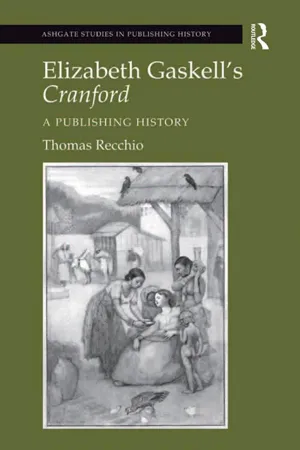
Tracing the publishing history of Elizabeth Gaskell's Cranford from its initial 1851-53 serialization in Dickens's Household Words through its numerous editions and adaptations, Thomas Recchio focuses especially on how the text has been deployed to support ideas related to nation and national identity. Recchio maps Cranford's nineteenth-century reception in Britain and the United States through illustrated editions in England dating from 1864 and their subsequent re-publication in the United States, US school editions in the first two decades of the twentieth century, dramatic adaptations from 1899 to 2007, and Anglo-American literary criticism in the latter half of the twentieth century. Making extensive use of primary materials, Recchio considers Cranford within the context of the Victorian periodical press, contemporary reviews, theories of text and word relationships in illustrated books, community theater, and digital media. In addition to being a detailed publishing history that emphasizes the material forms of the book and its adaptations, Recchio's book is a narrative of Cranford's evolution from an auto-ethnography of a receding mid-Victorian English way of life to a novel that was deployed as a maternal model to define an American sensibility for early twentieth-century Mediterranean and Eastern European immigrants. While focusing on one novel, Recchio offers a convincing micro-history of the way English literature was positioned in England and the United States to support an Anglo-centric cultural project, to resist the emergence of multicultural societies, and to ensure an unchanging notion of a stable English culture on both sides of the Atlantic.
Information
Chapter 1
Cranford in Household Words, An Accidental Novel
Any consideration of the publication history of Cranford must begin with its modest starting point as a single sketch in Dickens’s Household Words. Although “The Last Generation in England” (1849) and “Mr. Harrison’s Confessions” (1851), as J.G. Sharps observed about the former title, “will at once be recognized by devotees of Cranford as [...] preliminary to that more famous work” (85), Cranford first appeared under the title “Our Society at Cranford” as the lead entry in the 13 December 1851 number of Household Words (265–74). Gaskell had been a significant contributor to Dickens’s journal since its initial number on 30 March 1850 when Dickens chose to use “Lizzie Leigh” as the inaugural piece immediately after his “A Preliminary Word,” in which he defined his ambitions for his new periodical. Given the significance of Dickens’s ambitions for Household Words, which, in the words of Dickens’s finest twentieth-century biographer Edgar Johnson, were to “fight for tolerance and the progress of human welfare, and give no quarter to chicanery and oppression” (vol 2, 703), or, in Dickens’s own words, “raising up of those that are down, and the general improvement of our social condition” (quoted in Ackroyd 580), it was not a light matter for him to solicit Gaskell’s work in support of his task, and to give her, as it were, the first substantial (as opposed to preliminary) word. Indeed, since the contributors to Household Words were all anonymous, a point of some contention best illustrated by Douglas Jerrold’s observation that since the words “Conducted by Charles Dickens” appeared on the top of every page, the journal would best be thought of as “mononymous throughout” (cited in Johnson 704),1 it can be argued that Dickens found “Lizzie Leigh” the most apt statement at the moment of publication to capture the essence of his ambitions. Even though the fact of “Lizzie Leigh” being the first piece published in Household Words has been noted often, very little attention has been paid to the details of the story, other than the obvious point that is a fallen woman story. And no effort, to my knowledge, has been made to compare the language of “A Preliminary Word” with the language of another preliminary word, the “Preface” to Gaskell’s Mary Barton. I raise that point for these simple reasons: Mary Barton brought Gaskell’s work to Dickens’s attention; Dickens was very solicitous to recruit her soon thereafter; and Gaskell’s avowed purpose for writing Mary Barton, coupled with the documented genesis of that novel through Gaskell’s personal knowledge of the household conditions of the industrial poor in her role as the wife of a Unitarian minister in Manchester and her direct experience of having lost two of her children as infants (one still-born, the other of fever at ten months), her writing would have appealed to Dickens as quite literally emerging from direct experience of those things to which Dickens could only project imaginative sympathy. One other factor may have been at play: Dickens’s work to salvage the lives of fallen women through his work with Miss Angela Burdett-Coutts on emigration schemes; he helped Gaskell relocate the woman, today known only as Pasley, who served as the inspiration for Ruth (see Uglow 245–7 for the details).
The complex inter-animation I am suggesting here is implied with fine precision in this comment from Peter Ackroyd’s Dickens biography: “If Household Words becomes the secular companion of Dickens’s imaginative work, a novel such as Bleak House can in turn be seen as a fantastic and mysterious counterpart to Dickens’s journalism” (587). Central to Bleak House, of course, is the story of the fallen Lady Dedlock and her illegitimate daughter Esther Summerson, the paragon of domestic virtue. One way to look at Dickens’s grand ambitions for social reform, then, is to see the transformation of a society where the offspring of fallen women must die (cf. “Lizzie Leigh”) through a society where the child can prosper but the mother must die (cf. Ruth and Bleak House) to a society where each person is redeemable and no one is made a victim of self-serving pharisaical morality or of a life denying utilitarian “felicific calculus.” The ideal so sketchily rendered in my prose can be felt in the texture of the prose in all the texts named above, where the emphasis throughout is on bodily experience in the world, in order, in a formulation borrowed from Edmund Wilson’s “The Two Scrooges,” to demonstrate not only to the ruling classes but to all readers the human “actuality” of those who would be judged and found wanting by dogmatic, evangelical moralists or smug, numerical social reformers. “It is one of the great purposes for Dickens,” Wilson writes, “to show you these human actualities who figure for Parliament as statistical counters and for Political Economists as statistics; who can as a rule appear only even in histories in a generalized or idealized form” (23).
So as “a preliminary word” to the publication of Cranford, I would like to provide the broader context for the affinity between Dickens and Gaskell by looking at the overlapping details of language in the preliminary words to Mary Barton and Household Words. Dickens expressed his unambiguous enthusiasm for Gaskell’s writing and moral vision in his invitation letter dated January 31, 1850 to her to contribute to his new publication. Here, in part, is what he wrote:
[...] I do honestly know that there is no living English writer whose aid I would desire to enlist in preference to the authoress of Mary Barton (a book that most profoundly affected & impressed me). I venture to ask you whether you can give me any hope that you will write a short tale, or any number of tales, for the projected pages. [...] I should set a value on your help which your modesty can hardly imagine; and I am perfectly sure that the least result of your reflection or observation in respect of the life around you, would attract attention and do good. [...] If you could and would prefer to speak to me on the subject, I should be very glad to come to Manchester for a few hours and explain everything you might wish to know [...]. (Cited in Hopkins, Elizabeth Gaskell 137)
The language in Dickens’s letter makes as comprehensive an appeal as possible in relation to its purpose. Here the most famous author of his era petitions a new author in terms that are complimentary, deferential, and even beseeching. He singles Gaskell out as the one “living English” author who could best represent through her most ordinary work—her “reflection and observation in respect to the life around” her—Dickens’s goal to work toward the “general improvement of our social condition.” The formulation “whether you can give me any hope” conveys a sense of him as a suitor, implying that his happiness, the value of his life’s ambition, is implicated in some way by her answer. He even offers to travel from London to Manchester “for a few hours,” indicating with fine delicacy his intention in no way to intrude upon her but to assure her of his desire to be perfectly forthcoming about the substance of his proposal. The hint of big money—“I should set a value on your help which your modesty can hardly imagine”—adds to the range of his appeal (since, after all, he does not yet know her). Gaskell responded to his appeal with “Lizzie Leigh” and with subsequent cynicism to what she saw as his excessive praise.
But before Dickens’s request and his receipt of “Lizzie Leigh” is Mary Barton, the book that Dickens acknowledges so profoundly affected him. In the “Preface” to Mary Barton, Gaskell writes about how she had been thinking about writing a “story in some rural scene” when it struck her “how deep might be the romance in the lives of some of those who elbowed me daily in the busy streets of the town in which I resided.” In Chapter 6 of that novel, Gaskell develops the romance metaphor as the narrator reflects on John Barton’s difficulty in seeing beyond simple contrasts of suffering and comfort. “But he could not, you cannot, read the lot of those who daily pass you by in the street,” Gaskell writes.
How do you know the wild romances of their lives; the trials, the temptations they are even now enduring, resisting, sinking under? You may be elbowed one instant by the girl desperate in her abandonment, laughing in mad merriment with her outward gesture, while her soul is longing for the rest of the dead, and bringing itself to think of the cold-flowing river as the only mercy of God remaining to her here. You may pass the criminal, meditating crimes at which you will to-morrow shudder with horror as you read them. You may push against one, humble and unnoticed, the last upon earth, who in heaven will for ever be in the immediate light of God’s countenance. (58)
Such an appeal renders romance as suffering, something buried behind the public face that each individual has to muster in response to the necessities of public decorum. But what happens when public decorum becomes an impossibility? When suffering shatters one’s own features and demands, simply, to be expressed? What can one living a life of privilege do when confronted directly by the reality of such suffering? In the “Preface,” Gaskell continues: “I had always felt a deep sympathy with the careworn men, who looked as if doomed to struggle through their lives in strange alternations between work and want; tossed to and fro by circumstances, apparently in even greater degree than other men. A little manifestation of this sympathy, and a little attention to the expression of feeling on the part of some of the work-people with whom I was acquainted, had laid open to me the hearts of one or two of the more thoughtful among them; I saw that they were sore and irritable against the rich, the tenor of whose seemingly happy lives appeared to increase the anguish of the lottery-like nature of their own” (5). To make that sympathy real, something more than a self-indulgent emotion that might help rationalize one’s own privilege, Gaskell became “anxious [...] to give some utterance to the agony which, from time to time, convulses this dumb people; the agony of suffering without the sympathy of the happy, or of erroneously believing that such is the case” (5). Gaskell’s desire to “give some utterance” to the suffering of those whose lives she then delineates in the novel, and in the process presenting the working-class as diverse, imaginative, intelligent, and prone to error—in short, human—should not, as the critical tradition has done, be under-estimated, especially the domestic emphasis. As a woman, she could not stand for Parliament or even legally control her own finances, but as the wife of a Unitarian minister, she had the opportunity to enter the homes of the working class, to speak to individual workers face to face, to share common concerns of parental anxiety and infant mortality (having lost two, or perhaps three, children of her own). She then could try to speak to the governing and the middle classes through her writing, presenting something that the working class itself could not: “At present,” she writes, “they [the working class] seem to me to be left in a state, wherein lamentation and tears are thrown aside as useless, but in which lips are compressed for curses, and hands clenched ready to smite” (4). If the working class could not speak to the manufacturing/middle class for itself, Gaskell could try through writing in a way that both provides knowledge and gives pleasure (hence the mixed genres of her novel), and, like Dickens, work for “the general improvement of our social condition.” The very fact of Gaskell’s having written Mary Barton attests to her optimism, her faith that such a work can do good because readers will surrender themselves to the story, reflect on the texture of the lives of those depicted, and then perhaps (and the future is always a “perhaps”) act in accordance with the new knowledge they will have acquired from the subjective experience of reading. It seems to me that Gaskell’s implicit hope in writing Mary Barton is made explicit and extended in Dickens’s “A Preliminary Word.”
After expressing the fact that the name “chosen for this publication [Household Words] expresses, generally, the desire we have at heart in originating it,” Dickens asserts that he “aspires to live in the Household affections, and to be numbered among the Household thoughts of our readers” (1). Such an assertion assumes a radical faith in the functioning of what we might call today the inter-subjective activity of reading, the kind of blending of consciousness of text and reader that in the 1960s Georges Poulet articulated in his “Criticism and the Experience of Interiority,” where he points out that in reading we experience the thoughts of another or others as if they were our own (43–7 especially). Evoking terms such as “comrade” and “friend,” Dickens claims that his goal is to bring into the homes of his readers “the knowledge of many social wonders, good and evil, that are not calculated to render any of us less ardently persevering in ourselves, less tolerant of one another, less faithful in the progress of mankind, less thankful for the privilege of living in the summer-dawn of time” (1). Even though Dickens could be charged here with an insupportable naivete about social progress, defining the mid-nineteenth century as “the summer-dawn of time,” he offers a complex sense of the challenges his culture faced as it worked through material transformations for which there was little precedent (mainly industrialization, urbanization, and an emergent mass culture). First is the challenge to personal identity in the shifting social relations borne of an increasing economic and social competition which might render individuals less “ardently persevering” in themselves; second is the challenge to tolerance for those who seem newly to be a threat to traditional ways of life (and privilege); and third is the sense of social and cultural de-stabilization that feels more like conflict than progress. Combined, these challenges make a notion like the present (1850) being the “summer-dawn of time” seem an absurdity.
However, Dickens mitigates his faith in progress as such by expressing a higher faith in what he calls “the light of Fancy which is inherent in the human breast; which, according to its nurture, burns with an inspiring flame, or sinks into a sullen glare, but which (woe betide that day!) can never be extinguished” (1). Resisting the notion that human life is determined fundamentally by material conditions (what Dickens refers to in the same paragraph from which I have been quoting as the “mere utilitarian spirit”), but without rejecting the importance of addressing as vigorously as possible the material conditions that make Fancy more sullen than inspirational (Household Words did, after all, pursue questions of labor, of sewage, of water quality, education, and so on), Dickens, as Gaskell had done in her “Preface,” argues for the necessary community value of romance. Household Words sets out “To show all, that in all familiar things, even those which are repellant on the surface, there is Romance enough, if we will find it out” (1). As in Gaskell’s “Preface,” romance here has more to do with the complexity of subjective experience in all conditions of life; thus, Dickens puts forth a double challenge here, akin, again, to Gaskell’s task to demonstrate how both “masters” and “men” are “bound to each other by common interests” (3). Like Gaskell, who emphasizes the complex engagement of working men with the larger world such as in the naturalist, factory worker Job Legh, Dickens wants “to teach the hardest workers at this whirling wheel of toil, that their lot is not necessarily a moody, brutal fact, excluded from the sympathies and graces of imagination; to bring the greater and the lesser in degree, together, upon that wide field, and mutually dispose them to a better acquaintance and a kinder understanding” (1).
In Mary Barton Gaskell presents the possibilities of “a kinder understanding” through a series of deaths—John Barton’s son Tom, Mr. Carson’s son Harry, and then John Barton himself—, which is, I would argue, an understandable novelistic response to her deep sense of recent crisis that was on the verge of re-emergence. The deaths and the death-bed reconciliation scene between Barton and Carson provide a natural terminus for conflict without addressing the cause of the conflict. But her goal is to encourage readers of all classes to see that an effort at such understanding need not wait for death-bed scenes; there are threads of nature that bind human beings in community as shown in the characters Alice Wilson, with her knowledge and use of herbal remedies, and Job Legh, through his effort to understand nature scientifically, and as shown through the framing of the novel itself in natural settings upon which whole families are seen together. That sense of nature, a nature that permeates the consciousness of human beings, is picked up and extended in the last paragraph of “A Preliminary Word” through an extended echo of Shakespeare. The paragraph begins, “Thus, we begin our career.” Then alluding to “the old fairy story” wherein the “adventurer” is surrounded by voices telling him to turn back as he nears the object of his quest, Dickens proclaims in contrast,
[...] All the voices we hear, cry Go on! The stones that call to us have sermons in them, as the trees have tongues, as there are books in the running brooks, as there is good in everything! They, and the Time, cry out to us Go on! With a fresh heart, a light step, and a hopeful courage we begin our journey. The road is not so rough that it need daunt our feet: the way is not so steep that we need stop for breath, and, looking faintly down, be stricken motionless. Go on, is all we hear, Go on! In a glow already, with the air from yonder height upon us, and the inspiriting voices joining in this acclamation, we echo back the cry, and go on cheerily. (2)
The Shakespeare reference to sermons in stones and so on comes from As You Like It, Act II, scene i when Duke Senior, having left the “envious court” (l. 6) addresses “Amiens, and the other Lords” (l. 2), who, with the Duke, are dressed “like Foresters” (l. 2). As Gaskell does in Mary Barton and as Dickens does in all his novels, Shakespeare’s Duke argues that the ground for human community must begin with a mutual recognition of the inescapable realities of bodily experience as when “the winter’s wind,/Which, when it bites and blows upon my body,/Even till I shrink with cold, I smile and say/‘This is no flattery: these are counsellors/That feelingly persuade me what I am’” (ll. 9–13). “Our life,” the Duke concludes, “exempt from public haunt,/Finds tongues in trees, books in running brooks,/Sermons in stones, and good in everything” (ll. 18–20). Dickens’s confidence echoes the Duke’s (and, of course, to make this point, we have to put aside any number of Shakespearean ironies, but that is exactly what Dickens does); with trust in nature whose energies vibrate on the tuned strings of the human body, which in turn resonate in human consciousness, the Duke goes on in high spirits to confront the melancholy Jacques, just as Household Words goes on energetically from the unambiguous enthusiasm of “A Preliminary Word,” whose last word is “cheerily,” to the first sentence of “Lizzie Leigh”: “When Death is present in a household on Christmas Day, the very contrast between the time as it now is, and the day as it has been, gives a poignancy to sorrow,—a more utter blankness to the desolation” (2). Might the contrast between Dickens’s high spirits and Gaskell’s “melancholy” tale take the wind out of Dickens’s sails just as he launches his new venture? I think not, for in its own way, “Lizzie Leigh” can be read as confirmation of another line from Shakespeare that readers might recognize as missing from Dickens’s allusion, but, again, we hav...
Table of contents
- Cover
- Half Title
- Title Page
- Copyright Page
- Dedication
- Table of Contents
- List of Figures
- Acknowledgments
- Introduction: Materiality as Interpretation in Cranford
- 1 Cranford in Household Words, An Accidental Novel
- 2 Illustrating Cranford, Illustrating the Nation
- 3 “Charming and Sane”: School Editions of Cranford, 1905–1966
- 4 Dramatizing Cranford, 1899–2007
- Epilogue: Cranford in the Digital Age
- Appendix A: Household Words Installments
- Appendix B: Illustrated Editions
- Appendix C: School Editions and Related Material
- Appendix D: Dramatic Adaptations
- Bibliography
- Index
Trusted by 375,005 students
Access to over 1.5 million titles for a fair monthly price.
Study more efficiently using our study tools.
Frequently asked questions
Yes, you can cancel anytime from the Subscription tab in your account settings on the Perlego website. Your subscription will stay active until the end of your current billing period. Learn how to cancel your subscription
No, books cannot be downloaded as external files, such as PDFs, for use outside of Perlego. However, you can download books within the Perlego app for offline reading on mobile or tablet. Learn how to download books offline
Perlego offers two plans: Essential and Complete
- Essential is ideal for learners and professionals who enjoy exploring a wide range of subjects. Access the Essential Library with 800,000+ trusted titles and best-sellers across business, personal growth, and the humanities. Includes unlimited reading time and Standard Read Aloud voice.
- Complete: Perfect for advanced learners and researchers needing full, unrestricted access. Unlock 1.5M+ books across hundreds of subjects, including academic and specialized titles. The Complete Plan also includes advanced features like Premium Read Aloud and Research Assistant.
We are an online textbook subscription service, where you can get access to an entire online library for less than the price of a single book per month. With over 1.5 million books across 990+ topics, we’ve got you covered! Learn about our mission
Look out for the read-aloud symbol on your next book to see if you can listen to it. The read-aloud tool reads text aloud for you, highlighting the text as it is being read. You can pause it, speed it up and slow it down. Learn more about Read Aloud
Yes! You can use the Perlego app on both iOS and Android devices to read anytime, anywhere — even offline. Perfect for commutes or when you’re on the go.
Please note we cannot support devices running on iOS 13 and Android 7 or earlier. Learn more about using the app
Please note we cannot support devices running on iOS 13 and Android 7 or earlier. Learn more about using the app
Yes, you can access Elizabeth Gaskell's Cranford by Thomas Recchio in PDF and/or ePUB format, as well as other popular books in Literature & Literary Criticism. We have over 1.5 million books available in our catalogue for you to explore.