- 280 pages
- English
- ePUB (mobile friendly)
- Available on iOS & Android
eBook - ePub
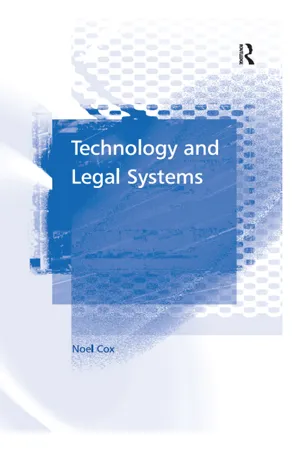
Technology and Legal Systems
About this book
The advent of the knowledge economy and society has made it increasingly necessary for law reformers and policy makers to take account of the effects of technology upon the law and upon legal and political processes. This book explores aspects of technology's relationship with law and government, and in particular the effects changing technology has had on constitutional structures and upon business. Part I examines the legal normative influence of constitutional structures and political theories. It focuses on the interrelationship between laws and legal procedure with technology and the effect technology can have on the legal environment. Part II discusses the relationship between government and technology both at the national and international level. The author argues that technology must be contextualized within a constitution and draws on historical and contemporary examples to illustrate how technology has both shaped civilizations and been the product of its political and constitutional environment.
PART I
THE NATURE OF LAW AND TECHNOLOGY
Technology, and technological changes, affects the legal system. These effects are partly direct, and partly indirect. The former include those comparatively rare instances where the process or form of government is directly affected by technological change, or by the advent of new technology. A simple example would be the creation and introduction of electronic voting for use in political elections, which might have significant implications for the electoral process, and on political campaigning. Indirect effects are those which occur via changes to the economy and in society, and may well be very much more wide-ranging, if more difficult to identify and measure, than the direct effects. Technological changes are altering the relationship of governed and government, and between government and government, and between government and the world legal order. But these changes are neither new in nature, nor are the changes always clearly discernible.
Legal systems also affect the development of technology, and changes in legal systems (whether wrought by technological changes or otherwise) can have significant effects upon business. This part of the book discusses the nature of law and technology, and the general relationship between government and business, as a specific sector of society which can be particularly sensitive to technological change, and also itself a source of many of the technological changes.
Chapter 1
The Nature of Law and Government
1.1 Introduction
What is the relationship between law and government? How does law evolve, and how does government evolve? What are some of the influences upon this relationship? These are extremely broad questions which have taxed theorists in a number of academic disciplines, and across jurisdictions – as well as politicians and others more directly concerned with the application of theory to practice – for many centuries. This Chapter will not presume to attempt to directly answer these questions, but will consider some aspects of the relationship, particularly as it affects law, business and technology.
Let us start with a brief definition of law – one which is neither comprehensive nor necessarily valid for all purposes, but which will suffice for this limited purpose. Law may be defined as the procedural and substantive environment through which rights, wrongs and responsibilities are assigned, judged and enforced by some external agency.1 Thus it may be seen as being at once an externally-imposed environmental element, within which individuals and communities must operate, and at the same time the internal product of that community – though the degree to which the individual and even communities influence the substance of the law may be strictly limited by various factors.2 Generally these laws are created, and interpreted, and judgements are enforced, by some element of the government of a state. There are of course other forms of law, but for the purposes of this book we will confine ourselves to this more formal and narrow concept of law.
Having provided a definition of law with which to work, we will now consider how this relates to government. This analysis will be based upon a case study of an actual government, so as to illustrate some aspects of the dynamics of the relationship.
1.2 Government – a Case Study
Government is, in its loosest definition, merely that process or apparatus which governs a given political entity. This of course immediately involves consideration of such controversial and contentious concepts as territoriality and sovereignty. These concepts are especially important because they concern the relationship of state to state, and are not purely domestic or national in nature. They are thus particularly important when considering the development of technological changes which have a global reach – as, increasingly, many do.
The Montevideo Convention of 1933 is generally regarded as articulating the modern requirements for statehood. According to the requirements of this Convention (strictly binding only on the party states, but generally accepted since then as representative of customary international law), a state must have a permanent population; it must have a defined territory; it must have a government; and it must have the capacity to enter into diplomatic relations.3 No other entity could be regarded as a state, whatever its de facto power. Leaderless populations or ethnic groups within states generally lacked sovereign status and, accordingly, the recognition and protection of public international law. However, having identified a given political entity as a state (and that may be a far from easy task, despite the apparent simplicity of the Montevideo requirements), much yet remains unsettled – primarily because there are few, if any, internationally valid norms of domestic law with respect to statehood. In other words, though a sovereign state may appear much the same externally, from within there are marked structural differences between one state and another.
The precise nature of the authority of a state within its own territory is not within the scope of international law, and is heavily influenced by the particular constitutional, political, historical, social and economic heritage of individual states. It is therefore difficult to generalize about the nature and form of government. However, there are certain common elements, at least among the modern legalistic entities which we call states. In earlier times, that is, before the advent of modern juridical states, there was a greater element of flexibility and consequently a lesser degree of similarity, in statehood.
We will consider one case study of a constitution (or constitutional structure), in order to show some aspects of the relationship between law and government. This example is New Zealand, which – almost uniquely – enjoys the advantages and disadvantages of an unwritten and unentrenched constitution. Its constitutional arrangements, and hence the relationship between law and government, are not controlled by what may be categorized as artificial constraints. They are rather the product of evolutionary political, social and economic forces which have been at work since 1840.4 No other country offers the opportunity to study an organic constitution of this sort.
New Zealand has a constitution which contains what might appear at first glance to be a dichotomy. It is a democratic monarchy, with executive power (and elements of legislative and judicial authority) vested in the Sovereign – or Crown, as the entity which the Sovereign represents is styled. Yet it has a government responsible to Parliament and thence to the electorate. This arrangement, typical of the nineteenth century British genius for improvisation and compromise (or what has also been described as muddle and hypocrisy), seems to work despite – or perhaps because of – its apparent weakness in principle.
New Zealand statutes have tended to use the terms ‘Her Majesty the Queen’ and ‘the Crown’ interchangeably and apparently arbitrarily.5 There appears to have been no intention to draw any theoretical or conceptual distinctions. This may simply be a reflection of a certain looseness of drafting, but it may have its foundation in a certain lack of certainty felt by legal draftsmen as much as by the general public.6 ‘The Crown’ itself is a comparatively modern concept in Commonwealth jurisprudence. As Maitland said, the king was merely a man, though one who does many things.7 For historical reasons the king or queen came to be recognized in law as not merely the chief source of the executive power, but also as the sole legal representative of the state or organized community.
According to Maitland, the crumbling of the feudal state threatened to break down the identification of the king and state, and as a consequence Coke recast the king as the legal representative of the state. It was Coke who first attributed legal personality to the Crown.8 He recast the king as a corporation sole, permanent and metaphysical.9
The king’s corporate identity10 drew support from the doctrine of succession that held that the king never dies11 – so that there might be no interregnum or lacuna of authority. It was also supported by the common law doctrine of seisin of land, where the heir was possessed at all times of a right to an estate even before succession.12 Blackstone explained that the king:
is made a corporation to prevent in general the possibility of an interregnum or vacancy of the throne, and to preserve the possessions of the Crown entire.13
Thus the role of the Crown was eminently practical. In the tradition of the common law constitutional theory was subsequently developed which rationalized and explained the existing practice – as, for example, in the development of the law of succession to the Crown.14
Generally, and in order to better conduct the business of government, the Crown was accorded certain privileges and immunities not available to any other legal entity.15 Blackstone observed that ‘[t]he King is not only incapable of doing wrong, but even of thinking wrong; he can never mean to do an improper thing, in him is no folly or weakness’.16 Mathieson has proffered the notion that the Crown may do whatever statute or the royal prerogative expressly or by implication authorizes, but that it lacks any natural capacities such as an individual or juridical entity may possess.17
In the course of the twentieth century the concept of the Crown has succeeded the king as the essential core of the corporation, which is now regarded as a corporation aggregate rather than a corporation sole.18 In a series of cases in both the United Kingdom and New Zealand, we can see the courts struggling to categorize the nature of the Crown.19
In Re Mason20 Romer J stated that it was established law that the Crown was a corporation, but did not indicate whether it was a corporation sole (as generally accepted) or a corporation aggregate (as Maitland argued). Maitland believed that the Crown, as distinct from the king, was anciently not known to the law but in modern usage had be...
Table of contents
- Cover
- Half Title
- Title Page
- Copyright Page
- Dedication
- Table of Contents
- Preface
- Introduction
- PART I THE NATURE OF LAW AND TECHNOLOGY
- PART II THE RELATIONSHIP OF GOVERNMENT AND TECHNOLOGY
- Bibliography
- Index
Trusted by 375,005 students
Access to over 1.5 million titles for a fair monthly price.
Study more efficiently using our study tools.
Frequently asked questions
Yes, you can cancel anytime from the Subscription tab in your account settings on the Perlego website. Your subscription will stay active until the end of your current billing period. Learn how to cancel your subscription
No, books cannot be downloaded as external files, such as PDFs, for use outside of Perlego. However, you can download books within the Perlego app for offline reading on mobile or tablet. Learn how to download books offline
Perlego offers two plans: Essential and Complete
- Essential is ideal for learners and professionals who enjoy exploring a wide range of subjects. Access the Essential Library with 800,000+ trusted titles and best-sellers across business, personal growth, and the humanities. Includes unlimited reading time and Standard Read Aloud voice.
- Complete: Perfect for advanced learners and researchers needing full, unrestricted access. Unlock 1.5M+ books across hundreds of subjects, including academic and specialized titles. The Complete Plan also includes advanced features like Premium Read Aloud and Research Assistant.
We are an online textbook subscription service, where you can get access to an entire online library for less than the price of a single book per month. With over 1.5 million books across 990+ topics, we’ve got you covered! Learn about our mission
Look out for the read-aloud symbol on your next book to see if you can listen to it. The read-aloud tool reads text aloud for you, highlighting the text as it is being read. You can pause it, speed it up and slow it down. Learn more about Read Aloud
Yes! You can use the Perlego app on both iOS and Android devices to read anytime, anywhere — even offline. Perfect for commutes or when you’re on the go.
Please note we cannot support devices running on iOS 13 and Android 7 or earlier. Learn more about using the app
Please note we cannot support devices running on iOS 13 and Android 7 or earlier. Learn more about using the app
Yes, you can access Technology and Legal Systems by Noel Cox in PDF and/or ePUB format, as well as other popular books in Law & Law Theory & Practice. We have over 1.5 million books available in our catalogue for you to explore.