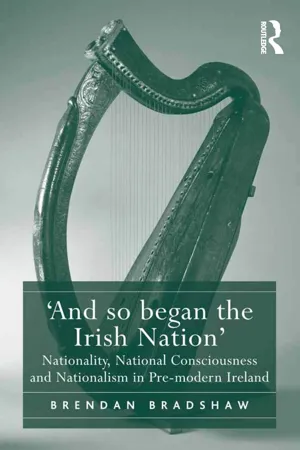
eBook - ePub
'And so began the Irish Nation'
Nationality, National Consciousness and Nationalism in Pre-modern Ireland
- 336 pages
- English
- ePUB (mobile friendly)
- Available on iOS & Android
eBook - ePub
'And so began the Irish Nation'
Nationality, National Consciousness and Nationalism in Pre-modern Ireland
About this book
Nationalism is a particularly slippery subject to define and understand, particularly when applied to early modern Europe. In this collection of essays, Brendan Bradshaw provides an insight into how concepts of 'nationalism' and 'national identity' can be understood and applied to pre-modern Ireland. Drawing upon a selection of his most provocative and pioneering essays, together with three entirely new pieces, the limits and contexts of Irish nationalism are explored and its impact on both early modern society and later generations, examined. The collection reflects especially upon the emergence of national consciousness in Ireland during a calamitous period when the late-medieval, undeveloped sense of a collective identity became suffused with patriotic sentiment and acquired a political edge bound up with notions of national sovereignty and representative self-government. The volume opens with a discussion of the historical methods employed, and an extended introductory essay tracing the history of national consciousness in Ireland from its first beginnings as recorded in the poetry of the early Christian Church to its early-modern flowering, which provides the context for the case studies addressed in the subsequent chapters. These range across a wealth of subjects, including comparisons of Tudor Wales and Ireland, Irish reactions to the 'Westward Enterprise', the Ulster Rising of 1641, the Elizabethans and the Irish, and the two sieges of Limerick. The volume concludes with a transcription and discussion of 'A Treatise for the Reformation of Ireland, 1554-5'. The result of a lifetime's study, this volume offers a rich and rewarding journey through a turbulent yet fascinating period of Irish history, not only illuminating political and religious developments within Ireland, but also how these affected events across the British Isles and beyond.
Information
Historical Method
Chapter 1
A Word on Words:
Definitions and Clarifications
Public History and Academic History
By ‘public history’ I understand, following Herbert Butterfield in The Englishman and his History (1943), the version of history that gains currency in the public domain and represents the popular understanding of what happened in the past, specifically what happened in the nation’s past. Like him also, I distinguish between public history and academic history. I take the latter to be the story of the past that circulates in academic circles based on research on contemporary records conducted in accordance with the historical discipline’s methodology by scholar’s trained in that discipline, usually by means of a university Ph.D. programme. In contrast to the scholarly monograph or academic lecture which are typically the means through which the findings of academic research are reported, public history is put into circulation by means of the popular media in the form of public addresses, newspaper and magazine articles, broadcasts by public figures, especially by politicians and intellectuals who appeal to history to validate views about the present. Public history is also shaped by the work of ‘popularisers’: amateurs – journalists, creative writers (novelists, dramatists, poets), artists whose main concern is to sell their wares or more nobly to use history to explore imaginatively the human condition.
Public History and the Intellectual
By intellectuals I understand figures whose views are accorded special weight in the public estimation by reason of their reputation for wisdom and learning. Typically they are academics who assume a public role as commentators upon current social, political and moral issues. Typically also they have been philosophers not historians – as in France, the home of the intellectual, from Voltaire and Rousseau to Sartre, Merleau-Ponty et al. Since World War II, a fair crop of anthropologists, sociologists and some historians (for example Foucault) have been accorded the status. In Ireland the version of the national past so fiercely criticised by the ‘revisionists’ in the 1970s and 1980s was fashioned by a nationalistically minded school of intellectuals stretching from Davis and his Young Ireland circle to Pearse and the Gaelic revivalists and from them to their legatees, for example Dónal Ó Corcaire, Séan Ó Faoláin et al. Politicians – the I.R.B., pre-Treaty Sinn Fein and its successors, Fianna Fáil and Fine Gael – were highly active in inculcating the message at a popular level.
Public History and the Academic Historian
The advancement of knowledge and understanding to which the academic historian like all academics is dedicated necessarily involves refinement and revision of the ‘received wisdom’, and in fulfilling that function, the ‘critique’ of public history. In undertaking the latter task it is not sufficient, as the revisionist historians of the 1970s and 1980s were content to do, to debunk the mythological content, as the revisionists believed it to be, of public history. It is also necessary to investigate the function which that version of the nation’s past served in the historical context in which it emerged. No doubt some elements of the public history put into circulation by Irish nationalists were malign, most especially the tendency to privilege the militant struggle to the obscuring of a long and distinguished constitutional tradition or again in some accounts to conflate Irish, Catholic, Nationalist. However the nationalist tradition also fulfilled a beneficent function in rooting successive generations of Irish people in the totality of the island’s past stretching back to its pre-historic inhabitants, and in enabling them to take ownership of the totality of the island’s cultural heritage. It is in that light that what Butterfield called the ‘purposeful unhistoricity’ of nationalist public history must be assessed.
Objectivity
I take the capacity to examine and report on the historical evidence objectively to be a necessary condition of doing academic history. However, I distinguish between objectivity and neutrality or ‘value-free’ history. As recent commentators have maintained, the latter is a psychological/emotional impossibility. We carry our values with us to the evidence. To assume that we do not is to blind ourselves to our deepest beliefs and prejudices, and by doing so to forfeit the possibility of preventing them from clouding our judgement. Further, that kind of pseudo-dispassionate approach to the historical record stifles the empathy/sympathy which enables the historian to enter imaginatively into the minds of the historical actors with whom he/she is involved and into their human predicament. Therefore the attitude of mind in which the historian may best approach the historical record is one that combines self-awareness with an intellectual openness and a capacity to examine the records honestly/objectively as well as sympathetically/empathetically. That is the attitude I discern in those historians who have best enabled me to understand the inner reality of past times, for example David Knowles, Peter Brown, E.P. Thompson, Glanmor Williams, Kathleen Hughes on early Christian Ireland, Joe Lee on modern Ireland. Was it lack of honest self-scrutiny that caused recent historians of revolutionary Ireland so to frame their accounts as to foster an exclusively southern Irish/stateist identity? (John M. Regan, ‘Southern Irish nationalism as a historiographical problem’, Historical Journal, 50 (1) 197–223: ‘The development of a southern nationalist identity through the agency of a stateist historiography was the product of a conscious or perhaps a subconscious enterprise between intellectuals and the state’).
Present-centred History
Ever since Herbert Butterfield’s Whig Interpretation of History (1931) present-centred history has had a bad press. The cry has been for past-centred history, history ‘for its own sake’ as a corollary to ‘value-free’ history. I take the one to be as little desirable as the other. The first obligation of the historian, it seems to me, is to the society in which he/she lives. It is to help explain ‘how we have got to where we are’, to understand the historically conditioned values, prejudices, aspirations that weigh upon us and by doing so to enable us to come to terms with them. Therefore the socially minded historian writes ‘with one eye on the present’, ‘present-centred’ history. There are dangers in doing so as Butterfield has warned: ‘anachronism’ – the projection of the present into the past; ‘abridgement’ – the construction of a false historical teleology. Proper training in the historical discipline should alert the historian to such traps and enable him/her to avoid them.
Chapter 2
Nationalism and Historical Scholarship in Modern Ireland†
The object of the present chapter is to suggest that the mainstream tradition of Irish historical scholarship, as it has developed since the 1930s, has been vitiated by a faulty methodological procedure. The study falls into two parts. The first considers a similar exercise conducted in this journal by Dr Steven Ellis in 1986.1 The intention here is to suggest that Ellis’ analysis of the problem is misconceived. The second part seeks to explore the problem ‘as it really is’ and ultimately to prescribe a remedy. Continuity between the two parts is provided by the fact that the issue comes down to a consideration of the place of nationalism as a formative influence on modern Irish historical scholarship. In short, Ellis sees nationalism as a proactive force in this connexion and identifies ‘Whig-Nationalist’ preconceptions as the basic source of confusion. The first part of this study, therefore, is concerned to refute that analysis and to show that the evidence adduced by Ellis does not sustain it. The second part argues that the modern tradition actually developed in self-conscious reaction against an earlier Nationalist tradition of historical interpretation and aspired to produce ‘value-free’ history in accordance with the criteria of scientific research elaborated in Herbert Butterfield’s The Whig Interpretation of History. It will be argued that that is precisely the problem.
I
Ellis rests his case on a study of the recent literature on the history of late medieval Ireland. He identifies three main features of the analysis found there as evidence of Whig-Nationalist misconceptions. One is the fundamental error, as he believes, of adopting Ireland as the substantive entity for investigation. To do so, he argues, is to assume an anachronistic perspective. Ireland had no meaningful historical existence in the late medieval period. It was merely a geographical expression, part of a borderland which demarcated two politico-cultural zones: one English, under the jurisdiction of the English monarch; the other formed by the Celtic peoples on the Atlantic fringe. These two zones, Ellis urges, provide the historically meaningful territorial entities of the period. They, therefore, constitute the proper objects of historical investigation rather than the national territorial units which emerged in the early modern period.2 Ellis’ two other examples of Whig-Nationalist bias relate to the conceptual categories in which historians of late medieval Ireland conduct their analyses. One is the notion of Gaelicisation. The term was coined to denote a process which historians envisage as central to the English Crown’s Irish problem at this period, namely the erosion of the English colony through the advance of the Gaelic septs, on the one hand, and, on the other hand, through the capitulation of the colonists to native ways. Here, Ellis suggests, nationalistically inclined historians have fallen into the classic trap against which Butterfield warned, of finding in the evidence what they are predisposed to see, the congenial prospect of a Gaelic resurgence.3 In reality, according to Ellis, the evidence merely signifies a process of adaptation whereby the colonists adjusted to the exigencies of border conditions while retaining their sense of Englishness and loyalty to the Crown. He notes the occurrence of the same phenomenon in other border territories which, significantly, he suggests, has not attracted nationalistically loaded terms such as Cambrianisation or Scoticisation. Ellis’ third example related to the area of ideology. Here he finds evidence of Whig-Nationalist bias in the use of the term ‘Anglo-Irish separatism’ in analysing the political ethos of the colonial community at this time. The term is intended to describe an aspect of the colonial mentality which found expression in periods of crisis in Anglo-colonial relations, and which has been taken to reflect a sense of alienation from the metropolis, and an awareness of a unique colonial identity based on the special nature of the community’s historical experience, its cultural distinctiveness and, above all, its separate constitutional system as a lordship under the English Crown. In fact, Ellis suggests, the evidence tells overwhelmingly against the existence of a separate colonial identity at this time. The colonists themselves defined their identity as English: the emergence of the distinctive Anglo-Irish appellation lay far in the future. The defining mark of their ideological stance was loyalism – loyalty to the Crown and to the English political community. And the rhetorical gestures that occasionally occur in the course of political crises have been misinterpreted. Anglo-Irish separatism, Ellis contends, like the Gaelic resurgence, had no historical reality in this period. Both are projections of a Nationalist frame of reference on to a period well before the thing itself had achieved any historical existence.4
In responding to Ellis’ thesis therefore the first task is to examine the conceptual categories which Irish medievalists bring to bear on their analyses and to show the value of these as tools for elucidating the situation ‘as it really was’. In that way, it will be possible to reject, as a non-sequitur, criticism of these as anachronistic products of Whig-Nationalist bias.
To begin with, something must be said in defence of the study of late medieval Ireland as a substantive entity. The defence need not rest on the fact, which in any case, Ellis seems to have overlooked, that Ireland was not a mere geographical expression at this period. It also enjoyed constitutional existence as a lordship under the English Crown. Be that as it may, it seems more useful to approach the question at a more general level in terms of the intellectual viability of investigating historical entities in a state of potential rather than actual existence. In this connexion, the remark has recently been made, by way of riposte to Butterfield’s strictures against a present-centred historical perspective, that ‘the most obvious of all historical questions is: “How did we arrive at the condition we are now in?”’5 A glance at the practice of historians of other European countries serves both to bear out that observation and to reduce the logic of Ellis’ case to absurdity. Are we to conclude automatically that the medieval historians of Spain, Italy and Germany – to name but a few – have succumbed to Whig-Nationalist anachronism in choosing to study the history of territories that had yet to attain political coherence in their period? The answer is, of course, that the proof of the pudding is in the eating – which takes the discussion to a consideration of the conceptual categories devised by Irish medievalists for the purpose of elucidating the evidence.
Examining the instances cited by Ellis in the context for which they were intended, it is clear that they provide well-adapted tools of analysis, not anachronistic perceptions projected from a modern Nationalistic standpoint. Thus, the reality of the situation which the term Gaelicisation was coined to describe entailed more than mere functional adaptation. The state of ‘degeneracy’ to which it refers, and about which contemporary officialdom expressed so much concern, was alarming precisely because it entailed a transformation of colonists, in effect, into ‘mere Irish’, through the adoption of the specifically Gaelic features of the border culture – language, manner of dress, social conventions. The process here described is, in fact, the familiar phenomenon of anthropological studies, acculturation, that is, the cultural assimilation of a minority social group when directly exposed to a flourishing majority culture.6 The term Gaelicisation well describes the specific content of the process of acculturation as it occurred in late medieval Ireland. Its use, therefore, is entirely compatible with an unbiased, scientific approach to the evidence.
Similarly, ‘separatism’ well describes an important current that developed within the political consciousness of the colonial elite in the late medieval period. Ellis is assuredly mistaken here in insisting that the colonial community constituted no more than a regional variant within a pan-English social group comprehending the Crown’s entire medieval patrimony. That a clear distinction was made between the colonists and any such regional sub-group is indicated by the contemporary designation which applied to the former the qualifying epithet ‘by blood’, thus setting them apart from the normal English ‘by birth’. Crucial to the distinction, it should be emphasised, was the awareness, not simply of territorial separation, but of constitutional separation as well. The colony constituted a lordship appended to the English Crown but not to the English realm – and the colonists showed themselves highly sensitive to the distinction.7 And all of this was reinforced in practice by effective political separation since, in virtue of its unique constitutional status, the colony possessed an institutional system parallel to the one in England and thus enjoyed a form of devolved government unknown elsewhere in the Crown’s dominions. Set against that background, the existence of a current of separatism within the political mentality of the colonial elite is reasonably discerned in the abundant evidence of colon...
Table of contents
- Cover Page
- Title Page
- Copyright Page
- Dedication
- Contents
- Acknowledgements
- Preface
- About the Author: Interview in History Ireland
- PART I HISTORICAL METHOD
- PART II INTRODUCTION
- PART III CASE STUDIES
- PART IV REVIEW ARTICLES
- PART V EPILOGUE
- PART VI APPENDIX
- Index
Trusted by 375,005 students
Access to over 1.5 million titles for a fair monthly price.
Study more efficiently using our study tools.
Frequently asked questions
Yes, you can cancel anytime from the Subscription tab in your account settings on the Perlego website. Your subscription will stay active until the end of your current billing period. Learn how to cancel your subscription
No, books cannot be downloaded as external files, such as PDFs, for use outside of Perlego. However, you can download books within the Perlego app for offline reading on mobile or tablet. Learn how to download books offline
Perlego offers two plans: Essential and Complete
- Essential is ideal for learners and professionals who enjoy exploring a wide range of subjects. Access the Essential Library with 800,000+ trusted titles and best-sellers across business, personal growth, and the humanities. Includes unlimited reading time and Standard Read Aloud voice.
- Complete: Perfect for advanced learners and researchers needing full, unrestricted access. Unlock 1.5M+ books across hundreds of subjects, including academic and specialized titles. The Complete Plan also includes advanced features like Premium Read Aloud and Research Assistant.
We are an online textbook subscription service, where you can get access to an entire online library for less than the price of a single book per month. With over 1.5 million books across 990+ topics, we’ve got you covered! Learn about our mission
Look out for the read-aloud symbol on your next book to see if you can listen to it. The read-aloud tool reads text aloud for you, highlighting the text as it is being read. You can pause it, speed it up and slow it down. Learn more about Read Aloud
Yes! You can use the Perlego app on both iOS and Android devices to read anytime, anywhere — even offline. Perfect for commutes or when you’re on the go.
Please note we cannot support devices running on iOS 13 and Android 7 or earlier. Learn more about using the app
Please note we cannot support devices running on iOS 13 and Android 7 or earlier. Learn more about using the app
Yes, you can access 'And so began the Irish Nation' by Brendan Bradshaw in PDF and/or ePUB format, as well as other popular books in Politics & International Relations & Early Modern History. We have over 1.5 million books available in our catalogue for you to explore.