eBook - ePub
Sor Juana In�de la Cruz and the Gender Politics of Knowledge in Colonial Mexico
- 230 pages
- English
- ePUB (mobile friendly)
- Available on iOS & Android
eBook - ePub
Sor Juana In�de la Cruz and the Gender Politics of Knowledge in Colonial Mexico
About this book
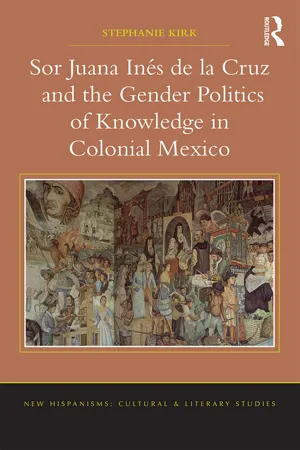
Each of the book's five chapters evokes a colonial Mexican cultural and intellectual sphere: the library, anatomy and medicine, spirituality, classical learning, and publishing and printing. Using an array of literary texts and historical documents and alongside secondary historical and critical materials, the author Stephanie Kirk demonstrates how Sor Juana used her poetry and other works to inscribe herself within the discourses associated with these cultural institutions and discursive spheres and thus challenge the male exclusivity of their precepts and precincts. Kirk illustrates how Sor Juana subverted the masculine character of erudition, writing herself into an all-male community of scholars. From there, Sor Juana clearly questions the gender politics at play in her exclusion, and undermines what seems to be the inextricable link previously forged between masculinity and institutional knowledge. Sor Juana Inés de la Cruz and the Gender Politics of Knowledge in Colonial Mexico opens up new readings of her texts through the lens of cultural and intellectual history and material culture in order to shed light on the production of knowledge in the seventeenth-century colonial Mexican society of which she was both a product and an anomaly.
Trusted by 375,005 students
Access to over 1.5 million titles for a fair monthly price.
Study more efficiently using our study tools.
Information
1 Dangerous Books and Vagabond Readers
The Gender Politics of the Library in Colonial Mexico
Doña Catalina de Alfaro Fernández de Cordova, a nun in the convent of Sancti-Spiritu in Alcaraz, Spain, was one of five Spanish women who contributed a poem to the elegies and panegyrics that preceded the last published volume of Sor Juana’s works, the Fama y Obras Póstumas (1700), assembled and edited by Juan de Castorena y Ursúa following Sor Juana’s death in 1695.1 Doña Catalina had also written a sonnet for the first volume of Sor Juana’s works, Inundación Castálida (first printed in 1689). In keeping with the tone of Castorena’s own texts (prologue, poems), Doña Catalina does not praise Sor Juana for her brilliant intellectual endeavors but instead lauds her turn toward piety, as exemplified in her willingness to sacrifice her beloved library.2 In contrast, Sor Juana’s biographer and friend, the Spanish Jesuit Diego Calleja, also represented the loss in terms of a move toward piety but nonetheless recognized the pain its surrender caused her.3 In his brief biography of Sor Juana, Calleja describes her books as her “four thousand friends” and as her “solace,” depicting the bitter reluctance with which she supposedly renounced them, poignantly describing the sorrow with which she gave them up (160). Doña Catalina depicts the fate of the confiscated books with what almost amounts to relish, categorically denying their use now to Sor Juana: “De quatro mil volúmenes sabidos/es esta sepultura librería/dentro los dicta una pavesa fria/todos a un desengaño resumidos” (n.p.) [From four thousand volumes that we know of/this library is now entombed/enfeebled all within/all brought together in harsh realization].
Having consigned Sor Juana’s beloved library to its deserved tomb, Doña Catalina shares the moral lesson she takes from this with the reader: “Saquemos desto que es la ciencia vana/fiebre del juizio” [Let us remove all that is empty knowledge/feverish understanding] and, in this same vein, posits further: “quien sabe amar a Dios solo es el sabio” [he who knows how to love God is the only wiseman] (n.p.). The way in which knowledge is represented here could not be further from how Sor Juana promotes it throughout her body of work, wherein she connects knowledge drawn from her intellectual pursuits to the worship of God. Sor Juana’s renders this connection in the most explicit of terms in the Autodefensa espiritual or Carta al Padre Núñez. She addresses the general idea of wisdom as pleasing to God: ¿No es Dios como Suma Bondad, Suma Sabiduría? Pues, ¿por qué le ha de ser más acepta la ignorancia que la ciencia?” [Is God not as ultimate goodness also ultimate wisdom? Well, then, why should ignorance be more pleasing to Him than learning?].4 She expounds, further, on the type of books beloved of male Christian humanists, such as the Jesuits, many of which she must have possessed in her library:
Si he leído los poetas y oradores profanos (descuido en que incurrió el mismo Santo) también leo los Doctores Sagrados y Santas Escrituras; demás que a los primeros no puedo negar que les debo innumerables bienes y reglas de bien vivir. Porque, ¿qué cristiano no se corre de ser iracundo a vista de la paciencia de un Sócrates gentil? ¿Quién podrá ser ambicioso a vista de la modestia de Diógenes Cínico? ¿Quién no alaba a Dios en la inteligencia de Aristóteles? Y en fin, ¿qué católico no se confunde si contempla la suma de virtudes morales en todos los filósofos gentiles?
[If I have read the prophets and secular orators (a lapse of which St. Jerome himself was guilty), I also read the Holy Doctors and Scripture and cannot deny that to the former I owe countless gifts and rules of good conduct. For which Christian will not avoid wrath when confronted by the patience of a pagan Socrates? Who can be ambitious in view of the modesty of the Cynic Diogenes? Who does not praise God in Aristotle’s intelligence? And finally, what Catholic can fail to be astonished when contemplating the sum of moral virtues in all of the pagan philosophers?]5
*********
Sor Juana Inés de la Cruz (1651–1695) and Juan de Palafox y Mendoza (1600–1659) both assembled important book collections in seventeenth-century New Spain, but their libraries were to meet with very different ends. We will see how one library has weathered the centuries to become part of UNESCO’s “Memory of the World” project, while we can only glimpse the other through brief textual references and fleeting artistic images. Sor Juana’s library is not unique in colonial Mexico in being lost to history. The library her intellectual peer Sigüenza y Góngora built up—of some 470 volumes—was broken up after its owner’s death, its contents also lost to posterity.6 Other colonial subjects suffered the loss of their libraries or book collections, some of them victims of the strict policing and confiscation carried out by the Inquisition.7 The largest-scale loss of libraries in colonial Mexican history was, of course, that of the Jesuit libraries, disassembled by the Viceregal government following the Society’s expulsion in 1767. The religious orders in general possessed some of the most impressive libraries in colonial Mexico and used them in both symbolical and practical terms as they evangelized the indigenous populations and ministered to and educated various New World populations. Unsurprisingly, the Franciscans, the first male order to arrive in 1524, were also first to found libraries, and these initially served to provide reference books for sermons and homilies as well as help the friars address the wider ideological issues that arose in the Spanish conquest of the Americas (Endean Gamboa 13). Their libraries also facilitated their work with the indigenous populations, to ensure doctrinal correctness in their application of the sacraments to the neophytes as well as assist in the education and preparation they provided for indigenous boys as they trained them to be acolytes (Endean Gamboa 13). Franciscans did not, moreover, find their poverty incompatible with the possession of books. Beginning with St. Francis, various leaders of the Order declared books held in common to be permissible, although private libraries were prohibited (Constantine Klukowski, cited in Endean Gamboa 7). The Jesuits, arriving later, in 1572, went on to found some of the most impressive libraries in their urban colleges and at the Casa Profesa, as well as their missions. No other order could match the Jesuits’ devotion to the pursuit of knowledge ad majorem dei gloriam, and their libraries became the center of this pursuit. Given the rivalries that existed among the religious orders and between the religious orders and the secular Church throughout the colonial period, a painful irony attends the fact that many of the Jesuits’ holdings went on to enrich the Franciscan mission libraries after the expulsion. When the Franciscans abandoned their missions between 1833 and 1855, the books were either further dispersed or lost.8
The circumstances in which Sor Juana lost her library are, however, unique and pertain directly to issues of gender, knowledge, and power. Palafox’s library offers a counterpoint to Sor Juana’s in a variety of ways. Both bishop and nun valued their books above all other possessions and dedicated their lives to scholarship and to the writing their books facilitated. Gender, however, was to provide the differentiation in the way they could pursue these intellectual activities. As a powerful member of the all-male ecclesiastical elite, Palafox’s library benefited from the Church’s support—both economic and moral—of a project that brought to bear the magnificent institution we see today. It was members of this same ecclesiastical hierarchy with whom Sor Juana negotiated constantly over her pursuit of knowledge. Eventually, Sor Juana lost the ability to navigate this tricky situation, and the authorities dismantled her book collection. The contrasting fates of the two libraries illustrate the protection many men enjoyed within the walls of educational and religious institutions. Palafox’s book collection became the magnificent library that stood within the walls of the Tridentine seminary of San Juan, providing the tools for the intellectual life the college offered. Sor Juana’s library was housed, anomalously, within the walls of San Jerónimo. Women in convents were not encouraged to dedicate themselves to a life of study, and Sor Juana’s great book collection was unique for a nun, granted to one who enjoyed special status due to her globally recognized intellectual and literary talents along with the protection the viceroys afforded her. San Jerónimo, however, could not provide the same institutional protection the colegio of San Juan offered Palafox, and confiscation of the books thus always loomed as a possibility. In her Respuesta a Sor Filotea de la Cruz, Sor Juana refers to the persecution that has attended her pursuit of knowledge: “todo ha sido acercarme más al fuego de la persecución, al crisol del tormento” (72) [all this has led me closer to the flames of persecution, the crucible of affliction]—the most extreme example of which is the imposition of a prohibition against her studies.9 She gives the example of a “prelada muy santa y cándida” [a very saintly and simple mother] whose implied lack of sophistication led her to think study would lead only to the Inquisition (72).10Consequently, and in a move that foreshadows Sor Juana’s ultimate loss of her library, the woman refused Sor Juana access to her books. Sor Juana defiantly explains how she could not help but continue to study, even without books, since her thirst for knowledge is a God-given gift whose control is beyond her capacity (72). In this famous section of the Respuesta, Sor Juana describes how she sought new insights in the world around her: studying perspective in the roof of the dormitory and chemistry in the kitchen.
A study of Palafox and Sor Juana’s libraries sheds light on the gendering of the library and, by extension, on the production and dissemination of knowledge in colonial Mexico. The circumstances surrounding their inception as well as their respective fates offer us a powerful example of the gender politics of knowledge, and of women’s exclusion from scholarly culture. Sor Juana’s daring trespass into the learned cultural debates of the day gained strength and momentum from her subversively impressive book collection that was deemed to be one of the greatest of her era in New Spain. Unlike Sor Juana, Palafox’s gender and status guaranteed an unquestioned entrée into colonial Mexican scholarly life. Yet he too drew on the strength and power his great book collection provided, as he laid his claim for supremacy in an intensely competitive masculine milieu. The space of the library also foregrounds how two crucial activities connected to the production and dissemination of knowledge—book collecting and reading—were complicit in the gendering of knowledge and erudition as masculine in colonial Mexican elite society.
The colonial Mexican library functioned as a space—both real and abstract—in which gender, power, and access to knowledge were constantly represented, contested, and inverted. Roger Chartier has analyzed the relationship between power and the library, describing how the latter served to inspire individuals to attempt the acquisition of total knowledge and thus access the power that this would supposedly confer. He describes the individual’s “dream of a universal library, real or imaginary, containing all the books that have ever been written,” showing how this search can stand metonymically for the accumulation of all Western knowledge (The Order vii and 62). It is on the basis of the search for knowledge that gender comes into play. Drawing upon the literal and figurative monumentalizing power of institutional structures, patriarchal society succeeded in configuring Western knowledge along exclusionary gender lines through the creation of mechanisms—principally institutionalized education—with which to formalize and perpetuate these restrictive practices. The often magnificent library stood as the jewel in the crown of elite masculine institutional culture, symbolizing the results of the European male’s pursuit of total knowledge. This totalizing quest underlies the constitution of great “princely, ecclesiastical and private ‘libraries’” through the commissioning of large-scale architectural projects which showed themselves “capable of welcoming the world’s memory” (The Order 62). Chartier’s analysis speaks to the creation of Palafox’s library, conceived of as preserving orthodox Catholic knowledge and now protected by UNESCO as a member of the Memory of the World Project.
The Library in the New World
The book’s importance as the symbol of supreme authority in Western European culture—stemming, of course, from the image of the Holy Book—became more intense in the New World milieu. As Spain undertook the mission to colonize the pagan Americas for Christendom, the importance the book held as both warranty of truth and knowledge or dangerous tool of heterodoxy took on a new and urgent meaning. The library fulfilled several important functions in this process of domination from conquest through colonization. Walter Mignolo’s theorizing of the “hegemony of the letter” in the Darker Side of the Renaissance demonstrates how the Spaniards used books and writing to subordinate and erase indigenous knowledge and impose their own epistemological systems in the service of political, religious, and symbolic domination.
If in the European Christian tradition the Bible was the one legitimate book—holder of truth and warrantor of knowledge—it possessed a sinister counterpart in the heretical book of magic,11 which, in the case of colonial Mexico, was potently embodied in the form of indigenous codices. The existence of both books thus charged all acts of reading with a potentially perilous authority. The conflict between the two learned traditions—Amerindian and European—engendered a dramatic tension within colonial reading practices, juxtaposing those which the Spanish clergy authorized and publicly performed with indigenous practices which, infused with the dangerous power of alterity, had been driven underground and carried out in secret. The uneasy coexistence of these equally persuasive textual bodies thus charged all acts of reading—(and here I refer also to non-Western types of practices of literacy)—with a potentially perilous authority. In the infamous Auto de Maní, carried out in 1562 by the Franciscan friar and Provincial of the Yucatán, Diego de Landa, Mayan codices were put to the flame in the hope of extinguishing the power they contained. In his Relación de las cosas de Yucatán, Landa describes the books they burned and how the Mayans reacted:
Usaba también esta gente de ciertos caracteres o letras con las cuales escribían en sus libros sus cosas antiguas y sus ciencias, y con estas figuras y algunas señales de las mismas, entendían sus cosas y las daban a entender y enseñaban. Hallámosles gran número de libros de estas sus letras, y porque no tenían cosa en que no hubiese superstición y falsedades del demonio, se los quemamos todos, lo cual sintieron a maravilla y les dio mucha pena. (104–05)
[These people also used certain marks or letters with which they wrote of their ancient things and of their knowledge in their books, and with these figures and some signs representing the same, they understood their things and communicated them and taught them. We found a great number of their books with these letters, and because they had nothing except superstitious things and falsities of the devil, we burned them all, which they felt most dreadfully and afflicted them greatly]
We see Landa’s Eurocentric gesture echoed—albeit enacted without explicit violence—in the foundation of the first academic library in the Western Hemisphere at the Colegio Imperial de Santa Cruz de Tlatelolco, founded in 1535 by the first Bishop of Mexico, the Franciscan Juan de Zumárraga, with the support of the Viceroy Antonio de Mendoza. Zumárraga was the first great European bibliophile to come to the New World. According to W. Michael Mathes, in his study of Santa Cruz de Tlatelolco, although Zumárraga left some of his precious volumes behind in Spain—a gesture Palafox would repeat in the seventeenth century—his collection was “sufficiently extensive” to be classed as a library and was the “first to be brought to the Americas” (7).12 The bishop’s library would eventually form part of a college for elite indigenous young men who were to be trained for ordination as native priests. The library and the seminary in which it stood were designed to incorporate elite Indians into the fold of Spain’s cultural patrimony while erasing their own traditions and accumulated wisdom, and by extension, stake a claim for the New World as a worthy site of this patrimony (Mathes 31).
The founding of the library responded to the peculiar challenges the New World implied for the imposition of Western culture. In the petition Zumárraga made to the Crown for funds to build his seminary, he r...
Table of contents
- Cover
- Title
- Copyright
- Dedication
- Contents
- Acknowledgments
- Introduction
- 1 Dangerous Books and Vagabond Readers: The Gender Politics of the Library in Colonial Mexico
- 2 Latinate Culture and Classical Erudition: The Gender Politics of Education in Colonial Mexico
- 3 Literary Dissections: The Gender Politics of Medicine and Anatomy in Colonial Mexico
- 4 Disseminating Knowledge: The Gender Politics of Print in Colonial Mexico
- 5 The New World Sacred: The Gender Politics of Piety in Colonial Mexico
- Postscript
- Bibliography
- Index
Frequently asked questions
Yes, you can cancel anytime from the Subscription tab in your account settings on the Perlego website. Your subscription will stay active until the end of your current billing period. Learn how to cancel your subscription
No, books cannot be downloaded as external files, such as PDFs, for use outside of Perlego. However, you can download books within the Perlego app for offline reading on mobile or tablet. Learn how to download books offline
Perlego offers two plans: Essential and Complete
- Essential is ideal for learners and professionals who enjoy exploring a wide range of subjects. Access the Essential Library with 800,000+ trusted titles and best-sellers across business, personal growth, and the humanities. Includes unlimited reading time and Standard Read Aloud voice.
- Complete: Perfect for advanced learners and researchers needing full, unrestricted access. Unlock 1.5M+ books across hundreds of subjects, including academic and specialized titles. The Complete Plan also includes advanced features like Premium Read Aloud and Research Assistant.
We are an online textbook subscription service, where you can get access to an entire online library for less than the price of a single book per month. With over 1.5 million books across 990+ topics, we’ve got you covered! Learn about our mission
Look out for the read-aloud symbol on your next book to see if you can listen to it. The read-aloud tool reads text aloud for you, highlighting the text as it is being read. You can pause it, speed it up and slow it down. Learn more about Read Aloud
Yes! You can use the Perlego app on both iOS and Android devices to read anytime, anywhere — even offline. Perfect for commutes or when you’re on the go.
Please note we cannot support devices running on iOS 13 and Android 7 or earlier. Learn more about using the app
Please note we cannot support devices running on iOS 13 and Android 7 or earlier. Learn more about using the app
Yes, you can access Sor Juana In�de la Cruz and the Gender Politics of Knowledge in Colonial Mexico by Stephanie Kirk in PDF and/or ePUB format, as well as other popular books in Literature & Literary Criticism. We have over 1.5 million books available in our catalogue for you to explore.