- 654 pages
- English
- ePUB (mobile friendly)
- Available on iOS & Android
eBook - ePub
About this book
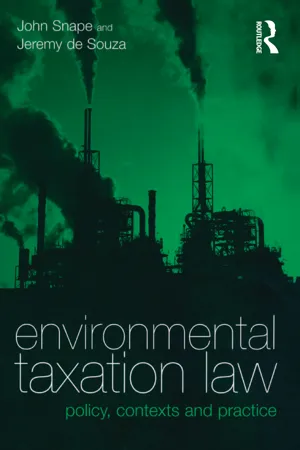
The theoretical arguments for environmental taxes and other types of economic instruments for environmental protection have been discussed extensively in the literature. Rather less well discussed has been the extremely complex form that such instruments have in fact taken in practice. Environmental Taxation Law: Policy, Contexts and Practice examines the legal implications of introducing environmental taxes and other economic instruments into the regulatory framework of UK law. In doing so, it analyzes and explains the difficulties of grafting environmental taxes onto the complexities of existing regulatory structures, not all of which, of course, were originally devised with environmental considerations in mind. Although the focus of the book is the UK's pioneering implementation of a web of distinct yet interrelated policy measures, it locates the UK's taxes and instruments not simply in their broader context of market and environmental regulation, but also in the contexts of European and international law.
PROLOGUE
Chapter 1
Preliminaries
1.1 Introduction
The concept of the environmental tax is a new and controversial presence in the European regulatory landscape. The UK has been a pioneer in the transformation of this new type of tax from a twinkle in the eye of the environmental economist to a legal reality. This book seeks to give a comprehensive but critical account of the law relating to environmental taxes in the UK. It discusses the policies which have shaped those taxes, together with their relationship both with other forms of environmental regulation, and with other (non-environmental) taxes. It also offers insights into the application of environmental taxes in practice. Throughout the book, UK law and policy is placed in its wider international and European contexts.
In the absence of a general legislative definition,1 the ways in which environmental taxes are to be identified and classified are, of course, key elements in this first chapter. The discussion begins,2 however, by introducing the essence of some even more fundamental concepts, a number of which we shall encounter again and again: what is a tax? How does the concept differ from other levies, such as charges for government services? Within the concept of a tax, what distinction is to be drawn between direct and indirect taxes? What types of tax fall into each category? In each case, we explain the specific importance of each of these questions to the key term ‘environmental taxes’, both the nature and the classifications of which we discuss in some detail below.3 Having explained the importance of each of these questions, as well as indicating something of the policies that inform them, we then go on to set out the approach which we have adopted to the material under consideration. The purpose of the study, as already stated, is to offer a critical account of the subject matter; para. 1.2.2 explains the viewpoint from which the criticism is made.
One of the all-embracing themes of the book is that of how – irrespective, almost, of the jurisdiction in which they are designed and implemented – the feasibility and design of environmental taxes (justified, as they often are, by reference to international environmental agreements), are subject to the law of international trade, as embodied in the 1994 revision of the General Agreement on Tariffs and Trade (‘GATT 1994’), and its related agreements, and in the institutions of the World Trade Organization (‘the WTO’). The UK is no exception to this general proposition and, furthermore, as a Member State of the EU, its own environmental levies are additionally subject to the provisions of the European Treaty. The nature and extent of both sets of treaty provisions, which coincide to a considerable extent, are considered in subsequent chapters.4 In this Introduction, the explanation of the essential concepts and of our approach to the subject matter as a whole, is followed by a brief introduction to the international and European context of the material, as well as to the place, within that setting, of the UK and its constituent countries.5 We seek to highlight throughout the book the governance questions to which these contexts give rise, since these help to explain, not only why European-wide action in the field of environmental taxation has proved so problematic, but also why the UK’s environmental taxes are of UK-wide application, rather than being found (as, for example, in Spain)6 in its constituent countries.
So far as the non-UK reader is concerned, the chief usefulness of the present volume, it is hoped, will be found in the detailed critical exposition, against the background discussed above, of the UK’s environmental levies and their institutional framework. To this end, para. 1.4.2 below contains an introductory overview of the levies, most importantly (in the chronological order of their introduction), landfill tax, a levy on the landfilling of waste; climate change levy, a levy on the industrial, commercial and agricultural use of energy; and aggregates levy, which taxes the extraction of primary minerals. All of the levies have both a regulatory context7 and a taxation context and paras 1.4.2 and 1.4.3 seek to give an overview of those contexts. Although, as will be seen, HM Customs and Excise (‘Customs’) is the government department mainly responsible for the administration and enforcement of each of these levies,8 the non-UK reader (and possibly, also, even the UK reader new to the subject), will be struck by the myriad other bodies with some subsidiary role in at least the former process. Paragraph 1.5 briefly introduces these bodies, by way of a prelude to the detailed, as well as much more wide-ranging, discussion in Chapter 4 below. Together, the elements of the discussion in this chapter will equip the reader to appreciate the fiscal context of the levies to be discussed in the rest of the book.
These opening remarks having been made, we turn first to certain basic issues of terminology and, specifically, to the idea of environmental taxes and the implications of the constituent elements of the term.
1.2 Terminology, approach and sources
The use of the term ‘environmental taxation’ in popular discourse tends to elide the particular significances of each of its two constituent elements.
This para. 1.2 accordingly begins by setting out an initial definition of the concept of a tax and briefly explaining its relationship, first, with the distinct concept of a charge for government services and, secondly, with the concept of a fine. Both of these distinctions, important in the study as a whole, will be revisited in more detail in a later chapter.9 The term ‘levy’,10 also common in public finance literature, operates as a generic term for both taxes and charges: the allocation of a particular levy to one or other category, and the implications of that process, depend on isolating the characteristics of a tax, and distinguishing it from a charge (or fee) for government services.
Within the concept of a tax is entrenched a further distinction which, in the specific context of environmental taxes, is also of considerable significance: that between direct and indirect taxes. We examine the distinction in some detail here, since it will be of fundamental importance in explaining the international aspects of environmental taxation,11 no less than its Community law implications.12
The preceding discussion forms the basis of an examination of the technical significance of the concept ‘environmental taxation’. This in turn leads into an explanation of th...
Table of contents
- Cover Page
- Dedication
- Title Page
- Copyright Page
- Contents
- About the Authors
- Authors’ Preface
- Table of Cases
- Table of Statutes
- Table of Statutory Instruments
- Table of Provisions of the European Treaty
- Table of European Community Legislation
- Table of Provisions of GATT 1994
- Table of Other Treaty Provisions
- Table of Abbreviations
- PART I: PROLOGUE
- PART II: POLICY AND CONTEXTS
- PART III: PRACTICE
- PART IV: PROSPECTS AND NEW DIRECTIONS
- PART V: PROVISIONAL ASSESSMENT
- Postscript
- Select Bibliography
- Index
Trusted by 375,005 students
Access to over 1.5 million titles for a fair monthly price.
Study more efficiently using our study tools.
Frequently asked questions
Yes, you can cancel anytime from the Subscription tab in your account settings on the Perlego website. Your subscription will stay active until the end of your current billing period. Learn how to cancel your subscription
No, books cannot be downloaded as external files, such as PDFs, for use outside of Perlego. However, you can download books within the Perlego app for offline reading on mobile or tablet. Learn how to download books offline
Perlego offers two plans: Essential and Complete
- Essential is ideal for learners and professionals who enjoy exploring a wide range of subjects. Access the Essential Library with 800,000+ trusted titles and best-sellers across business, personal growth, and the humanities. Includes unlimited reading time and Standard Read Aloud voice.
- Complete: Perfect for advanced learners and researchers needing full, unrestricted access. Unlock 1.5M+ books across hundreds of subjects, including academic and specialized titles. The Complete Plan also includes advanced features like Premium Read Aloud and Research Assistant.
We are an online textbook subscription service, where you can get access to an entire online library for less than the price of a single book per month. With over 1.5 million books across 990+ topics, we’ve got you covered! Learn about our mission
Look out for the read-aloud symbol on your next book to see if you can listen to it. The read-aloud tool reads text aloud for you, highlighting the text as it is being read. You can pause it, speed it up and slow it down. Learn more about Read Aloud
Yes! You can use the Perlego app on both iOS and Android devices to read anytime, anywhere — even offline. Perfect for commutes or when you’re on the go.
Please note we cannot support devices running on iOS 13 and Android 7 or earlier. Learn more about using the app
Please note we cannot support devices running on iOS 13 and Android 7 or earlier. Learn more about using the app
Yes, you can access Environmental Taxation Law by John Snape,Jeremy de Souza in PDF and/or ePUB format, as well as other popular books in Law & Environmental Law. We have over 1.5 million books available in our catalogue for you to explore.