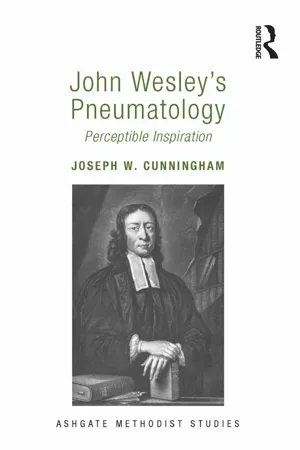
- 172 pages
- English
- ePUB (mobile friendly)
- Available on iOS & Android
eBook - ePub
About this book
Perceptible inspiration, a term used by John Wesley to describe the complicated relationship between Holy Spirit, religious knowledge, and the nature of spiritual being, is not unlike the term 'Methodist' which was also coined by critics of Methodism during the eighteenth century in Britain. John Wesley's adversaries, especially the pseudonymous John Smith with whom Wesley exchanged letters for a period of three years, frequently challenged the plausibility of direct spiritual sensation, which Wesley defended. What does Wesley mean by perceptible inspiration? What does the teaching reveal about the nature and existence of God in Wesley's thinking? What does it suggest about the spiritual nature of humankind? In John Wesley's Pneumatology, it is argued that 'perceptible inspiration' more than a sidebar of Methodist thought, offers a useful model for considering the various features of Wesley's views on the work of the Spirit in relation to human existence, participatory religious knowledge, and moral theology.
Information
Chapter 1
Perceptible Inspiration as Pneumatological Model: A Critical Appraisal of John Wesley’s Correspondence with ‘John Smith’ (1745–48)
From May 1745 to March 1748, John Wesley was engaged in correspondence with a pseudonymous figure named ‘John Smith’1. Henry Bett has claimed that Smith was really Thomas Secker, Bishop of Oxford (1747–50) and Archbishop of Canterbury (1758–68).2 However, recent scholarship has suggested otherwise. According to Albert Outler for instance, while ‘Secker’s theological stature and outlook would match those of the man who wrote these letters … other internal details leave the question open.’3 Regardless of Smith’s historical identity, it is clear from the letters that he was both pious and well-informed in theological matters.4 Why did Smith initiate contact? Evidence within the sources suggests that consternation with Wesley’s Earnest Appeal to Men of Reason and Religion (1743), along with selections from his Farther Appeal (1744–45), was partially responsible. In addition, a brush with practising Methodists in or around the Bristol area may have led him to write – a claim made by Frank Baker.5 Nevertheless, regardless of what prompted it, Smith’s impetus for writing is clear. He possessed deep misgivings about Wesley’s theology and wished to give its proponent a chance to clarify. While Smith’s manifold critique ranged from the issue of lay-preaching to that of present-day miracles, much of his concern centred on the issue of perceptible inspiration – the idea that men and women might directly encounter or sense the Holy Spirit. Smith pressed Wesley for a viable answer to the perplexing problem of perceptible inspiration:
The question then is this, does God’s Spirit work perceptibly on our spirit by direct testimony … by such perceivable impulses and dictates as are as distinguishable from the suggestions of our own faculties as light is discernible from darkness … or does he imperceptibly influence our minds to goodness by gently and insensibly assisting our faculties, and biasing them aright?6
Amidst a busy itinerancy filled with preaching and publication, Wesley accepted the challenge extended by Smith, and responded to each of his letters with care, precision, and at length. In some respects, the two had met their match in one another. Both men were knowledgeable of the Church and her theology, both were well-educated and articulate, both were adept at critically analysing opposing positions, and both expressed a sincere interest in seeking the truth. However, unlike his opponent, John Wesley embraced the possibility of direct spiritual knowledge. Wesley believed that, in the economy of salvation,7 the Holy Spirit stirs the hearts of believers to faith and assurance as the fruits of righteousness, peace, joy, and love are germinated in Christian practice. Wesley’s espousal of this teaching was emphatic: ‘For this I earnestly contend; and so do all who are called Methodist preachers.’8
What are the specifics of his teaching? Wesley held that God enables humans to perceive, by faith, the witness of the Holy Spirit. Subsequently, as the Spirit renews our mind and moral character, the fruits of inspiration (peace, joy, love, and righteousness) begin to proliferate. Each of these distinctive movements, as well as their inter-relatedness with respect to humanity’s experience of God, is fundamental to Wesley’s theology of the Spirit’s person and work in the economy of salvation, and implicit within the concept of perceptible inspiration, when appropriated as a pneumatological doctrine.9 Although the teaching has primarily been read in terms of his theory of religious knowledge,10 when extrapolated, it exposes Wesley’s understanding of via Spiritus, the way of the Spirit in relation to humankind and salvation. Indeed, during Wesley’s exchange with John Smith, Wesley consistently defined perceptible inspiration in terms of saving faith and its fruits (peace, joy, righteousness, and love), or inward and outward holiness manifested in the lives of believers by the power of the Holy Spirit.
We are now at length come to the real state of the question between Methodists (so called) and their opponents. Is there perceptible inspiration or is there not? Is there such a thing … as faith producing peace and joy and love, and inward (as well as outward) holiness? Is that faith which is productive of these fruits wrought in us by the Holy Ghost, or not? And is he in whom they are wrought necessarily conscious of them, or is he not?11
Becoming conscious of God’s gracious activity, believers gain confidence and trust in God as saviour and sanctifier. In its widest sense, perceptible inspiration refers to God consciousness and the panoply of the Spirit’s work wherein believers feel and seek to express the peace, joy, righteousness, and love of God in Christ. More particularly however, perceptible inspiration was Wesley’s term for the Spirit’s direct testimony of assurance and humanity’s perception of it.
[Perceptible] inspiration … be pleased to observe what we mean thereby. We mean that inspiration of God’s Holy Spirit whereby he fills us with righteousness, peace, and joy, with love to him and all mankind. And we believe it cannot be, in the nature of things, that a man should be filled with this peace and joy and love by the inspiration of the Holy Ghost without perceiving it, as clearly as he does the light of the sun.12
Wesley was insistent that spiritual consciousness is essential for salvation. Relational, affective, and moral knowledge of God, along with the outward expression of Christ’s love to humankind based upon the inward testimony communicated to the inspirant by the Divine, are imperative for Christian living.
That Wesley defined perceptible inspiration in part by pointing to the fruits of holy living raises a theological problem, however. Wesley held that righteousness, love, peace, and joy are the immediate fruits of spiritual knowledge, as well as characteristics of the event itself. John Smith, on the other hand, insisted that these constitute the natural effects of God’s operation, but not the event itself. While ‘good things … wrought in [humans],’13 wrote Smith, the ‘question to be debated … [is] not whether the fruits of inspiration are things perceptible, but whether the work of inspiration itself be so; whether the work of God’s Spirit in us be as easily distinguishable from the workings of our own spirit as light is from darkness.’14 In response to this problem, skewing the line between physics and metaphysics Wesley maintained that inspiration was both perceptible and supernatural.
If not through our natural faculties, reason, or physical sensation, then how is inspiration known? Wesley’s answer was faith.15 As he explained in his Earnest Appeal:
You cannot reason concerning spiritual things if you have no spiritual sight, because all your ideas received by your outward senses are of a different kind; yea, far more different from those received by faith or internal sensation than the idea of colour from that of sound … [The] ideas of faith differ toto genere from those of external sensation.16
By faith, men and women internally perceive God’s testimony of peace, joy, righteousness and love. To witness the Spirit’s presence, which is both above and immanent with respect to our physical being, one must have faith, a supernatural gift endowed to human beings. As Wesley remarked to Smith, ‘over and above those other graces which the Holy Spirit inspires into or operates in a Christian, and over and above his imperceptible influences, I do intend all mankind should understand me to assert … every Christian believer hath a perceptible testimony of the Spirit that he is a child of God.’17 The inspiration of the Spirit, which comforts and assures newly born sons and daughters of God in Christ, is a gift beheld through direct perception of the Spirit’s inspiring energy.18 In addition to the visible fruits borne of practice, believers do experience by faith an inward consciousness of God’s presence – a consciousness of intimate spiritual participation.19
Perceptible inspiration signifies Wesley’s view of the inward illumination of the Spirit directly known by human agents (through faith) accompanied by the fruits of peace, joy, righteousness, and love. As he explained to John Downes in response to the latter’s 1759 polemical work, ‘We do speak of grace (meaning thereby that power of God which worketh in us both to will and to do of his good pleasure), that it is “as perceptible to the heart” (while it comforts, refreshes, purifies, and sheds the love of God abroad therein) “as sensible objects are to the senses”.’20 The Spirit’s work, which Wesley identified with the power of grace, is as perceptible to the heart as texture is to touch – though each represents a distinct faculty directed at categorically distinct realities. Wesley’s doctrine of perceptible inspiration points to God’s self-disclosing Spirit who breathes filial confidence, peace, joy, and love into the souls of faithful believers. It was so vital to his theology that he called it ‘the main doctrine of the Methodists’, ‘the substance of what we all preach.’21 He even went so far as to state that ‘none is a true Christian [until] he experiences it,’22 and furthermore, ‘I cannot believe [God] will receive any man into glory (I speak of those under the Christian dispensation) “without such an inspiration of the Holy Ghost as fills his heart with peace and joy and love”.’23 Surfacing in his correspondence with John Smith, Wesley’s doctrine of perceptible inspiration highlights God’s gracious initiative to refashion and renew human beings into God’s image and likeness through the Spirit of holiness.
Against this notion, Smith raised the following criticisms.
You seem then to me to contend with great earnestness for the following system, viz., that faith (instead of being a rational assent and moral virtue for the attainment of which men ought to yield the utmost attention and industry) is altogether a divine and supernatural illapse from heaven, the immediate gift of God, the mere work of Omnipotence, given instantaneously and arbitrarily, not with any regard to the fitness of the recipient, but the absolute will of the Donor. That the moment this faith is received the recipient’s pardon is signed in heaven, or he is justified. This pardon or justification is immediately notified to him by the Holy Ghost, and that not by his imperceptibly working a godly assurance, but by such a perceptible, such a glaring attestation as is as easily discernible from the dictates of reason or suggestions of fancy as light is discernible from darkness.24
Instead of a dispassionate assent to the truth of revelation accompanied by virtuous living, Wesley, according to Smith, had reduced faith to an ecstatic event in which the believer is instantly forgiven and assured of it directly by the Holy Spirit. If this were true, held Smith, justification by faith would be dependent exclusively on the sovereign will of God without any regard for...
Table of contents
- Cover Page
- Title Page
- Copyright Page
- Contents
- Preface
- 1 Perceptible Inspiration as Pneumatological Model: A Critical Appraisal of John Wesley’s Correspondence with ‘John Smith’ (1745–48)
- 2 Grace as Pneumatological Operation
- 3 Faith as Pneumatological Operation
- 4 Witness of the Spirit as Pneumatological Operation
- 5 The Fruits of the Spirit as Pneumatological Operation
- Conclusion
- Bibliography
- Index
Trusted by 375,005 students
Access to over 1.5 million titles for a fair monthly price.
Study more efficiently using our study tools.
Frequently asked questions
Yes, you can cancel anytime from the Subscription tab in your account settings on the Perlego website. Your subscription will stay active until the end of your current billing period. Learn how to cancel your subscription
No, books cannot be downloaded as external files, such as PDFs, for use outside of Perlego. However, you can download books within the Perlego app for offline reading on mobile or tablet. Learn how to download books offline
Perlego offers two plans: Essential and Complete
- Essential is ideal for learners and professionals who enjoy exploring a wide range of subjects. Access the Essential Library with 800,000+ trusted titles and best-sellers across business, personal growth, and the humanities. Includes unlimited reading time and Standard Read Aloud voice.
- Complete: Perfect for advanced learners and researchers needing full, unrestricted access. Unlock 1.5M+ books across hundreds of subjects, including academic and specialized titles. The Complete Plan also includes advanced features like Premium Read Aloud and Research Assistant.
We are an online textbook subscription service, where you can get access to an entire online library for less than the price of a single book per month. With over 1.5 million books across 990+ topics, we’ve got you covered! Learn about our mission
Look out for the read-aloud symbol on your next book to see if you can listen to it. The read-aloud tool reads text aloud for you, highlighting the text as it is being read. You can pause it, speed it up and slow it down. Learn more about Read Aloud
Yes! You can use the Perlego app on both iOS and Android devices to read anytime, anywhere — even offline. Perfect for commutes or when you’re on the go.
Please note we cannot support devices running on iOS 13 and Android 7 or earlier. Learn more about using the app
Please note we cannot support devices running on iOS 13 and Android 7 or earlier. Learn more about using the app
Yes, you can access John Wesley's Pneumatology by Joseph W. Cunningham in PDF and/or ePUB format, as well as other popular books in Theology & Religion & Christian Denominations. We have over 1.5 million books available in our catalogue for you to explore.