eBook - ePub
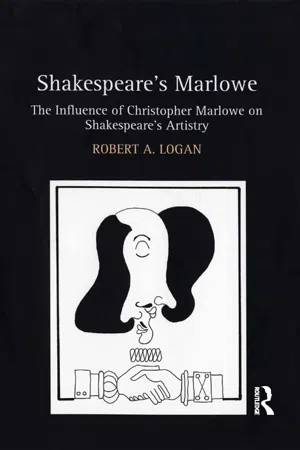
Shakespeare's Marlowe
The Influence of Christopher Marlowe on Shakespeare's Artistry
- 260 pages
- English
- ePUB (mobile friendly)
- Available on iOS & Android
eBook - ePub
About this book
Moving beyond traditional studies of sources and influence, Shakespeare's Marlowe analyzes the uncommonly powerful aesthetic bond between Christopher Marlowe and William Shakespeare. Not only does this study take into account recent ideas about intertextuality, but it also shows how the process of tracking Marlowe's influence itself prompts questions and reflections that illuminate the dramatists' connections. Further, after questioning the commonly held view of Marlowe and Shakespeare as rivals, the individual chapters suggest new possible interrelationships in the formation of Shakespeare's works. Such examination of Shakespeare's Marlovian inheritance enhances our understanding of the dramaturgical strategies of each writer and illuminates the importance of such strategies as shaping forces on their works. Robert Logan here makes plain how Shakespeare incorporated into his own work the dramaturgical and literary devices that resulted in Marlowe's artistic and commercial success. Logan shows how Shakespeare's examination of the mechanics of his fellow dramatist's artistry led him to absorb and develop three especially powerful influences: Marlowe's remarkable verbal dexterity, his imaginative flexibility in reconfiguring standard notions of dramatic genres, and his astute use of ambivalence and ambiguity. This study therefore argues that Marlowe and Shakespeare regarded one another not chiefly as writers with great themes, but as practicing dramatists and poets-which is where, Logan contends, the influence begins and ends.
Information
1 Marlowe and Shakespeare: Repositioning the Question of Sources and Influence
DOI: 10.4324/9781315608754-1
I
Among the many forces attributed to the fashioning of Shakespeare’s professional life, the influence of Christopher Marlowe has long been considered indisputable. However, although not readily acknowledged, attempts to pin down and define this influence have frequently resulted in inconclusiveness. To be sure, the scholarship resulting from the tracking processes has often proved illuminating, especially when it causes us to reflect on the methodology used in detecting influence or encourages us to scrutinize the aesthetic aims and historical contexts of each writer’s works. But endeavors to make definite the lines of influence have been seriously hampered by problems encountered in trying to fathom what is historically unknowable. As a result, discussions of Marlowe’s effect on Shakespeare, as well as Shakespeare’s on Marlowe, have all too often blurred the line that separates fact from speculation.
For those scholars who concentrate exclusively on making definite the links between the two writers’ works, delineating influence is almost guaranteed to breed frustration and, in consequence, to intensify their eagerness to describe bonds that are explicit. Apart from the difficulties emerging from the narrowness of the pursuit, such efforts have resulted in the development of two overlapping propensities: forcing conclusions and allowing speculation to harden into fact. Examples of fabricated links that have been used to connect Marlowe with Shakespeare abound. In Two Gentlemen of Verona, for instance, the story of Hero and Leander is mentioned twice (I, i, 21–26 and III, i, 117–20). 1 But, in spite of the number of times Marlowe has been suggested as a source, in neither allusion is there anything specific enough to connect the references to his Hero and Leander; moreover, no evidence exists to ascertain that the play was written after the poem. A second example of this same supposed source appears in As You Like It. Attempting to ground Orlando’s love in commonsense realism, Rosalind pooh-poohs the romantic notion of dying for love (IV, i, 87–100). One of her examples is Leander who, she claims, drowned because of a cramp. But neither this detail nor the dire fate of the young lover appears in Marlowe’s rendering of the tale. Evidently, the myth of Hero and Leander enjoyed a general currency such that every reference to it (especially after the writer’s death) need not be attributed to Marlowe. As You Like It also presents other opportunities for forced links when Touchstone says, “… it strikes a man more dead than a great reckoning in a little room” (III, iii, 12–13). Some scholars find in this an echo of the line from The Jew of Malta, “Infinite riches in a little room” (I, i, 37); 2 others, more biographically inclined, see in it a reference to Ingram Frizer’s striking Marlowe dead in a room in Eleanor Bull’s house during a quarrel over “le recknynge.” In neither case is the “source” more than zealous speculation.
Those scholars who move beyond source hunting in tracing the influence of Marlowe and Shakespeare also encounter impediments. This is particularly true when the explanations of influence within a single Shakespearean play become entangled in complexity or lead to irresolvable difficulties. The Merchant of Venice is a case in point. As I will later demonstrate, not only does the play contain influence from diverse Marlovian sources, some clearer than others, but also different degrees and kinds of Marlovian influence—the degrees ranging from specific to general to uncertain.
Anyone who examines Shakespeare’s works seeking to explain Marlowe’s influence is certain to meet up with these and other impediments, beginning with whether the influence is from Marlowe or from someone else. Probably the greatest single obstacle is a question that finally resists a definite or conclusive answer—as, say, the influence of magic in Doctor Faustus on magic in The Tempest. But even this hindrance can be offset if, by shifting our perspective, we understand and accept three principles: (1) Marlowe’s influence cannot usually be reduced to uncomplicated explanations; (2) much of it relies on deduction and conjecture rather than hard evidence; and, most important, (3) the study of influence should never be considered an end in itself but primarily a process, one that expands critical inquiry through fresh perspectives and raises new issues about the theatrical and literary resourcefulness of each writer. The following chapters regard both influence and the study of influence as such. Consequently, they are dedicated to the larger purpose of arriving at a clearer and richer understanding of the creative distinctiveness of both Marlowe and Shakespeare.
Given this objective, the present study proposes to build upon what we can determine of the nature and the extent of Marlowe’s influence on Shakespeare’s theatrical and literary practices. By “theatrical practices,” I mean those strategies that Shakespeare devised to give the production of his plays maximum effectiveness, whether measured pragmatically, by the plays’ degree of commercial success, or aesthetically, by such ingredients as conflict and tension, spectacles (visual and verbal), and climactic moments. “Literary practices” include the shaping of a specific intellectual and emotional content in conjunction with the manipulation of the play’s style, structure, and characterizations.
I intend to follow the progression of Shakespeare toward an unabashed acceptance of Marlowe’s influence, taking into account how, over time, he shifted from moments of a commonly supposed defensive belittlement—most often in the form of parody—to an enthusiastic adaptation of his fellow playwright’s dramaturgical techniques and stylistic tendencies in language and syntax. Along the way, I will consider not only what Shakespeare appropriated and, through refinements, made his own, but also what he rejected, especially in the realm of Marlovian values.
I begin the following discussion by exemplifying the need to separate evidence from presupposition, questioning in particular the validity of the long-posited critical tradition of a hostile “rivalry” between the two dramatists and its bearing on influence—a speculation that, unfortunately, has hardened into a fact. I then outline the possible reach of Marlowe’s influence, clarifying what in the past we have meant by “sources” and “influence” and what, because of advances in contextualizing dramatic works, we can mean now. This section leads to an analysis of the significance of a study of Marlowe’s influence (primarily) and the various forms of influence, from the most to the least definite, that the ensuing chapters encompass. I conclude the discussion with a brief examination of the preconceptions and expectations of a study of Marlowe’s influence on Shakespeare.
II
By the early 1590s, Marlowe and Shakespeare were living in London and actively writing for the city’s commercial theater. Born in 1564, a little over two months apart, each had established himself as a playwright by his mid-20s. But, as is well known, Marlowe began composing plays before Shakespeare and rapidly gained recognition and prominence. No evidence has been found to tell us whether Marlowe and Shakespeare ever actually met or whether Shakespeare acted in one of Marlowe’s plays, but both are quite likely. 3 As every student of sixteenth-century drama knows, in 1592 Robert Greene 4 in A Groatsworth of Wit, writing to “those gentlemen his quondam acquaintance, that spend their wits in making plays” [usually identified with Marlowe, Nashe, and Lodge], ridiculed the multitalented Shakespeare, saying, “an upstart crow, beautified with our feathers, that with his Tiger’s heart wrapt in a player’s hide, supposes he is as well able to bombast out a blank verse as the best of you: and being an absolute Iohannes fac totum, is in his own conceit the only Shake-scene in a country.” 5 The first italicized phrase parodies a line from Part 3 of Henry VI, 6 and Greene gives the playwright one final thrust with the unsubtle pun “Shake-scene.” James Shapiro repeats a point of general scholarly agreement in saying that Greene appears to be addressing Marlowe when, earlier in A Groatsworth, he speaks of the “famous gracer of tragedians.” 7 Because Greene is able to make fun of Shakespeare and to refer to Marlowe as “famous” [even though he also attacks him], 8 we understand that the two dramatists were well-known, successful figures on the London theater scene. The specific meanings of Greene’s vitriolic remarks in A Groatsworth and Henry Chettle’s protest against them in his Epistle to Kind-Harts Dreame, written two and one-half months after the satiric pamphlet, remain unclear. 9 But, for my purposes here, the importance of the two documents lies less in their content than in their demonstration of the visible professional status and notable reputations of Marlowe and Shakespeare. Given their standing as it is characterized in these documents, it would be less conceivable that they did not meet than that they did.
But there is even more conclusive evidence to consider. Philip Henslowe’s entries in his Diary for the ten performances of The Jew of Malta and fifteen of Henry VI in 1592 indicate in the entries for March 10 and 11, April 4 and 5, May 4 and 5, and May 19 and 20 that The Jew of Malta and Henry VI were played in succession. 10 Henslowe’s information helps us to envision the working milieu within which Marlowe and Shakespeare were writing and producing their plays; seeing each other on something like a daily basis at the theater promotes the likelihood that the two playwrights, even if not close friends, knew one another and that they almost certainly knew each other’s works as staged plays. Moreover, although no evidence exists to establish the fact, it is conceivable that Shakespeare acted in The Jew of Malta at the Rose in 1592–93 or at the theater in Newington Butts in 1594.
During Marlowe’s lifetime, the popularity of his plays, Robert Greene’s unintentionally elevating remarks about him as a dramatist in A Groatsworth of Wit, including the designation “famous,” and the many imitations of Tamburlaine suggest that he was for a brief time considered England’s foremost dramatist. 11 That he had a firm sense of his success cannot be doubted; in the Prologue to the second part of Tamburlaine, he exclaims:
The general welcomes Tamburlaine received
When he arrivèd last upon our stage
Hath made our poet pen his second part … (2 Prologue, 1–3)
Marlowe’s sense of his professional status is not surprising: he vigorously expresses his self-awareness as an innovator in the Prologue to the first part of Tamburlaine; in the same play, he declares his fervor toward the powers of the poet through the warrior leader’s well-known speech on beauty and poetry (1 V, i, 135–90); and in Hero and Leander, he reveals a self-referential literary consciousness. 12 But, by 1592, well before Marlowe’s untimely death in 1593, Shakespeare was also making his mark on the London theatrical world and receiving major critical attention—largely because of his Henry VI plays. 13 Henslowe’s Diary shows that, in March of 1592, The Jew of Malta and Part 1 of Henry VI—that is, the plays of both writers—were being presented in repertory at the Rose Theater, 14 and that, within the two years following, as the title pages of Edward II and the 1595 quarto of Part 3 of Henry VI indicate, the Earl of Pembroke’s Men were performing the two writers’ plays. 15 These documents clearly establish both the co-presence of the two dramatists and their attempt to attract the same sources of production for the staging of their plays, thereby increasing the opportunities for influence and creating what several critics have seen as a plausible context for an unfriendly rivalry.
For us now, the term “rivalry” can be employed to mean competition that is friendly, unfriendly, or vigorously antagonistic, and the context can be either personal or professional. But Shakespeare uses the word “rival” throughout his works without a connotation of hostility to mean exclusively either a competitor or an associate, a companion. In A Midsummer Night’s Dream, he plays upon both meanings of the word when Helena says to Demetrius and Lysander: “You both are rivals, and love Hermia, / And now both rivals to mock Helena” (III, ii, 155–56). Almost always, Shakespeare creates situations of rivalry that characterize suitors, not professional rivals. Roslyn Knutson points out that in Q2/F of Hamlet, the phrase “rivals of my watch” is in Q1 “partners of my watch,” suggesting the likelihood that this is the accepted contemporary meaning given to the word and that this is “a sense in which ‘rival’ might apply to sixteenth-century businesses.” 16
Since the Henry VI plays were actually beginning to be performed by 1592 and since the possibility exists that The Comedy of Errors and The Taming of the Shrew may have been written and even staged before that time, then for...
Table of contents
- Cover
- Half Title Page
- Dedication
- Title Page
- Copyright Page
- Contents
- Acknowledgments
- Epigraph
- 1 Marlowe and Shakespeare: Repositioning the Question of Sources and Influence
- 2 “Unfelt Imaginations”: Influence and Characterization in The Massacre At Paris, Titus Andronicus, and Richard III
- 3 Hero and Leander and Venus and Adonis: Artistic Individuality and the Ideology of Containment
- 4 Edward II, Richard II, the Will to Play, and an Aesthetic of Ambiguity
- 5 “For a Tricksy Word / Defy the Matter”: The Influence of The Jew of Malta on The Merchant of Venice
- 6 Marlowe’s Tamburlaine Plays, Shakespeare’s Henry V, and the Primacy of an Artistic Consciousness
- 7 Making the Haunt His: Dido, Queen of Carthage as a Precursor to Antony and Cleopatra
- 8 “Glutted with Conceit”: Imprints of Doctor Faustus on Macbeth and The Tempest
- 9 Conclusion: Marlovian Incentives
- Bibliography
- Index
Trusted by 375,005 students
Access to over 1.5 million titles for a fair monthly price.
Study more efficiently using our study tools.
Frequently asked questions
Yes, you can cancel anytime from the Subscription tab in your account settings on the Perlego website. Your subscription will stay active until the end of your current billing period. Learn how to cancel your subscription
No, books cannot be downloaded as external files, such as PDFs, for use outside of Perlego. However, you can download books within the Perlego app for offline reading on mobile or tablet. Learn how to download books offline
Perlego offers two plans: Essential and Complete
- Essential is ideal for learners and professionals who enjoy exploring a wide range of subjects. Access the Essential Library with 800,000+ trusted titles and best-sellers across business, personal growth, and the humanities. Includes unlimited reading time and Standard Read Aloud voice.
- Complete: Perfect for advanced learners and researchers needing full, unrestricted access. Unlock 1.5M+ books across hundreds of subjects, including academic and specialized titles. The Complete Plan also includes advanced features like Premium Read Aloud and Research Assistant.
We are an online textbook subscription service, where you can get access to an entire online library for less than the price of a single book per month. With over 1.5 million books across 990+ topics, we’ve got you covered! Learn about our mission
Look out for the read-aloud symbol on your next book to see if you can listen to it. The read-aloud tool reads text aloud for you, highlighting the text as it is being read. You can pause it, speed it up and slow it down. Learn more about Read Aloud
Yes! You can use the Perlego app on both iOS and Android devices to read anytime, anywhere — even offline. Perfect for commutes or when you’re on the go.
Please note we cannot support devices running on iOS 13 and Android 7 or earlier. Learn more about using the app
Please note we cannot support devices running on iOS 13 and Android 7 or earlier. Learn more about using the app
Yes, you can access Shakespeare's Marlowe by Robert A. Logan in PDF and/or ePUB format, as well as other popular books in Literature & Literary Criticism. We have over 1.5 million books available in our catalogue for you to explore.