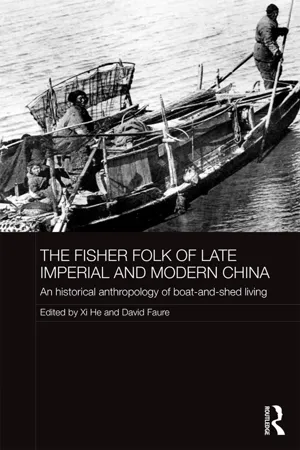
Although most studies of rural society in China deal with land villages, in fact very substantial numbers of Chinese people lived by the sea, on the rivers and the lakes. In land villages, mostly given to farming, people lived in permanent houses, whereas on the margins of the waterways many people lived in boats and sheds, and developed their own marked features, often being viewed as pariahs by the rest of Chinese society. This book examines these boat and shed living people. It takes an "historical anthropological" approach, combining research in official records with investigations among surviving boat and shed living people, their oral traditions and their personal records. Besides outlining the special features of the boat and shed living people, the book considers why pressures over time drove many to move to land villages, and how boat and shed living people were gradually marginalised, often losing their fishing rights to those who claimed imperial connections. The book covers the subject from Ming and Qing times up to the present.
eBook - ePub
The Fisher Folk of Late Imperial and Modern China
An Historical Anthropology of Boat-and-Shed Living
- 212 pages
- English
- ePUB (mobile friendly)
- Available on iOS & Android
eBook - ePub
The Fisher Folk of Late Imperial and Modern China
An Historical Anthropology of Boat-and-Shed Living
About this book
Information
Part I
As seen from historical sources
1 Government registration in the fishing industry in south China during the Ming and the Qing
Yang Peina
The people who lived on boats had always given the impression that they lived adrift, following their catch where the waves took them, mooring wherever they pleased. Yet, life at sea was never very far from land. Land provided the drinking water, the markets, the temples and even the landmarks for any boat population living by the shoreline, and many more lived not only on boats but also on land, going to sea only as their livelihood took them. This chapter deals with one aspect of the sea–land relationship. Governments saw the chance for tax among boat people, and the threat to social and political order if they were ganged up as “pirates”. In the Ming and the Qing dynasties, an interest to tax and to maintain law and order brought on administrative measures that defined and shaped the boat population. A major part of those policies had to do with registration of households, of land and of boats.
Registration of households via river mooring stations
At the founding of the Ming dynasty in the fourteenth century, the imperial government had realized that the coastal population were gathered in bands, which were divided by the manner by which they fished or were engaged in various other economic activities. Coastal resources consisted of salt, fish and transport routes, and they were tightly guarded. As the Ming government established its rule, it applied household registration (lijia) to the coastal population, dividing them into units of tens and hundreds of households according to the occupations that they followed, primarily as commoners (min), salterns (zao) or fishing people (yu). The imperial government also ensured a military presence by the establishment of military colonies (weisuo) that were manned by military (jun) households. Each category of household was held responsible for labour service peculiar to the nature of its manner of living.1
Ming dynasty law was quite clear on the registration of fishing people. In 1382, it was decreed that people who resided on boats and were known as the Dan were to be registered for tax at offices known as river mooring stations (hebosuo). In Xiangshan county, where the 1548 edition of the gazetteer has left a description of how such an office functioned, registration was set up in 1391. In that county, the fishing people made up a substantial portion of the county population, and were grouped into six of the 39 lijia divisions known as du or tu. According to the manner by which the Dan households fished – that is to say, whether they fished with large or small nets or baskets of various types – they were further subdivided into 19 groups. Every year, one among the 2,620 households so registered was to be responsible for delivering the fish tax (yuke) of some 2,000 piculs of rice, 3,000 catties of fish oil and 68 catties of fish glue to the river mooring station. A single official supported by a clerk manned that station. The fishing people were obliged to volunteer household information on pain of confiscation of their fishing equipment.2 Between 1381 and 1383, in Fujian province, 28 river mooring stations were set up, and 46 in Guangdong.3
As Liu Zhiwei has pointed out, it must be understood that, despite the wording of the law, the river mooring stations did not ever register all the fishing people, and that, even then, many were registered, not for labour service as fishing households but for military service as military households.4 Registration under neither category succeeded. The description from the 1548 Xiangshan county gazetteer notes that towards the open sea to the northwest of the county, the Dan were not registered, paid no tax and the government had no means of registering them.5 In Danzhou (Hainan), the demand for military service simply gave the local official the excuse for tax default, because, as they claimed, military exaction had caused massive exodus and, therefore, the river mooring taxes were left unpaid.6 As the exodus of fishing people from the river mooring stations continued into the second half of the fifteenth century, the government began to close some of the stations.
Closing the stations implied the removal of the officials in charge, but not the removal of the tax quotas, which remained on the books for the whole of the Ming dynasty. In effect, it simply meant that the county magistrate now took direct charge of taxation accruing from the fishing people. In some places, changes might have been made to the lijia divisions into which they were classed, as in Xingning county in Guangdong, for instance. There, in one of the du divisions, as the foreshore was brought under cultivation, cultivators were brought together into two separate tu, and the tax-paying Dan were grouped with tax-paying Yao people to make up a new division.7 In Lingshui county (Hainan), the 1618 prefectural gazetteer notes that four villages belonging to the river mooring station located near the present-day Sanya city were tenants on land held by commoners even though they remained to be held responsible for the fish tax.8
The reference to fishing people being tenants on land opens up a totally different aspect of complications in Ming dynasty taxation. The 1691 Chengxiang county gazetteer notes that after the river mooring station there was closed in 1532, the boat people were not only held liable for the fish tax but were also saddled with other taxes that had been transferred to them by the incumbents in the registration division they had joined. In 1671, the magistrate transferred the responsibility for those other taxes back onto the land population so that the fishing people were held liable only for the fish tax.9 Just as likely as the fishing people being held liable for taxes imposed on land was the shifting of the uncollected fish tax to the land population, or the farming of taxes to people who were powerful enough to profit from excess charges or who suffered from being bound to taxes that they could not collect. Those developments had to do with long-term changes in land taxation in the Ming dynasty and needs to be carefully considered below.
Registration of the foreshore
The failure of household registration for tax purposes was written over all of Ming China by the fifteenth century, and the long process began that culminated in what historians refer to as the single-whip reform. Two processes were central to that transformation: the conversion of corvee to a tax paid in silver, and the registration of land, not people, as the basis of taxation. Both processes were apparent in taxation imposed on coastal populations, including fishing people. They came to completion only by the early seventeenth century.10
Throughout the Ming dynasty, tax reform on the fishing people was a thorny problem because, as they lived on boats and did not hold land, obviously fishing people could not be taxed on the basis of land held. Yet, as more and more people deserted household registration, the tax burden fell increasingly and excessively upon people who remained on the registers. Although on occasion the Ming government granted tax amnesty, in the long term, tax remission did not solve the problem of how fishing people might be fairly taxed. Some officials advocated re-registration.11 In other places, such as Xinxing county in Guangdong, the tax remitted from fishing people was absorbed by the rest of the county population, and, as the gazetteer noted “many people were implicated”.12
The early Qing scholar Gu Yanwu recorded a vivid account of the change that came over ownership of the foreshore, which resulted by the seventeenth century. In Changpu county in Fujian, he said, tidal land could be divided into two types. On one type, nets could be set up at high tide, a distinction being made, even then, between deep-netting and shallow-netting locations. On the other type of tidal land, it was possible to catch fish by hand at low tide, and a distinction was made on that type between mud flats and sandy flats. All such land was privately owned. He noted that a century before his time, ownership accrued to people who worked on the land, but by the time he was writing, the land was bought and sold by powerful families.13 A similar description of Guangdong province might be found in the writings of author Qu Dajun, who lamented that “although profit from the sea was bounteous, it had to be sought from man and not from heaven”.14 How that came about may be illustrated by a dispute over the foreshore in nearby Chao’an county.
In the 1691 Chao’an county gazetteer, the county magistrate, who himself had compiled the gazetteer, presented the case as the encroachment of poor people’s foraging rights on the foreshore by the wealthy and powerful who were not necessarily living by the coast. He noted that back in the Ming dynasty, in 1624, as a result of litigation brought by the people registered in the lijia, an official notice had been issued and carved on stone to ban such encroachment. He also noted that since 1688, there had been continuous litigation and so he sought a similar injunction from the provincial governor on the encroachment of the foreshore. The provincial governor acceded to the request, with the provision that details of tax distribution in the lijia needed to be examined. Reference to the lijia suggests that the details of the litigation were far from trivial and that at stake was not really a case of rich versus poor, but the supersession of one institution of tax collection by another, exactly what one would expect when corvee service gave way to land registration during the Ming.
The magistrate, in his presentation, described the rich as having used the profit from controlling the foreshore – in one case, the foreshore owner charged 30 cash from fishing people as they went out to fish – to defray litigation costs, and that, because they won their case, the previous magistrate had accepted their plea and given them licences for their claims. Thereupon, in bringing suit against people registered in the lijia, the rich were able to produce documents to prove that they had been held liable for tax on the disputed land. The current magistrate retorted by arguing that tax had been charged not on land but on registered males (ding) and that, therefore, if registration for tax was the basis of the claim, the fishing people had equal claim.15 That very interesting remark harked back to registration of boat people, and suggested that registration had continued, not necessarily thoroughly or practically, over the number of males each household reported. Whether or not the governor might accept the case as the current magistrate had presented it, therefore, the chance of tax collection was doomed from the start. It would have been as difficult to keep track of household males in the floating population as it was of households. The lijia that had not been delivering in the Ming made short shift of any effort to reassert its authority in the early Qing.
As time went on, the records become abundant that the foreshore had been registered for tax in various forms. Reclamation went on in earnest in Guangdong and Fujian, absorbing large numbers of coastal people, among whom many would have lived on boats as tenants and labourers for generations. In the Pearl river delta, Helen Siu and Liu Zhiwei have described in detail the redefinition of the Dan status in the reclamation process.16 Along parts of the coast, salt fields had also been registered from the early Ming, and as the registration of saltern households collapsed like all household registration did, a similar process of encroachment by the wealthy and powerful was in place in those areas. Yet, certainly enough, many people continued to live on boats and maintain their living through fishing and transport, and through circumstances not totally connected with tax collection, the government found it increasingly attractive to register boats.
Boat registration
In the sixteenth century, piracy on the coast posed a very serious threat to the Ming government. The pirates were more than buccaneers, they were marauding bands that preyed on coastal settlements, including the cities. They were known to contemporaries as “Japanese pirates” (wokou), even though many had no connection with Japan. There were also the collectors of protection money, such as Xu Chaoguang, who surrendered to the government in 1545, who had sent out “huge junks” (jujian) to demand payment in return for tickets in proof that payment had been made.17 Many followed in Xu’s footsteps, the most well-known to historians is probably the family of Zheng Chenggong, who at the end of the Ming dynasty held out against the Qing. His family owned salt fields in Guangdong and ...
Table of contents
- Cover
- Half Title
- Series Information
- Title Page
- Copyright Page
- Table of Contents
- List of Illustrations
- List of Contributors
- Map
- Acknowledgements
- A note for the reader
- Preface
- Introduction: Boat-and-shed living in land-based society
- Part I As seen from historical sources
- Part II As encountered in field research
- Part III As contemporary stereotypes
- Appendix 1: The religious festival of the Liu-wang-wei, 19 May 1877, North China Herald
- Appendix 2: Mechanization, market and moving ashore
- Glossary of Chinese characters
- Index
Trusted by 375,005 students
Access to over 1.5 million titles for a fair monthly price.
Study more efficiently using our study tools.
Frequently asked questions
Yes, you can cancel anytime from the Subscription tab in your account settings on the Perlego website. Your subscription will stay active until the end of your current billing period. Learn how to cancel your subscription
No, books cannot be downloaded as external files, such as PDFs, for use outside of Perlego. However, you can download books within the Perlego app for offline reading on mobile or tablet. Learn how to download books offline
We are an online textbook subscription service, where you can get access to an entire online library for less than the price of a single book per month. With over 1.5 million books across 990+ topics, we’ve got you covered! Learn about our mission
Look out for the read-aloud symbol on your next book to see if you can listen to it. The read-aloud tool reads text aloud for you, highlighting the text as it is being read. You can pause it, speed it up and slow it down. Learn more about Read Aloud
Yes! You can use the Perlego app on both iOS and Android devices to read anytime, anywhere — even offline. Perfect for commutes or when you’re on the go.
Please note we cannot support devices running on iOS 13 and Android 7 or earlier. Learn more about using the app
Please note we cannot support devices running on iOS 13 and Android 7 or earlier. Learn more about using the app
Yes, you can access The Fisher Folk of Late Imperial and Modern China by Xi He, David Faure, Xi He,David Faure in PDF and/or ePUB format, as well as other popular books in Social Sciences & Regional Studies. We have over 1.5 million books available in our catalogue for you to explore.