- 184 pages
- English
- ePUB (mobile friendly)
- Available on iOS & Android
eBook - ePub
About this book
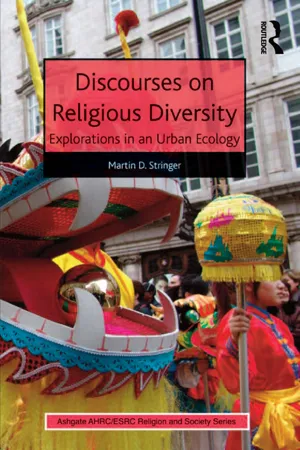
Religious diversity is an ever present, and increasingly visible, reality in cities across the world. It is an issue of immediate concern to city leaders and members of religious communities but do we really know what ordinary members of the public, the people who live in the city, really think about it? Major news items, inter-religious violence and notorious public events often lead to negative views being expressed, especially among those who would not consider themselves to have a religious identity of their own. Martin Stringer explores the highly complex series of discourses around religion and religious diversity that are held by ordinary members of the city; discourses that are often contradictory in themselves and discourses that show that attitudes to religion vary considerably depending on context and wider local or national narratives. Drawing on examples from UK (particularly Birmingham, one of the UK's most diverse cities), Europe and the United States, Stringer offers some practical suggestions for ways in which discourses of religious diversity can be managed in the future. Students in the fields of religious studies, sociology, anthropology and urban studies; practitioners involved in inter-religious debates; and church and other faith leaders and politicians should all find this book an invaluable addition to ongoing debates.
Information
Chapter 1
Religion and Urban Theory
A couple of years ago I had some work done by a local plumber. He did his job and then, as he was leaving, we got to chatting. He asked me what I did for a living and I told him that I taught at Birmingham University. ‘What do you teach?’ he asked. I replied ‘Religion’, one of many alternatives I can use, but probably the most general and the most widely understood. ‘Oh’, he said, ‘I was at the house of a Muslim the other day, nice chap, had a large picture of a man with a turban just inside his front door’.
I get all kinds of responses when I tell people what I do. Religion is one of those subjects that people feel that they ought to have some kind of opinion about. This response, however, was unusual and led, somewhat indirectly to the writing of this book. What I have been interested in was the way in which ordinary people of the city, particularly of Birmingham, Britain’s second city, understand, react to, and talk about the religious diversity around them. This plumber personalised his sense of religious diversity through his account of an encounter with a Sikh client (the merging of Sikhs and Muslims in the popular imagination became very clear following 9/11 when turban-wearing Sikhs suffered more persecution because of their visibility than most of the Muslim population). Others respond with different kinds of comments, different images and assumptions that are held within society and different models of diversity. What follows, therefore, and what is essential to this book, is an analysis of the way in which ordinary individuals begin to manage their responses to religious diversity, and in some sense actually begin to manage that diversity, through their different responses.
Much of the discussion about religious diversity, or interreligious relations in the academic literature, tends to begin either from the perspective of philosophy/theology, or from an understanding of religions as distinct and definable social groupings within society. So, for example, there is considerable theological and philosophical material debating the finer points of whether it is possible to engage creatively between the religions at all (see e.g. Hedges 2010, Cheetham 2011). Or, more usually, whether it is possible to hold a position that acknowledges any truth in one religion while holding firmly to the truth of another, and so on (Cornille 2008). This is not a debate that I wish to enter into.
From a more sociological, and increasingly from a political science-based perspective, the debate about religious diversity has assumed that there are things called ‘religions’ out there that are interacting, and that that interaction needs to be either studied or managed. When we explore in more detail what these ‘things’ called religions actually are, then in most cases the assumption being made is that a ‘religion’ is primarily a group of people, more or less organised, who share a common belief system and who engage in a common set of rituals. It is also assumed that these people see their ‘religion’ as a central element of their own identity and so can define themselves relatively unproblematically as ‘Christian’, ‘Buddhist’, ‘Muslim’ or whatever. Some writers, such as Gerd Baumann (1996), have questioned this basic assumption, and talk of ‘discourses’ rather than social groupings, but the ultimate effect is actually very much the same. Almost all authors working in this field assume that ‘religions’ are a social fact and that the real question is ‘how do they, or how should they, interact?’
I want to question this assumption and I want to do this by starting somewhere very different. I do not wish to address the question of ‘what is a religion’, or even to begin with any assumptions about what a religion is. I covered those kinds of questions in a previous book looking at the role of specifically religious discourses within contemporary Britain (2004). Rather, I want to begin by listening to the people who live within the city and to hear how they are talking about religion, religions, and religious diversity and to identify the kind of assumptions that they are making within their conversations. More significantly, however, I want to ask where these assumptions may have come from and how they interact with the changing reality of the city itself.
For some years now I have been working within a number of different communities in the inner-urban areas of Birmingham, and before that I worked very closely with similar communities in Manchester. I also have a number of research students who have worked in different inner-urban communities and been involved in detailed ethnographic work in these areas. I therefore began this project with a great deal of circumstantial data. I did not, however, have the kind of detailed data on religion and religious diversity that I would have liked to collect to answer the kind of questions I was interested in. I therefore explored a number of different kinds of approach and different potential frameworks to see what makes most sense of the data that I had already collected and what further data could be collected to address the specific issues of religious diversity.
I want to develop the specifically methodological issues surrounding this study in Chapter 2 when I begin to talk about the kind of data that I collected and the different ways in which it could be approached. In this chapter, therefore, I want to stand back somewhat from the more specific issue of religious diversity, and the language used to express that diversity, to explore the range of theoretical frameworks within which the study of religion and the city have been understood in the past and so, as it were, to set my own study within this wider theoretical context.
Mapping Urban Theory
Urban theory can cover so much, from so many different disciplines including anthropology, sociology, political science, and urban geography among others. I am not going to be exhaustive in my survey of how religion interacts with urban theory; rather I am going to attempt to map the field to provide a sense of the range of theoretical frameworks available. In doing this I will aim to explore the various theories under consideration through a grid. On the vertical axis I wish to see a continuum from ‘top down’ to ‘bottom up’ reflecting the stance of the theory in relation to the population of the city. On the horizontal axis I will suggest a similar continuum from ‘macro’ to ‘micro’ representing the scope of the theoretical framework. Both of these axes should be seen as continua, but for the purposes of this discussion I want to suggest that this grid can provide four categories which can then be used to look more closely at the theories themselves. These categories are top down–macro, top down–micro, bottom up–macro, bottom up–micro. I will look at each of these in turn and explore the kind of theoretical frame and wider assumptions that are present in the work of the authors placed in each category. I will then look at how these authors, or others working within the same frame, have engaged with religion within their theories. In order to simplify the discussion I will provide only two or three examples of the kind of theories that are present in each quadrant of the grid.
Top Down–Macro
Any top down–macro study will be seen primarily as a classic bird’s-eye view of the city. In other words all those writers who begin with the geographical positioning of the city and its overall shape and structure would belong to this category. Much of the work that deals with the history of the city or the city as an idea (whether real or fictional) can also be fitted into this quadrant, which probably reflects the vast majority of theoretical writing on the city itself. For the purposes of this discussion I am going to look at two kinds of theory. The first deals with the concept of ‘morphology’ and looks at the role religion plays in the mapping of the city and its development over time. The second will focus much more on governance and questions about the role of religion as a category in the political economy of the city. These are both issues that, in one way or another, will be picked up in the following chapters, but it is perhaps the governance issue that I will focus on most clearly and I will come back to this in Chapter 8.
The classic work on the working class by Friedrich Engels (1987 originally published 1844) clearly opens this kind of analysis. Based in Manchester, Engels notes the way the emerging industrial city has developed with an inner commercial core, a band of worker’s slums surrounding it ‘stretching like a girdle, averaging a mile and a half in breadth’ and beyond that a buffer of lower middle class before the ‘remote villas with gardens’ of the upper middle class in ‘wholesome country air’ (1987, 86). What struck Engels in particular was that ‘the members of this money aristocracy can take the shortest road through the middle of all the labouring districts to their places of business, without ever seeing that they are in the midst of the grimy misery that lurks to the right and the left’ (1987, 86). Of course Engels goes beyond a simple mapping exercise to outline the economic and power relationships built into this model, but it is clearly the city as a whole that is his concern.
This essentially morphological approach to the city, seeing it in terms of concentric rings, was picked up 80 years later by the Chicago School of sociology writing in the 1920s and 1930s. The Chicago School developed analyses that fit into both the top down–macro and the bottom up–micro quadrants of the grid. In an early paper, outlining his vision for the study of Chicago, the founder of the school, Robert Park, laid out an agenda that included both broad city wide approaches and specific neighbourhood studies (1952, 13–51, originally published in 1916). When looking at the city-wide context, Park’s concern was both with the movement of people within the city over time and with what he calls the ‘moral order’ of the city. The movement of people can be seen both in the gradual movement of whole populations from inner-urban areas outwards as their economic base improves, but also in the movement of individuals, which can run counter to the movement of populations; ‘as individuals rise or sink in the struggle for status in the community they invariably move from one region to another; go up to the Gold Coast, or down to the slum, or perhaps occupy a tolerable position somewhere between the two’ (1952, 80).
Drawing on Darwinian ideas, advances in animal and plant ecology, and the work of Spencer on the ‘super-organism’, the image that Park chose to describe his investigation of the city was that of an ‘urban ecology’ (1952, 118, 146). This leads to the idea that the forces for growth, and the rules governing that growth, are in some ways independent of the individuals and populations involved: ‘it is rather a product of natural forces, extending its own boundaries more or less independently of the limits imposed upon it for political or administrative purposes’ (1952, 167). McKenzie and Burgess built on Park’s basic ideas to develop the classic ‘bulls eye’ model of the city with concentric rings through which the different populations moved over the course of time as part of this organic process of growth (McKenzie 1933, 173–8, Park 1952, 171, 194, Burgess 1967, 51).
In terms of religion, or religious diversity, then the best this kind of analysis can achieve is to note some kind of connection between certain ethnic groups and specific religions, such as that between the Irish or the Italians and Catholicism or the Germans and Lutheranism, and then to use the movement or mixing of the ethnic populations as a proxy for the movement of religious communities. This is something that Lowell Livezey and his colleagues do to a certain extent in the Religion and Urban America Project at the end of the last century (Livezey 2000a). This project is rooted in the Chicago tradition of sociological analysis, although it recognises how far the methodological questions have developed and is able to build on these developments to provide a more nuanced account than is seen in Park, McKenzie and Burgess. The project also recognises that the nature of religion, and the place of religion in American society as a whole, has also developed in the second half of the twentieth century, what Robert Wuthnow describes as the ‘restructuring of American religion’ (1998). Livezey relates this religious restructuring to a corresponding restructuring of the urban context and a refocusing of the moral culture (2000a, 3–23). The question of religious diversity, however, only really comes to the fore in relation to the city as a whole and when that whole is viewed from a bird’s-eye perspective.
Writers in the mid twentieth century provided a wide range of critiques of the Chicago school and its ecological model. Perhaps the most substantial begins by saying that the ecological language of the model takes no account of the forces, political and economic, and more specifically the people, the political leaders, business leaders and city managers, that were needed to make the model work (Thorns 2002, 28–30). The organic growth of the city, these critiques suggest, does not happen of its own accord; it is managed by the city authorities and is the result of many different decisions, most of which are political and economic. David Thorns identifies the ‘managerial approach’ as the first major critique of the Chicago School in chronological terms and identifies this specifically with the work of John Rex and Robert Moore who investigated ethnicity and housing in an inner urban area of Birmingham in the 1960s (Rex and Moore 1967). Rex and Moore, however, focussed almost entirely on local, or middle, managers and so probably should fit within a micro quadrant of my model. It was the Marxist inspired work of political theorists in the 1970s, therefore, that began to offer a more serious alternative to the Chicago School at the macro level with their analysis of the political economy of cities as a whole (Castells 1977, Harvey 1973).
The analysis of the city through the lens of political economy focuses on the way in which political and economic decisions affect the growth and development of the city. In this view all economic decisions are political in that they are made to forward a political, and often a class, agenda. It is the political elite, those Engels refers to as the ‘Big-Wigs’, who have control of this system, and the same elite are also in control of the means of production, as well as the process of consumption, within the capitalist economy (Harvey 1973, 130–36). The decisions, therefore, are not neutral, or organic as Park suggested, they serve a particular ruling sector of society. An interesting recent example of this kind of approach comes from the work of Dolores Hayden looking at the development of suburbs at the outer edges of US cities (2006). Here the conventional narrative has always been one of ‘private enterprise’ and ‘market forces’ such that people were said to want to leave the cities and move to areas which were more open and with more land. The developers, therefore, built large uniform suburbs in places like Levittown on Long Island, because that is what the market demanded. What Hayden demonstrates is that this is far from the truth. In the 1930s the Roosevelt administration chose to subsidise, through tax breaks and beneficial land deals, the building of large cheap estates on the outer edges of cities (often without the infrastructure of roads and sewerage etc. to support them) and because of a lack of viable alternatives in the inner urban areas individual families were forced to buy properties and move out to these edge of city estates, at which point the political authorities were forced in turn to provide the infrastructure, providing yet another form of subsidy to the developers. This kind of pattern can be reproduced across the world where politicians and developers work round local legal systems to provide profit for themselves.
More recently the work of Saskia Sassen and others on ‘global cities’ builds on both the Chicago School and the political economy theorists to look at how global capitalism has led to a specific form of the urban experience (Sassen 1991). While Sassen does deal in passing with questions of migration, immigration and ethnicity within the cities she is focussing on (1991, 299–317) there is no direct reference to religion. The point she does make, however, is to note the way in which London, New York and Tokyo (the only three cities at the time she was writing that met her criteria of ‘global cities’), despite having very different histories, governance structures, economies and cultures, have all responded in parallel ways in terms of economic base, spatial organisation and social structure to the global economic and political forces of the last 30 years (1991, 4). This suggests that much of what I am proposing within this text may be equally true for many other cities across the world, although that would, of course, have to be tested empirically.
We could perhaps compare Sassen’s work, at least in its global vision, with that of Hugh McLeod, who looked at the role of religion within the development of London, Berlin and New York in the second half of the nineteenth century (1996). McLeod does see commonalities between these three cities, but also identifies a number of significant differences. He situates them at different stages in relation to the alienation of the working class from religion. At the turn of the twentieth century New York represented the first stage, the loosening of ties with the church, London represented the second stage, the decline in attendance at regular church services, and Berlin represented the third, the ‘widespread repudiation even of the Christian rites of passage’ (1996, 207). This should at least warn us that globalization is not a recent phenomena and also that there are numerous texts available on the historical place of religion within the city. Most of these historical accounts, however, as with that of McLeod, tend to focus on one religion, most normally Christianity, as the level of religious diversity found in a city such as Birmingham today is a very recent phenomena, a product in part of the processes of migration and immigration that Sassen discusses.
Top Down–Micro
With the top down–micro quadrant we move onto what has been referred to as ‘city cultures’ (Miles, Hall and Borden 2004). The top down element means that we are still concerned with work that treats the city in a holistic fashion, theorising about the city as a unit, or perhaps even more specifically in this context, as an ecology, although picking up a different understanding of ‘ecology’ from that which is usually associated with Park’s work. One element of Park’s ecology was associated with Darwinism and the idea of the city as an organism. Another built on the idea of the particular locality, and the idea of a specific ecology for a particular riverbank or hedgerow for example (1952, 146, McKenzie 1967). From the top down–micro perspective, therefore, I am thinking of ecology in the sense of an environment, the range of organisms living within a specific niche that interact and co-exist to form a single unit. The micro, however, also focuses our attention on the individual or the smaller social groups within the city and the way in which these are affected by the possibility of a wider urban ecology.
In focussing on the top down–micro quadrant I want to look first at those theories that see the urban context as alienating in some way, as separating the individual off from the wider community. The classic work in this area is Louis Wirth’s essay ‘Urbanism as a Way of Life’ (1938) although many modern theorists prefer to look back beyond this to Georg Simmel’s work that covers a very similar area but with much more depth and sophistication (1950, originally published 1903). This kind of approach has underpinned much of the debate throughout the twentieth century on secularisation, and the role of ‘urbanisation’ within this process, and I will touch on some of this literature below. The second set of theories I wish to pick up are those related to religion in the public sphere, built on ideas of civic society and the work of Jürgen Habermas (1991) among others. This has been developed in a number of different ways by those specifically concerned with the role of religion in civic society and will provide a strong theme within the rest of this book.
Both Wirth and Simmel were interested in the effect of urbanisation on the individual. Simmel was concerned primarily with what he conceived of as the psychological impact of the city, or metropolis, on individual citizens (1950, 409–10). This impact can be seen in a number of often contradictory, or even conflicting, ways. Simmel picks up, for example, the way in which the increased pace of life within the city leads to a more intellectual, even objective approach to others rather than one based on emotion and subjectivity (1950, 410). On the other hand the metropolis also enabled a certain level of freedom for the individual to develop their own personality and to reconstruct themselves (1950, 413–14). In both cases it is individualism that is at the core of the impact of the city, and it is this increasing focus on the individual, either negatively or positively, that is identified as the essential experience of the metropolis. For Simmel it is also important to note the role of money both in the development of the different understandings of individualisation and in the sustaining of those states within the metropolis (1950, 411, 1990, originally published 1907).
Wirth develops a very similar argument, building on Simmel’s own work alongside that of Weber, Durkheim and other late-nineteenth-century scholars (1938). He begins by following a Weberian methodology and proposing two ideal types that represent rural and urban contexts (1938, 3). The rural is focussed on community and tradition while the urban, following Simmel, focuses on the individual. The drivers for the focus on the individual are not quite the same for Wirth as they are for Simmel, with more emphasis being placed on the size and density of the city rather than the pace of life and nature of human interactions as such. However, it is still the individualisation of the urban ecology that Wirth wants to highlight in opposition to the commun...
Table of contents
- Cover Page
- Title Page
- Dedication
- Copyright Page
- Contents
- List of Tables
- Acknowledgements
- 1 Religion and Urban Theory
- 2 Discourses of Diversity
- 3 The Two Towers
- 4 Religion in a Context of Super-diversity
- 5 Taking to the Streets
- 6 The Year of the Golden Pig
- 7 Urban Memory
- 8 Managing Discourses of Religious Diversity
- Bibliography
- Index
Trusted by 375,005 students
Access to over 1.5 million titles for a fair monthly price.
Study more efficiently using our study tools.
Frequently asked questions
Yes, you can cancel anytime from the Subscription tab in your account settings on the Perlego website. Your subscription will stay active until the end of your current billing period. Learn how to cancel your subscription
No, books cannot be downloaded as external files, such as PDFs, for use outside of Perlego. However, you can download books within the Perlego app for offline reading on mobile or tablet. Learn how to download books offline
Perlego offers two plans: Essential and Complete
- Essential is ideal for learners and professionals who enjoy exploring a wide range of subjects. Access the Essential Library with 800,000+ trusted titles and best-sellers across business, personal growth, and the humanities. Includes unlimited reading time and Standard Read Aloud voice.
- Complete: Perfect for advanced learners and researchers needing full, unrestricted access. Unlock 1.5M+ books across hundreds of subjects, including academic and specialized titles. The Complete Plan also includes advanced features like Premium Read Aloud and Research Assistant.
We are an online textbook subscription service, where you can get access to an entire online library for less than the price of a single book per month. With over 1.5 million books across 990+ topics, we’ve got you covered! Learn about our mission
Look out for the read-aloud symbol on your next book to see if you can listen to it. The read-aloud tool reads text aloud for you, highlighting the text as it is being read. You can pause it, speed it up and slow it down. Learn more about Read Aloud
Yes! You can use the Perlego app on both iOS and Android devices to read anytime, anywhere — even offline. Perfect for commutes or when you’re on the go.
Please note we cannot support devices running on iOS 13 and Android 7 or earlier. Learn more about using the app
Please note we cannot support devices running on iOS 13 and Android 7 or earlier. Learn more about using the app
Yes, you can access Discourses on Religious Diversity by Martin D. Stringer in PDF and/or ePUB format, as well as other popular books in Theology & Religion & Religion. We have over 1.5 million books available in our catalogue for you to explore.