Critiquing the politics and dynamics of the transcultural poetics of reading literature, this book demonstrates an ambitious understanding of the concept of the poet across a wide range of traditions – Anglo-American, German, French, Arabic, Chinese, Sanskrit, Bengali, Urdu – and philosophies of creativity that are rarely studied side by side. Ghosh carves out unexplored spaces of negotiation and intersections between literature, aesthetics and philosophy. The book demonstrates an original method of 'global comparison' that displaces the relatively staid and historicist categories that have underpinned comparative literature approaches so far, since they rarely dare stray beyond issues of influence and schools, or new 'world literature' approaches that affirm cosmopolitanism and transnationalism as overarching themes. Going beyond comparatism and reformulating the chronological patterns of reading, this bold book introduces new methodologies of reading literature to configure the concept of the poet from Philip Sidney to T. S Eliot, reading the notion of the poet through completely new theoretical and epistemic triggers. Commonly known texts and sometimes well-circulated ideas are subjected to refreshing reading in what the author calls the 'transcultural now' and (in)fusionised transpoetical matrices. By moving between theories of poetry and literature that come from widely separated times, contexts, and cultures, this book shows the relevance of canonical texts to a theory of the future as marked by post-global concerns.
eBook - ePub
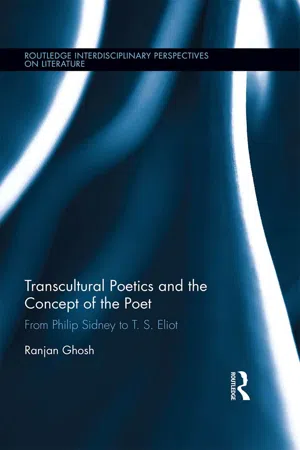
Transcultural Poetics and the Concept of the Poet
From Philip Sidney to T. S. Eliot
- 196 pages
- English
- ePUB (mobile friendly)
- Available on iOS & Android
eBook - ePub
About this book
Information
1 Trans-habit
Accident is the omission of act in self & the hindering of act in another; This is Vice, but all Act is Virtue. To hinder another is not an act; it is the contrary; it is a restraint on action both in ourselves & in the person hinder’d, for he who hinders another omits his own duty at the same time.
—William Blake1
“Do you really think,” inquired the patient Diotima of the polemical Socrates, “that if a thing isn’t beautiful it’s therefore bound to be ugly?. … And that what isn’t learned must be ignorant? Have you never heard of something which comes between the two?” Plato2
Within the rhythms of life, the swinging gateway opens and novelty emerges spontaneously to revitalize the world, tempering whatever has moved to an extreme, and reclaiming whatever has strayed from the path. Whatever is most enduring is ultimately overtaken in the ceaseless transformation of things.3
Can habit, with its repetition, a uniformity of happening, and comfort-generation have a conative property to trouble and stir? A certain habit of doing or performing repeated over a time generates an indulgence for a change, albeit transient. But the transience is a habitation for experiencing a performative alternative which might be disruptive in a positive way. What that means is that the ‘alternative’ can be re-creative resulting in habit-shedding; consequently, it espouses a new act which, again, in its repetitive fervour, can surface as a new habit. If getting positioned over is a habit, abandoning oneself for the ‘random’ is a habit too. A habit dies hard but it can have the simmer beneath the supposed encrustation, graduating from a deadened status to a ‘staging’, from an establishment to enfranchisement. Habit then is not a polarity, rather, is reason; it is also difficult to reason why something becomes a habit. Habit is will and intelligence locked in a tricky combination. Going out of habit—the trans-habit—is a way of seeing and performing the flanuer in all of us. Michel Serres’s glorious evocativeness is worth our attention:
Method passes through the forest considering the trees of no account; it crosses the wide sea. Thus the farmer ploughs the field to kill all plants and roots and to coax it so that a single plant may flourish without rivals; he despises as a savage the woodsman who is expert in trees and vines, in the places and times of each, finding his way in the forest with no paths or compass, by means of markers so ingrained that they become instinctive. Taking the straight path out of the woods without seeing anything is equivalent to liberating oneself from savagery or wilderness. These two relationships to places and space are still the distinguishing mark today of the distance between the man of science and the man who is called, disparagingly, a literary man or poet—wild—the distance between the landscape and the panorama.4
Here lies the profound antagonism between the science of habit with the poetics of habit. Rabindranath Tagore points out how the habit of rhythm of the universe is a trick, a mystery, a panorama and a labyrinth. Our living, thinking and modes of expression in art and life are impatient with the wry and insipid forms of habit. Habit operates to challenge our conditions of existence and thought; its potency is in outlawing the most conceivable curves where ‘adventures begin with shipwreck’.5 The poet is the sailor is the rambler. Habit is in revisiting habit wherein the story stays embosomed.
Jim Garrison rightly notes:
to say customs form habits is a pragmatic naturalist’s way of agreeing with Gadamer that culture has us before we have it, and that our task is to become reflectively aware of our habits to discriminate those that enable us to understand from those that do not. We all live lives prescripted for us by cultural texts; for example, ideas like “Free Will,” “the Bible,” or “Enlightenment ideals of Rationality” condition our understandings, including feelings, about ourselves and others even as we strive to edit and emendate the story of our lives. To acknowledge oneself as controlled by habits and conditioned by prior social customs is simply to recognize that one’s values, beliefs, interests, perceptions, and so on are primordially predetermined by the social context, including dominant cultural texts, of a given historical epoch. We cannot eliminate social conditioning or the prejudices that result; we can only deceive ourselves into believing that we have. Socially conditioned habits constitute our self-identities.6
Habits determine our experience, our precincts of knowledge, through familiarity bred thereof. So Thomas Carlyle lets us see through his Sartor Resartus how customs ‘has hoodwinked us, from the first; we do everything by Custom, even Believe by it; that our very Axioms, let us boast of Free-thinking as we may, are oftenest simply such Beliefs as we have never heard questioned’.7 Trans-habit challenges our customs of thinking and thought, leaving inherited habitual attitude under scrutiny. This is not to discredit all forms of thought and knowledge that habits establish and generate. Carlyle is right to observe that ‘habit is the deepest law of human nature. It is our supreme strength: if also, in certain circumstances, our miserablest weakness’.8 Habit then builds the fire of opposition under it and trans-habit intensifies and diversifies that inherent opposition further. The repetitiveness of habit and consciousness against being dulled by its iterative torpor can result in moral virtues and a separate vein of emotion9; habit in its seriality can be physiological in nature and origin too.10 Habit insensitivises us to its own operations; we are habituated into losing our consciousness of habit. The authority of habit deauthorises us.
Powered by an inward principle, habit, as a ‘blind giant’, conceals, as Ralph Waldo Emerson notes, our power of improvement. Contradicting Emerson, I would like to argue by saying that describing habits is not always about describing ourselves, for if habit straps a law it also exposes man to ‘another law’. Habit is inviolately regulative and yet self-reflexive (a Carlylean unconscious). Emerson’s observations, however, implicate this hypostasizing and yet transforming power of habit:
[…] I desire to warn you against the smallest taint of evil existing in you, because, there are such things as habits. I beseech you to consider that every action you do is either the beginning of a habit, or is part of a habit already existing. And the terror of this consideration lies in this fact, that we are not one thing, and our habits another, but that we are formed by them, and changed by them.11
Trans-habit is a complicated game of authority positions: changing baton of power, intent, will and creativity. It produces the power and dynamics of ‘listening’.
The rhythm of life and our ways of seeing are habits caught in hexis and praxis—emerging from the verb ekhein which is about having a state and disposition.12 Felix Ravaisson looks into an active agency that habit is capable of concealing: disposition transforming into a potential (dunamis) that can trigger change and counter-change (hexeos). Potential is acquired for mutable disposition and stay possessed for more actualization (energeia). Clare Carlisle and Mark Sinclair explain Ravaisson’s understanding of active force in habit as a drive or tendency which comes close to Leibniz’s interpretation of the law of inertia: ‘if hexis signifies a “way of being”, it is a way of being of the body, which is not the mere mechanism or material thing envisaged by Descartes and Kant, but intrinsically active and dynamic. If, through habit, “the idea becomes being”, this is a process that involves the body and its movements’.13 Will and instinct are complicit in habit manifestation or abilities of habit which although stays as apparent antipodes are yet not incommensurable opposites: ‘habit is the dividing line, or the middle term, between will and nature; but it is a moving middle term, a dividing line that is always moving, and which advances by an imperceptible progress from one extremity to the other’.14 Habits come with beliefs and embodied habits come with emotions, as John Dewey tells us. There cannot be much disagreement with Dewey when he observes that all habits are affection and instrumental in constituting the self, bearing a ‘projectile power’.15 Habit works with the force of will and also with a sense acquired through a commitment to a repetition. It orders and systemises our actions and, strangely, in its benumbingly customised and socialised monotony, bears the worm of a manifestation which can be transitive and refigurative in nature. The understanding and affection that habit builds are, hence, thrown into crises, brought under violence, resulting in an unpeace which becomes a potential trigger for greater manifestations. Interruption in the continuity of habit becomes an inception in thought. Habit thinks when habit is denied. Ruptures in habits do not simply come from rational interrogation into the legitimacy and validity of its continuity; they come from impulses also—the sudden power to break free from routine codes of acts and thoughts, a release of energy that solicits imagination and indulgences. Trans-habit is the provocation to stop being deceived by the beauty of customs and mores and being confronted instead by the sublime of self-exceeding that reconsiders our threshold factors of existence. This generates ‘active listening’.
I
T. S. Eliot’s brief but deep habitation in Immanuel Kant resulted in four essays in the early part of his career. He believed that Kant spent a lifetime in the ‘pursuit of categories, fixed only which he believed, rightly or wrongly, to be permanent, and overlooked or neglected the fact that these are only the more stable of a vast system of categories in perpetual change’.16 One may argue saying that this fixing of categories is tantamount to habit formation: habit of aesthetics, etymologically meaning perceiving. However, trans-habit implicates categories under revision and change resulting in, to refer to Eliot again, ideas and flux—‘each is the other’ because ‘idea and flux are … relative to each other, but … also to our point of view; from which there are inevitably degrees of reality, leading up to the Idea of the Good, which is, however, identical with all the other degrees, being at once a goal and an immanent concrete universal’.17 Habits of thinking without being independent and irreducible categories explore the relation of the one to the many where interpretation mediates between the domains of being and becoming to evolve a coherence that is not permanent. This lends an antagonistic rhythm to trans-habit—its witful investment in debate and the inevitable incidence of opposition because ‘what makes a real world is difference of opinion’.18 In Sanskrit philosophy, there are the vada and dwandhyas—the logic and dynamics of counter or opposition. Trans-habit initiates what in the Buddhist, Hindu and the Jaina tradition is called tarka. This pattern of negotiation or dialogue does not always require resolution or expire in agreement. Tarka on or about a habit leads to revisionary premises, pushing the frontiers of possibility. It can work diffractively—foregrounding a premise where vada, vivada (counter argument), pramana (evidence, reason), non-pramana, pratyaksa (perception), anuman (inference) do not work in a pattern that is neither and conclusive nor inconclusive, not always in an inflexible soundness of judgement bu...
Table of contents
- Cover
- Half Title
- Title Page
- Copyright Page
- Table of Contents
- Preface: Forces of Habit
- Acknowledgements
- 1 Trans-habit
- 2 Mistress-Knowledge? Abuse, Apology and After
- 3 ‘To you I submit my selfe, and worke. Farewell’: The Poet and the Reader
- 4 ‘Launch not beyond your depth but be discreet’: The Tulip Poet
- 5 ‘Fearful Symmetry’: Quantum Creativity
- 6 ‘Hero as Poet’: Thomas Carlyle and ‘Future Poetry’
- 7 ‘O life unlike to ours!’: Matthew Arnold as an Indian Sage?
- 8 The ‘Platinum’ Poet and the Trans-Habitual Making of a Poem
- Bibliography
- Index
Trusted by 375,005 students
Access to over 1.5 million titles for a fair monthly price.
Study more efficiently using our study tools.
Frequently asked questions
Yes, you can cancel anytime from the Subscription tab in your account settings on the Perlego website. Your subscription will stay active until the end of your current billing period. Learn how to cancel your subscription
No, books cannot be downloaded as external files, such as PDFs, for use outside of Perlego. However, you can download books within the Perlego app for offline reading on mobile or tablet. Learn how to download books offline
Perlego offers two plans: Essential and Complete
- Essential is ideal for learners and professionals who enjoy exploring a wide range of subjects. Access the Essential Library with 800,000+ trusted titles and best-sellers across business, personal growth, and the humanities. Includes unlimited reading time and Standard Read Aloud voice.
- Complete: Perfect for advanced learners and researchers needing full, unrestricted access. Unlock 1.5M+ books across hundreds of subjects, including academic and specialized titles. The Complete Plan also includes advanced features like Premium Read Aloud and Research Assistant.
We are an online textbook subscription service, where you can get access to an entire online library for less than the price of a single book per month. With over 1.5 million books across 990+ topics, we’ve got you covered! Learn about our mission
Look out for the read-aloud symbol on your next book to see if you can listen to it. The read-aloud tool reads text aloud for you, highlighting the text as it is being read. You can pause it, speed it up and slow it down. Learn more about Read Aloud
Yes! You can use the Perlego app on both iOS and Android devices to read anytime, anywhere — even offline. Perfect for commutes or when you’re on the go.
Please note we cannot support devices running on iOS 13 and Android 7 or earlier. Learn more about using the app
Please note we cannot support devices running on iOS 13 and Android 7 or earlier. Learn more about using the app
Yes, you can access Transcultural Poetics and the Concept of the Poet by Ranjan Ghosh in PDF and/or ePUB format, as well as other popular books in Literature & Literary Criticism. We have over 1.5 million books available in our catalogue for you to explore.