eBook - ePub
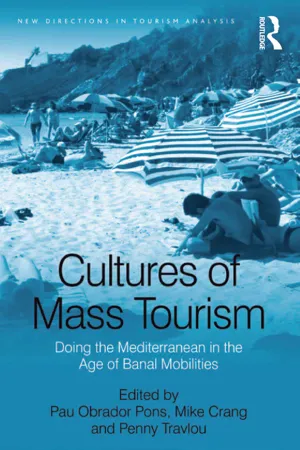
Cultures of Mass Tourism
Doing the Mediterranean in the Age of Banal Mobilities
- 192 pages
- English
- ePUB (mobile friendly)
- Available on iOS & Android
eBook - ePub
Cultures of Mass Tourism
Doing the Mediterranean in the Age of Banal Mobilities
About this book
With more than 230 million international tourists a year, the Mediterranean region is the largest tourist destination in the world. This book outlines that its economic importance is matched by its significance as a cultural and aesthetic phenomenon. Through a series of ethnographic insights into some of the key sites of mass Mediterranean tourism, it focuses on package tourists' experiences of the serial, banal and depthless spaces that are mushrooming along the coast and the enchantments, dissolutions and dreams that saturate them. Moving away from the notion of authentic places corrupted by mass tourism, the book shows how new forms and spaces are made and remade by the mobilities and performances of locals, workers and tourists. Finally, the book looks at the complex materialities of mass tourism and the many networks that make it possible.
Information
Chapter 1
Introduction: Taking Mediterranean Tourists Seriously
Pau Obrador Pons, Mike Crang and Penny Travlou
This book is about the emerging cultures of mass tourism. While the rise of mass tourism has been the subject of much attention, the focus has tended to be on the impact it has upon local peoples, local economies or local environments as well as on economic and managerial issues. This book instead wants to take the cultures of mass tourism seriously, knowing that even putting it so sounds like an oxymoron to many. With more than 230 million international tourists a year, the Mediterranean is the largest tourist destination region in the world. To follow Löfgren (1999) the Mediterranean is now less united by Braudel’s rhythms of olive, grain and wine cultivation, shared trade and Roman legacies than the fortnightly pulse of the package tour, the circulation of resort types and the shared culture of sun-seeking tourism. This book sets out to demonstrate that the economic importance of mass tourism in the Mediterranean is matched by its significance as cultural and aesthetic phenomena. As well as transforming the derelict economies of the Mediterranean, mass tourism is one of the most sensational cultural phenomena of our times and is a central feature of the contemporary everyday in Western Europe (Rojek 1993, Inglis 2000, Franklin and Crang 2001). It can no longer be considered as a discrete activity, contained in special locations and times, but paraphrasing Franklin it ‘has become a metaphor for the way we lead our everyday lives in a consumer society’ (2003: 5). Mass tourism has developed into a new cultural formation that mixes global, national and local influences. Most of the elements of this cultural formation, which have yet to be addressed, destabilize fixed and coherent identities for places. Mass Mediterranean tourism is rather creating a new space of related and refracted practices through reciprocally entwined, though not equal, cultures of work and tourism. It is these new practices and spaces that this collection brings together.
Mass Mediterranean tourism is a historically specific phenomenon that is generally associated with three different elements. First and foremost, it is associated with the democratization of leisure and the extension of tourism to all sectors of society. It is in this respect a ‘quantitative notion’ that refers to the ‘proportion of the population participating in tourism or on the volume of tourist activity’ (Bramwell 2004: 7). Secondly mass tourism is also associated with a particular mode of tourism production that emphasizes economies of scale. Mass tourism involves the industrialization of leisure, the translation of Fordist principles of accumulation to tourism, including the large replication of standardized products, the reduction of costs and the promotion of mass consumption and spatial and temporal concentration. Cheap package holidays are the most visible manifestation of this mode of production, which is currently being replaced by more sophisticated versions combining economies of scope with economies of scale. Finally, mass tourism is associated with a particular tourist sensibility that emphasizes warm climate, coastal pleasures, freedom from the regulated world, relaxation and a party atmosphere. Often defined in opposition to classical ideas of travel as sightseeing, mass tourism represents a different tourist experience that is summarized with the three ‘S’s: sun, sea and sand (and also sex and spirits).
These three elements come together for the first time in the late nineteenth century in the coastal towns of Britain, notably Blackpool (Bennett 1983, Walton 2000). After the Second World War mass tourism internationalizes, establishing the Mediterranean as its main destination and its most remarkable manifestation. A number of factors made possible the emergence of mass tourism including innovations in transport, the consolidation of a welfare system, the increase in real income, the reorganization and rationalization of time and the improvement of international relations. Over the past 20 years or so mass tourism has embarked on a still ongoing process of restructuration that has profoundly reshaped the neat picture that emerged in the 1950s and 1960s (Bramwell, 2003, Aguiló 2005). The introduction of more flexible forms of accumulation in tourism has lead to the expansion of mass tourism beyond the beach, with a diversification of tourist experience though the industrialization of leisure as well as climatic and hedonistic pleasures remain a common denominator in the majority of Mediterranean tourism. In this context it would be a mistake to reduce mass tourism to beach tourism and indeed to ignore its relationship with everyday life in Northern Europe.
Mass tourist sites are some of the most iconic examples of western consumer societies; and yet the study of tourism is still dominated by policy led work, with a productivist bias that emphasizes the topics and values linked to processes of production. Issues related with the organization of tourist provision and its impact have systematically received priority over issues related with touristic consumption. Even when consumption is addressed it tends to be through the production of marketing materials, and the creation of landscapes for consumption, turning mass tourism into ‘a logical extension of the general principle of industrial capitalism to the realm of leisure’ (Böröcz in Koshar 1998: 325). The majority of literature on mass tourism and beach resort tourism, including the works of Bramwell (2004), Apostolopoulos et al. (2000) and Montanari and Williams (1995), adopts an economic and managerial perspective on resort development, growth and increasingly, sustainability. Some of these works make reference to cultural change, focusing mainly on the impacts of mass tourism on the host community. However studies of the culture of tourists are relatively uncommon and those of the culture of mass tourism even rarer. Simply taking the holdings of one of the editor’s university catalogues, less than 10 percent of the more than 200 volumes on tourism were significantly focused around the tourists themselves, their experiences and what they made of them. And of those, most were then picking out specific interesting niches of cultural tourists (such as backpackers or spiritual tourists). This seems to reflect the origins of much of the interesting work on cultures of tourism through anthropology. There the tradition of the study of isolated local communities has often set up an uneasy relationship with tourism and tourists, where their presence is seen as a threat to local identity (and the credential of professional travellers and scholars) (Crick 1992, Risse 1998, Galani-Moutafi 2000, Crang 2009). The effect has been that cultural studies of tourism are freighted with problematic legacies of scholarship that saw ‘host’ communities as static, small scale recipients of industrially produced flows of people. Local cultures are seen as eroded by a homogenous inauthentic, consumer culture.
The study of mass tourism is shaped through a series of striking paradoxes. For sure, mass tourism does promise pure entertainment and often flirts with the banal; and yet the conceptualization of tourism still relies on outdated notions of authenticity that establish social distinctions between good and bad tourism. Much critical academic work focuses upon breaking down those promises to reveal the often unpalatable social realities involved in their production. Inglis (2000: 5) notes ‘The dreams are powerful and beautiful’ and we should be careful of dismissing them and their role in people’s lives, even if ‘dedicated dreambusters in their big boots will, correctly, point out the horrors and boredom of actually existing tightly packaged trips, the mutual exploitation of tourist and native’. Mass tourism is thin on meaning and ideological narratives and very dense on physicality and sensuality; and yet scholars with an interest in cultures of tourism have chosen overwhelmingly to examine discourses, meanings and ideological structures at the cost of physicality. With the emergence of mass tourism, the Mediterranean has been re-integrated within a global set of cultural, social and economic networks; however the Mediterranean is still conceptualized as a bounded region that is subject of external forces producing impacts, a region that needs to be preserved from foreign invaders. This book responds to our discomfort with these shortcomings. Dominant perspectives on tourism have failed to provide an adequate basis for exploring the cultural dimension of mass tourism.
Despite its enormous significance mass tourism rarely makes an appearance in contemporary social science, which tends to marginalize this tourist phenomenon. With few exceptions, most notably Urry (1990) and Bauman (2000), tourism is a stranger to current theorizations on consumption, globalization, identity formation and the consolidation of new modes of bio-political regulation. If used as an example, it is often of a shallow identity or subjectivity. In recent years there have appeared several high profile collections and volumes reflecting a surge in interest in cultures of tourism and their significance. The most significant of these are Urry and Sheller’s Tourism Mobilities (2004), Desmond’s (1999) work on Staging Tourism, the histories of vacationing by Löfgren (1999) and Inglis (2000), the collections by Crouch on leisure and tourism geographies (1999), by Bærenholdt et al. on ‘Performing Tourist Places’ (2004) and by Minca and Oakes on the paradoxical desires and outcomes of tourism (2006). All these works interrogate the practices and cultures of tourism as this volume does, but the beach and mass tourism form only a fairly limited aspect of the whole. Most of the works on cultures and practices of tourist still focus on specialist forms of usually high status tourism, such as ecotourism, literary and heritage, adventure tourism. There are, nevertheless several great works looking at ‘living with’ or ‘coping with’ mass tourism in the Mediterranean (Boissevain 1996, Waldren 1996, Abram et al. 1997) and tourist representations (Selwyn 1996). There are also some interesting examples of work devoted to the sun and sand tourism and cultures of the beach (Lenček and Bosker 1998, Urbain 2003), the lure of the sea (Corbin 1994) and sunlight (Carter, 2007). Despite all these valuable contributions, the prevailing view is still that exemplified in the classic work of Turner and Ash (1975) which vilifies mass tourism as uncultured, uncaring and alienating. They describe mass tourists as ‘the barbarians of the age of leisure, the golden hordes’ and the Mediterranean as ‘a pleasure periphery’ (1975: 1). Confronted with the all too apparent constrictions and obvious exploitations of mass tourism, tourist studies generally downplays the banal, the un-exotic and, in particular, the pleasurable character of the tourist experience, reproducing the binary opposition between travel and tourism. It is these moments of actual existing pleasure that this work seeks to recover and to which it gives serious attention, balancing the horrors and boredom with the dreams and hopes, the exploitations with the liberties (Inglis 2000: 5). ‘It is important’, Löfgren reminds us, ‘to see that standardized marketing does not have to standardize tourists. Studies of staging of tourist experience in mass tourism often reduce or overlook the uniqueness of all personal travel experience’ (1999: 8). The lack of attention to the cultures of mass tourism, especially the dreamings and doings of mass tourists, is a major shortcoming in tourist studies. Dominant frameworks – heavily dependent on romantic ideas of travel – dismiss at the best of times the liveliness and creativity of mass tourism. More often than not they fail to unpack the phenomenon at all.
This edited collection contributes to the study of mass tourism with a series of ethnographical insights into some of the key sites of this tourist phenomenon, including the villa, the beach, the island and coastal hotel. In so doing, we want to extend the surge of interest in cultures and practices of tourism beyond specialist products, bringing to light a major component of contemporary consumer culture in Western Europe. The prime focus of this book is on the mundane and banal aspects of mass tourism. We argue for attentiveness to the diversity of practices in mass tourism and look at theorizing it as a way of being in the world, as materially constituted and constituting a social world, being alongside other people and a way of relating to places. The book has an unequivocal empirical orientation with all chapters reporting from recent and ongoing field research in the Mediterranean. However underlying the book there is also a deep rooted theoretical concern with developing new perspectives on mass tourism, new ways of looking at and thinking of this tourist phenomenon that break with the shortcomings of dominant perspectives. Equally we believe it is important to break with the tendency to isolate this tourist phenomenon from the main debates in the social sciences. The field of mass tourism has an enormous potential to be a fertile ground for developing social theory, in particular that relating to contemporary consumer culture. In this introductory chapter we summarize some of the theoretical concerns underpinning this book. We identify three broad areas of inquiry relating with banality and biopolitics, the spatial and temporal dimension of mass tourism and its enactment. It is not our intention to set out a canonical perspective on mass tourism, but to identify some emerging research agendas. Our intention is to contribute to the renewal of a field in desperate need of fresh ideas.
Banality and Biopolitics on the Beach
Rather than adopting an economic or managerial perspective, this book sets out to demonstrate the cultural significance of mass tourism and the significance of mass tourism to mass culture. Such an approach encounters its most serious challenge in the perceived banality of mass tourism. We are confronted with tourist phenomena that draw on gritty vulgarity, playful crowds, a culture of indulgence, a series of corporeal pleasures and the blend of the ancient with the ironic and the kitsch among other things. Mass tourism offers a distinctive form of entertainment – more ‘vulgar’ and ‘corporeal’ – that clashes with the sophistication and detachment of middle class forms of travel, the values of which underpin dominant conceptualizations of tourism. The significance of the banal in tourism has been systematically overlooked by dominant perspectives which have privileged the exotic and the spectacular. There has been little interest and respect for the banal practices and pleasures of ordinary tourists. In downplaying the banal, dominant perspectives have reproduced a social hierarchy of travellers and tourists, thus sanctioning a set of ideological and social distinctions that is as much a stake in class distinction as an actual description of tourist practices. As Franklin and Crang point out ‘too often we risk treating the numerous and enumerated tourists as foreign species, “Turistas Vulgaris”, only found in herds, droves, swarms and flocks’ (2001: 8). Mass tourism might be a ‘depthless’ and a fluid phenomenon with few meanings and utopias attached but it still is a site of relevant social and cultural practices that speak mainly to the body and the sentient. A cultural perspective on mass Mediterranean tourism demands reflection on these elements, including the ordinary experiences of the package tour, the proliferation of highly commodified environments devoted to leisure, the hedonism of night life in Eivissa and Faliraki and the corporeality of sunbathing, among others.
How to make sense of the banal in tourism is one of the main concerns of this book. Drawing on the Frankfurt School some scholars prefer to proclaim the insubstantiality of the banal spaces of late capitalism, emphasizing their impoverishing effects on social life. Others working within the theoretical framework of identity politics prefer the celebration of the banal as a site of political resistance, taking it as a symbolic expression of the more disadvantaged sectors of society. As Meghan Morris noted twenty years ago ‘banality’ serves as a mythic signifier that has all too easily served as a mask for the question of value, and of ‘discrimination’ (Morris 1988: 27). Instead, the route this edited collection follows emphasizes the multiple moods and mutations of the practical, the ordinary and the everyday, that is the banal (Billig 1995). Tourism is part of a ‘banal seduction’ then, not some Baudrillardian ‘fatal shore’ of catastrophic cultural negation, but the ongoing enchantment yet circumscription of life. We start from Haldrup’s, ‘banalizing tourism’, where the time–space of tourism and the everyday permeate each other, but this book goes further in calling attention to the banal itself as being the ways tourist practices produce and reproduce social life and materialize structures of feeling and moral dilemmas. We suggest it is ‘enabling’ for tourist studies and not merely ‘something that is left behind after it has been exorcized or redeemed in the movements of cultural analysis’ (Seigworth 2000: 229). Tourism does not need to be recovered from banality, either by finding the exceptional within it nor by finding its normality exceptional. Banal desire is grounds for neither condemning tourism as beyond redemption nor redeeming some putative resistance – it is instead the medium of tourism. Thus paying attention to it is to heed what Michel de Certeau called ‘the oceanic rumble of the ordinary’ where
the task consists not in substituting a representation for the ordinary or covering it up with mere words, but in showing how it introduces itself into our techniques – in the way in which the sea flows back into pockets and crevices in beaches – and how it can reorganize the place from which discourse is produced (de Certeau 1984: 5)
This collection thus faces the difficulty of much work on mass culture in avoiding ventriloquizing the ordinary, or creating some monolithic, undifferentiated everyday sense that is the same for everyone and applicable to no one, or romanticizing the popular to invest the study with glow of resistance. With different degrees of intensity the contributors to this book seek to address this by dislocating attention away from symbolic meanings and discourses to the actual everyday doings and enactments of tourists and their role in the production of social meanings and knowledges. Turning attention towards embodied social performances opens the possibility to acknowledge the significance of the banal in tourism and escape the conceptual straight-jacket that has prevented social science making sense of mass tourism.
The route we follow involves recovering a sense of culture beyond traditional elitist or exotic forms to include the ordinary experiences of common people, but without seeing those terms as defining each other. It also involves the stretching of culture beyond the rational and the visible to include the everyday invisible elements that make up social life, the lay and popular knowledges, the habits, skills and conventions as well as the unreflexive practices. Culture here is not a fixed, finished product but a historically specific formation that has to be continuously enacted. As Edensor (2001) explains, tourism is a mundane system of practice and performance, a highly regulated and choreographed space as well as a realm of improvization and contestation. In developing a pragm...
Table of contents
- Cover Page
- Title Page
- Copyright Page
- Contents
- List of Figures
- List of Authors
- 1 Introduction: Taking Mediterranean Tourists Seriously
- 2 Morocco: restaging Colonialism for the Masses
- 3 Banal Tourism? Between Cosmopolitanism and Orientalism
- 4 The Island That Was Not There: Producing Corelli’s Island, Staging Kefalonia
- 5 The Mediterranean Pool: Cultivating Hospitality in the Coastal Hotel
- 6 ‘De Veraneo en la Playa’: Belonging and the Familiar in Mediterranean Mass Tourism
- 7 Hosts and Guests, Guests and Hosts: British residential Tourism in the Costa del Sol
- 8 Mobile Practice and Youth Tourism
- 9 Corrupted Seas: The Mediterranean in the Age of Mass Mobility
- Index
Trusted by 375,005 students
Access to over 1.5 million titles for a fair monthly price.
Study more efficiently using our study tools.
Frequently asked questions
Yes, you can cancel anytime from the Subscription tab in your account settings on the Perlego website. Your subscription will stay active until the end of your current billing period. Learn how to cancel your subscription
No, books cannot be downloaded as external files, such as PDFs, for use outside of Perlego. However, you can download books within the Perlego app for offline reading on mobile or tablet. Learn how to download books offline
Perlego offers two plans: Essential and Complete
- Essential is ideal for learners and professionals who enjoy exploring a wide range of subjects. Access the Essential Library with 800,000+ trusted titles and best-sellers across business, personal growth, and the humanities. Includes unlimited reading time and Standard Read Aloud voice.
- Complete: Perfect for advanced learners and researchers needing full, unrestricted access. Unlock 1.5M+ books across hundreds of subjects, including academic and specialized titles. The Complete Plan also includes advanced features like Premium Read Aloud and Research Assistant.
We are an online textbook subscription service, where you can get access to an entire online library for less than the price of a single book per month. With over 1.5 million books across 990+ topics, we’ve got you covered! Learn about our mission
Look out for the read-aloud symbol on your next book to see if you can listen to it. The read-aloud tool reads text aloud for you, highlighting the text as it is being read. You can pause it, speed it up and slow it down. Learn more about Read Aloud
Yes! You can use the Perlego app on both iOS and Android devices to read anytime, anywhere — even offline. Perfect for commutes or when you’re on the go.
Please note we cannot support devices running on iOS 13 and Android 7 or earlier. Learn more about using the app
Please note we cannot support devices running on iOS 13 and Android 7 or earlier. Learn more about using the app
Yes, you can access Cultures of Mass Tourism by Pau Obrador Pons, Mike Crang in PDF and/or ePUB format, as well as other popular books in Biological Sciences & Environmental Science. We have over 1.5 million books available in our catalogue for you to explore.