- 212 pages
- English
- ePUB (mobile friendly)
- Available on iOS & Android
eBook - ePub
About this book
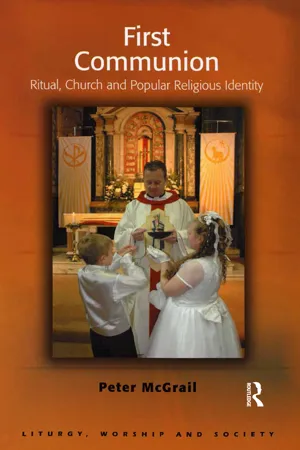
One of the most carefully prepared liturgies of any Roman Catholic parish's year is the celebration of 'First Communion'. This is the ritual by which seven- or eight -year-old children are admitted to the Eucharist for the first time. It attracts the largest congregations of any parish liturgy, and yet is frequently marked by tension and dissent within the parish community. The same ritual holds very different meanings for the various parties involved - clergy, parish schools, regularly communicating parishioners, and the first communicants and their families. The tensions arise from dissonance between the parties on such key issues as expected patterns of Church attendance, Catholic identity, dress and expenditure, and family formation. The relationships and discontinuities between popular and 'official' religion is at the heart of these tensions. They touch upon deep-seated anxieties concerning the future viability of the very structures and patterns of parish life during the current period of falling Church attendance and parish closures. For those within the Church who are concerned to understand and address the issues in its structural decline, this book will make sometimes uncomfortable but always stimulating reading. Peter McGrail examines the relationship between Church structures and popular religious identity, viewed through the lens of the first communion event. Drawing out hitherto unrecognised connections and significances for the future of the Catholic Church at local level, the insights into the decline of the parish as an institution present challenges to all with an interest in and concern for the future of the Church in the English-speaking world. Bringing to the fore the relationship and tensions between liturgy and Church structures, both historically and at the present time, this book offers academics and students alike extensive material for reflection and future development..
Information
Chapter 1 First Communion until the Eve of Quam Singulari
DOI: 10.4324/9781315582443-2
Each time the ritual of first communion is celebrated today its participants are invited to enter into a condition of liturgical amnesia. Since the Second Vatican Council a false memory has been mapped onto this event through the Church’s presentation of it as a rite of Christian initiation. This mapping detaches the ritual as celebrated today from the systems of meaning that underpinned it in the past. Such detachment does not operate simply at a theoretical level – rather it risks devaluing the memories and experiences of earlier generations. The insistence upon an initiatory understanding of first communion can therefore open a rift within the event itself, between the formal discourse of the Church and the residual power of the generations of experience within the popular consciousness of Catholics today.
From an academic perspective, it is essential that there be a recovery of the earlier discourses of meaning associated with the ritual, for two reasons. First, it is impossible to measure the extent to which the initiation discourse has penetrated into the collective consciousness of the Catholic community unless those earlier discourses are properly acknowledged. Second, the relationship between formal ecclesial and popular discourses within the ritual today cannot be understood unless we at least consider the extent to which those popular approaches to the rite reflect earlier approaches that were once formally endorsed. These still remain – albeit in altered form – generating resistance to ritual change. This opening chapter lays the groundwork for this task of recovery; it presents an overview of the true history of this ritual, resisting the tendency to leap from the third century to the twentieth that is inherent in the Sacrament of Initiation discourse. Most of this overview will comprise a review of recent scholarship in the field. The chapter will conclude with my own hypotheses in a possible reconstruction of the early history of the ritual in England. The three chapters that follow will then build upon this overview by exploring English textual and archival material.
The Linkage of First Communion and Human Development
The potential for mismatch between the current theology of initiation and the ritual as celebrated becomes evident when we consider the origins of the ritual of first communion. The primary theological reference point for today’s discourse of Christian initiation is the patristic marriage of educational and ritual processes that together made up the classic catechumenate – as described, for example, by Ambrose of Milan or Cyril of Jerusalem (see Yarnold, 1994a). Within this perspective, today’s children are presented as modern-day catechumens, completing on their first communion day an extended initiatory process that began at their baptism. The internal inconsistencies of this approach will be discussed in detail in Chapter 5 . However, even at the surface level of ritual history, the mapping of the early catechumenate onto today’s celebration of first communion cannot succeed with any real integrity. The catechetico-ritual complex for first communion is not at all a creation of the patristic era. Rather, the stimuli that eventually led to its development were a series of theological and educational questions that only emerged at the onset of the second millennium, and that then progressively preoccupied Church authorities through the medieval scholastic, Reformation and Enlightenment periods. The question that eventually led to the creation of the formal first communion in France during the final decade of the sixteenth century was not one of Christian initiation. Instead, the ritual took concrete form thanks to a long-standing concern to correlate an understanding of the human life-course – and in particular of the processes of intellectual development – with sacramental theology. The twin questions that underpin the origins of the ritual were how to ensure on the one hand that a child possessed the intellectual capacity to properly understand what he or she was doing in receiving communion, and on the other that the experience of the event would remain with them through life.
For most of the first millennium this linkage of the reception of first communion to a defined stage of human development was not an issue. Children were generally admitted to the eucharist at baptism (Fisher, 1965 ; Cabié, 1987 ; Johnson, 1999). In that sense, it can legitimately be argued that admission to the eucharist did indeed form part of the complex of initiation during that period. The Gelasian Sacramentary testifies to the adaptation of an early Roman ritual process for adult initiation for use with children, and that culminated in their admission to the eucharist (Mohlberg et al., 1981). However, two developments that took place towards the end of the first millennium compromised this early practice and produced a very different sacramental regime, one that still underpins today’s Catholic practice – the formal initiatory discourse notwithstanding.
The first of these developments was the gradual fragmentation of the initiatory process. This was precipitated by the success of the Church’s growth and initially came about through focus not on admission to the eucharist, but on the contribution of the Bishop to the original initiatory complex. The early Western Church orders for baptism – such as that found in the much-disputed Apostolic Tradition of Hippolytus (Botte, 1963), or the earlier liturgical strands that underpin the Gelasian Ordo (Mohlberg et al., 1981) – presume the presence of the Bishop at the final sequence of initiation rituals. His specific role in the entire complex occurred between the candidates’ water immersion and their admission to the eucharist – the anointing with chrism that reflects the remote origins of today’s confirmation ritual. As the number of candidates for admission into the Church increased and dioceses spread beyond towns and cities, it became impossible for all to be gathered in one place at one time for the initiation rituals. The solution that was generally adopted saw the Bishop’s presence at baptism become optional. Presbyters baptized candidates and immediately admitted them to the eucharist. The Bishop retained his chrismating role, but generally exercised it outside the baptismal liturgy – sometimes years after a person had been admitted to the eucharist. The beginnings of a free-floating episcopal ritual that crystallized into ‘confirmation’ were thus set in place.
The second development brought about a further fragmentation of the original initiatory complex, setting in motion a progressive severance of admission to the eucharist from baptism. The primary impetus for this was a significant shift in the focus of eucharistic theology that took place towards the end of the first millennium. This shift moved from a generally symbolic approach to the eucharist towards the adoption of an increasingly realistic understanding of Christ’s presence in the sacrament; that the substance of bread and wine was inwardly and effectively changed into the body and blood of Christ (Fisher, 1965 , pp. 101–102). The eucharist gradually began to be thought of almost entirely from the viewpoint of the Real Presence (Jungmann, 1959 , p. 89), and the response of the Magisterium to the anti-realism of Berengarius of Tours (d. 1088) reinforced the position (Cabié, 1986 , p. 247; McPartlan, 1995 , p. 38). This super-realistic perspective impacted upon the question of the admission of children to the eucharist because it placed increasing emphasis upon the responsibility of the communicant to understand exactly what he or she was receiving. This in turn introduced the question as to when somebody possessed the necessary intellectual capacity to make an informed assent to the Church’s teaching on the sacrament. This question, which had not arisen during the patristic period, assumed increasing importance. If a capacity to understand and believe was a prerequisite for reception of the eucharist, then two things became necessary: first, a process of education that preceded the admission to the sacrament, and second, an ability to recognize the point at which a child’s developing natural reasoning powers were sufficiently formed to permit the intellectual response that the new realistic approach required. It was this preoccupation with human development that increasingly came to dominate second-millennium thinking on admission to the eucharist. The concern directly contributed to the development of the ritual of first communion, fed into many of the discourses associated with it, and finally precipitated a crisis at the turn of the nineteenth and twentieth centuries that the reform of Quam Singulari sought definitively to resolve.
The introduction into the formal corpus of Church teaching of a direct relationship between the reception of first communion and the question of age took place in an almost accidental, tangential manner. Concern around the appropriate age for the onset of communicating became confused with another age-related issue that flanked it. This was the question of the age at which children acquired sufficient discretionary powers to become morally culpable for their actions. This question, too, carried implications for sacramental practice, because with culpability came the requirement for formal confession of sins to a priest. But when was this ‘age of discretion’ attained? Turner (2000) cites a number of texts that evidence a broad range of opinion, locating it at different points between the ages of seven and fourteen. Canon 21 of the Fourth Lateran Council of 1215 drew the issue into the formal Magisterium (Turner, 2000 , 8, 5). This canon required penitents to confess their sins at least annually after the ‘years of discretion’ (annos discretionis) had been attained. That requirement does not in itself impact upon the age for first admission to the eucharist. However, the demand for annual penance is followed in the canon by the phrase, ‘reverently receiving at least in Eastertide the sacrament of the eucharist’. Whatever the intentions of the council fathers, the inclusion of this phrase in a text primarily concerned with confession had the long-term effect of linking the start of communicating with the ‘years of discretion’.
In pastoral terms, however, vagueness remained as to what exactly those ‘years’ were. Lateran IV did not offer a specific age, leaving the question open to continued debate in future centuries (cf. Turner, 2000 , 8, 5). There is evidence from French rituals that, Lateran IV notwithstanding, the administration of communion to infants continued in parts of France into the seventeenth century (Lemaitre, 1987 , pp. 18–19). However, the general age drift was upwards, and in 1562 the twenty-fourth Session of the Council of Trent reinforced the link between the start of communion and a stage in human development. As had been the case for Lateran IV, the inclusion of material on the admission of children to the eucharist was caught up in a debate on a different matter – in this case, the reception of communion under two species (Lemaitre, 1987 , p. 29). The issue at Trent was, of course, contextualized within the sacramental debates of the Reformation period; if the medieval super-realistic position on the eucharist is called into doubt, then the requirement for a delay in admission to the eucharist similarly loses its importance. The decision of the Council was – as in most cases – to reaffirm the traditional Roman perspective. The response was phrased in juridical terms by Canon 4 of the session: ‘If anyone says that the communion of the eucharist is necessary for children before they have reached the years of discretion, let him be anathema’ (Denzinger and Shönmetzer, 1977 , section 1734; hereafter DS).
This decree, together with Canon 21 of Lateran IV, thus laid down the legal foundations for the admission of children to the eucharist that remain in force today: children are not required to receive holy communion until they attain the ‘age of discretion’. Once they have reached that age, however, they are obliged to receive it.
Trent, like Lateran IV, did not offer a clear definition of what exactly was intended by those ‘years of discretion’. The Catechism of the Council of Trent (published in England as The Catechism of the Curats in 1687) similarly drew back from defining the ‘ages of discretion’ too closely – recognizing that different children enjoyed different abilities to understand:
But at what age the Sacred Mysteries are to be given to Children, no one can better determine than the Father and Priest, to whom they confess their sins, for it belongs to Them to try, and examine the Children, whether they have learn’d the knowledge of this admirable Sacrament, and any rellish to it. [p. 230]
A similar reticence is found over too closely defining the age at which confession was to begin (p. 263). This reticence introduces a common-sense insight that was repeated in 1910, namely that different children mature at different stages. The discipline, therefore, that Trent envisaged was that children would be educated in faith by their parish clergy. Along the way a decision would be made for each individual as to whether he or she had attained the use of reason sufficiently to understand the sacrament, and at that stage the child would begin to communicate. This highly nuanced and personal approach was, however, undermined by three related developments that very quickly moved first preparation for, and then the act of receiving, first communion into a group context and at a more absolutely defined age.
From Individual Accession to the Eucharist to the Ritual of First Communion
In preferring not to define too closely the ‘age of discretion’, the Council of Trent left open an area of ambiguity that later generations felt a need to resolve. The origins of this ambiguity lay, as we have seen, in the tendency for the Tridentine corpus to speak of both an ‘age of reason’ and an ‘age of discretion’; indeed, Trent appears use the two interchangeably. However, Catholic tradition instinctively prefers clear definition to more open systems of meaning, and it is not surprising that the coexistence of the two terms invited debate as to whether the two were identical in practice. The situation that emerged was described in 1910 by the decree Quam Singulari:
In the course of time many errors and deplorable abuses have crept in in deciding what is meant by the ‘age of reason and discretion’. For some would maintain that the age of discretion for receiving the Sacrament of Penance is not the same as that for the reception of the Holy Eucharist. They feel that for Confession the age of discretion is reached when children can distinguish between right and wrong, and so can sin; but that for receiving the Holy Eucharist a more mature age is requisite, one at which they can have a fuller knowledge of the truths of faith and may better prepare themselves. Consequently, owing to varying local practices and views, in some places the age of ten years, in others, twelve, fourteen or even more are required, and until that age children are not allowed to receive Holy Communion. [AAS, vol. ii, p. 579]
An example of this distinction between the ages of ‘reason’ and ‘discretion’ can be found in the writings of the English Vicar Apostolic, Richard Challoner (1681–1781), who worked in London. Challoner (1737) distinguished between the two ages, holding that the age of reason was ‘commonly presumed after seven years’ whilst the age of discretion was arrived at ‘seldom earlier than ten years’ (pp. 74–5). Challoner associated the latter with admission to the eucharist, but linked the age of reason with confirmation (p. 23). By the mid-nineteenth century, the discourse of the age of discretion, cited as around the age of twelve, emerges in the early first communion material published in England. However, and significantly, this material relates the age of twelve not to confirmation but to first communion (A Catechism for First Communicants, 1781, p. 6). This appears to have remained the normal age at which first communion was administered in England, whilst an earlier start was made to confessing – usually around the age of seven.
The second factor that led – albeit unintentionally – towards a more regimented and corporate approach to admission to the eucharist was the post-Tridentine development of broad catechetical structures that articulated a child’s education in faith from early childhood to the admission to the eucharist in the early teens. A key figure in this development was Charles Borromeo (1538–84), Archbishop of Milan. His 1574 Instructions to the confessors of his diocese outlined a detailed process by which each local priest should instruct the children in his pastoral care (Goubet-Mahé, 1987 , pp. 54–6). Borromeo divided catechetical instruction into three age-related stages. The first ran from the ages of five to six, when a child was taught to examine its conscience and to distinguish between right and wrong. The ages of seven and eight were described as the ‘Little Catechism’. During this period a more complete religious instruction was given, leading to the sacraments of confession and confirmation. The third stage, the ‘Grand Catechism’, led to first communion between the ages of ten and twelve. Borromeo’s clearly articulated system was gradually adapted in France.
The third development flowed naturally from the second. It is a relatively short step from preparing the children together to admitting them to the eucharist as a cohort in a single ceremony. This step appears to have been taken in France towards the end of the sixteenth century, with the first recorded event taking place in 1593 under Jaques Gallemant (1559–1630) in the parish of Aumale in the diocese of Rouen (Goubet-Mahé, 1987 , p. 63; Turner, 2000 , 7, 10). The event acquired its definitive shape in the Latin Quarter of Paris during the first two decades of the seventeenth century. This was initially under the ministry of Adrien Bourdoise (1559–1630) at the church of St Nicholas of Chardonnet (Goubet-Mahé, 1987 , pp. 65–9; Turner, 2000 , 6, 10), and then at the nearby and far more important church of St Sulpice. From these local beginnings the ritual appears to have spread rapidly across France and beyond – a genuine example of a popular religious development that quickly received local episcopal sanction.
The pace at which the ritual spread is partly due to the early support it received from major players in the French Catholic community at the time – not least Jean Jacques Olier and Vincent de Paul. However, its rapid take-up must reflect a positive perception of its effectiveness – an effectiveness that extended beyond the potential impact that the event had on the individual child. The development of a special ‘Mass of First Communion’ at which all the children of a given age-determined cohort were admitted to the eucharist together, considerably raised the public profile of the event. This was no longer simply an intensely personal and essentially private moment, linked to an individual child’s human development; instead, it could become a highly visible spectacle of faith and devotion for the parish community as a whole. This could extend the range of ends that the ritual served – from the spiritual maturation of the individual to strengthening the devotion, identity and institutional strength of the broader Catholic community.
The process for first communion that was developed in early sixteenth-century Paris thus articulated a remarkable marriage between catechetical process and ritual event in the service of a clear aim_ to stimulate in participants an emotional and intellectual response that would ensure an allegiance to the Church which would then be sustained through life. A desired secondary effect was that the touching spectacle of childhood piety would also move the hearts of adult spectators. The event provided an annual opportunity for the re-education and revitalization of the entire parish community (Sauzet, 1987 , p. 38f; Robert, 1987 , p. 99f).
For this to happen two things were necessary. First, the ritual of first communion needed to be sufficiently dramatic both to form a life-long impression on the child and to evoke an emotional response from adults present. Second, the process of preparation needed to be thorough and to impress firmly upon the children the importance of the event for which they were preparing. The genius of the French first communion ritual – and particularly the approach that was codified at St Sulpice – was to unite these in a clearly articulated programme of catechesis that extended over a number of years and culminated in an elaborate sequence of rituals. The traditions of St Sulpice reached their final form in the early nineteenth century under the Sulpician Faillon (The Method of S. Sulpice, 1896; Colomb, 1958). They offer a meticulously detailed process of preparation for first communion. The int...
Table of contents
- Cover Page
- Halftitle Page
- Series Page
- Title Page
- Copyright Page
- Dadication Page
- Table Of Contents
- Acknowledgements
- List of Abbreviations
- Introduction
- 1 First Communion until the Eve of Quam Singulari
- 2 The Eucharist in English Published Texts (1568–1910)
- 3 The Implementation of the Decree Quam Singulari in England (1910–11)
- 4 The Shifting Social and Religious Context for the Celebration of First Communion across the Twentieth Century
- 5 First Communion as a Sacrament of Initiation in Vatican II
- 6 The Ethnography of First Communion
- 7 Discourses of Meaning on the Ground
- 8 Power and Conflict in the Preparation for First Communion
- 9 Different Ritual Patterns in the First Communion Mass
- 10 First Communion and Consumption
- Conclusion
- Appendix
- Bibliography
- Index
Trusted by 375,005 students
Access to over 1.5 million titles for a fair monthly price.
Study more efficiently using our study tools.
Frequently asked questions
Yes, you can cancel anytime from the Subscription tab in your account settings on the Perlego website. Your subscription will stay active until the end of your current billing period. Learn how to cancel your subscription
No, books cannot be downloaded as external files, such as PDFs, for use outside of Perlego. However, you can download books within the Perlego app for offline reading on mobile or tablet. Learn how to download books offline
We are an online textbook subscription service, where you can get access to an entire online library for less than the price of a single book per month. With over 1.5 million books across 990+ topics, we’ve got you covered! Learn about our mission
Look out for the read-aloud symbol on your next book to see if you can listen to it. The read-aloud tool reads text aloud for you, highlighting the text as it is being read. You can pause it, speed it up and slow it down. Learn more about Read Aloud
Yes! You can use the Perlego app on both iOS and Android devices to read anytime, anywhere — even offline. Perfect for commutes or when you’re on the go.
Please note we cannot support devices running on iOS 13 and Android 7 or earlier. Learn more about using the app
Please note we cannot support devices running on iOS 13 and Android 7 or earlier. Learn more about using the app
Yes, you can access First Communion by Peter McGrail in PDF and/or ePUB format, as well as other popular books in Theology & Religion & Religion. We have over 1.5 million books available in our catalogue for you to explore.