eBook - ePub
Indigenous Symbols and Practices in the Catholic Church
Visual Culture, Missionization and Appropriation
- 300 pages
- English
- ePUB (mobile friendly)
- Available on iOS & Android
eBook - ePub
Indigenous Symbols and Practices in the Catholic Church
Visual Culture, Missionization and Appropriation
About this book
Indigenous Symbols and Practices in the Catholic Church presents views, concepts and perspectives on the relationships among Indigenous Peoples and the Catholic Church, as well as stories, images and art as metaphors for survival in a contemporary world. Few studies present such interdisciplinary interpretations from contributors in multiple disciplines regarding appropriation, spiritual and religious tradition, educational issues in the teaching of art and art history, the effects of government sanctions on traditional practice, or the artistic interpretation of symbols from Indigenous perspectives. Through photographs and visual materials, interviews and data analysis, personal narratives and stories, these chapters explore the experiences of Indigenous Peoples whose lives have been impacted by multiple forces - Christian missionaries, governmental policies, immigration and colonization, education, assimilation and acculturation. Contributors investigate current contexts and complex areas of conflict regarding missionization, appropriation and colonizing practices through asking questions such as, 'What does the use of images mean for resistance, transformation and cultural destruction?' And, 'What new interpretations and perspectives are necessary for Indigenous traditions to survive and flourish in the future?'
Information
Chapter 1
Resistance and Change: Visual Culture, Missionization and Appropriation
In the past, Indigenous responses to a variety of evangelizing and conversion attempts have led to a complex set of conditions and differences between and among communities. Some Catholics and scholars have attributed the differences to the variety and number of Indigenous communities with their own belief systems and practices. Still others attribute it to the weather and climate (since in warmer climes it was easier for Church officials to “maintain oversight and supervision”); to the amount of destruction and death due to disease; to the length and degree of contact (as with tribal communities who first met the newcomers); to the number of Indigenous people who actively support and evangelize for the Church; to political policies and legal practices.1 Yet these ideas concern past evangelizing processes. The purpose of this chapter is to look more recently at social, political, and visual contexts in a number of areas as particularly relevant for an examination and discussion of Catholic missionary and Indigenous relations over the past fifty years. Although some of the topics have been discussed in greater depth elsewhere, this chapter is designed to provide an overview of the discussions from an interdisciplinary perspective. It situates the discussion within social and historical movements by examining the topics through visual studies research to provide a grounding for the chapters, as well as a basis for investigating ideas and perspectives.
There is a continuous and lengthy stream of possibilities that are raised to suggest the complexity and variety of Indigenous and Catholic contexts arising from the impact of conquest and ongoing colonization and missionization. In the United States, it is stimulated and supported by a legal system that often serves its own motives and ends more than that of Native Peoples.2 In the past, contact, conversion efforts, and legal mandates were largely instituted and applied to Indigenous Peoples with little opportunity for active decision-making and agency. More recently, viewpoints regarding these contexts and situations assume an end to racist attitudes regarding Indigenous beliefs, as well as the implied sense that changes have occurred regarding policies of colonization, assimilation, and missionization. Although there are conditions that have contributed to the perception of change as well as stimulated real change such as increased educational opportunities, political activism, influence in the courts, and increased control over natural resources, Indigenous communities continue to grapple with paternalism and parochial ideologies. The assumptions and perceptions of change that were initiated and stimulated may be attributed in part to the efforts of two organizations during the 1960s: the American Indian Movement and the Catholic Church. In some overt ways, these organizations worked in opposition to each other, which contributed to forms of active resistance. The efforts and current status of the two organizations continue to appear to be at crossed purposes, yet they somewhat mirror each other. The following provides a brief examination of these two movements as a way of setting the context for over the past forty-plus years and the history that has contributed to the perception that change is no longer needed and missionization is a thing of the past.
Organizational Movements in the 1960s: AIM and the Catholic Church
The formation and organization of movements in the 1960s such as the American Indian Movement and the ecumenical movement by the Catholic Church after the Second Vatican Council (1962–65) were designed to address the history of physical abuse and cultural genocide, prohibitions against traditional practices, mis-education of Native youth, and assimilation policies of the past. In Minneapolis in 1968, Clyde Bellacourt, George Mitchell, Eddie Benton Benai, and Dennis Banks founded the “Concerned Indian Americans,” which soon became the American Indian Movement (AIM). The organization was founded out of concern for the desperation and deplorable conditions of Native Peoples living in some of the larger cities in the United States and Canada, but particularly those in the United States most affected by the relocation and termination programs of the 1950s and 1960s. Peter Matthiessen quoted a member of the movement as saying, “AIM wasn’t so much an organization as a level of conscience, of commitment to our Indian People.”3 This commitment included addressing issues of employment, social services, legal rights, protection from police abuse and brutality, and the education of Native students initially in kindergarten through twelfth grades.4 AIM also integrated into the education of Native students a revival of traditional practices and ceremonies by leaders such as Wallace Black Elk, Frank Fools Crow, Pete Catches, Leonard Crow Dog, and John Fire Lame Deer among others. For many, these efforts as well as others have contributed to a sustained revival of traditional practices aimed at the education and development of Native youth through programs such as Native-way Schools, Elders conferences, and the Indigenous Women’s Network. Although it is not possible to name all of those who were influential, two examples are illustrative of Indigenous efforts. Eddie Benton Benai, a founder of the Red Schoolhouse and an Anishinaabe Midewiwin spiritual leader in Minneapolis, and Vern Harper and Pauline Shirt, founders of First Nations School (formerly Wandering Spirit Survival School) in Toronto, designed schools to provide Native and First Nations students with curriculums oriented toward Native culture and traditions. AIMs efforts and impact in education and traditional renewal are still in evidence today.
During this same period, the Catholic Church instituted changes in policies and practices designed to mitigate the negative effects of missionizing and assimilation policies, and to present a new attitude regarding its role in Indigenous communities. After the Second Vatican Council, the Church actively adopted policy changes designed to be reflective of “inclusion” and openness to the religious beliefs of others. These efforts, combined with the subsequent Roman Instruction of 1994, speak of enculturation with sincere approval, if not enthusiasm, albeit with cautionary language regarding any “syncretism” of traditions.5 For some American Catholics, the changes instituted a crisis of identity that led to confusion about their faith and past relations with other spiritual and religious traditions. The call for better relations with nonbelievers, greater openness to the beliefs of others, and more democratic collegiality initiated this identity confusion and may have contributed to the loss of active participation by Catholics in general.6 Efforts to apologize and engage in discussions with Indigenous Peoples, in some cases, created an internal conflict for missionaries, as well as Catholics who tried to balance between the goals of a mission and conversion practices, and efforts toward ecumenism.7
The language of Vatican II affected missionaries in particular by charging them to reconsider “the attitude of Catholicism to non-Christian religious traditions, lessening the tone of condemnation toward them and seeking reconciliation.”8 In terms of organizational theory, the charge of Vatican II called for individuals who were vested in Church principles to change historical policies and practices, something difficult to do without “buy-in” from staff. In general, clergy remained reticent and skeptical of the changes, and, as Christopher Vecsey remarks:
Even if missionaries were willing to acknowledge the integrity of cultures, they were not eager to espouse relativism when it came to the question of religions. The whole history of Christian missionization was bound up in the claim that Christianity as a system exists sui generis. According to the Church, the Indian should not be allowed to think that aboriginal religion was comparable to true faith.9
This thinking remains in evidence. However, some clergy in the 1970s and 1980s eagerly embraced the inclusion of Native traditions and practices in Church services. For instance, church buildings were remodeled and brought in line with traditional Native and Indigenous structures, and objects and images were used and employed as decoration. Native Catholics were actively recruited for spiritual orders, particularly the priesthood, something almost unheard of in the Catholic Church in previous decades with the exception of catechists, deacons, and oblates.10 However, even in recent years the impact of recruitment efforts into the priesthood has been minimal. Few Native vocations exist, and reports of difficulty for Native people entering the ministry, such as hiding tribal affiliations while in the seminary, continue to surface.11
Critics have interpreted the policy changes initiated during Vatican II and continuing to the present as ways to “save faith (or face)” given the Church’s historic role in Indigenous communities, especially those most affected by missionization.12 They also have been interpreted as attempts at co-optation of AIM and subsequent groups who would actively strive to separate Indigenous and Catholic practices. For instance, some churches financially supported AIM during the civil rights era for what may have been politically expedient reasons. And some AIM members compared the Sundance with taking communion in the Christian denomination—a parallel that Vine Deloria charged has absolutely no validity whatsoever.13 Yet, when examining these two organizations, the indication of conflict and resistance between the organizations and its members is evident even given the presence of colonialist mentality and efforts to accomplish directives surrounding religion and traditional practices. On the one hand, as an organization AIM attempted to separate from the effects of Christianity as an enemy of Indigenous Peoples, yet individuals continued to struggle with the internalized effects of missionization and colonization. On the other hand, the Catholic Church sought ecumenism as a way to apologize for the detrimental actions of the past. However, it did not want to eliminate standards and policies designed to preserve Catholicism and subsume Indigenous traditions, yet practicing Catholics were sometimes at a loss as to their roles and responsibilities. In both cases, individuals struggled with conflicting purposes, histories, and effects that challenged individual identities and called for the formation of new ones.
More recently, both the Catholic Church and AIM are perceived through different lenses than they were early in the civil rights movement of the 1960s. The Catholic Church continues to struggle with effectiveness due to recent court judgments and decisions regarding physical and emotional abuses, waning membership, and the increased need to respect and incorporate the beliefs of others. Physical abuses by clergy and resulting legal issues have diminished power and influence, as well as the financial resources of the Church significantly.14 Most importantly, the coming to light of these abuses has reduced the level of public trust and “faith” contributing to what can be described minimally as diminished organizational effectiveness. Yet the Church maintains a strong presence in Native communities if not from active Catholic participation, than from the standpoint of landholdings, educational facilities, and the sheer longevity of relations that continues to provide a presence hard to dispel or ignore.
On the other hand, the effectiveness of AIM as an organization and its presence in the public arena also has waned due to a variety of factors that include external pressures from largely US government agencies and internal organizational conflicts. Internal struggles affect the ability of an organization to deal with conflicts within and external to the group. This sometimes includes damage done to individuals by outside pressures and actions. As Andrea Smith notes:
Native activists have found that it is impossible to maintain the fight for liberation without a simultaneous movement to heal the damage done by colonization. Much of the American Indian Movement’s drug and alcohol abuse and mistreatment of women can be attributed to the fact that its male leadership did not deal with the impact of colonization on their psych...
Table of contents
- Cover Page
- Title Page
- Copyright Page
- Dedication
- Contents
- List of Figures
- Notes on Contributors
- Preface
- Acknowledgements
- Abbreviations
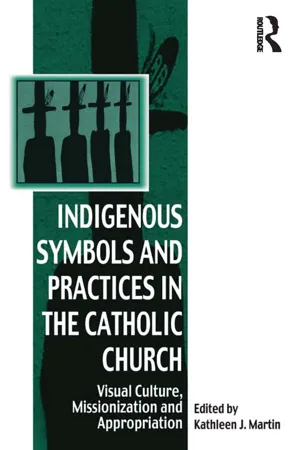
- Note on Cover Photo
- Notes on Terminology
- Introduction
- 1 Resistance and Change: Visual Culture, Missionization and Appropriation
- 2 Spiritual Freedom, Pious Appropriation
- 3 Denying Religion: Native Americans and French Missionaries in Early New France
- 4 Past and Present Transformation of Hawaiian Religious Participation
- 5 Ghosts of Photography: The 1890 Ghost Dance and Afterimages of the Sacred
- 6 Negotiating the Evidence: Christianity and the Ruins of Native America
- 7 “Jesus was not an Indian”: Encountering Native Images in the Catholic Church
- 8 Ke Kauhale O Limaloa: A Kanaka Maoli Approach to Teaching through Image Making
- 9 The Photographic Vision of Delvin Slick: Beauty and Power in Sacred Places
- 10 California Imagery in Context: The Mono Basin Kutzadika’a Paiutes
- 11 “Dancing the Comanches”: The Santo Niño, La Virgen (of Guadalupe), and the Genizaro Indians of New Mexico
- 12 Trickster’s Art and Artifice: Concluding Thoughts
- Bibliography
- Index
Trusted by 375,005 students
Access to over 1.5 million titles for a fair monthly price.
Study more efficiently using our study tools.
Frequently asked questions
Yes, you can cancel anytime from the Subscription tab in your account settings on the Perlego website. Your subscription will stay active until the end of your current billing period. Learn how to cancel your subscription
No, books cannot be downloaded as external files, such as PDFs, for use outside of Perlego. However, you can download books within the Perlego app for offline reading on mobile or tablet. Learn how to download books offline
We are an online textbook subscription service, where you can get access to an entire online library for less than the price of a single book per month. With over 1.5 million books across 990+ topics, we’ve got you covered! Learn about our mission
Look out for the read-aloud symbol on your next book to see if you can listen to it. The read-aloud tool reads text aloud for you, highlighting the text as it is being read. You can pause it, speed it up and slow it down. Learn more about Read Aloud
Yes! You can use the Perlego app on both iOS and Android devices to read anytime, anywhere — even offline. Perfect for commutes or when you’re on the go.
Please note we cannot support devices running on iOS 13 and Android 7 or earlier. Learn more about using the app
Please note we cannot support devices running on iOS 13 and Android 7 or earlier. Learn more about using the app
Yes, you can access Indigenous Symbols and Practices in the Catholic Church by Kathleen J. Martin in PDF and/or ePUB format, as well as other popular books in Theology & Religion & Religion. We have over 1.5 million books available in our catalogue for you to explore.