- 222 pages
- English
- ePUB (mobile friendly)
- Available on iOS & Android
eBook - ePub
Serialization and the Novel in Mid-Victorian Magazines
About this book
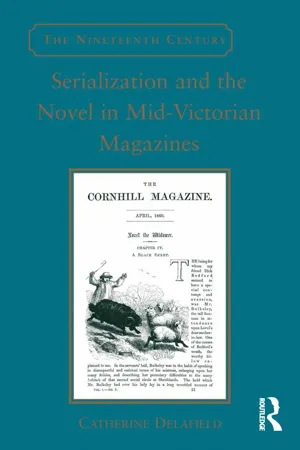
Examining the Victorian serial as a text in its own right, Catherine Delafield re-reads five novels by Elizabeth Gaskell, Anthony Trollope, Dinah Craik and Wilkie Collins by situating them in the context of periodical publication. She traces the roles of the author and editor in the creation and dissemination of the texts and considers how first publication affected the consumption and reception of the novel through the periodical medium. Delafield contends that a novel in volume form has been separated from its original context, that is, from the pattern of consumption and reception presented by the serial. The novel's later re-publication still bears the imprint of this serialized original, and this book's investigation into nineteenth-century periodicals both generates new readings of the texts and reinstates those which have been lost in the reprinting process. Delafield's case studies provide evidence of the ways in which Household Words, Cornhill Magazine, Good Words, All the Year Round and Cassell's Magazine were designed for new audiences of novel readers. Serialization and the Novel in Mid-Victorian Magazines addresses the material conditions of production, illustrates the collective and collaborative creation of the serialized novel, and contextualizes a range of texts in the nineteenth-century experience of print.
Information
Chapter 1
Serialization and the
Nineteenth-Century Periodical
The use of instalments was intrinsic to the development of the novel form in the nineteenth century. The serial had been associated with lower forms of literature but the instalment system became essential to the production process and to the economics of publishing for publishers, authors and editors. This chapter provides firstly some background to the serialization of the novel within the nineteenth-century periodical by discussing broader attitudes to serialization before moving on to the relationship between serial and periodical. This is then followed by a brief overview of the novels and magazines which form the core texts for the study as a whole. Finally there is a discussion of the periodical context for the serial including the use of illustration and of the paratexts which acted as boundaries in the serialization process.
Serialization in the Nineteenth Century
The serialization of a new work of fiction, in a periodical or by publishing in parts, meant that a novel was being read at intervals over a period of time. This had an impact on that novel in terms of both its composition and its reception. For the author it was essential to keep elements of the plot under discussion and to make characters recognisable when they reappeared from instalment to instalment. The author and his publisher also gained the benefit of the novel’s being talked about by readers from week to week and month to month. The published parts used moments of tension or anticipation to encourage repeat buying. At the same time there was a danger of stereotyping or simplifying characters, and critics were scathing of the overuse of coincidence, crisis and padding.
The serialization of the novel in the nineteenth century derived in part from practices developed in the eighteenth century to service many types of literature.1 Robert D. Mayo has pointed out that the potential audience for a serialized work in a magazine was only about two hundred thousand in 1800 and that such fiction during the period 1740 to 1815 was ‘trashy, affected, and egregiously sentimental’.2 A few decades later, a much larger audience of readers was being conditioned to approach the respectable consumption of fiction and other educational material through reading in parts. Allan Dooley has suggested that serial publication in the nineteenth century grew as a result of the shortage of type to set up the pages of the novels.3 Production in parts meant, however, that publishers could afford to produce literature and that consumers could afford to read and collect it. Robert Patten describes the serialization process as ‘democratizing’ book reading and book buying,4 and the evolution of part publication and of the magazine printing of serials demonstrates how the two forms of serialization were to some extent co-dependent in popularizing the reading of fiction.
This apparent alliance between commercial imperatives and the new reading public in the mid nineteenth century was, however, heavily criticized by reviewers of the period. The Spectator commented of the first instalment of Nicholas Nickleby that there was ‘just enough to serve as a meal to the mob of readers’,5 and in March 1843, John Wilson Croker in the Quarterly Review predicted ‘early oblivion’ for the serialization of new fiction.6 The Pickwick Papers had first appeared monthly from April 1836 until November 1837 and, in his Preface to the cheap volume edition of 1847, Dickens reported: ‘My friends told me it was a low, cheap form of publication by which I should ruin all my rising hopes’.7 In the Preface to the first collected Pickwick of 1837, Dickens described his ‘general design’ as simple enough to appear in ‘this detached and desultory form’. His success in that form, in both monthly parts and weekly periodical parts, gave him the authority to develop a structure beyond the ‘gentle and not unnatural progress of adventure’8 which characterized Pickwick. Much later he used that authority to write a ‘Postscript in lieu of Preface’ to Our Mutual Friend, dated 2 September 1865. In this, he explained the difficulty of his design for that novel, originally serialized in 20 parts:
it would be very unreasonable to expect that many readers, pursuing a story in portions from month to month through nineteen months9 will, until they have it before them complete, perceive the relations of its finer threads to the whole pattern which is always before the eyes of the story-weaver at his loom.
He then harked back to his original success twenty years before:
Yet, that I hold the advantages of the mode of publication to outweigh the disadvantages, may be easily believed of one who revived it in the Pickwick Papers after long disuse, and has pursued it ever since.10
Where Dickens saw publishing in parts as a craft, critics saw the form of the serial as counter-creative. In 1855, a reviewer in the North British Review protested that ‘Art will not endure piecemeal generation’.11Although complimenting David Copperfield, a writer in the Prospective Review in 1851 observed that ‘The serial tale … is probably the lowest artistic form yet invented … which affords the greatest excuse for unlimited departures from … consistency, completeness and proportion’.12 The Morning Advertiser in 1852 insisted that ‘the instalment system … is by no means conducive to a fair estimate of the ability of a fiction-writer, or the coherence and construction of his story’. The reviewer reinforced the viewpoint of the critics of high culture by describing serialization as ‘a series of spasmodic efforts at fixed intervals, rather than the performance of continuous and homogeneous work, in which the due proportion of its parts shall be symmetrically contrived’.13 Reviewing the volume edition of Framley Parsonage, the Westminster Review commented that ‘the habit of writing a story in periodical instalments is almost always fatal to that coherence and proportion without which no work can lay claim to any really artistic merit’.14 The anonymous reviewer objected to novel-writing on this model as a type of industrial production like ‘Manchester goods … retailed at so much per yard’.15 The cottage industry conjured up by Dickens was transmuted into mass production and commercial exchange.
Where authors could see artistic control, critics identified commercialization and lack of direction. Anthony Trollope himself called it the ‘rushing mode of publication’ but the Westminster Review differentiated George Eliot’s publication in parts, observing that ‘she makes those pauses and gives us those breaks which are so necessary for repose in the enjoyment of a work of art’.16 Middlemarch, for instance, was scheduled to appear in eight half volumes at two-monthly intervals corresponding to the ‘books’ within the novel.17 Daniel Deronda appeared monthly from February to September 1876, maintaining this half-volume length for each instalment. Reviewing the first part of the novel, the London Globe and Traveller went further in distinguishing Eliot from other authors of part-work serials: ‘George Eliot may be published in parts, but she writes with a view to the effect of the whole. Dickens made every part a little whole in itself; … he reads better piece-meal. Thackeray’s characters were like our acquaintance [and we] cared for their society more than their history’.18 It seems that the association with Eliot whose parts comprised substantial portions of her novels could elevate the status of the part-work serial. The Non Conformist of 21 February 1872 acknowledged, again with reference to Middlemarch, that ‘a separate publication makes more pretension [than monthly instalments in magazines], and is not to be … cavalierly treated’.19
The overtly commercial, repeat-buying arrangement of a periodical seems thus to have made the production treadmill of serialization more prominent in the minds of critics. In addition, periodical serialization had a long association with lower forms of literature and poor production values. Dickens mentions in his 1847 preface to The Pickwick Papers the shilling numbers of ‘interminable novels’ sold by pedlars around the country.20 Although this might suggest that his claims of having revived the practice are rather exaggerated, by the mid nineteenth century he and many other novelists had honed their deployment of this part-work process.
For nineteenth-century critics, the serial – and especially the serial within a periodical – threatened the boundaries of art. It appeared effectively to be authored by a group or collective within the pages of the periodical issue. Laurel Brake has observed that the authorship of a serial is ‘collective … [through] intertextuality and editing’ and Mary Hamer calls it ‘a group activity’.21 John Sutherland now regards novels as ‘the outcome of collaboration, compromise or commission’22 whereas contemporary reviewers maintained the view that literature was to be valued by (their) absolute artistic standards of individualized authorship and not by the needs or fluctuations of the market. Anonymity or attribution to the group was viewed by contemporary critics as contrary to an expressed need for ownership and identification. In addition, new serialized fiction was dangerously incomplete and appeared not to be shaped or sculpted. The serial within a magazine also enjoyed horizontal integration with other embedded texts and was in competition and dialogue with these other texts. Such a serial existed in a form that was not bounded and absolute. Finally...
Table of contents
- Cover Page
- Title Page
- Copyright Page
- Contents
- List of Figures
- Acknowledgements
- List of Abbreviations
- Introduction: Rereading the Novel
- 1 Serialization and the Nineteenth-Century Periodical
- 2 Authorship and the Serialized Novel
- 3 Serialization and the Periodical Editor
- 4 The Periodical and the Serialized Novel
- 5 The Serialized Novel
- 6 The Afterlife of the Serialized Novel
- Appendices
- Bibliography
- Index
Trusted by 375,005 students
Access to over 1.5 million titles for a fair monthly price.
Study more efficiently using our study tools.
Frequently asked questions
Yes, you can cancel anytime from the Subscription tab in your account settings on the Perlego website. Your subscription will stay active until the end of your current billing period. Learn how to cancel your subscription
No, books cannot be downloaded as external files, such as PDFs, for use outside of Perlego. However, you can download books within the Perlego app for offline reading on mobile or tablet. Learn how to download books offline
Perlego offers two plans: Essential and Complete
- Essential is ideal for learners and professionals who enjoy exploring a wide range of subjects. Access the Essential Library with 800,000+ trusted titles and best-sellers across business, personal growth, and the humanities. Includes unlimited reading time and Standard Read Aloud voice.
- Complete: Perfect for advanced learners and researchers needing full, unrestricted access. Unlock 1.5M+ books across hundreds of subjects, including academic and specialized titles. The Complete Plan also includes advanced features like Premium Read Aloud and Research Assistant.
We are an online textbook subscription service, where you can get access to an entire online library for less than the price of a single book per month. With over 1.5 million books across 990+ topics, we’ve got you covered! Learn about our mission
Look out for the read-aloud symbol on your next book to see if you can listen to it. The read-aloud tool reads text aloud for you, highlighting the text as it is being read. You can pause it, speed it up and slow it down. Learn more about Read Aloud
Yes! You can use the Perlego app on both iOS and Android devices to read anytime, anywhere — even offline. Perfect for commutes or when you’re on the go.
Please note we cannot support devices running on iOS 13 and Android 7 or earlier. Learn more about using the app
Please note we cannot support devices running on iOS 13 and Android 7 or earlier. Learn more about using the app
Yes, you can access Serialization and the Novel in Mid-Victorian Magazines by Catherine Delafield in PDF and/or ePUB format, as well as other popular books in Literature & Gothic, Romance, & Horror Literary Criticism. We have over 1.5 million books available in our catalogue for you to explore.