- 188 pages
- English
- ePUB (mobile friendly)
- Available on iOS & Android
eBook - ePub
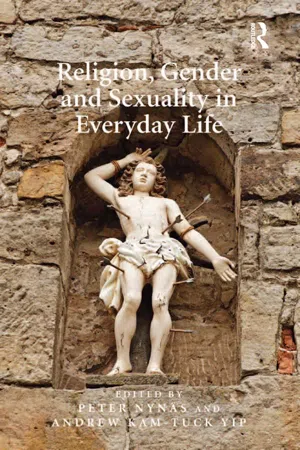
Religion, Gender and Sexuality in Everyday Life
About this book
Exploring the intersection between religion, gender and sexuality within the context of everyday life, this volume examines contested identities, experiences, bodies and desires on the individual and collective levels. With rich case studies from the UK, USA, Europe, and Asia, Religion, Gender and Sexuality in Everyday Life sheds light on the manner in which individuals appropriate, negotiate, transgress, invert and challenge the norms and models of various religions in relation to gender and sexuality, and vice versa. Drawing on fascinating research from around the world, this book charts central features of the complexities involved in everyday life, examining the messiness, limits, transformations and possibilities that occur when subjectivities, religious and cultural traditions, and politics meet within the local as well as transnational contexts. As such, it will be of interest to scholars of sociology, anthropology, geography and cultural studies examining questions of religion and spirituality, gender and sexuality, and individual and collective identities in contemporary society.
Information
Chapter 1 Re-framing the Intersection between Religion, Gender and Sexuality in Everyday Life
DOI: 10.4324/9781315605029-1
This volume brings together eight contributions by an international team of scholars, exploring the intersection between religion, gender and sexuality in contemporary societies. While the examination of this intersection does not constitute a new topic, we argue for the need to re-frame this intersection in order to capture its diverse facets and outcomes. This is an important endeavour in light of recent debates concerning the location and persistence of religion in contemporary society on the one hand, and the hitherto narrow focus on religion as an intrinsically constraining and restrictive force in relation to gender and sexuality. We would argue that, in order to fully understand this intersection, we need to not only re-evaluate the relationship between religion and gender and sexuality, but also the character and role of religion itself in contemporary society.
The empirical focus of the contributions in this volume covers an extensive geographical area, including the UK, USA, Pakistan, Indonesia, Belgium and Israel. They collectively illustrate the multi-faceted and intricate nature of the intersection between religion, gender and sexuality – and the multiple outcomes this entails – on local, national and global levels. In terms of religious traditions, the contributions engage with Christianity, Islam, Hinduism, Sikhism and Judaism. Before introducing each of the contributions, we would like to discuss three unifying themes that contextualise this volume conceptually.
The Relocation and Persistence of Religion in Contemporary Society
The recent debate on religion has to a large extent stressed that processes on a macro level have implications for how we comprehend religion. At the heart of this debate concerning the location of religion lies the issue of secularisation. The erosion and decline of religion was long considered to be an inevitable feature of modernity (e.g. Bruce 2002, 2011). However, the validity of this claim or ideology has become increasingly questioned and more nuanced understandings of religion have emerged which take into serious consideration historical, geopolitical and socio-cultural specificities. Within this framework, religion is viewed as a complex and multidimensional phenomenon that takes different forms depending on the varying trajectories of modernisation and social differentiation across different historical, national, social and cultural contexts (e.g. Davie 2007, Turner 2011). Indeed, the recognition of multiple modernities has sensitised scholars to multiple manifestations of the complex relationship between modernity and religion.
The main challenge to the secularisation thesis comes from the observation that it often occurs concurrently with different forms of counter-developments (e.g. Berger 1999, Davie 2007, Turner 2011). At the background of the resurgence of religion we find many different processes such as the proliferation and persistence of religions within immigrant communities, the rise of charismatic movements, the establishment of new religious movements and the growth of non-institutional spiritualities. These counter-developments challenge earlier expectations about a linear progression of secularism and modernisation.
However, in order to comprehend better the postsecular condition and the resurgence of religion we need to make a distinction between, on the one hand, a shift in religiosity; and on the other, a shift in awareness or consciousness of religion and religion-related issues. Habermas puts emphasis on this shift in consciousness when he claims that ‘in terms of sociological indicators … the religious behaviour and convictions … have by no means changed to such an extent as to justify labelling these societies “postsecular”’ (Habermas 2008: 17, his emphasis).1 We can however, according to Habermas, address the growing public consciousness that has in particular been brought about by different processes that have undermined the secularist belief in the disappearance of religion, the connection of religion with global conflicts, the rise of religious voices in connection with value-laden civil and political issues and controversies, and increasing immigration. Therefore, we need to address the postsecular in terms of a relocation of religion and not in terms of a process opposite to or in contrast to secularisation. Further, this requires from us investigations of the reconfigurations and implications that are involved in the relocation of religion.
These trends have marked many modern societies and it has become more and more obvious that religion as such does not lose relevance and influence in society, politics, culture, or in the everyday lives of individuals. Therefore, in the debates about these contradictory trends of, on the one hand, continuing religious decline, and on the other, enduring religious vitality, scholars have pointed to the relevance of a range of alternative interpretive frameworks, such as de-secularisation, re-socialisation, de-Christianisation, and the emergence of a postsecular society (Casanova 1994).
In addition to these forms of the changes addressed above, we also have to take into account how the new cultural and religious complexity as such involves a quite different change in the religious landscape. Even though scholars who address the resurgence of religion have shed light on different aspects, the focus has been on qualitative change. In this respect, Frisk (2009: iii) has provided a general overview of this change and how it is linked to globalisation:
As to the changes, each author describes them a little differently, but there are a few characteristics that several of them bring up … Eclecticism and syncretism; emphasis on personal experience at the expense of ideology or dogma; uninstitutionalism or religiosity in the private mode; radical egalitarianism or recognizing each person as his/her own spiritual authority; self-spirituality or a shift from God to human being; and emphasis on this-worldliness rather than emphasizing life after death … Globalization is of course only one of the processes triggering this shift, but I think that as a major cause it has been quite neglected in the discussion so far.
Indeed, one very striking feature of the contemporary religious landscape is the emphasis on working with oneself, more specifically with one’s mind, body and spirit, as well as emotions, goals, values and relations. This has been referred to as ‘the subjective or expressive turn of culture’ (Heelas and Woodhead 2005), ‘the de-differentiation of the person’ (Davie 2007) or ‘self-realization’ (Hervieu-Legér 2000). The wide range of what we regard as popular culture has come to play an ever more important role in the distribution of religious and spiritual beliefs, ideas, practices and identities and may become influential for religious life of both individuals and groups (e.g. Lynch 2007, Partridge 2004, 2005).
Many post-institutional forms of religiosity are characterised by the privatisation of religion, a dimension that has further been reinforced also by secularism. Despite these strong influencers in the religious landscape in the West, we can also point at its counterpart, namely deprivatisation. Part of the resurgence of religion today is about how religion makes a comeback in the public sphere within modern democratic polities (Koenig and Guchteneire 2007). Much of the growing public awareness that Habermas (2008) refers to – as mentioned above – has emerged from ‘the dilemmas posed by religious otherness’, and focused on reframing ‘the ongoing tensions between religious cultures and civic political life’ (Dillon 2010: 141–2). Therefore, the resurgence of religion is in many ways a societal issue and challenge, rather than simply a private matter.
It should not be neglected that an important background to this ‘new’ presence of religion in the public sphere and the rise of public awareness of religion-related issues is formed by new media technologies, as Lynch et al. argue, ‘[C]ontemporary media and culture encourage the “deregulation” of religious ideas and symbols, allowing them to circulate through society in ways that are increasingly beyond the control of religious institutions’ (2012: 1). Indeed, new media technologies could enable religious discourses to play a strong role in the public sphere and the nexus of religion and media need to be thoroughly explored (Moberg and Granholm 2012). Furthermore, the changing media landscape has also affected power relations between religious groups and other institutions, and has made possible new and innovative forms of both collective and individual religious agency. Indeed, in many western societies we have witnessed how various forms of media provide new and significant platforms for debates and negotiations about sexuality and gender and how these platforms make space for a plurality of both religious and secular voices and claims.
Central to many received perspectives on secularisation was also the assumption that there is an inherent ‘incompatibility between some features of “modernity” and religious belief’ (Taylor 2007: 543). Turner has made a relevant observation when he claims that modern nation-states have become increasingly compelled to organise and regulate religion through a plethora of policies. He refers to this as the ‘management of religions’ (2011: 175–84), but this is also a matter of sovereignty. Connolly has addressed the paradox of sovereignty in late modernity, and how this paradox is reinforced by intertwined local and transnational processes and instances that compose ‘a plurality of forces circulating through and under the positional sovereignty of the official arbitrating body’ (2005: 145). In other words, the contemporary ‘postsecular’ condition also implies that we are required to account for a society that is characterised by a cluster of discursive public processes rooted not only in established institutions, but also in highly significant broader social movements and cultural trends that strive to transform their particular positions into legitimate societal values and practices.
However, taken together many of the above mentioned shifts in the religious landscape in Western societies involve a relocation of boundaries and blurring of previously more clearly marked and differentiated ‘secular’ and ‘religious’ spheres. Smith argues this point well:
[0]utside the sphere of secular public discourse… there are circles of discourse that are metaphysically and theologically much thicker … So the challenge, it seems, is… to figure out whether and how and on what terms to admit such thicker belief into public discourse. (2010: 215)
Smith’s question is topical in many Western cultural and societal contexts and surfaces in several contributions in this volume. It addresses problematic issues such as plurality versus shared norms and values, and the preconditions for the organisation of a publicly justified language. On the one hand, when engaging in public civic and political debate religious individuals and groups need to translate ‘their religious norms into a secular idiom’ (Dillon 2010: 146). Therefore, when we take a closer look at debates around a contested issue that involves both ‘religious’ and ‘secular’ parties, the difference between a ‘religious’ idea or argument as opposed to a ‘secular’ one is not necessarily clear (Dillon 2010). We can therefore question how reasonable it is to presuppose that the dichotomy between secular and religious is meaningful at the level of individual self-identification. Contemporary social actors are increasingly prone to blur the boundaries between different sectors of knowledge and in juxtaposing scientific, religious, esoteric and therapeutic discourses and practices (Furseth 2006). In this respect, Turner (2011) contends that the world of the sacred appears to be shrinking and the separation of the sacred and the profane evaporating in contemporary societies. Hence, to continue regarding religion versus secularity implies a simplistic and problematic distortion of what is a very complex phenomenon.
From an exploration of the relocation of religion it is clear that encounters, debates and conflicts between voices affiliated with religious or non-religious positions become a much more complex issue than merely one concerning the bridging of differences with regard to formal theologies or worldviews. These complexities need to be addressed from several vantage points. The relevance of power relations within religious and secular institutions and in their interplay should not be ignored. It might be assumed that the contemporary condition raises many challenges for contemporary social actors. Focusing on the emotional aspect, Riis and Woodhead discuss the tensions and contradictions in contemporary society, arguing that ‘different domains of a polycentric society pursue their values self-referentially’ and that ‘[m]any individuals find their lives dispersed between competing symbolic and social systems, while seeking a unified and consi...
Table of contents
- Cover
- Halftitle Page
- Title Page
- Copyright Page
- Contents
- List of Tables
- Notes on Contributors
- Acknowledgements
- 1 Re-framing the Intersection between Religion, Gender and Sexuality in Everyday Life
- 2 The Resistance from an Alterspace: Pakistani and Indonesian Muslims beyond the Dominant Sexual and Gender Norms
- 3 Spirituality, Activism, and the ‘Postsecular’ in the Sisters of Perpetual Indulgence
- 4 Hindu, Muslim and Sikh Young Adults: Gendered Practices in the Negotiation of Sexuality and Relationship
- 5 Coping with Religious and Cultural Homophobia: Emotion and Narratives of Identity Threat among British Muslim Gay Men
- 6 Sexualities in the Migration Context: Religious Influences on Views on Abortion and Homosexuality
- 7 Queering Conversion: Exploring New Theoretical Pathways to Understand Religious Conversion in a Western Context
- 8 Body and Sexuality Constructs among Youth of the Ultra-Orthodox Jewish Community
- 9 When God is Not So Good: Corporate Religion contra New Social Movements
- Index
Trusted by 375,005 students
Access to over 1.5 million titles for a fair monthly price.
Study more efficiently using our study tools.
Frequently asked questions
Yes, you can cancel anytime from the Subscription tab in your account settings on the Perlego website. Your subscription will stay active until the end of your current billing period. Learn how to cancel your subscription
No, books cannot be downloaded as external files, such as PDFs, for use outside of Perlego. However, you can download books within the Perlego app for offline reading on mobile or tablet. Learn how to download books offline
Perlego offers two plans: Essential and Complete
- Essential is ideal for learners and professionals who enjoy exploring a wide range of subjects. Access the Essential Library with 800,000+ trusted titles and best-sellers across business, personal growth, and the humanities. Includes unlimited reading time and Standard Read Aloud voice.
- Complete: Perfect for advanced learners and researchers needing full, unrestricted access. Unlock 1.5M+ books across hundreds of subjects, including academic and specialized titles. The Complete Plan also includes advanced features like Premium Read Aloud and Research Assistant.
We are an online textbook subscription service, where you can get access to an entire online library for less than the price of a single book per month. With over 1.5 million books across 990+ topics, we’ve got you covered! Learn about our mission
Look out for the read-aloud symbol on your next book to see if you can listen to it. The read-aloud tool reads text aloud for you, highlighting the text as it is being read. You can pause it, speed it up and slow it down. Learn more about Read Aloud
Yes! You can use the Perlego app on both iOS and Android devices to read anytime, anywhere — even offline. Perfect for commutes or when you’re on the go.
Please note we cannot support devices running on iOS 13 and Android 7 or earlier. Learn more about using the app
Please note we cannot support devices running on iOS 13 and Android 7 or earlier. Learn more about using the app
Yes, you can access Religion, Gender and Sexuality in Everyday Life by Peter Nynäs, Andrew Kam-Tuck Yip in PDF and/or ePUB format, as well as other popular books in Social Sciences & Sociology. We have over 1.5 million books available in our catalogue for you to explore.