- 286 pages
- English
- ePUB (mobile friendly)
- Available on iOS & Android
eBook - ePub
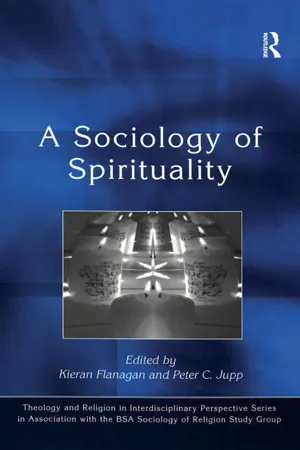
A Sociology of Spirituality
About this book
The emergence of spirituality in contemporary culture in holistic forms suggests that organised religions have failed. This thesis is explored and disputed in this book in ways that mark important critical divisions. This is the first collection of essays to assess the significance of spirituality in the sociology of religion. The authors explore the relationship of spirituality to the visual, individualism, gender, identity politics, education and cultural capital. The relationship between secularisation and spirituality is examined and consideration is given to the significance of Simmel in relation to a sociology of spirituality. Problems of defining spirituality are debated with reference to its expression in the UK, the USA, France and Holland. This timely, original and well structured volume provides undergraduates, postgraduates and researchers with a scholarly appraisal of a phenomenon that can only increase in sociological significance.
Information
Chapter 1
Spirituality: Some Disciplinary Perspectives
Peter R. Holmes
There is an increasing realisation that belief in an authentic, tangible, spiritual reality is now widespread and more, significantly, is occurring outside the main Christian churches. Thus, Hay and Hunt (2000), researching among the UK un-churched, noted a significant numerical growth, from 29 per cent in 1987 to 55 per cent in 2000, in those who believe spirituality is something to be found in their own personal experience. Allied to this rise is a growing number who indicate an awareness of evil. This rose from 12 per cent to 25 per cent (Hay and Hunt 2000: 13). Postmodern people are now looking beyond religion for their spirituality (Young-Eisendrath and Miller 2000b). In our lifetime in the social sciences we have moved from a position where it was unfashionable to talk about spiritual reality to the present day: Now among the un-churched it is increasingly acceptable to speak of one’s own spirituality, one’s personal journey and experiences (Drane 2002).
This growth of spiritual awareness is reflected in a diversity of academic disciplines that also seem to capture a cultural moment, one of increasing significance. This chapter explores the emergence of spirituality in some of these disciplines through an exploration of some of their literatures. Before looking at spirituality within disciplinary settings, a number of questions emerge.
First, we must decide whether we believe in the existence of spirituality, and if we do then the academic question is whether it is possible to study it at all. Many have traditionally seen spirituality as a mystery. If we do see spirituality this way, then we have a choice. Either we acknowledge we cannot study it directly because of its intangibility. Alternately, we accept the study of spirituality at a corporeal level, but only through its outcomes and symptoms. In accepting this latter option we are also acknowledging that current academic tools are unable to study the incorporeal essence of spirituality. In this chapter, seven disciplinary areas are selected, all well illustrating the emergence of interest in spirituality. Some of these areas are broad academic domains like sociology, while others are more specific subjects like medicine and health care within the human sciences. Before proceeding to these disciplines, the problem of defining spirituality needs to be laid out.
Defining Spirituality and Understanding its Complexity
The need to find a definition of spirituality first became obvious to me over 30 years ago when I previously encountered Schaeffer’s effort to define what it meant to be human and spiritual in contemporary society (Schaeffer 1972). Traditionally I had seen God as spiritual, and us as created in His image. But up until that time I had found few definitions of human make up within traditional Christianity that upheld this spiritual aspect of our personhood. I felt that to be human was to be spiritual, after the Holy Spirit, but at that time this was not something one could easily read about. Although traditional definitions of the spiritual nature of human personhood do already exist in the Church (Fitzpatrick and Wellmuth 1259 [1949]) today the landscape has changed dramatically. The canvas is now much broader. What has happened is that spirituality as a domain has broken away from its traditional religious moorings. The reason is that the concept of spirituality has begun to appear in numerous academic and professional disciplines, all outside traditional religion. This is happening in fields as diverse as nursing and social theory. Attempts at a single definition are therefore increasingly problematic, because any definition must take account of many disciplines, numerous research methodologies and an increasing range of domains of practice.
One of the outcomes of this growth of interest in spirituality is that even traditional Christianity now needs to fit into this new picture. An example of this emerges in Ballard’s exploration of the place of the Bible within this new spirituality (Ballard 2003). Another example that explores how traditional Christian communities need to redefine what is now meant by spirituality is the Iona Document (Armirtham and Pryor 1991). Schneiders (1993: 10–15) found that the more she worked at the theoretical elaboration of this new field of spirituality studies the more serious and complicated the questions became. She explored spirituality from the traditional Christian private and personal perspective and related it to more contemporary fields such as psychology and anthropology, noting on the way that this new interest is more ontological and existential than academic.
As with others who have explored the topic of spirituality, one seems some distance from writing a definition that is adequate (Holmes 2005). This task is being made increasingly difficult because very little comparative research is being done between the various emerging spiritualities in Western culture. So this chapter must be viewed as a work in progress. Personally I am in two minds whether we can achieve a definition or now even need one. Seeking a definition that is all encompassing would obscure the diversity of disciplinary approaches that make the topic so interesting. Spirituality might well be a topic that by its very nature defies any single definition.
Even while we are struggling to define this spirituality, the domain continues to grow and mature (see Sutcliffe and Bowman 2000). As spirituality grows it seems increasingly to defy efforts to treat it as a single discipline with a single definition. As Sutcliffe and Bowman note, spirituality is finding its own gurus and even eccentric exponents. Hazarding a definition of spirituality, one can treat it (very inadequately) as the human search for meaning, particularly relationally, and that for many today this incorporates a supernatural/corporeal dimension that suggests many of us have discovered we are more than our physical biology.
Within the Church there is no doctrine of human spirit or spirituality. This lack inhibits our visualising and practicing spirituality as a valid relational aspect to faith. The Church’s failure could well be one of the reasons why we have seen such an increase of interest in the subject. Though having said that, the Hebrew concept of ‘body–spirit’ unity based on Genesis 3 suggests a holistic view of human make-up, an equality and a balance in the two aspects of our one nature. Body and spirit co-exist and co-mingle within one another in our one holistic nature. This Hebrew model contrasts with the idea that spirituality is the good ‘core’ to human nature, as the Greeks tended to see it.
But there are other benefits to seeing human nature as having a spiritual aspect. The notion of body-spirit unity enables us to look beyond our physical nature to our spiritual nature. Such a view also sets humanity apart from other species, thereby giving human personhood an implicit deep value, of being in God’s image. This in turn suggests the possibility that we can all be greater than who we are now, thus releasing us from the constraints of material circumstances. In reaching beyond ourselves, the notion of the human spirit also suggests the possibility of a supernatural life for all of us, both personally and together. The possibility is offered of our being able to connect with others at more subliminal levels than mere words and body functions. Spirituality also suggests at least two stories exist between us and not just a physical one. In clinical work, this idea of connecting at emotional spiritual levels can be particularly helpful, especially when looking at male and female conflict. The idea of human spirituality also gives us a platform for engaging with spiritual reality while at the same time suggesting we all have the ability to write a history greater than our human lifetime.
These reflections led me to a profound shift in self-understanding: that human nature, body and spirit, is constant, whether seen from Scripture or from outside the Church. We are all in the same place, with the same deep human need to understand more clearly why we exist. But this spirit-body model of human nature helps us to understand better that the contemporary search for spirituality involves all people being on a similar spiritual journey.
The mapping of this domain of spirituality and human spiritual nature is still in early stages. Yet, almost every religion in the world, as well as every culture, would recognise a spiritual dimension to human make-up, and/or the presence of a spiritual reality, or value systems that are ‘spiritual’. In contemporary society, there has been a profound shift in understanding of the notion of the spiritual one. Heelas formulates this well when he observes that the religious (for God) is giving way to the spiritual (for life) (Heelas 2002: 358).
Some argue that spirituality is not much different to emotional phenomena like love, hate, trust and forgiveness. Its very nature is something experienced but ‘unseen’, therefore defying more pragmatic traditional empirical research such as that shaped by positivism. As the dominant paradigm in the twentieth century, it has made meaningless research into an intangible reality like spirituality. However, this has not stopped numerous ideas emerging over the last 20 years, suggesting how one can study spirituality, both in religious (Kinerk 1981 passim) and non-religious contexts.
Hay and Hunt (2000: 41) suggest that outside certain religious contexts spirituality is still inchoate, not yet having a developed language. Even where it is developing, it is often doing so within the confines of specific academic or professional disciplines (for example nursing or business), where it tends to reflect the language and expectations of a particular discipline. Thus, spirituality has now entered a series of boxes, discrete and with distinct argots. Can these argots be applied across contexts and disciplines, or should we seek to build a single new language from out of these diverse fields, a uniquely distinctive argot for spirituality?
Views differ, but Sheldrake suggests spirituality must be studied in the context of its culture, implying that any serious study of spirituality therefore needs to be multi-disciplinary. To study spirituality in a particular cultural context requires the use of a hermeneutical or interpretive framework (Sheldrake 1999: 69). Such an approach could take it outside any single academic domain. Is this feasible? How would we tackle this? What academic framework would we use?
This question is made more complicated in that most people have an ontological and existential priority of living spirituality, rather than academically studying it – playing the clarinet rather than learning its theory or manufacture. Spirituality generates an emancipatory interest in becoming more human. This has meant that much of the time we see a strict separation of the academic and the personal. Can these aspects of spirituality be combined? If so, how? Can spirituality be both learned, clinically applied and also lived? To make this possible we need to find marking criteria to assess progress in spiritual maturing and its wholeness. If this expectation were to be applied in a university context, would it be possible to fail a student for not attaining what is believed by the teacher to be greater spiritual maturity? There is another dimension to spirituality that Goddard (1995) has explored.
He suggests that in the West, spirituality is developing along two lines. The first relates to the metaphysical, focusing on the supernatural, but also often incorporating belief in a higher being. The second is also metaphysical, but carrying for many a belief in the ‘solid’ nature of reality, recognising human personhood as having a spiritual nature, and maybe even admitting to a spiritual reality, though often dismissing a Creator (Goddard 1995: 808–15). We have to work with this bifurcation, but should we try to keep it together? By doing so would we enrich the subject? It is to be argued that the central ground is to be held that allows spirituality to be both material and incorporeal, because part of the apparent failure of Western Christianity has been its study as a metaphysical, sterile and historic phenomenon, rather than as personally relevant, salugenic or positively transformative. ‘Salugenic’ refers to the sense of wholeness that induces healthy living as opposed to sickness (pathogenic).
Fragmentation is further encouraged by the rise in alternative philosophies of knowledge, encouraging more interpretive and reflexive research. So can we find any basic principles for effectively researching spirituality across these emerging fields, or do they vary too much? Perhaps we need to develop a new set of research tools for the study of this subject, but if so, where will they come from? Traditional definitions of spirituality are no longer helpful, and new ones tend to remain discrete to the subject or to the discipline of which they are part. No one academic domain or discipline seems equipped to meet this emerging diverse challenge, within so many diverse fields.
Contemporary Spirituality as Emerging in Academic Disciplines
The genesis of these disciplinary concerns regarding spirituality rests on a complex range of values and changes in contemporary society, including disillusionment with ‘success’, the loss of religious faith, and the growing interest in values other than those that are material. The 1960s saw two important processes emerging in Europe and the USA – a questioning of traditional church-based seeker spirituality; and people outgrowing the values of the early scientific era (Tracy 2004).
If academic study is about making sense of some of these shifts, why are some academic disciplines more amenable to spirituality than others? One reason might be the nature of the discipline and its closeness to the human search for meaning. For example nursing, one of the fields with a maturing spirituality, daily confronts issues like suffering and death. Also, within domains like business we are no longer dealing only with ‘success’, but increasingly with the human need for ‘significance’. By contrast, in other areas such as philosophy, the emergence of spirituality as a significant matter of consideration is less easy to discern.
With this chaotic uneven emergence of spirituality across a range of disciplines one of the key questions emerging is whether multi-disciplinary approaches to research are better than a more discrete-within-a-discipline approach. These options are being debated on a number of websites, for example on (http://dmoz.org/Science/Social_Sciences/Psychology/Psychology_and_religion). This web reference looks at issues of the integration of spirituality in these fields. Another indication of the rising significance of these matters is that world-class research institutes are now financing research on the ‘galvanizing of mind, religion and spirituality’ (Templeton Research Lectures 2005–07) (See http://www.metanexus.net/lectures/winners/penn.html). Yet, overall, such expressions of research interest seem random and spasmodic, although academic interests in spirituality veer towards multi-disciplinary approaches and ideals. But such ambitions seem premature without some study of how specific disciplines formulate notions of spirituality and fit these to their needs and expectations.
Psychology
Spirituality in psychology is now a significant area (Young-Eisendrath and Miller 2000a). Behind the spiritual journey of most of us is the human search for meaning. ‘Why am I here?’ Carl Rogers eventually distilled this quest into two simple questions, ‘Who am I, really?’ and ‘How can I become myself?’ (Fairchild 1978: 212). These questions point to the ontogenetic in all of us, our sense of finitude on the one hand and what lies beyond our capacity to live on the edges of personal consciousness (Grof 1975). Spiritless psychology has awakened in many the conviction that we are more than our biology, having capacity, experience and hunger for supra-sensible reality. The scientific loss of human spirituality has led to a loss of our value of human life (Christians 1998). May provided an early recognition of this need for a spirituality in psychotherapy (1974...
Table of contents
- Cover
- Half Title
- Title Page
- Copyright Page
- Dedication
- Table of Contents
- List of Tables
- List of Contributors
- Acknowledgements
- Introduction
- 1 Spirituality: Some Disciplinary Perspectives
- 2 The Spiritual Revolution: Another False Dawn for the Sacred
- 3 The Holistic Milieu and Spirituality: Reflections on Voas and Bruce
- 4 Beyond Secularisation versus Sacralisation: Lessons from a Study of the Dutch Case
- 5 Spirituality on the Margin of the Church: Christian Spiritual Centres in The Netherlands
- 6 Why so Many Women in Holistic Spirituality? A Puzzle Revisited
- 7 Contentious Headscarves: Spirituality and the State in the Twenty-First Century
- 8 Georg Simmel: Religion and Spirituality
- 9 Spirituality: From a Religious Concept to a Sociological Theory
- 10 In Search of Spiritual Capital: The Spiritual as a Cultural Resource
- 11 The Embodied Spirituality of the Post-Boomer Generations
- 12 Visual Spirituality: An Eye for Religion
- Conclusion
- Index
Trusted by 375,005 students
Access to over 1.5 million titles for a fair monthly price.
Study more efficiently using our study tools.
Frequently asked questions
Yes, you can cancel anytime from the Subscription tab in your account settings on the Perlego website. Your subscription will stay active until the end of your current billing period. Learn how to cancel your subscription
No, books cannot be downloaded as external files, such as PDFs, for use outside of Perlego. However, you can download books within the Perlego app for offline reading on mobile or tablet. Learn how to download books offline
Perlego offers two plans: Essential and Complete
- Essential is ideal for learners and professionals who enjoy exploring a wide range of subjects. Access the Essential Library with 800,000+ trusted titles and best-sellers across business, personal growth, and the humanities. Includes unlimited reading time and Standard Read Aloud voice.
- Complete: Perfect for advanced learners and researchers needing full, unrestricted access. Unlock 1.5M+ books across hundreds of subjects, including academic and specialized titles. The Complete Plan also includes advanced features like Premium Read Aloud and Research Assistant.
We are an online textbook subscription service, where you can get access to an entire online library for less than the price of a single book per month. With over 1.5 million books across 990+ topics, we’ve got you covered! Learn about our mission
Look out for the read-aloud symbol on your next book to see if you can listen to it. The read-aloud tool reads text aloud for you, highlighting the text as it is being read. You can pause it, speed it up and slow it down. Learn more about Read Aloud
Yes! You can use the Perlego app on both iOS and Android devices to read anytime, anywhere — even offline. Perfect for commutes or when you’re on the go.
Please note we cannot support devices running on iOS 13 and Android 7 or earlier. Learn more about using the app
Please note we cannot support devices running on iOS 13 and Android 7 or earlier. Learn more about using the app
Yes, you can access A Sociology of Spirituality by Peter C. Jupp, Kieran Flanagan in PDF and/or ePUB format, as well as other popular books in Philosophy & Political Philosophy. We have over 1.5 million books available in our catalogue for you to explore.