eBook - ePub
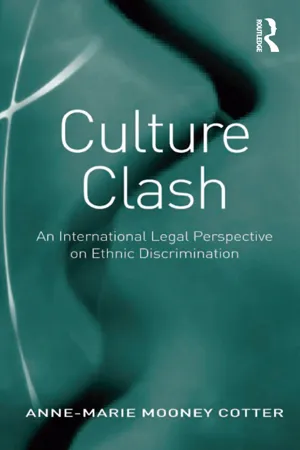
Culture Clash
An International Legal Perspective on Ethnic Discrimination
- 388 pages
- English
- ePUB (mobile friendly)
- Available on iOS & Android
eBook - ePub
About this book
The globalization process has foregrounded ethnic discrimination as an increasingly important area of law around the world. Allowing a better understanding of the issue of ethnic discrimination and inequality, this book offers a comparative analysis of legislation impacting ethnic equality in various Anglophone countries. It demonstrates that it is possible to achieve equality at both national and international levels. A compelling historical analysis of the North American Free Trade Agreement and the European Union Treaty is provided together with a detailed examination of diversity and the law. The book will interest practitioners and others interested in ethnic legal issues.
Chapter 1
Introduction to Culture Clash
So we come here today to dramatize a shameful condition. In a sense we’ve come to our nation’s capital to cash a check. When the architects of our republic wrote the magnificent words of the Constitution and the Declaration of Independence, they were signing a promissory note to which every [human] was to fall heir. This note was the promise that all … would be guaranteed the unalienable rights of life, liberty, and the pursuit of happiness … A check which has come back marked insufficient funds. We refuse to believe that there are insufficient funds in the great vaults of opportunity of this nation. And so we’ve come to cash this check, a check that will give us upon demand the riches of freedom and the security of justice.1
In our universal quest for justice in general, and tolerance for ethnic differences in Culture Clash, we may learn from the immortal words of one of the greatest civil rights leaders and human rights activists Dr. Martin Luther King Jr. This book, Culture Clash, focuses on the goal of ethnic equality, and the importance of the law and legislation to combat ethnic discrimination in these troubling times. The aim of this book is to better understand the issue of inequality and to improve the likelihood of achieving ethnic equality in the future and ending ethnic inequality. Culture Clash examines the primary role of legislation, which has an impact on the court process, as well as the primary role of the judicial system, which has an impact on the fight for ethnic tolerance. This is the eighth book in a series of books on discrimination law. Other titles in the series are Gender Injustice dealing with gender discrimination, Race Matters dealing with race discrimination, This Ability dealing with disability discrimination, Just A Number dealing with age discrimination, Heaven Forbid dealing with religious discrimination, Ask No Questions dealing with sexual orientation discrimination, and Pregnant Pause dealing with maternity discrimination. A similar approach and structure is used throughout the series to illustrate comparisons and contradictions in discrimination law.
Fundamental rights are rights which either are inherent in a person by natural law or are instituted in the citizen by the State. The ascending view of the natural law of divine origin over human law involves moral expectations in human beings through a social contract, which includes minimum moral rights of which one may not be deprived by government or society. The competing view is that courts operating under the Constitution can enforce only those guarantees which are expressed. Thus, legislation has an impact on the court system and on society as a whole. Internationally and nationally, attempts have been made to improve the situation of all ethnic groups and outlaw discrimination.
In looking at the relationship between ethnic inequality and the law, the book deals comprehensively with the issue of ethnic discrimination throughout its chapters by outlining important legislation in the area, with no particular position argued necessarily but with the intent to give the reader the knowledge to make up their own mind; also, for the most part, the countries examined were chosen because of their predominant common law background, because of their predominant use of the English language in legislation and case law, and because of their predominant role in the fight against discrimination: Chapter 1 introduces the reader to the core area of ethnic inequality; Chapter 2 covers ethnic inequality in ethnic relations around the world; Chapter 3 looks at the United Nations; Chapters 4 and 5 examine ethnic inequality in Australia and New Zealand, and Africa and South Africa, respectively; Chapters 6 and 7 examine ethnic inequality in Canada, Mexico and the United States, and the North American situation with the North American Free Trade Agreement as to its impact on ethnic inequality, respectively; Chapters 8 and 9 examine ethnic inequality in the United Kingdom and Ireland, and the European situation with the European Union Treaty as to its impact on ethnic inequality, respectively; and Chapter 10 concludes this overview of ethnic inequality.
The globalization process and the various economic agreements have a direct impact on people’s lives as key players in the labor market today. This study seeks to comparatively analyze legislation impacting ethnic equality in various countries internationally. It also examines the two most important trade agreements of our day, namely the North American Free Trade Agreement and the European Union Treaty in a historical and compelling analysis of equality. Although an important trade agreement with implications for labor, the North American Free Trade Agreement has a different system from the European system in that it has no overseeing court with jurisdiction over the respective countries. Further, the provisions for non-discrimination in the labor process are contained in a separate document, the North American Agreement on Labor Cooperation. On the other hand, the European Union Treaty takes a different approach, by directly providing for non-discrimination, as well as an overseeing court, that is, the European Court of Justice, and the treaty is made part of the domestic law of every Member State, weakening past discriminatory laws and judgments. Further, the European process actively implements ethnic equality by way of European Union legislation.
North America, as the new world with its image of freedom and equality, is considered to have made great strides in civil rights. However, the American philosophy of survival of the fittest and the pursuit of materialism have slowed down the process. With the advent of the European Union, the coming together of nations has had a very positive influence on the enforcement of human rights, much more so than that of North America, because of the unique European approach.
All parties must cooperate, and governments need to work with businesses, trade unions and society as a whole; together, they can create an environment where people of all ethnic groups can participate at all levels of political life and decision-making. Indeed, combating ethnic inequality and achieving ethnic equality requires a strong “ethnic matters” focus in constitutional, legal, judicial and electoral frameworks for people of all ethnic groups to be actively involved at the national and international levels.
According to liberal democracy, the rule of law is the foundation stone for the conduct of institutions. Culture Clash offers a defense of the notion that social reform is possible and plausible through key institutions, which include the legal system and its use of the law. For liberal democracy, the legislative system is the core for the governance of society in the way it functions toward social equality of opportunity. It is clear that if we reform our legislation and our laws, then there will be a change in the institutions of society and their functioning, which will be a major step forward in societal reform.
The law is of central importance in the debate for change from ethnic inequality to ethnic equality. Actionable and enforceable rights are legal norms, which represent social facts demarcating areas of action linked with universalized freedom.2 Law is a powerful tool, which can and must be used to better society. Associated with command, duty and sanction, and emanating from a determined source, law is a rule of conduct enforced by sanctions, and administered by a determinate locus of power concentrated in a sovereign or a surrogate, the court. Therefore, the justice system and the courts play a vital role in enforcing the law.
Legitimacy has subjective guarantees of internalization with the acceptance and belief in authority, and objective guarantees of enforcement with the expectation of reactions to the behavior.3 Therefore, law must recognize equally all members of society, including minority women, in order for it to be effective. Further, in order for a law to be seen as legitimate from society’s point of view and accepted by the people in general to be followed, a process of inclusive interaction by all affected must first be realized. When creating laws, this means that input from diverse groups is critical.
Thus, laws have two components, namely, facts, which stabilize expectations and sustain the order of freedom, and norms, which provide a claim of approval by everyone. Law makes possible highly artificial communities whose integration is based simultaneously on the threat of internal sanctions and the supposition of a rationally motivated agreement.4 Discrimination and injustice can be undercut through the effective use of both the law and the courts.
The facticity of the enforcement of law is intertwined with the legitimacy of a genesis of law that claims to be rational, because it guarantees liberty. Laws can go a long way in forbidding inequality and providing for equality; where one ends the other begins. There are two ranks of law, namely ordinary law of legislation, administration and adjudication, and higher constitutional law affecting rights and liberties, which government must respect and protect. The latter encompasses the constitutions of the various nations as interpreted by the supreme courts. Law holds its legitimacy and validity by virtue of its coercive potential, its rational claim of acceptance as right. It is procedurally constructed to claim agreement by all citizens in a discursive process purported to be open to all equally for legitimacy and a presumption of fair results. The legitimate legal order is found in its reflexive process. Therefore, we must all believe that equality is a good and necessary thing, which is essential to the very growth of society.
Thus, conflict resolution is a process of reasoned agreement where, first, members assume the same meanings by the same words; secondly, members are rationally accountable for their actions; and third, mutually acceptable resolutions can be reached so that supporting arguments justify the confidence in the notion that the truth in justice will not be proven false.5 Disenchantment with the law and the legal process only serves to undermine the stabilization of communities. By legitimizing the legal process and holding up the ideals of equality in the fight against ethnic discrimination, the law and the courts can bring about change.
People of all ethnicities have had to fight in the formulation of laws and in the enforcement of equality in the courts. Class rests on economic determination and historical change, like ethnicity. Inequality in the distribution of private property among different classes of people has been a characteristic of society. The ruling class loathes that which it is not, that which is foreign to it, and this has traditionally been minorities. The patriarchal system has freely fashioned laws and adjusted society to suit those in power, and this has traditionally been white Anglo-Saxon Protestant men. Ethnic discrimination takes race discrimination one step further; while race discrimination pits race against race, ethnic discrimination undercuts one’s very own race.
Ethnic attributes, opportunities and relationships are socially constructed and are learned through socialization processes. They are context and time-specific but changeable, since ethnic determines what is expected, allowed and valued in a given situation. In most societies, there are differences and inequalities between ethnic groups in the assignment of responsibilities, undertaking of activities, access to and control over resources, and decision-making opportunities, with ethnicity part of the broader sociocultural context. There are important criteria for analysis, including ethnicity, race, gender, poverty and class, age, disability, religion and sexual orientation, and hence all these can, alone or combined, amount to discrimination.
The concept of equality is the ignoring of difference between individuals for a particular purpose in a particular context, or the deliberate indifference to specified differences in the acknowledgement of the existence of difference. It is important to note that assimilation is not equality. The notion of rights and of equality should be bound to the notion of justice and fairness. Legal freedom and rights must be seen as relationships not possessions, as doing, not having. While injustice involves a constraint of freedom and a violation of human dignity through a process of oppression and domination, justice involves the institutional conditions necessary for the development and exercise of individual capacities for collective communication and cooperation.6 Discrimination is the withholding from the oppressed and subordinated what enables them to exercise private and public autonomy. The struggle must be continued to bring about psychological, sociological and institutional changes to allow all members of the human race to feel equal and to recognize one another as being so. Solidarity and cooperation are required for universal and global equality.
Though humans are mortal and civilizations come and go, from biblical times to our days, there has been a fixed pivot for the thoughts of all generations and for men of all continents, namely the equal dignity inherent in the human personality.7 Even Pope John XXIII described the United Nations Declaration of Human Rights in his 1963 encyclical Pacem in Terris, as “one of the most important acts of the United Nations” and as “a step towards the politico-judicial organization of the world community”; “In social life, every right conferred on man by nature creates in others (individuals and collectivities) a duty, that of recognizing and respecting that right.”8 Further, Pope John Paul II described the importance of work and of just remuneration in his 1981 encyclical Laborem Exercens:
Work bears a particular mark of … humanity, the mark of a person operating within a community of persons … While work, in all its many senses, is an obligation, that is to say a duty, it is also a source of rights on the part of the worker. These rights must be examined in the broad context of human rights as a whole, which are connatural with man, and many of which are proclaimed by various international organisations and increasingly guaranteed by the individual States for their citizens. Respect for this broad range of human rights constitutes the fundamental condition for peace in the modern world: peace both within individual countries and societies and in international relations … The human rights that flow from work are part of the broader context of those fundamental rights of the person … The key problem of social ethic … is that of just remuneration for work done … Hence, in every c...
Table of contents
- Cover Page
- Dedication
- Title Page
- Copyright Page
- Contents
- Biography
- 1 Introduction to Culture Clash
- 2 Culture Clash in Ethnic Discrimination
- 3 Culture Clash in the United Nations
- 4 Culture Clash in Australia and New Zealand
- 5 Culture Clash in Africa and South Africa
- 6 Culture Clash in Canada, Mexico and the United States
- 7 Culture Clash in the North American Free Trade Agreement
- 8 Culture Clash in the United Kingdom and Ireland
- 9 Culture Clash in the European Union
- 10 Conclusion to Culture Clash
- Bibliography
- Index
Trusted by 375,005 students
Access to over 1.5 million titles for a fair monthly price.
Study more efficiently using our study tools.
Frequently asked questions
Yes, you can cancel anytime from the Subscription tab in your account settings on the Perlego website. Your subscription will stay active until the end of your current billing period. Learn how to cancel your subscription
No, books cannot be downloaded as external files, such as PDFs, for use outside of Perlego. However, you can download books within the Perlego app for offline reading on mobile or tablet. Learn how to download books offline
Perlego offers two plans: Essential and Complete
- Essential is ideal for learners and professionals who enjoy exploring a wide range of subjects. Access the Essential Library with 800,000+ trusted titles and best-sellers across business, personal growth, and the humanities. Includes unlimited reading time and Standard Read Aloud voice.
- Complete: Perfect for advanced learners and researchers needing full, unrestricted access. Unlock 1.5M+ books across hundreds of subjects, including academic and specialized titles. The Complete Plan also includes advanced features like Premium Read Aloud and Research Assistant.
We are an online textbook subscription service, where you can get access to an entire online library for less than the price of a single book per month. With over 1.5 million books across 990+ topics, we’ve got you covered! Learn about our mission
Look out for the read-aloud symbol on your next book to see if you can listen to it. The read-aloud tool reads text aloud for you, highlighting the text as it is being read. You can pause it, speed it up and slow it down. Learn more about Read Aloud
Yes! You can use the Perlego app on both iOS and Android devices to read anytime, anywhere — even offline. Perfect for commutes or when you’re on the go.
Please note we cannot support devices running on iOS 13 and Android 7 or earlier. Learn more about using the app
Please note we cannot support devices running on iOS 13 and Android 7 or earlier. Learn more about using the app
Yes, you can access Culture Clash by Anne-Marie Mooney Cotter in PDF and/or ePUB format, as well as other popular books in History & European Medieval History. We have over 1.5 million books available in our catalogue for you to explore.