eBook - ePub
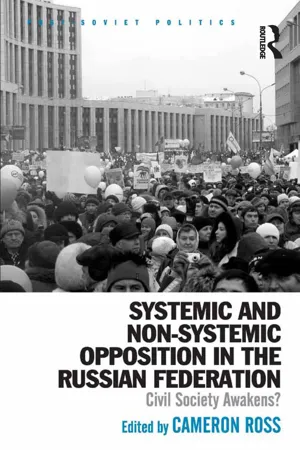
Systemic and Non-Systemic Opposition in the Russian Federation
Civil Society Awakens?
- 230 pages
- English
- ePUB (mobile friendly)
- Available on iOS & Android
eBook - ePub
About this book
Over the period December 2011-July 2013 a tidal wave of mass protests swept through the Russian Capital and engulfed scores of cities and regions. Civil society, it appeared, had at last woken up. This fascinating book examines the rise and fall of the non-systemic opposition and the role of the systemic political opposition during this turbulent period. Leading experts in the field from Russia along with scholars from the UK and the US reflect on the conditions that have made large-scale protests possible, the types of people who have taken part and the goals of the opposition movement at both the national and regional levels. Contributors discuss what steps the regime has taken in response to this challenge and examine the relationship between the systemic and non-systemic opposition and what potential exists for the creation of a broad-based opposition coalition. The role of the expanding Russian middle class is discussed along with contemporary developments among the Russian left against the backdrop of the global economic crisis. The political, social and ethnic dimensions of the protest movement are also examined at both the national and regional levels in this truly comprehensive study of the rebirth of civil society in modern Russia.
Information
Chapter 1
Civil Society and Protests in Russia
Some scholars have suggested that little has changed in civil society in Russia since the collapse of the Soviet system (Ljubownikow, Crotty, and Rodgers 2013: 164). It is true that most independent social organisations in Russia were weak and marginal at the end of the first post-Soviet decade, and the situation has not improved greatly for most of them to the present day. It also may be said accurately that Vladimir Putin has sought to subordinate civil society to domination by the state. Certainly some aspects of the relationship between the state and social organisations that is envisioned in Putin’s model are reminiscent of features of the Soviet system (Ljubownikow, Crotty, and Rodgers 2013: 164). Yet this chapter will argue that a great deal has changed in civil society in Russia since the beginning of the post-Soviet period. The assessment of the degree of such change depends to a large extent on the perspective of each person who analyses trends in Russian society and politics. Those who have directed their attention to civil society in Russia mainly because they have hoped that it would contribute to the success of democratisation in that country are likely to conclude that there has been little significant change. Yet as Russians themselves look at organisations in their society, most of them do not assess such organisations in terms of their contribution to the growth of democracy in their country’s political system. A variety of evidence indicates that most Russians evaluate the work of nongovernmental organisations (NGOs) in terms of the impact that they feel in their lives. They ask whether any of those organisations have produced improvements by addressing the problems that most trouble them. We need to keep that perspective in mind as we examine trends in civil society in Russia.
Problems of Civil Society in Post-Soviet Russia
The 1990s, the first years after the demise of the Soviet system, were a painful and difficult period for most people in Russia, in which providing for basic necessities in the face of economic instability was the overriding concern. The consensus of scholars is that during this period, most Russians continued to rely primarily on informal networks of family members and friends to satisfy their most urgent needs (Crotty 2009: 88, Ljubownikow, Crotty, and Rodgers 2013: 158). Indeed, it is recognised that Russian citizens continue to resort to informal practices based on friendships and trade-offs of favours at the present day to ensure the adequate provision of key services (Greene 2012: 138). As part of the unofficial legacy of the Soviet system, Russians have regarded the public sphere – including not only political institutions but also social organisations – with suspicion, as a realm of corruption and cynicism (Richter and Hatch 2013: 331). Thus in the 1990s, as Sarah Henderson (2010: 261) says, ‘many viewed NGOs with hostility, mistrust, or, at best, indifference’. Lev Jakobson and Sergei Sanovich (2010, 292) argue that the public’s lack of confidence in such organisations is still the main obstacle to the expansion of civil society in Russia. Support for organisations dedicated to the defence of human rights has been particularly weak (Volkov 2011: 39), partly because the discourse about individual rights that comes from Western countries with more liberal traditions does not evoke as positive a response in Russia.
In general, after the fall of the Soviet system, civil society in Russia was marginal in its place in society and the political system. As Henderson (2010: 250) puts it, ‘the non-profit sector that emerged in the first decade of the post-Soviet era was weak, fragmented, and poorly connected with political elites and with the populations it claimed to represent’. A major handicap of non-profit organisations in that period was a lack of funding, and that continues to be a serious deficiency (Chebankova 2013: 147, Obshchestvennaya palata 2013: 26). Surveys of the leaders of NGOs in Russia have consistently found that most of the respondents identify a lack of financial resources as their most troubling problem. Debra Javeline and Sarah Lindemann-Komarova (2010: 174) report on a survey of NGO officers in which only 2.9 per cent identified ‘pressure on organisations from government’ as one of their primary problems, while ‘not enough money, material resources’ was named by 59.1 per cent of respondents, putting that problem in first place. It is not surprising that Jo Crotty (2009: 96) says of NGOs that she has studied that ‘economic pressures, coupled with an absence of resources … led to the decline of these groups, rather than attempts by the state to reign in their activity’. Raising funds by soliciting donations from Russian citizens was not feasible for the vast majority of non-profit organisations for a number of years, not only because of widespread suspicion of social organisations, but also because most Russians found themselves with marginal financial resources due to decreases in their real incomes. Recently Sergei Ljubnikow and Jo Crotty (2013: 5) concluded that the absence of domestic sources of funding is still the factor that is most detrimental for the development of nongovernmental organisations in Russia. When Janet Elise Johnson and Aino Saarinen (2011: 48) asked the officers of women’s crisis centres in Russia about their main problems, the respondents pointed ‘first and foremost’ to the lack of sufficient financing for their facilities and services.
Initially, in the post-Soviet years, financial support for NGOs from businesses was scarce; even in more recent years, most businesses have not been eager to assist non-profits, according to Denis Volkov (2011: 7) of the Levada Centre. Though some other scholars report that during the last several years the business world has begun to give funds to the non-profit sector on a growing scale (Jakobson and Sanovich 2010: 293), they add that corporate donations flow only to projects that are approved by government authorities on one level or another (Jakobson and Sanovich 2010: 293, Volkov 2011: 7). For organisations that have a contentious relationship with the political regime – resulting from their confrontation of authority over violations of citizens’ rights – funding from Russian business is said to be impossible (Jakobson and Sanovich 2010: 293). In the aftermath of the collapse of the Soviet system, assistance from local governments was crucial for many social organisations, particularly for those that had been sponsored by the state earlier. Ol’ga Alekseeva (2010: 309) estimates that in the 1990s, non-profit organisations in Russia received 40 per cent of their resources from local governments. A large proportion of that assistance was not in the form of money, but consisted of office space, equipment, telephone service, and other resources at the disposal of local officials. On the other hand, some NGOs stepped into the role of contractors who entered into agreements with local governments to provide social services that government entities previously had delivered directly to citizens (Fröhlich 2012: 375).
Financial support for non-profit organisations from foreign governments and foundations was a new feature in Russia in the post-Soviet period, and it was very significant for some NGOs although the majority have never received funding from foreign sources (Alekseeva 2010: 308). Foreign donors largely concentrated their assistance on organisations that had come into existence during the late 1980s or the 1990s, and those focused on human rights, women’s rights, and other issues that the donors considered central for the building of democracy (Henderson 2010: 255). Sarah Henderson (2010: 264) notes that the emphasis of Western donors led them to work with ‘a relatively narrow’ selection of NGOs, and she argues that those organisations were ‘unrepresentative’ of most of Russian society. Christian Fröhlich (2012: 379) points out that in the 1990s the non-profits that were the focus of support from Western donors sought to follow ‘Western liberal models of a civil society independent of the state and the market’. Though grants from foreign sources did make it possible for the leaders of some NGOs to learn the professional practices employed by Western non-profits, studies by several scholars have found that organisations that relied mainly on foreign funding devoted their efforts to the goals which most important for the funding organisations instead of emphasising issues that were of primary concern for their potential constituencies in Russia (Henderson 2010: 264; Chebankova 2013: 119). Thus NGOs that depended heavily on foreign support built ties with donor organisations outside of Russia rather than strengthening their links with groups in the population of their own country (Jakobson and Sanovich 2010: 286).
After the end of the 1990s foreign funding for non-profit organisations was decreasing because of shifts in the priorities of foreign governments and foundations (Jakobson and Sanovich 2010, 287–288; Johnson and Saarinen 2011: 41). At this point it is worth emphasising that the decline of support from outside sources for organisations in civil society in Russia began because of factors other than the actions of the government of that country, although it is true that within a few years the Putin administration did voice its distaste for foreign financial support for NGOs. According to Jakobson and Sanovich (2011: 287), the model in which some Russian nongovernmental organisations depended primarily on foreign money had exhausted itself in the early 2000s. The combination of the effects of the decrease in interest in Russia among foreign donors and the imposition of greater restrictions by the Putin regime has led to a ‘crisis of financing’ for some non-profit organisations (Volkov 2011: 11). There may be different interpretations of the probable consequences of that situation. One could view the decline of foreign grant funding for some NGOs as weakening Russian civil society, and there undoubtedly are serious problems for those organisations that have depended heavily on such grants. On the other hand, for the majority of non-profits which never received grants from foreign sources, the lack of availability of such funding will hardly make a difference. Further, some scholars think that the drying up of most money from abroad will encourage the growth of a civil society that is more deeply rooted in domestic society, as social organisations in Russia seek to replace external sources of support with internal ones (Jakobson and Sanovich 2011: 289). In other words, the changed situation might give organisations that previously placed primary value on their relationship with agencies in the West an incentive to devote more attention to meeting the needs of groups in Russian society in order to win greater support within their country.
Some nongovernmental organisations have been successful in cultivating support among groups in their society. One key factor in gaining confidence from a domestic constituency appears to be framing issues in a manner that is compatible with the values and attitudes of Russian society. Fröhlich (2012: 376) points out that organisations of the disabled in Russia that avoid presenting their goals in a framework drawn from a human rights-based approach (which would be more acceptable in the West) and instead emphasise ‘social inequalities and the poor living conditions of children with disabilities and their families’ achieve greater resonance in Russian society. Lisa McIntosh Sundstrom (2006: 186) has shown that the Committees of Soldiers’ Mothers have gained a high level of credibility among the majority of Russians by framing their goals in relation to the image of a mother who strives to protect her son, an image that is firmly grounded in traditional Russian culture. Further, Fröhlich (2012: 385) has found that most organisations that seek to improve conditions for the lives of people with disabilities in Russia have not chosen a strategy consistent with the Western notion of civil society as independent from the state and often in conflict with it, but have sought cooperation with the state, which has worked to their advantage by cultivating connections that facilitate the representation of the interests of their constituents. As he puts it, the close relationship between the All-Russian Society of the Disabled (VOI) and the government has enhanced the political opportunities for VOI (Fröhlich 2012: 380–381). In his view, professionalised NGOs serving people with disabilities have adapted a ‘Western human rights-based approach of social inclusion’ in order to make it more compatible with the norms of Russian culture and the necessity of entanglement with the state (Fröhlich 2012: 384).
Vladimir Putin and State Domination of Civil Society
After Vladimir Putin became president of Russia, he proceeded to reduce the independence of all centres of power outside the institution of the presidency as he concentrated more and more authority in his own hands. As a result, the degree of pluralism in the political system of Russia decreased dramatically between 2000 and 2008. Around the time that his second term as president began in 2004, Putin openly turned his attention to civil society (Evans 2006: 149, Robertson 2009: 531). He has often spoken of the importance of developing civil society, but it is clear that his vision of civil society is quite different from that which is usually endorsed in the West. Putin does not see civil society in his country as being independent from the state and often entering into an adversarial relationship with the centre of political authority. Instead, as this author pointed out several years ago, Putin ‘interprets civil society as a network of organisations that, while remaining technically outside the state, will be co-opted to assist the leadership of the political regime in pursuing the objectives that it has chosen for society’ (Evans 2006: 152). In short, Putin’s model is of a civil society that is dominated by the state and that serves the interests of the Russian nation. The Russian political regime has increased its efforts to put that model into action after the events in Ukraine in 2004 and 2014, which the Kremlin has viewed as showing the danger of a civil society that supports opposition to the state.
Among the measures that the Putin administration has taken to try to translate that model into institutional reality has been the adoption of legislation designed to tighten the regulation of nongovernmental organisations. The laws that have been approved with that end in mind during the last several years have been covered in detail elsewhere, and their impact has been widely debated (Richter and Hatch 2013: 336). It is clear that the law on NGOs which was adopted in 2006 increased the requirements for reporting by such organisations, and that it has imposed a greater burden on the staff of non-profit organisations in filling out forms and gathering information for reports, thus further straining the resources of such organisations (Johnson and Saarinen 2011: 48, Ljubownikow and Crotty 2013: 2). On the other hand, some NGO leaders were happy that the legislation of 2006 could eliminate fake non-profits that diverted money to purposes other than those for which it was contributed (Johnson and Saarinen 2011: 42). The language of that law suggested that it could be used to justify closing organisations whose goals were not approved by state officials, but reports on the enforcement of the law indicate that it has not been employed to terminate organisations whose work has irritated the government (Javeline and Lindemann-Komarova 2010: 174). Some scholars have said that the law of 2006 made it more difficult to obtain funding from foreign sources (Ljubnownikow and Crotty 2013: 8). Since early 2013, the enforcement of the more recent legislation that requires any noncommercial organisation in Russia that receives foreign funding and engages in political activity to register as a ‘foreign agent’ has been extraordinarily heavy-handed in some cases, in which a bevy of officials of various agencies have simultaneously descended on the offices of each NGO, demanding information about a variety of aspects of the operation of that organisation, most of which have nothing to do with the provisions of the ‘foreign agent’ law (Winning 2013). Also, in practice the definition of political activity under that law has been very broad in some cases, for example including the Levada Centre publishing the results of opinion surveys that is has conducted (Zakharov 2013). The legislation regulating nongovernmental organisations that has been enacted at the behest of the Putin regime is part of a system of selective incentives and disincentives that encourage civil society organisations to cooperate with the state and make life more difficult for those that choose to confront the structures of authority (Evans 2006: 154, Richter and Hatch 2013: 329).
The political leadership of Russia has made efforts to create organisations that it has sponsored as it tries to implement its vision of a civil society that serves the state (Richter and Hatch 2013: 335, Ljubownikow, Crotty, and Rodgers 2013: 162). So far the most widely publicised of those organisations have not been highly successful, as was implied when the youth organisation Idushchie vmeste – a Kremlin project from the start – was replaced with Nashi, which now seems to have little energy and may itself be due for retirement. The political regime has also created institutions that are part of the state but were intended to strengthen connections with civil society and provide channels for feedback from the population. The new institutions that the Putin leadership probably saw as most important for that purpose are the public chambers on the national, regional and local levels. The national Public Chamber (Obshchestvennaya palata) came into existence following a proposal by Vladimir Putin in 2004, and began functioning in early 2006 (Evans 2008, Richter 2009). It has 126 members who were drawn from nongovernmental organisations and a variety of professions, and the presidency plays a key role in selecting those members. During the initial period of its operations, that chamber got involved in some well-publicised conflicts, but after that it seemed to become more careful and has remained quiet on the most controversial issues arising from Russian society during the last few years. A recent proposal for changes in the membership of that body is probably designed to make it more clearly part of the system of support for the national political leadership (Nagornykh et al. 2014). It is often said that most of the public chambers, rather than providing forums for dialogue, ‘have come to resemble state bureaucracies’ (Richter and Hatch 2013: 337).
The official who is usually called the ‘Human Rights Ombudsman’ of Russia, who from 2004 to 2014 was Vladimir Lukin, has consistently been more willing to speak out on actions by the state that he sees as infringing on basic rights. His suggestions that go against the grain of official policy are rarely put into practice by the president, however. Another institution that at times has provided representation for independent groups is the President’s Council on Human Rights and Civil Society, currently headed by Mikhail Fedotov. Though the composition of that council has been broadened in a manner apparently intended to weaken its connection with human rights groups and other dissenters, Fedotov also has been a critic of some official actions on controversial matters. It is perhaps surprising that a former chairperson of that council, Ella Pamfilova – who resigned after reportedly being pressured by some within the presidential administration – has been chosen by Putin to replace Vladimir Lukin as the Human Rights Ombudsman (Gorbachev 2014). That appointment reflects one side of Putin’s strategy for dealing with discontented members of society, which co...
Table of contents
- Cover Page
- Title Page
- Copyright Page
- Contents
- List of Figures and Tables
- List of Contributors
- Introduction
- 1 Civil Society and Protests in Russia
- 2 The Protest Movement in Russia 2011–2013: Sources, Dynamics and Structures
- 3 Defining Common Ground: Collective Identity in Russia’s Post-Election Protests and Rallies
- 4 Middle Class Support for Democracy and Political Protests in Russia
- 5 The Post-Soviet Russian Left – Escaping the Shadow of Stalinism?
- 6 The Systemic Opposition in Authoritarian Regimes: A Case Study of Russian Regions
- 7 Combating the Opposition: United Russia’s Electoral and Party Reforms 2012–13
- 8 Political, Social and Ethnic Protests in Bashkortostan and Tatarstan
- 9 Civic Protests in Tyumen Region: December 2011–September 2012
- 10 The Protest Movement in Yekaterinburg
- Index
Trusted by 375,005 students
Access to over 1.5 million titles for a fair monthly price.
Study more efficiently using our study tools.
Frequently asked questions
Yes, you can cancel anytime from the Subscription tab in your account settings on the Perlego website. Your subscription will stay active until the end of your current billing period. Learn how to cancel your subscription
No, books cannot be downloaded as external files, such as PDFs, for use outside of Perlego. However, you can download books within the Perlego app for offline reading on mobile or tablet. Learn how to download books offline
Perlego offers two plans: Essential and Complete
- Essential is ideal for learners and professionals who enjoy exploring a wide range of subjects. Access the Essential Library with 800,000+ trusted titles and best-sellers across business, personal growth, and the humanities. Includes unlimited reading time and Standard Read Aloud voice.
- Complete: Perfect for advanced learners and researchers needing full, unrestricted access. Unlock 1.5M+ books across hundreds of subjects, including academic and specialized titles. The Complete Plan also includes advanced features like Premium Read Aloud and Research Assistant.
We are an online textbook subscription service, where you can get access to an entire online library for less than the price of a single book per month. With over 1.5 million books across 990+ topics, we’ve got you covered! Learn about our mission
Look out for the read-aloud symbol on your next book to see if you can listen to it. The read-aloud tool reads text aloud for you, highlighting the text as it is being read. You can pause it, speed it up and slow it down. Learn more about Read Aloud
Yes! You can use the Perlego app on both iOS and Android devices to read anytime, anywhere — even offline. Perfect for commutes or when you’re on the go.
Please note we cannot support devices running on iOS 13 and Android 7 or earlier. Learn more about using the app
Please note we cannot support devices running on iOS 13 and Android 7 or earlier. Learn more about using the app
Yes, you can access Systemic and Non-Systemic Opposition in the Russian Federation by Cameron Ross in PDF and/or ePUB format, as well as other popular books in Politics & International Relations & Civics & Citizenship. We have over 1.5 million books available in our catalogue for you to explore.