This collection brings together innovative research from socially-oriented applied linguists working in sports. Drawing on contemporary approaches to applied linguistics, this book provides readers with in-depth analyses of examples of language-in-use in the context of sport, and interprets them through the lens of larger issues within sport culture and practice. With contributions from an international group of scholars, this an essential reference for scholars and researchers in applied linguistics, discourse analysis, sport communication, sport management, journalism and media studies.
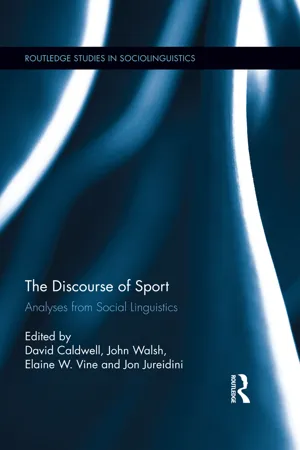
eBook - ePub
The Discourse of Sport
Analyses from Social Linguistics
- 240 pages
- English
- ePUB (mobile friendly)
- Available on iOS & Android
eBook - ePub
The Discourse of Sport
Analyses from Social Linguistics
About this book
Information
1
Discourse, Linguistics, Sport and the Academy
1.1 Overview
We begin this chapter by unpacking the title of this edited collection, revealing the underlying orientations and assumptions of the collection, defining what we mean by terms such as discourse and social linguistics and outlining the methods through which we approach language analysis. We then present a brief review of the key scholarly works involving language and sport: what has been done, what are some of the noteworthy texts in the field and where this collection fits within current scholarship. This is followed by a brief introduction to each of the chapters. Finally, by way of conclusion, we present our readers with an invitation to engage with this edited collection—The Discourse of Sport: Analyses from Social Linguistics.
1.2 Our Terminology
Readers will notice that we begin our title with the phrase ‘Discourse of sport.’ Within the academy, the term ‘discourse’ can vary greatly in its conceptualisation and application across different disciplines. Given this, it is important to offer some basic parameters with respect to how we use this term. The capitalisation of Discourse in the title is significant in that it signals what Gee (1990) calls ‘big D’ Discourse:
A Discourse is a socially accepted association among ways of using language, of thinking, feeling, believing, valuing, and of acting that can be used to identify oneself as a member of a socially meaningful group or “social network,” or to signal (that one is playing) a socially meaningful role.
(Gee 1990, 143)
In this sense, the ‘Discourse of sport’ neatly captures a plurality that is potentially missing from the phrase the ‘language of sport’ or ‘linguistics of sport’ (see the discussion that follows). Gee (1990), for example, quite specifically uses the plural ‘ways’ of using language. This enables us to open our linguistic and analytical lens to diversity and plurality within the Discourse of sport and to engage with the range of language varieties, genres, registers, lexes, grammars and phonology/graphology that constitute the Discourse of sport. ‘Big D’ Discourse also enables us to extend our analytical lens beyond language specifically, to include other modes of meaning, “as it is always more than just language” (Gee 1990, 142). Caple (this volume), for example, considers the role of visual image in sports Discourse.
While Gee’s definition of ‘big D’ Discourse is useful in terms of foregrounding linguistic variation and providing an overarching theoretical lens, the majority of the chapters in this collection are aligned with ‘little d’ discourse, or ‘language-in-use’ (Gee 2014, 19–20), which is concerned with “connected stretches of language that make sense, like conversations, stories, reports, arguments, essays” (Gee 1990, 142). For further discussion of Gee’s distinction between ‘big D’ and ‘little d’ discourse, see Walsh and Caldwell (this volume).
We need to be very clear that we conceptualise these D/discourses as complementary and not mutually exclusive. If we are to do our job effectively as social linguists in describing, analysing and bringing to consciousness the ‘little d’ discourse of sport, then we will invariably have something to say about the ‘big D’ Discourse of sport. As linguists, however, our emphasis is predominately on language. And as will be discussed in the following section, it is precisely this emphasis on language-in-use in sport, a close analysis of the ‘little d’ discourse in sport, that we see as our contribution to the field.
While we encourage the phrase ‘Discourse of sport,’ we do, however, avoid the phrase ‘language of sport,’ preferring instead to use the phrase ‘language in sport.’ We resist the use of the preposition ‘of’ because it potentially implies a singular, unified, homogenous language of sport. Sport, like any major field, is subject to variation across languages, dialects, as well as contextual variation. The topic of multilingualism in sport, for example, is itself a bourgeoning area of inquiry, illustrated by Lavric et al.’s (2008) edited collection titled The Linguistics of Football and the affiliated bibliography titled The Football and Language Bibliography Online (Giorgianni and Lavric 2013). While our collection focuses predominately on the English language, it also engages with languages other than English (see Lavric and Steiner this volume, Wilton this volume, Lavric and Weidacher this volume). Even if one limits oneself to a specific language, or tries to unify language types under the general field of sport, the language practices are still far from homogenous. Contextual variation means that there are many and varied text-types enacted in sporting contexts. From a Systemic Functional Linguistic orientation (Halliday and Matthiessen 1999; Martin and Rose 2007), sport discourse is constituted through different genres and registers, which are invariably realised by different lexicons, grammars and phonologies/graphologies.
If there is one constant in this volume, it is the field of sport, but even then, within that broad field of sport, this collection varies in terms of the types of sport examined, the specific participants involved in those sports, and so on. Walsh and Jureidini’s chapter on the real-time, in-match language used by coaches in Australian rules football describes a genre that is predominately instructional, a tenor that is informal, a field that is highly technical and a mode that is spoken. In contrast, Ismail’s chapter on gender bias in Western sports news in Malaysia draws on a range of language genres including recounts, expositions and information reports. The register is typically formal, the field is typically non-technical and the mode is written. In each case, the language practices, as realised through such distinct social and cultural contexts, are quite different, and it is precisely these variations that we are interested in describing, analysing and bringing to consciousness. In other words, what are some of the vast and varied language practices that constitute our world of sport?
The earlier discussion takes us to the second part of our title: ‘Analyses from Social Linguistics.’ For us, the following quote from English and Marr (2015) captures not only the role of the linguist but also the specific role of social linguistics that informs the work presented here:
… we are primarily interested in the kind of linguistics that incorporates what Halliday calls the “messy” bits (1978, 38); that is a social linguistics … We are linguists because we use the descriptive tools and insights that the discipline provides. We are social linguists because we study linguistic data from the perspective of communicative activity. We are sociolinguists because we look at language and communication in society. We are social semioticians because we explore communication as meaning and meaningful in the social world and we are applied linguists because we believe the study of language and language-related fields is relevant to real-world issues.
(English and Marr 2015, 3, 5)
This quote serves as a reference point for readers when they encounter these various terms throughout this volume: linguist, social linguist, applied linguist and so on. For the purposes of this introduction, however, we want to highlight two specifics from this quote: the role of the linguist, and the connection between language and the social. As linguists, we are bound by the range of descriptive tools and insights available within the discipline. However, there is no one method of description, no single set of descriptive tools. Within this collection, the contributors draw on a range of contemporary approaches to linguistics, including corpus linguistics, Systemic Functional Linguistics, critical discourse analysis and interactional socio-linguistics. The common thread across these approaches is their view of language as embedded in society. The second, and related point to highlight is the foregrounding of the social—a connecting of linguistic data to real-world issues in the social world of sport. Not every contributor does this in the same way, nor to the same extent (see e.g. Wrench and Garrett, this volume, who focus more on real-world issues, cf. Clarke, this volume, who focuses more on linguistic data), but it is safe to say that this volume is not an exercise in formalist linguistics. We are not interested in describing the language features in sport for the understanding of language description alone. We describe and analyse language use and its features in sport because this invariably informs us about sport as a communicative activity, as a meaningful social world that constitutes real-world issues.
1.3 Key Works
Language in sport encompasses a broad area of scholarship. Here we acknowledge some of the noteworthy texts, bibliographies and journals from the past twenty years in chronological order; those publications which provide background and inspiration to this collection, and which will serve as a valuable resource for anyone interested in future study in this area. Drawing on these texts, we then highlight what we see as underdeveloped in the research to date and in turn reveal the scope for this volume: a diverse collection of socially oriented, linguistic-based studies in the context of contemporary sport.
We begin with the senior secondary and tertiary-level textbook from Beard (1998): The Language of Sport. Beard’s (1998) analysis of the language of ‘sports-talk’ includes detailed linguistic analysis of sports media discourse, such as sports commentary and sports writing. In the tradition of the social linguistics described earlier, Beard’s work also examines the role language plays in representing and construing the social world of sport, with particular reference to themes such as gender and national identity.
Developed in the mid-2000s by the Innsbruck Football Research Group, The Linguistics of Football (Lavric et al. 2008) is an edited collection, especially ambitious and generous in its scope. The collection comprises more than thirty papers focusing on linguistics in football (or soccer), presented under a range of headings, including football and media, and football and multilingualism. The volume has a strong focus on European football, and is a rich site for linguistic analysis at the local, national and international levels. It applies linguistic analyses to a variety of individual football contexts, through a range of lenses. In these terms—an eclectic edited volume applying linguistics to the context of sport—The Linguistics of Football is close to this current volume.
Another important contribution from the Innsbruck Football Research Group is the Innsbruck Football and Language Bibliography (Giorgianni and Lavric 2013). First developed as part of the aforementioned edited collection (Lavric et al. 2008), this online bibliography is one of the most useful resources for those interested in the general topics of discourse, language and sport. Currently, the online bibliography lists more than 2,200 titles: “It updates and completes the references given there (from 20 pages they have grown to 100 pages now), containing publications in English, French, Spanish, Italian, Polish, Russian and other languages and culture.” (Giorgianni and Lavric 2013, 1). While much of this online bibliography is devoted specifically to the language of football/soccer, it also includes other more general sections which focus on ‘sport and language’ as well as ‘sport and mass media.’
… it also contains other subsections that might be of interest, e.g. “Football and Other Disciplines,” “Sport and Language,” “Sport and Mass Media,” etc., as well as a section about “Dictionaries” and a collection of “Websites.” On all these points, we do not pretend to be exhaustive, but we are happy about any useful contributions.
(Giorgianni and Lavric 2013, 1)
As an online resource, this bibliography is regularly updated with contemporary work in the field and is a source of reference for many of the contributors in this volume. We would like to take this opportunity to encourage anyone who has done work in the area of language and sport to contribute to this bibliography.
Working in the U.S. context, Meân and Halone (2010) produced a special issue in the Journal of Language and Social Psychology dedicated to sport, language and culture. As a starting point, we note our shared orientation towards language-in-use as inextricably tied to sporting culture: “The role of language, discursive practices, and related forms of communicative inter/action are pivotal aspects through which sport and culture manifest” (Meân and Halone 2010, 254). The special issue features papers linked to media and identity, including provocative topics such as race, gender and masculinity. Much like Lavric et al. (2008) the journal is ambitious and expansive in its scope, engaging in a variety of theories, disciplines and sporting contexts. In reflecting on the special issue, Halone and Meân state, “The conversation is far from complete” (Halone and Meân 2010, 393). We see our edited collection as continuing the conversation; it is another important step in an ongoing dialogue (see also Meân’s foreword in this volume for her reflections).
Fifteen years on from Beard’s (1998) textbook is another book-length publication, Schirato’s (2013) Sports Discourse. Focusing predominately on ‘big D’ Discourse in Gee’s terms (1990, 2014), Schirato employs Discourse and critical theory to examine how the language practices of value systems of the field or sport are reflected in, and at the same time constitute, the social world around us. As with the other key works reviewed here, Schirato covers a range topics including Victorian sport, gender and sport, the modern Olympic Games and the influence of new technologies. This edited collection is thus complementary to Schirato’s book in that we focus on ‘little d’ discourse in the context of ‘big D’ Discourse, while Schirato can be char-acterised as focusing more on ‘big D’ Discourse.
Routledge has recently published two handbooks of relevance to the topic of language in sport: the Routledge Handbook of Sport Communication (Pedersen 2013) and the Routledge Handbook of Sport and New Media (Billings and Hardin 2014). Pedersen (2013) contains fifty chapters covering a wide range of perspectives on sport communication, from traditional media (e.g. print and television) to digital and social media, spanning disciplinary approaches from sociology to management. Billings and Hardin’s (2014) handbook comprises thirty-one chapters, examining the relationship between new media technologies and the ever-changing sports media landscape. While these volumes mention ‘communication,’ neither mentions ‘language,’ or the discipline of linguistics. The effort of this book is, therefore, to offer an alternative, close linguistic analysis, framed within a ‘Discourse’ view of the social context of language use in sport.
In concluding this section on ‘key works,’ it is important to acknowledge the following journals which engage with, to varying degrees, the topic of language in sport: Soccer & Society, Sport in Society, and the International Association for Communication and Sport.
1.4 This Collection
There clearly exists scholarly work combining the fields of linguistics and sport. However, as we suggest, and as proposed by Meân and Halone (2010), there is scope to significantly increase research in this area, especially when compared with other applications of linguistics and other interdisciplinary research in the field of sport. The Innsbruck Football and Language Bibliography (Giorgianni and Lavric 2013), for example, lists approximately two hundred publications under the theme of ‘sport and language.’ T...
Table of contents
- Cover
- Title
- Copyright
- Contents
- Lixst of Tables and Figures
- Foreword
- Acknowledgements
- 1 Discourse, Linguistics, Sport and the Academy
- 2 Language as a Key Resource for the Football Coach: A Case Study of In-Game Coaching at One Australian Rules Club
- 3 Representations of Experience in the Language of Televised and Radio Football Commentaries: Patterns of Similarity and Difference in Transitivity
- 4 Personal Assistants, Community Interpreting and Other Communication Strategies in Multilingual Football Teams
- 5 ‘I Didn’t Know You Were Allowed Two Goalkeepers’: How Football Managers Negotiate Invitations to Criticise Referees in the Media
- 6 The Interactional Construction of Evaluation in Post-Match Football Interviews
- 7 The Visceral and the Analytics: Discourses in the Evaluation of Sports Players
- 8 Constructions of ‘Whiteness’: Race, Sport and Australian Media
- 9 Rankings in Sports Discourse and Their Metaphors
- 10 Of Cover Girls and Bad Boys: A Corpus Linguistic Analysis of Gendered Keywords in Malaysian Sports News Discourse
- 11 The Register of Sports News around the World—A Quantitative Study of Field in Newspaper Sports Coverage
- 12 Results, Resolve, Reaction: Words, Images and the Functional Structure of Online Match Reports
- List of Contributors
- Index
Trusted by 375,005 students
Access to over 1.5 million titles for a fair monthly price.
Study more efficiently using our study tools.
Frequently asked questions
Yes, you can cancel anytime from the Subscription tab in your account settings on the Perlego website. Your subscription will stay active until the end of your current billing period. Learn how to cancel your subscription
No, books cannot be downloaded as external files, such as PDFs, for use outside of Perlego. However, you can download books within the Perlego app for offline reading on mobile or tablet. Learn how to download books offline
Perlego offers two plans: Essential and Complete
- Essential is ideal for learners and professionals who enjoy exploring a wide range of subjects. Access the Essential Library with 800,000+ trusted titles and best-sellers across business, personal growth, and the humanities. Includes unlimited reading time and Standard Read Aloud voice.
- Complete: Perfect for advanced learners and researchers needing full, unrestricted access. Unlock 1.5M+ books across hundreds of subjects, including academic and specialized titles. The Complete Plan also includes advanced features like Premium Read Aloud and Research Assistant.
We are an online textbook subscription service, where you can get access to an entire online library for less than the price of a single book per month. With over 1.5 million books across 990+ topics, we’ve got you covered! Learn about our mission
Look out for the read-aloud symbol on your next book to see if you can listen to it. The read-aloud tool reads text aloud for you, highlighting the text as it is being read. You can pause it, speed it up and slow it down. Learn more about Read Aloud
Yes! You can use the Perlego app on both iOS and Android devices to read anytime, anywhere — even offline. Perfect for commutes or when you’re on the go.
Please note we cannot support devices running on iOS 13 and Android 7 or earlier. Learn more about using the app
Please note we cannot support devices running on iOS 13 and Android 7 or earlier. Learn more about using the app
Yes, you can access The Discourse of Sport by David Caldwell, John Walsh, Elaine W. Vine, Jon Jureidini, David Caldwell,John Walsh,Elaine W. Vine,Jon Jureidini in PDF and/or ePUB format, as well as other popular books in Languages & Linguistics & Linguistics. We have over 1.5 million books available in our catalogue for you to explore.