The remarkable success of the 1972 UNESCO Convention Concerning the Protection of World Cultural and Natural Heritage is borne out by the fact that nearly 1,000 properties have now been designated as possessing Outstanding Universal Value and recognition given to the imperative for their protection. However, the remarkable success of the Convention is not without its challenges and a key issue for many Sites relates to the touristic legacies of inscription. For many sites inscription on the World Heritage List acts as a promotional device and the management challenge is one of protection, conservation and dealing with increased numbers of tourists. For other sites, designation has not brought anticipated expansion in tourist numbers and associated investments. What is clear is that tourism is now a central concern to the wide array of stakeholders involved with World Heritage Sites.
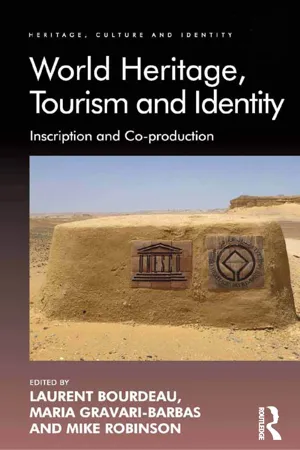
eBook - ePub
World Heritage, Tourism and Identity
Inscription and Co-production
- 290 pages
- English
- ePUB (mobile friendly)
- Available on iOS & Android
eBook - ePub
World Heritage, Tourism and Identity
Inscription and Co-production
Chapter 1
World Heritage and Tourism: From Opposition to Co-production
The relationship between World Heritage and tourism is a long standing and complex one. Despite tourism being mentioned only once amongst the 38 articles of the 1972 “Convention Concerning the Protection of the World Cultural and Natural Heritage”1 (UNESCO 1972) it has been a constant reality in the day-to-day practices of site management and has long underpinned how World Heritage Sites are perceived, encountered and experienced in the wider social and political realm. Over 40 years and more since the Convention, consideration of tourism as an active variable in the production and consumption of World Heritage has shifted from being implicit, to being ever-more explicit in both policy and practice.
There are of course numerous sites on the World Heritage List which, for reasons of protection, daily management, or issues of physical and perceptual access, do not attract significant numbers of tourists. In addition, the designation of World Heritage status may fall upon sites, particularly urban sites, which already have some degree of tourist activity. However, in the main it is difficult to think of World Heritage Sites without imagining swarms of tourists taking photographs, lines of parked tour buses and attendant souvenir stalls. Anyone arriving at a World Heritage Site is confronted by the realities of tourism; significant numbers of tourists, along with a service sector which has developed in scale and scope to meet the needs of the temporary but recurrent tourist population. Aside from some signs of the long term attrition of physical fabric and litter, there are seldom markers of excess tourists immediately visible. Negative impacts tend to be cumulative and hidden, revealing themselves rather more subtly through price inflation, community displacement and acculturation. More direct and visible is the process of infrastructure developments associated with tourism development, and while not necessarily within the boundaries of World Heritage Sites it has been argued that they can impact on the quality of the site (Leask and Fyall 2006). Certainly within the academic literature considerable attention has been given to studies which exemplify the problems that tourism can, and does, pose to the physical fabric of cultural and natural heritage sites and to the socio-cultural well-being of nearby local communities. Such studies have fed, and are fed by, a pervasive discourse which suggests that tourism is de facto, a threat to World Heritage. But while the impacts of tourism—whatever their extent—are assessed, measured and managed, wider geo-political questions are raised regarding the category of World Heritage itself and whether there is indeed some degree of a causality between site designation and the ability to attract tourists. However, it goes without saying that World Heritage Sites are not homogeneous and their management is not monolithic (Bourdeau, Gravari-Barbas and Robinson 2011; Di Giovine 2009). They differ considerably in terms of their reputation, the extent of the tourism flows around them and the extent to which the State and related actors contribute (Ashworth and van der Aa 2006). It is this diversity in the face of the uniformity of production, and production at the nexus between the global and the local, which creates an interesting “heritagescape” (Di Giovine 2009) and an interesting field of research (Djament-Tran, Fagnoni and Jacquot 2012).
The entanglements existing between tourism and World Heritage are in evidence across the marketing and communication networks that pervade the developed and developing world. Many destinations, whether at the national or regional scale, privilege “World” heritage amongst their inventories of attractions to visit, in actions of genuine pride but also in the knowledge that they carry an additional appeal for the tourist market. Tour operators devise their routes and itineraries to include World Heritage Sites as “highlights” and there are operators that specialize in packaging World Heritage centered itineraries. The British-based company Hurlingham Travel offers what it presents as the “World’s Most Expensive Vacation” (at $1.5 million) to see all of the World Heritage Sites in “luxury,” cutting through some 157 countries (http://hurlinghamtravel.co.uk/). While it appears that no one, at the time of writing, has undertaken the tour it demonstrates in the extreme the prestige that is loaded onto the World Heritage label. The United Nations Educational, Scientific and Cultural Organisation (UNESCO) itself plays to the realities of the iconic role of World Heritage Sites in national tourism marketing campaigns and frequently carries advertisements for country destinations in its World Heritage Magazine that frame heritage sites and landscapes, not only as having particular values and that require protection, but as places for tourists to visit. More indirectly too UNESCO is caught up in the dilemma of promoting World Heritage Sites whilst at the same time seeking their protection from the excesses of tourism. In 2008 for instance UNESCO collaborated in the publication of the popular promotional guide 1001 Historic Sites You Must See Before You Die (Cavendish 2008), which while offering a Preface by the then Director-General of UNESCO, Koichiro Matsuura warning of the dangers of poorly managed tourism, nevertheless provided a highly visible promotional message.
Guide-books similarly give prominence to World Heritage in their prescriptive narratives of destinations. Visual texts directed to prospective tourists by way of national advertising campaigns and filmic montages that aim to provide a scopic overview of place in a limited time, again, strongly feature images of World Heritage Sites and, in a similar vein, creative works of film, literature and commercial advertising, have, knowingly and unknowingly, increasingly employed World Heritage Sites as both background and foreground for story purposes. In the vernacular recollections of journeys and holidays that now litter cyberspace in the form of blogs and personal diaries, replete as they are with copious photographs, visits to World Heritage Sites are accorded a degree of detail and reverence and a visit to them has become a kind of social marker of achievement. What is important to note about these various representations of World Heritage and their intersections with the realms of tourism is that they speak of a process of both conscious and unconscious appropriation whereby the sites, structures and landscapes that have been accorded “outstanding universal value” (OUV) through the UNESCO procedure, are then projected and promoted for possessing this value by agents that normally have had no direct input into the processes of valuation and assessment. Such appropriation is an entirely rational action on a number of grounds.
First, for a tour operator or destination marketing organization, it is common sense to draw upon those resources that will attract tourists by virtue of their strong aesthetic appeal or some other feature that will “promise” the tourist a noteworthy experience. What we may term the “attractiveness” of World Heritage requires deeper interrogation and we will return to this later. The consistent and longstanding highlighting of World Heritage in tourism marketing campaigns acts to further embed sites in public consciousness and accentuates their value. They accrue their own social capital by virtue of their very presence in the public sphere. The overlap of World Heritage Sites with the iconic markers of international travel and tourism that pre-date the 1972 Convention—the Pyramids of Giza, Statue of Liberty, Coliseum of Rome, Taj Mahal, etc.—points to a recognized value outside of the UNESCO process and that resonates with a wider system of representation and recognition that tourism taps into and which Barthes (1972) recognized in his well-known critique of the guidebook as a form of reductionism. Many World Heritage Sites map directly onto well established “must-see” tourist attractions.
Second, the ways by which the tourism sector draws on World Heritage speaks to an accepted authority of UNESCO and the inter-active processes of nomination and inscription between Nation state and the transnational influence of this United Nations body. Implicitly this is an acceptance of the 10 criteria used to evaluate World Heritage and the over-arching concept of “outstanding universal value.” Though not articulated as such, those elements within the vast, diverse and fragmented tourism sector that readily adopt the images and stories of World Heritage, are effectively validating the power of UNESCO in deciding that some aspects of tangible cultural heritage is more important/significant/outstanding than other aspects. Within the discourse of marketing, UNESCO provides the ultimate endorsement of a product, taking it from the self-appointed processes of national interest and parochial concern and into the apparent realms of something “objectively verified” and of “trans-national” importance. This allows a tour operator, or a destination, to move away from saying that tourists should visit a site because the national or regional authority suggests we should, but rather implies there is a higher and more pervasive/persuasive voice that can direct the tourist to something special.
Third, and related to the above, the layers of value that accumulate through the label of World Heritage and the additional pulling power this implies, are perceived to bestow a potential economic premium in the form of an increased volume of tourists, plus, additional tourist-related development, mainly in the form of retail and accommodation. In terms of attracting increased numbers of tourists Fundamental economic rationality entails that the category of World Heritage presents a market opportunity to those engaged in tourism. While we can recognize the diversity of sites, the dissemination of norms, discourse through the international conventions (Cousin 2008), together with the role played by international institutions and the mass media in the promotion and diffusion of World Heritage values and, what Marcotte and Bourdeau (2006, 2012) note as the reputation of the World Heritage label, all points to the power and pervasiveness of a universalist perspective (Benhamou 2010) and to the UNESCO meta-narrative claim of unity in diversity (Di Giovine 2009), with the World Heritage List as the emblematic expression of this.
Being “Part of the World” and the “World Brand”
The rationale that gave rise to the 1972 Convention and the category of World Heritage fundamentally remains as one of protection and preservation of sites, monuments, cultural and natural landscapes, for the benefit of wider humanity. Through the State signatories to the Convention (190 member states have ratified the Convention as of September 2013) UNESCO fulfils a paternalistic role as a guardian of cultural and natural heritage “under threat” and recognized to be “unique and irreplaceable” and whose “deterioration or disappearance” would constitute a “harmful impoverishment of the heritage of all the nations of the world,” presumably including the handful of nations that have not signed up to the Convention. At one level it could be argued that to be included in the World Heritage List was to acknowledge the fragility and uniqueness of a particular site and an awareness that it is under particular threat. At another level this could be seen to suggest the weakness of governance for heritage on the part of the member states and their inability to protect their own sites. In cases relating to developing countries where the principles and practices of heritage management and appropriate legislation for site protection may not have fully evolved, intervention through the efforts of UNESCO as a response could be welcome. Reading the sheer number of sites now designated as World Heritage and taking into account the unaltered text of the Convention, it would seem that there have never been so many heritage sites in need of protection.
To be a World Heritage Site is to have participated in a process of evaluation. At one level this is a kind of accreditation; an outcome or reward for matching up to a set of criteria, widely accepted. A heritage site, property or landscape is “tested” against the over-arching concept of Outstanding Universal Value. This itself has been long debated inside and outside of the UNESCO sphere and whilst firmly embedded in the 1972 Convention and remaining the fundamental condition for the inscription of World Heritage, since the Convention and particularly since the first 12 sites were inscribed in 1978, there have been numerous attempts to examine and refine the concept and the way it is mobilized in selecting Sites for the World Heritage List. Over the years the criteria have been refined and since a review of Operational Guidelines in 2005 there are now 10 criteria; the first six dealing in the main with cultural heritage and the remaining four dealing with natural heritage.2 The Operational Guidelines themselves have undergone several reviews in the normative course of their on-going ‘testing’ against sites submitted for inclusion on the List and though the principle of OUV has remained sacrosanct in the listing of World Heritage, we can identify shifts in the ways it has been interpreted. Christina Cameron (2005) in a keynote paper to a Special Expert Meeting on the World Heritage Convention held in Kazan identified that in the mid-1980s the interpretation of the term Outstanding Universal Value had shifted from something which equated to ‘best of the best’ and was in effect applied to sites which were already widely recognized as being “iconic,” to an interpretation of sites being “representative of the best.”3 In the Operational Guidelines which came into being in 2005, Outstanding Universal Value was defined as being “so exceptional as to transcend national boundaries and to be of common importance for present and future generations of all humanity” (UNESCO 2005).
This is a powerful claim and it begs so many questions: In what ways do World Heritage Sites transcend national boundaries? How does this transcendental value manifest itself? And what is actually meant by the term common importance for present and future generations and, important in what sense? Despite elaborate and nuanced discussions which have taken place over the years around the concept of OUV and the attendant World Heritage Criteria it is noticeable that adjustments have been slight and even re-enforcing (Parent 1979).4 Value is largely defined as relating to the material being of the Site with emphasis upon issues such as integrity and authenticity. Historical values, along with artistic or aesthetic values, are given primacy in what Michael Petzet (2005: 9) refers to as “classical values.” We can see the lineage tracing itself back to Kant with this emphasis upon non-instrumental values almost in a self-generating and self-sustaining way to produce, via a rational and objective process, World Heritage. But whatever intellectual challenges the concept generates, the key point is that it has accepted authority through the signatories to the Convention; an authority that has also been accentuated through accumulated practice.
Accepting the parameters of World Heritage is to recognize a category of heritage. Understanding World Heritage as a category is useful in that it allows us to consider not just what is included in the category but also what is excluded. This in turn encourages us to focus on the implications of belonging to a particular category or not. Most categories are recognized as being constructed according to the shared properties that their members share. However, this classical, objectivist view of categories is dependent upon the external hand of the people doing the categorizing and is not solely dependent upon “real world” similarities (Lakoff 1990). While it is important that we recognize the subjectivist, relativist realities of the World Heritage category, this does not necessarily challenge its value. The observation of the steadily climbing total of sites that belong to this category attests to its functionality as well as to its success. With or without knowing how a site measures up to the concept of OUV, there is a desire to be part of the category. The key to understanding this lies in way in which sites are projected to a level of “world” recognition. At the same time in creating and embellishing the “World Heritage” category a distance of separation is created with the rest of what we term heritage. This “other” heritage is de facto de-valued in relation to its more extra-ordinary, “significant” counterpart. Public meaning and attachment to ordinary heritage may or may not be altered but in terms of prioritizing resources to maintain and manage heritage it would seem that there is displacement in favor of designated World Heritage.
The term “world” is laden with expectations and assumptions that are made manifest when it is widely accepted and applied. It carries within it several meanings. It implies universal acknowledgment akin to the notion of a “world” championship where, out of the processes of contestation between several, a winner emerges. It implies ranking and reward, whereby “world” heritage receives a metaphorical gold medal and as a consequence other heritage sites do not. In principle a claim as to what constitutes OUV needs to be clear and unambiguous. In practice OUV is a matter of judgment, collectively arrived at and based in experience that is inevitably relative and subjective where the line between World Heritage winners and losers is a fine one. This is not to denigrate the subjectivity of the approach but merely to recognize it.
Locating World Heritage within a wider understanding of global sociology is helpful in allowing us to understand the desire to be part of what Elliot and Schmutz (2012) term the “Universal Cultural Order.” The “world” as a holistic entity, as something greater than the sum of its parts and which implies action and conduct as “global” in scope, is a distinctly modernist idea born in the period between the two world wars and picked up institutionally in the fervor of post-World War Two optimism. As Pemberton (2001) has argued, the idea of the global is a seductive one with a rhetoric that pervades the cultural sphere as well as economic and technological interests. The meta—message of World Heritage is a courageous, positive and powerful one—that there are tangible reminders of the past—which have the capacity to remind us all, now and in the future, of the successes and failures of humanity. We should remind ourselves that World Heritage is project of UNESCO in the context of the United Nations emerging out of twentieth-century turmoil, war, ignorance and the ongoing threat of physical and intellectual destruction. The Hague Convention for the Protection of Cultural Property in the Event of Armed Conflict, adopted by UNESCO in 1954, was symbolic of an emerging ideal of a “c...
Table of contents
- Cover Page
- Title Page
- Copyright Page
- Contents
- List of Figures
- List of Tables
- List of Contributors
- 1 World Heritage and Tourism: From Opposition to Co-production
- 2 The Use and Impact of World Heritage Designation by Canadian Heritage Sites—An Exploratory Media Analysis
- 3 The Impact of World Heritage on Tourism and the Integrity of Heritage: Some Experience from Mexico
- 4 Implications of World Heritage Designation for Local Residents: A Case Study from Taishan and Taiqian, China
- 5 Cultural Routes as World Heritage Sites: Challenges of the Nomination of the Ancient Silk Roads
- 6 The Relationship between World Heritage Designation and Local Identity
- 7 Local Consequences of Global Recognition: The “Value” of World Heritage Status for Zanzibar Stone Town
- 8 Gender and (World) Heritage: The Myth of a Gender Neutral Heritage
- 9 The Local-to-Global Dynamics of World Heritage Interpretation
- 10 Immediacy, Photography and Memory: The Tourist Experience of Machu Picchu
- 11 The Social Life of the Castles: Inclusion, Exclusion, and Heritage Sites in Ghana
- 12 Place Making and Experience in World Heritage Cities
- 13 Le Morne Cultural Landscape Heritage Site: Its Different Senses of Attachment and Contestation
- 14 Expectations and Experiences of Visitors at the Giant’s Causeway World Heritage Site, Northern Ireland
- 15 Demolition of Tangible Properties as an Intangible Practice
- 16 The Ethics of Landscape: Discourses of Cultural and Environmental Sustainability in the Heart of Neolithic Orkney World Heritage Site
- 17 Old Maps, New Traffics: Political Itineraries around Scattered Heritage of Portuguese Origin
- 18 World Heritage and Sustainable Tourism: Shared Values?
- Index
Trusted by 375,005 students
Access to over 1.5 million titles for a fair monthly price.
Study more efficiently using our study tools.
Frequently asked questions
Yes, you can cancel anytime from the Subscription tab in your account settings on the Perlego website. Your subscription will stay active until the end of your current billing period. Learn how to cancel your subscription
No, books cannot be downloaded as external files, such as PDFs, for use outside of Perlego. However, you can download books within the Perlego app for offline reading on mobile or tablet. Learn how to download books offline
Perlego offers two plans: Essential and Complete
- Essential is ideal for learners and professionals who enjoy exploring a wide range of subjects. Access the Essential Library with 800,000+ trusted titles and best-sellers across business, personal growth, and the humanities. Includes unlimited reading time and Standard Read Aloud voice.
- Complete: Perfect for advanced learners and researchers needing full, unrestricted access. Unlock 1.5M+ books across hundreds of subjects, including academic and specialized titles. The Complete Plan also includes advanced features like Premium Read Aloud and Research Assistant.
We are an online textbook subscription service, where you can get access to an entire online library for less than the price of a single book per month. With over 1.5 million books across 990+ topics, we’ve got you covered! Learn about our mission
Look out for the read-aloud symbol on your next book to see if you can listen to it. The read-aloud tool reads text aloud for you, highlighting the text as it is being read. You can pause it, speed it up and slow it down. Learn more about Read Aloud
Yes! You can use the Perlego app on both iOS and Android devices to read anytime, anywhere — even offline. Perfect for commutes or when you’re on the go.
Please note we cannot support devices running on iOS 13 and Android 7 or earlier. Learn more about using the app
Please note we cannot support devices running on iOS 13 and Android 7 or earlier. Learn more about using the app
Yes, you can access World Heritage, Tourism and Identity by Laurent Bourdeau,Maria Gravari-Barbas, Laurent Bourdeau,Maria Gravari-Barbas,Mike Robinson, Laurent Bourdeau, Maria Gravari-Barbas, Mike Robinson in PDF and/or ePUB format, as well as other popular books in Business & Hospitality, Travel & Tourism Industry. We have over 1.5 million books available in our catalogue for you to explore.