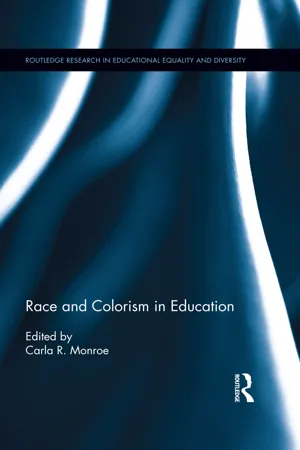
As one of the first scholarly books to focus on colorism in education, this volume considers how connections between race and color may influence school-based experiences. Chapter authors question how variations in skin tone, as well as related features such as hair texture and eye color, complicate perspectives on race and they demonstrate how colorism is a form of discrimination that affects educational stakeholders, especially students, families, and professionals, across P-16 institutions. This volume provides an outline of colorism's contemporary relevance within the United States and shares considerations for international dimensions that are linked to immigration, refugee populations, and Canada. By situating colorism in an educational context, this book offers suggestions for how educators may engage and confront this form of discrimination.
- 202 pages
- English
- ePUB (mobile friendly)
- Available on iOS & Android
eBook - ePub
Race and Colorism in Education
About this book
Information
Part One
The Complexity of Race and Color in Education
In Chapter 1, Janie Victoria Ward and Tracy L. Robinson-Wood, two senior scholars whose voices have shaped the colorism research base, join with new colleague Noreen Boadi to synthesize available research on colorism, particularly as related to African American communities. Their chapter reveals the striking influence of color bias on human development and interpersonal relationships, especially during the critical years of compulsory U.S. schooling. The authors then show readers how educational and psychological interventions may equip individuals, families, and communities with resources and tools to recognize and disarm colorism.
Of course, the voices of people who have been affected by colorism are essential to appreciating the color complex and its consequences. Chapter 2, authored by Kimberly Jade Norwood and Carla R. Monroe, builds on the concept of colorist bullying that is presented in the first chapter. Norwood and Monroe utilize two narratives to identify how colorized aggression may be enacted in the lives of African American women. Disparate ways that color bias may affect Black women are analyzed.
Advancing scholarly conversations and crafting pragmatic solutions requires deliberate decisions to listen to others’ voices. In Chapter 3, John L. Taylor, Suzanne Desjardin, Irene Robles-Lopez, and Charita Johnson Stubbs show how individuals can be intentional in hearing and gaining sensitivity to Black and Latina voices about colorism in family, educational, and work-place settings. By drawing on their shared experience, the co-authors show how university classrooms and research experiences can puncture professional silence and make scholastic spaces available to compelling insights about color discrimination.
Chapter 4 by Lilia D. Monzó and Peter McLaren uses Marxist Feminist Critical Pedagogy as a lens to understand the experiences of Latina women and the role of transnational capital in relation to color consciousness. Monzó and McLaren discuss key issues that shape the lives of Latinas and guide readers through a vision for transformation.
Last, Chapters 5 and 6 address mixed-race populations in college and university environments. Paul Shang and Heather Shea Gasser consider colorism from an institutional standpoint and discuss structural considerations such as data collection and analysis. C. Casey Ozaki and Laura Parson concentrate on human development considerations and ways that students of mixed racial heritage can be affected by color bias and supported during their post-secondary years. The chapters jointly reinforce the value of expanding perspectives beyond singular racial identities and recognizing colorism’s pernicious grip across racialized groups.
1
Resisting Everyday Colorism in Schools
Strategies for Identifying and Interrupting the Problem that Won’t Go Away
As the two senior authors of this chapter, Janie Victoria Ward and Tracy L. Robinson-Wood bring to this work decades of reflection and concern about the seemingly intractable nature of colorism, a problem that will not go away. More than 30 years ago, as Black doctoral students in a program that trained psychologists, educators, and teachers, we wrote our first article on Black women and colorism. As we write this current chapter on colorism, we are struck by the fact that what we wrote then and what we are writing now is heartbreakingly similar. During the 1980s, we used the technology available to us: floppy disks, dot matrix printers, and cassette recorders to chronicle the experiences of colorism in the lives of Black women. We were doctoral candidates and budding researchers having conversations with Black women who recounted the psychological influence of messages they received about the significance of skin color and hair throughout their childhood, adolescence, and young adulthood. Some of these messages about skin color preferences were transmitted in the home and in schools by parents, extended family members, and by teachers. The members of our focus groups shared stories of the divisiveness and isolation they experienced as the forces of colorism pit Black people against one another on the basis of immutable characteristics. Over the last few decades, this issue has received increased prominence and conversations about skin color consciousness have become more commonplace. Social scientists have focused on the phenomenon, providing ample research evidence to support the notion that skin color preferences are alive, well, and result in undeniable social, economic, and political consequences for Black people (Herring, Keith, & Horton, 2004).
In this chapter, we review the literature on colorism and identify specific practices that are associated with biased and discriminatory skin color attitudes and behaviors in school settings. Exercising favoritism, using colorism as a weapon, and expressing and acting on skin color preferences in dating and mating are highlighted for discussion. In the final section of this chapter, we discuss the role that teachers can play in reducing the incidences of skin color bias in K-12 institutions. Talking about race in schools can be fraught with challenges. Often, educators render race a fugitive topic, finding the subject as uncomfortable to approach in the school as it is in larger society. Part of the discomfort teachers feel, we suspect, is due to the fact that they bring to the discussion their own histories, memories, and experiences. While some educators have personal and professional familiarity with this topic, others are less aware.
Our examination of skin color prejudice and discrimination in school settings emerges from a conceptual framework that integrates three foundational principles: (1) the importance of teachers achieving cultural competence associated with addressing colorism in the classroom (e.g., the ability to identify, appreciate, and accurately interpret culturally based social and psychological attitudes and behaviors that drive the phenomena); (2) the importance of promoting social-emotional development in children which includes helping young people recognize and resist discrimination, develop bias awareness, build self-regulation for the range of emotions and behaviors they experience in the face of racially charged situations, and participate in healthy relationships indicative of self-respect and concern for others; and (3) helping children to recognize, navigate, and respond to social inequities by building on individual and group strengths to facilitate resilience and healthy resistance. These are the building blocks upon which our proposed intervention designed to reduce school-based colorist violence is constructed.
Colorism is best described as the internalized bias and favor for a distinct set of phenotypical characteristics that include lighter skin, Eurocentric facial features (e.g., aquiline nose, thin lips), and “good” hair texture (e.g., hair that is long and straight or wavy, rather than tightly coiled and/or kinky). Additional characteristics such as education and income also shape perceptions of who is considered dark or light skinned (Burton, Bonilla-Silva, Ray, Buckelew, & Hordge Freeman, 2010; Hall, 2010). This form of social categorization supports a particular ideological stance, the value of “whiteness as rightness,” and in so doing shapes perceptions of who is deemed attractive, intelligent, honorable, and worthy (Burton et al., 2010; Hall, 2010). For these reasons, race scholars today see colorism as “an intraracial system of inequality” in which the allocation of privileges and disadvantages are based on skin color (Hunter, 2002, 2005; Rockquemore, 2002; Wilder & Cain, 2011, p. 578).
Researchers have examined the ways in which the lives of Black men and women have been affected by the physical, social, psychological, emotional, and economic influences and consequences of skin color bias. For instance, contemporary colorism scholars have found a significant association between lighter skin tone and greater educational attainment (Branigan et al., 2013; Hughes & Hertel, 1990; Keith & Herring, 1991). Compared to Blacks who are darker, light-skinned Blacks are more likely to earn more money (Goldsmith, Hamilton, & Darity, 2006, 2007), live in White neighborhoods, work in predominantly White business environments, and attend predominantly White schools (Burton et al., 2010; Hill, 2002). Income and socioeconomic status (Hill, 2000; Keith & Herring, 1991; Mullins & Sites, 1984), marriage rates (Hughes & Hertel, 1990; Rondilla & Spickard, 2007), and marriage with higher-status people (Goldsmith et al., 2006) are all influenced by skin color. Researchers also examine the categorization of skin color and its role within crime and criminal justice trends. Individuals with Negroid phenotypic features such as dark skin, full lips, a wide nose, and tightly coiled hair are strongly linked to negative stereotyping, as they are presumed to be more violent (Blair, Chapleau, & Judd, 2005), and their prison sentences are longer (Blair, Chapleau, & Judd, 2005; Viglione, Hannon, & DeFina, 2011). Among immigrants, the lighter the skin color, the better the chance to achieve the proverbial American dream. Using data from the New Immigrant Survey (Jasso, Massey, Rosenzweig, & Smith, 2004), a national survey that provided extensive information about new lawful immigrants in the United States (U.S.) including skin color, Hersch (2008) found that lighter skin was associated with higher employment wages when certain labor-related skills and demographics (e.g., education, English language proficiency, previous occupation before migrating to the U.S., and family background) were taken into account. Race, ethnicity, and country of origin were also considered and these demographics are highly correlated with skin color. On average, immigrants with the darkest skin color earned 17% less than comparable immigrants with the lightest skin color (Hersch, 2008).
The United States is becoming increasingly multicultural, with greater demographic variation than ever before. Non-white people are integrating into society with greater visibility throughout social institutions and are represented in larger numbers across all media. These cultural shifts might suggest to some that the significance of skin color differences is declining. However, we must ask, if this supposition is accurate, why does everyday colorism continue to be the problem that will not go away? In this chapter, we argue that skin color operates as a form of social capital and reflects a form of social power and unearned privilege that both produces and reproduces inequality. This privilege translates into increased access to educational attainment, upwardly mobile social networks, greater income opportunities, and access to higher-earning dating partners and potential spouses. The ways in which educators may confront and work to eliminate such realities are considered.
Colorism in the Family
In healthy African American families, colorism, particularly skin color bias (e.g., the devaluation of dark skin color and the favoring of light skin), is named, not minimized or ignored. In addition, there is discussion of the ways in which color consciousness has divided Black people and how Black people have perpetuated colorism. Such attitudes and behaviors are seen as the legacy of a racist past whose ongoing effects must be continually challenged and resisted at the individual and racial/ethnic group level. Yet not all families engage these types of conversations with their children. Some parents find the topic distressing, unimportant, irrelevant, or non-existent. Some individuals even accept the veracity of skin color stereotypes and see little need to challenge these ideas with their children or in their spheres of interaction.
The majority of the literature on colorism concerns adult preferences and behaviors. When adolescents and young adults are discussed, scholarly topics tend to pertain to skin color’s effect on children’s psychological development, particularly identity and self-esteem and on personal choices in dating and mating (e.g., Robinson & Ward, 1995). Those who focus on colorism in youth emphasize the locus of socialization practices that operate within the family. In research studies, memoirs, and biographies, Black adults, in reflecting on what they remember hearing about skin color differences from family members when they were growing up, report a wide array of feelings ranging from parental acceptance, to rejection, or denigration. Personal struggles around intrafamilial color preferences, although often kept a secret (Parmer, Arnold, Natt, & Janson, 2004), are nonetheless acted on through cultural nuances such as metaphors, jingles, and wives’ tales (Russell, Wilson, & Hall, 1992). Wilder and Cain (2011) found that Black women remembered learning early in life from females within the family to associate negativity with darkness and to equate goodness with lightness. Dark-skinned daughters were encouraged to stay out of the sun and marry light-skinned men. They often felt that fewer expectations of social mobility were held for them. Messages about skin color differences received in childhood were not easily forgotten. In fact, parents and caregivers who showed and acted on aesthetic preferences toward some children at the expense of others appear to have affected the lives of these individuals well into adulthood.
In addressing the family dynamics that can occur between Black mothers and children, Green (1991) suggested that while some parents exhibit preferential treatment towards their light-skinned children, others may express an intense level of protectiveness toward their dark-skinned children. The negative correlates of colorism may exist as internalized oppression in Black families and contribute to a child’s skin color being as important as birth order or gender (Burton, Bonilla-Silva, Ray, Buckelew, & Hordge Freeman, 2010). Rockquemore (2002) has addressed the family dynamics that can occur between White mothers and their Black and White biracial children. Many of these children frequently reported being aware of their White mothers’ racist views of their Black fathers. Negative interactions between biracial people and monoracial Blacks was a research theme with negative and stereotypical valuations about skin color emerging. What the previously discussed research reveals is that children and youth carefully pay attention to the adults in their lives, the choices they make, the values they espouse, and the preferences they express within interpersonal relationships. The lessons they learn come not only from their observations of family and friends, but also from the powerful messages they are exposed to about skin color preference and the values placed on these differences. Visual and print media heavily perpetuate widespread notions, particularly through the entertainment, beauty, fashion, and advertising industries.
Media and Colorism
Teenagers in the U.S., as major consumers, are part of a massive communications empire and are targeted by the music, television, film, and cable industries, which engage in all manners of image transmission that reflect and perpetuate colorist attitudes and values. Starting...
Table of contents
- Cover
- Title
- Copyright
- Dedication
- Contents
- Foreword
- Acknowledgments
- Introduction
- PART ONE The Complexity of Race and Color in Education
- PART TWO International Perspectives on Race and Color in Education
- Concluding Thoughts
- Contributors
- Index
Trusted by 375,005 students
Access to over 1.5 million titles for a fair monthly price.
Study more efficiently using our study tools.
Frequently asked questions
Yes, you can cancel anytime from the Subscription tab in your account settings on the Perlego website. Your subscription will stay active until the end of your current billing period. Learn how to cancel your subscription
No, books cannot be downloaded as external files, such as PDFs, for use outside of Perlego. However, you can download books within the Perlego app for offline reading on mobile or tablet. Learn how to download books offline
Perlego offers two plans: Essential and Complete
- Essential is ideal for learners and professionals who enjoy exploring a wide range of subjects. Access the Essential Library with 800,000+ trusted titles and best-sellers across business, personal growth, and the humanities. Includes unlimited reading time and Standard Read Aloud voice.
- Complete: Perfect for advanced learners and researchers needing full, unrestricted access. Unlock 1.5M+ books across hundreds of subjects, including academic and specialized titles. The Complete Plan also includes advanced features like Premium Read Aloud and Research Assistant.
We are an online textbook subscription service, where you can get access to an entire online library for less than the price of a single book per month. With over 1.5 million books across 990+ topics, we’ve got you covered! Learn about our mission
Look out for the read-aloud symbol on your next book to see if you can listen to it. The read-aloud tool reads text aloud for you, highlighting the text as it is being read. You can pause it, speed it up and slow it down. Learn more about Read Aloud
Yes! You can use the Perlego app on both iOS and Android devices to read anytime, anywhere — even offline. Perfect for commutes or when you’re on the go.
Please note we cannot support devices running on iOS 13 and Android 7 or earlier. Learn more about using the app
Please note we cannot support devices running on iOS 13 and Android 7 or earlier. Learn more about using the app
Yes, you can access Race and Colorism in Education by Carla Monroe in PDF and/or ePUB format, as well as other popular books in Education & Education General. We have over 1.5 million books available in our catalogue for you to explore.