- 302 pages
- English
- ePUB (mobile friendly)
- Available on iOS & Android
eBook - ePub
About this book
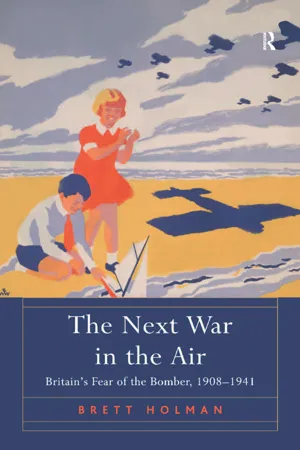
In the early twentieth century, the new technology of flight changed warfare irrevocably, not only on the battlefield, but also on the home front. As prophesied before 1914, Britain in the First World War was effectively no longer an island, with its cities attacked by Zeppelin airships and Gotha bombers in one of the first strategic bombing campaigns. Drawing on prewar ideas about the fragility of modern industrial civilization, some writers now began to argue that the main strategic risk to Britain was not invasion or blockade, but the possibility of a sudden and intense aerial bombardment of London and other cities, which would cause tremendous destruction and massive casualties. The nation would be shattered in a matter of days or weeks, before it could fully mobilize for war. Defeat, decline, and perhaps even extinction, would follow. This theory of the knock-out blow from the air solidified into a consensus during the 1920s and by the 1930s had largely become an orthodoxy, accepted by pacifists and militarists alike. But the devastation feared in 1938 during the Munich Crisis, when gas masks were distributed and hundreds of thousands fled London, was far in excess of the damage wrought by the Luftwaffe during the Blitz in 1940 and 1941, as terrible as that was. The knock-out blow, then, was a myth. But it was a myth with consequences. For the first time, The Next War in the Air reconstructs the concept of the knock-out blow as it was articulated in the public sphere, the reasons why it came to be so widely accepted by both experts and non-experts, and the way it shaped the responses of the British public to some of the great issues facing them in the 1930s, from pacifism to fascism. Drawing on both archival documents and fictional and non-fictional publications from the period between 1908, when aviation was first perceived as a threat to British security, and 1941, when the Blitz ended, and it became clear that no knock-out blow was coming, The Next War in the Air provides a fascinating insight into the origins and evolution of this important cultural and intellectual phenomenon, Britain's fear of the bomber.
Chapter 1
Introduction
In January 1935, the Evening News invited its readers to send in their memories of the German air raids on Britain during the Great War. The prospect of a guinea for the most interesting letter published each day no doubt spurred interest, but even so the response was impressive. The newspaper published dozens of letters from Londoners over the next six weeks, telling stories of ‘the horror, the ruin, the stoicism and the heroism of a bombarded city’.1 A doctor reported that a Gotha raid on the night of 24 September 1917 had caused ‘an indescribable panic’ outside his Finsbury surgery: terrified people tried to fight their way inside past others desperately trying to get out.2 He was sorry to say that ‘the aliens were the chief cause of the mad stampede, mostly Russians and fairly young’.3 One selection of letters focused on the experiences of women: the Honourable Mrs M. Greville wrote of the ‘legacy of shattered nerves’ among her generation, and Mrs E. Broomfield recalled the air-raid drills she and her class-mates had practised in school – ducking under their desks – something she hoped that British children would never have to go through again.4 Another issue was devoted to the Zeppelin raid of 13 October 1915. Writers told of ‘The horror! The terror!’ they endured that night, with one seeing an old woman with half her face blown off, and another stepping in a pool of blood.5 There were also many heart-rending stories of loved ones killed or wounded by the German bombs. Joyce Berry saw one of her sisters, aged eight, politely thank those who pulled her out of the ruins of their home, and then die. Mrs E. Chator’s daughter was 18 when their house was bombed in one of the last air raids of the war, killing six people; 17 years later she still suffered from shock, and would never work again.6 Taken together, the letters represent impressive testimony to the continuing presence of the Great War in British life. But the Evening News wasn’t interested only in remembering the war. It had the present in mind, and the future too. It explained that its purpose in soliciting the memories of its readers was so that ‘a younger generation will catch a glimpse of the perils that London faces now’:
If war came to-morrow London would be an inferno of exploding bombs, of gases drifting in poisonous clouds through the streets, of flames leaping from building to building. Squadron upon squadron of enemy aeroplanes – hundred after hundred filling the sky – would rain down death upon the city. There would be no escape from that destroying horror – except flight from the doomed capital of the Empire.7
The message was that Britain was now practically defenceless: in 1918, the newly formed Royal Air Force (RAF) had made Britain ‘the strongest nation in the air’, but by 1935 it had slumped to only ‘seventh in the air forces of the world’.8
The Evening News belonged to Lord Rothermere’s press empire, and the letters it published were just one part of his strategy to force the British government to undertake serious aerial rearmament. When in March another Rothermere paper, the Sunday Dispatch, began serialising S. Fowler Wright’s apocalyptic story of aerial warfare, The War of 1938, the Evening News claimed that to do so was nothing less than its ‘duty’.9 More significant was Rothermere’s announcement on 30 January 1935 of the formation of the National League of Airmen (NLA), a pressure group designed to marshal public support for a large air force.10 The NLA had as its official organ the Sunday Dispatch, but all of the Rothermere papers devoted ample space to its activities, including the Evening News and the flagship Daily Mail, then with a circulation above 1.5 million.11 By the end of March, 2,300 pilots had joined the NLA as full members, including such well-known names as Amy Mollison (nèe Johnson) and Claude Grahame-White. The number of non-flying associate members far exceeded this number, with some taking advantage of a scheme offering flying lessons at a heavy discount.12 As their justification for joining, many sent in accounts of their own air-raid experiences which mirrored those published in the Evening News. Indeed, some of the latter letters had also referred to the NLA with approval: ‘speed up the National League of Airmen’, as Mrs Crossing of Holloway wrote.13 The NLA began a series of meetings in London and the provinces; the first was in Lewisham which, as the Evening News pointed out, had suffered from bombing in the Great War.14 Its headquarters in fashionable Grosvenor Square was portrayed as a hive of activity, overseen by its president, Captain Norman Macmillan MC, a fighter ace and test pilot, and its secretary, Collin Brooks, Rothermere’s right-hand man.15 During the 1935 general election campaign, the NLA endorsed 160 candidates who signed up to its seven-point programme, the first of which was ‘The creation and maintenance of an Air Force equal in size and equipment to that of any other Power’.16 The urgent necessity for air parity was explained by Macmillan in an article describing how an air raid on Liverpool could cripple its docks and starve the nation: ‘All things are possible. One thing is certain. No single European nation will dare attack another unless, by preponderance of bombing aeroplanes, it can strike so hard that its adversary will surrender quickly. The nation which is thus attacked will have no time to prepare an adequate counter-stroke – the one sure form of air defence.’17 If Macmillan was right, then only the same ability to destroy enemy cities would save Britain’s own cities from this fate.
Rothermere doubtless had commercial motives; the Daily Mail had suffered in the circulation wars of the early 1930s, and his airmindedness campaign used the techniques of sensationalist journalism, as when the Evening News apparently manufactured a controversy over the serialisation of The War of 1938.18 But he was not alone in his desire for a strong British air force, as the rapid growth of the NLA showed.19 Nor were the ideas about aerial bombardment published in his newspapers in any way out of the ordinary. By the mid-1930s, many people in Britain had come to fear what was sometimes referred to as the knock-out blow from the air: a sudden, rapid and overwhelming aerial bombardment of its cities, as impossible to predict as it was to resist. Where did this fear come from, and what effects did it have?
Imagining the Next War in the Air
The future did not always appear different from the present. In 1763, for example, the anonymous author of The Reign of George VI, 1900–25 could only envisage early twentieth-century warfare as being exactly the same as that of the mid-eighteenth century, with muskets, muzzle-loading cannon and cuirassiers. In his landmark study of the future-war literary genre, Voices Prophesying War, I.F. Clarke shows that the habit of imagining the next war as something different from the last began in the late eighteenth century, driven by the increasing tempo of technological change. So, just two decades after The Reign of George VI was written, a rash of stories depicting airborne invasions of Britain appeared, inspired by the invention of the hot-air balloon by the Montgolfiers in France.20 In its modern form, the genre of future-war fiction was established by Lieutenant-Colonel George Chesney in his novel The Battle of Dorking, published in 1871. A reaction to the shocking Prussian victory over France that year, The Battle of Dorking portrayed an unstoppable German invasion of Britain and inspired hundreds of fantasies of the next war in the next half-century.21 This genre was most popular in Britain itself, but many French, German and American titles appeared also.
Many of these stories attempted to assess how the increasing numbers of new types of weapons coming into service, such as the machine gun and the self-propelled torpedo, might change warfare. Interestingly, most such efforts to anticipate the future of war took place outside the armed forces. As Clarke observes:
The great paradox running through the whole of this production of imaginary wars between 1871 and 1914 was the total failure of army and navy writers to guess what would happen when the major industrial nations decided to fight it out … None of them ever seems to have imagined that technology might be able to create new instruments of war. That was left to the civilian; for in the fifty years before the First World War the only writers who came anywhere near to seeing how science and industry might change the traditional pattern of warfare were Albert Robida, H.G. Wells, and Conan Doyle.22
The First World War seemed to prove this want of imagination on the part of the professional warriors. The effects of new or untested technologies such as indirect-fire artillery, tanks, machine guns, barbed wire and poison gas conspired to make generals seem like fools, when their carefully planned offensives exchanged many thousands of lives for advances of just a few hundred yards. That this stereotype of ‘lions led by donkeys’ was unjust is beside the point.23 The fact is that it was widely held after 1918, and for many it justified the practice of writing the next war, particularly for those outside the services.24
The development of military aviation before 1914 presents a partial exception to this picture. The formation of the Royal Flying Corps (RFC) in 1912 meant that there was a cohort of officers who by virtue of their routine activities had to face the question of how this new technology would be used in wartime.25 Some members of this community participated in public debates about the value of aviation, as did a few officers outside the RFC.26 Even taking these individuals into account, however, it remains the case that the most innovative and influential ideas about airpower during the Edwardian period came from outside the military, from independent thinkers like H.G. Wells and Lord Montagu of Beaulieu. Although aircraft had already been used by other nations for bombing in Libya and the...
Table of contents
- Cover Page
- Half Title page
- Dedication
- Title Page
- Copyright Page
- Contents
- List of Figures
- Acknowledgments
- List of Abbreviations
- 1 Introduction
- Part I: Threats
- Part II: Responses
- Part III: Crises
- Bibliography
- Index
Trusted by 375,005 students
Access to over 1.5 million titles for a fair monthly price.
Study more efficiently using our study tools.
Frequently asked questions
Yes, you can cancel anytime from the Subscription tab in your account settings on the Perlego website. Your subscription will stay active until the end of your current billing period. Learn how to cancel your subscription
No, books cannot be downloaded as external files, such as PDFs, for use outside of Perlego. However, you can download books within the Perlego app for offline reading on mobile or tablet. Learn how to download books offline
Perlego offers two plans: Essential and Complete
- Essential is ideal for learners and professionals who enjoy exploring a wide range of subjects. Access the Essential Library with 800,000+ trusted titles and best-sellers across business, personal growth, and the humanities. Includes unlimited reading time and Standard Read Aloud voice.
- Complete: Perfect for advanced learners and researchers needing full, unrestricted access. Unlock 1.5M+ books across hundreds of subjects, including academic and specialized titles. The Complete Plan also includes advanced features like Premium Read Aloud and Research Assistant.
We are an online textbook subscription service, where you can get access to an entire online library for less than the price of a single book per month. With over 1.5 million books across 990+ topics, we’ve got you covered! Learn about our mission
Look out for the read-aloud symbol on your next book to see if you can listen to it. The read-aloud tool reads text aloud for you, highlighting the text as it is being read. You can pause it, speed it up and slow it down. Learn more about Read Aloud
Yes! You can use the Perlego app on both iOS and Android devices to read anytime, anywhere — even offline. Perfect for commutes or when you’re on the go.
Please note we cannot support devices running on iOS 13 and Android 7 or earlier. Learn more about using the app
Please note we cannot support devices running on iOS 13 and Android 7 or earlier. Learn more about using the app
Yes, you can access The Next War in the Air by Brett Holman in PDF and/or ePUB format, as well as other popular books in History & 20th Century History. We have over 1.5 million books available in our catalogue for you to explore.