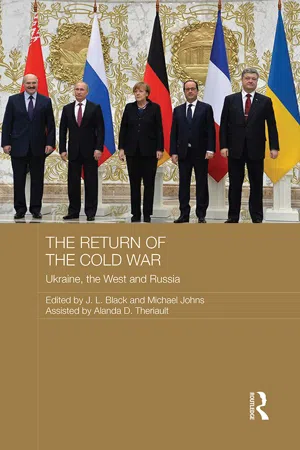
This book examines the crisis in Ukraine, tracing its development and analysing the factors which lie behind it. It discusses above all how the two sides have engaged in political posturing, accusations, escalating sanctions and further escalating threats, arguing that the ease with which both sides have reverted to a Cold War mentality demonstrates that the Cold War belief systems never really disappeared, and that the hopes raised in the aftermath of the collapse of the Soviet Union for a new era in East-West relations were misplaced. The book pays special attention to the often ignored origins of the crisis within Ukraine itself, and the permanent damage caused by the fact that Ukrainians are killing Ukrainians in the eastern parts of the country. It also assesses why Cold War belief systems have re-emerged so easily, and concludes by considering the likely long-term ramifications of the crisis, arguing that the deep-rooted lack of trust makes the possibility of compromise even harder than in the original Cold War.
eBook - ePub
The Return of the Cold War
Ukraine, The West and Russia
- 290 pages
- English
- ePUB (mobile friendly)
- Available on iOS & Android
eBook - ePub
The Return of the Cold War
Ukraine, The West and Russia
About this book
Information
Part I
International relations
1 Assisted suicide
Internal and external causes of the Ukrainian Crisis
Sergei M. Plekhanov
In 2014, cataclysmic developments in Ukraine made that country, Europe’s second largest by territory and eighth largest by population, the site of the world’s most dangerous conflict since the Cold War – a conflict which erupted almost simultaneously at the local, regional and global levels. Since November 2013, Ukraine experienced a violent overthrow of the government and subsequent uprisings in southern and eastern regions; loss of part of its territory; a civil war which took thousands of lives and made 1.5 million Ukrainians refugees; and the contraction of its economy by about one-fifth, resulting in severe deterioration of socio-economic conditions, especially in the country’s eastern regions.
Internationally, the events in Ukraine led to the worst deterioration of relations between Russia and the West since the early 1980s. Russia’s annexation of Crimea and support of separatists in East Ukraine were condemned by Western leaders as acts of aggression endangering the world order. NATO suspended cooperation with Russia and beefed up its force deployments on Russia’s western borders. Russia increased the numbers and readiness of its own forces in areas of possible conflict with NATO. Both sides conducted threatening military exercises and increased the activities of their air and naval forces. The exchange of economic sanctions between Western countries and Russia assumed the character of economic warfare, the US government openly stating that its sanctions were aimed at crippling the Russian economy and stimulating popular discontent with the Putin regime. An intense global information war set in, utilizing the entire spectrum of mass media and the Internet.
The surge in Russia–West tensions increased the risk that, if escalation were to reach a certain point, a NATO–Russia war might break out with possible use of nuclear weapons. The frosty atmosphere that set in between Russia and NATO put new strains on the existing structures of arms control and clouded prospects for new arms control agreements. In December 2014, the hands on the Doomsday Clock maintained by the Bulletin of Atomic Scientists were moved from 5 to 3 minutes to midnight – the perceived level of danger which was previously marked in 1949–53 and in 1981–4 (in 1991, the level was 17 minutes to midnight).1 Dr Alexei Arbatov, a leading Russian arms control expert, observed:
Taking the first real limitation on nuclear weapons, the 1963 Partial Test Ban Treaty, as the starting point for the history of nuclear arms control, today marks the first time in a half century that there is a real prospect of losing the legal regime for managing the most horrific instrument of devastation ever created. Although arms control has faced difficulties in the past, never before have virtually all negotiating tracks been simultaneously stalled, existing treaties been eroded by political and technological developments, and the planning for next steps been so in doubt.2
The tragedy that befell Ukraine had internal and external causes that reinforced each other. There was struggle for power among Ukraine’s elites, and there was struggle for influence over Ukraine between Russia and the West. Neither internal nor external struggles excluded the possibilities of finding compromises that could have avoided the shattering of the Ukrainian state and the surge in international tensions. Why did the rival political forces in Ukraine fail to keep their power struggles within constitutional bounds, short of a coup and a civil war? Why did Russia and the West fail to keep their competition for influence over Ukraine at levels below that of a cold-war-type zero-sum game?
At the core of the Ukrainian tragedy are the problems of Ukrainian statehood – its genesis, its identity, its contending models, and its very viability. Ukraine emerged from its Soviet base as ‘an incomplete state’, as historian Serhiy Kudelja put it.3 Its borders were Soviet administrative boundaries drawn by Moscow according to Soviet development plans that obviously did not provide for the eventual formation of a future Ukrainian sovereign political unit. About one-quarter of the population considered themselves ethnic Russians, and many of those considering themselves ethnic Ukrainians were connected with Russia by family and cultural ties and had difficulty thinking of Russia as a foreign country. Not surprisingly, 70 per cent of Ukrainians voted in the all-Union referendum of March 1991 in support of preserving a democratically reformed Soviet Union. And when 90 per cent of them voted for Ukraine’s independence in the December 1991 referendum, for most of them that was a pragmatic response to the new reality: by the end of the year, the Soviet state simply ceased to exist. Contrary to Ukrainian nationalist mythology, the Ukrainian state came into being not as culmination of a long struggle for independence by a nation keenly aware of its unique identity and determined to restore its natural sovereignty, but rather by default, as a product of the disintegration of the larger state of which it was an organic part.
Ukraine’s declaration of independence was not perceived by most Ukrainians as an anti-Russian move. The crucial part in the act of abolishing the Soviet Union was played by the leaders of the Russian and Ukrainian Soviet republics, which together with the Belarusian Republic formed the core of the Soviet Union and of the historical Russian state. That core was shattered not by a conflict between its three East Slavic parts, but by an act of collusion between the republican elites who jointly decided to liquidate the federal government of the Soviet Union and thereby acquire sovereign power over their republics’ territories redefined as new independent states. The centrifugal forces unleashed by M. S. Gorbachev’s reforms were harnessed by the republican elites intent upon transition to capitalism on their own terms, under their own control, and in line with specific conditions in each of the republics.
Having abandoned the Soviet project, the new leaders of both Russia and Ukraine looked westwards, keen to obtain Western guidance and support for their jump from state socialism to neoliberal capitalism. But even as both Ukraine and Russia were gravitating westwards, their leaders pragmatically maintained close ties between the two countries on the basis of their shared interests. This balancing act between maintaining traditional bonds and integrating with the West would not be easy to maintain. Throughout the years of independence, Ukrainian society remained divided between pro-Western and pro-Russian orientations, pro-Russian sentiments usually more widespread at the mass level, pro-Western attitudes prevailing among the ruling elite and politically active intellectuals.
As in all post-communist countries, Ukraine’s shift to capitalism entailed enormous economic and social costs. As industrial and agricultural production plummeted, Ukraine’s GDP contracted by more than one-half. Privatization of state property by extra-legal means led to the rise of ‘oligarchs’, a small group of tycoons who amassed great wealth through their plunder of public property in cahoots with the ruling bureaucracy. Meanwhile, unemployment, inflation and the shrinking of social expenditures impoverished millions of families. In 1991 to 2013, Ukraine’s population declined from 52 to 44 million. The precipitous deterioration of the quality of life bred large-scale social discontent and political instability.
Pro-Western Ukrainians saw the causes of the transition crisis in the continuing influence of Russia on Ukraine, and Ukraine’s dependence on Russia. Soviet and Russian legacies were regarded as shackles around Ukraine’s ankles, depriving it of freedom to join the West and become a prosperous European democracy. Pro-Russian Ukrainians blamed the country’s troubles on the disastrous policies of the leaders and argued for the restoration of closer ties with Russia. After 2000, Russia began to recover from its own transition crisis. Its renewed economic growth was highly beneficial for Ukraine, as trade and investment ties with Russia grew and millions of Ukrainians flocked to Russia as migrant workers. Ukraine’s Westernizers saw these trends as portending loss of independence and return of imperial domination.
As is typical of a new independent state, Ukraine’s leaders have from the very beginning attached great importance to the tasks of nation building. Ukraine’s second president, Leonid Kuchma, who issued a voluminous book under his authorship on the subject, declared in 2003, paraphrasing the Count of Cavour, one of the leaders of newly independent Italy in 1861: ‘We must create the Ukrainians’.4 General public support for the project of building an independent post-Soviet Ukraine, which, as one of the richest and economically most developed of the Soviet republics, would thrive as a democratic state with a prosperous market economy, was initially present in all segments of Ukrainian society, and this sentiment did not depend on any hostility to, or the idea of breaking ties with, Russia. Indeed, Ukrainian society was largely free from ethnic conflict, the linguistic and cultural bonds serving as powerful antidote to ethnic phobias or rivalries.
But this kind of moderate, inclusive and tolerant sense of belonging to a not yet fully assembled nation was deemed too weak a construction material from which the new nation was to be forged. The new political demand for nationalist ideas led to a revival of radical Ukrainian nationalism, a minority persuasion based mostly in the country’s Western regions. This nationalism, shaped culturally by the experience of generations of Western Ukrainians who had lived since the Middle Ages outside the historical Russian state as minorities within the Polish and later Austro-Hungarian empires, had its ideological roots in the 1920s and was strongly influenced and inspired by European fascism. Its vision of the Ukrainian nation, offered by such writers as Mykola Mikhnevsky, Dmytro Dontsov, Mykola Stsiborsky:
Was essentially ethnicist. A pure and inspiring ‘national idea’ could only exist as the representation of the spirit of a homogeneous ethnic nation, free from all internal ‘impurity’ and disunity … Ukraine therefore had to be purged of all Jewish, Polish, and above all Russian influence. Moreover, the homogeneous ethnic nation would … be run as a corporate state, with the nationalist political party providing its ‘ruling caste’.5
Radical nationalism was at odds with the mindset of most Ukrainians. Apart from the cultural gap between Western Ukraine and the rest of the country, the historical association of the nationalist movement with fascism and Nazi Germany’s invasion of the Soviet Union thoroughly discredited it. To the radicals, personalities such as Stepan Bandera, leader of the Organization of Ukrainian Nationalists in the 1930s and 1950s, were national heroes who gave their lives for the independence of Ukraine; to most Ukrainians, they were hated collaborators with Hitler sharing with the Nazis responsibility for the reign of terror in Ukrainian territories during the Second World War. Yet now that Ukraine did get its independence as a result of the Soviet dissolution, radical nationalist ideas entered Ukraine’s political mainstream. The ideology was modified, but the core notions – a total break with Russia, ‘Ukrainianization’ of the population by purging the cultural space of any Russian influence, integration with the West – found supporters in the new Ukraine.
The strong political demand for nationalism among the elites of post-communist states, whether newly created states, as in the case of Ukraine, or old states freed from Soviet domination, as in the case of Poland or Hungary, was rooted in the circumstances of Eastern Europe’s transition to capitalism. These elites were in the ruling classes of the communist system, and an effective way of winning recognition and legitimacy in the West was for former communists to present themselves as victims of Soviet/Russian imperialist oppression and as patriots determined to gain or regain national independence. In terms of domestic politics, every post-communist elite had a keen interest in a new national creed to replace communist ideology and help them to maintain control of their country while navigating the stormy seas of the systemic transition.
In Ukraine, a more moderate version of nationalism was created in response to this need. It borrowed the main ideas from the radicals, but sought to shape the fascist-era creed into an ideology more likely to attract mass support in Ukraine, compatible with democratic values and acceptable to the West. But the problem remained. Ukraine’s new rulers wanted a nationalism that would appeal to all diverse segments of Ukrainian society, as the unifying political force for nation building. Yet national-democrats were ideologically beholden to radical nationalists, and radical nationalism remained a divisive totalitarian force with marginal political appeal.
As Andrew Wilson noted in his study of Ukrainian nationalism:
The ethno-nationalist premises of Ukrainian nationalist argument tend to breed the assumption that the non-nationalist majority will simply fall in line. However, although most nationalists have themselves stressed the importance of an all-inclusive state-building project, they tend not to realise that many of their key concepts are in fact ethno-nationalist and that they are therefore engaged in a self-limiting project of ethno-nationalist mobilization. However, without the support of the non-nationalist majority, the Ukrainian state rests on a dangerously narrow base … This has been disguised by the fact that political mobilisation is much stronger amongst Ukrainophone Ukrainians than among Russophone Ukrainians, who have yet to develop strong political organisations of their own. The relative vacuum in the political centre has encouraged the nationalists to pursue their nationalising project, but has also deluded them about their relative chances of success. Ukrainian nationalists have tended to blame their political weakness on the ‘denationalised’ population in eastern and southern Ukraine and in the countryside … but are likely to be surprised by the resilience of Russophone resistance to Ukrainianisation policies … So long as Ukrainianisation continues to be a key part of the nationalist agenda the risk of estrangement between Ukrainophones and Russophones remains real.6
After 22 years of the project to ‘create Ukrainians’ by such methods as the ban on the use of Russian language in official and civic legal matters, the creation of a new historical narrative presenting Russia as the former oppressor of the Ukrainians...
Table of contents
- Cover
- Half Title
- Title Page
- Copyright Page
- Table of Contents
- List of illustrations
- List of contributors
- Foreword
- Preface
- Acronyms and abbreviations
- PART I: International relations
- PART II: Military
- PART III: Economic and social conditions
- PART IV: Image and perception
- PART V: Preference points
- Appendix
- Index
Trusted by 375,005 students
Access to over 1.5 million titles for a fair monthly price.
Study more efficiently using our study tools.
Frequently asked questions
Yes, you can cancel anytime from the Subscription tab in your account settings on the Perlego website. Your subscription will stay active until the end of your current billing period. Learn how to cancel your subscription
No, books cannot be downloaded as external files, such as PDFs, for use outside of Perlego. However, you can download books within the Perlego app for offline reading on mobile or tablet. Learn how to download books offline
Perlego offers two plans: Essential and Complete
- Essential is ideal for learners and professionals who enjoy exploring a wide range of subjects. Access the Essential Library with 800,000+ trusted titles and best-sellers across business, personal growth, and the humanities. Includes unlimited reading time and Standard Read Aloud voice.
- Complete: Perfect for advanced learners and researchers needing full, unrestricted access. Unlock 1.5M+ books across hundreds of subjects, including academic and specialized titles. The Complete Plan also includes advanced features like Premium Read Aloud and Research Assistant.
We are an online textbook subscription service, where you can get access to an entire online library for less than the price of a single book per month. With over 1.5 million books across 990+ topics, we’ve got you covered! Learn about our mission
Look out for the read-aloud symbol on your next book to see if you can listen to it. The read-aloud tool reads text aloud for you, highlighting the text as it is being read. You can pause it, speed it up and slow it down. Learn more about Read Aloud
Yes! You can use the Perlego app on both iOS and Android devices to read anytime, anywhere — even offline. Perfect for commutes or when you’re on the go.
Please note we cannot support devices running on iOS 13 and Android 7 or earlier. Learn more about using the app
Please note we cannot support devices running on iOS 13 and Android 7 or earlier. Learn more about using the app
Yes, you can access The Return of the Cold War by J. L. Black, Michael Johns, J. L. Black,Michael Johns in PDF and/or ePUB format, as well as other popular books in Scienze sociali & Studi sull'etnia. We have over 1.5 million books available in our catalogue for you to explore.